Condensation in eaves with non-vented soffit

   / Condensation in eaves with non-vented soffit #1  

tlj87

Gold Member
Joined
May 29, 2006
Messages
439
Location
PA
Tractor
JD 4700, Kubota BX2370-1, Kubota RTV1140CPX, Kubota F3060, Club Car Precedent
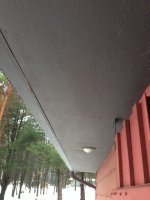
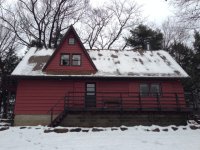
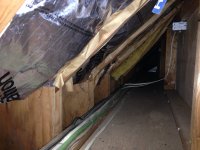
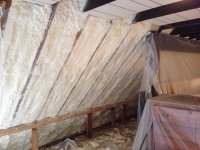
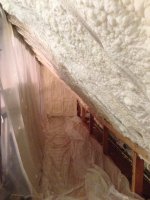
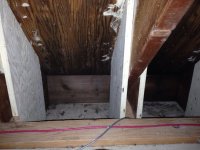
At the beginning of the month, we moved into what was previously a three season, weekend only home. The building was constructed in the early-1970's and has non-vented soffit and no ridge vent. The walls and entire roof are insulated with foil backed fiberglass insulation (all space is finished including the attic). While in a kneewall today, I pulled back some of the insulation to look at the eaves and found the west end of the building (in photos, the end to the left of the dormer) were damp about 2-3 feet up from the soffit. I cut out the damp insulation and have fans drying the areas out. There is no obvious mold, punky wood or other issues although there is some slight discoloration which leads me to believe there has been some moisture here before. It is winter (almost) and any drastic measures are not feasible until spring, so I seek any advice to get us through the winter or maybe even completely address the issue. I've attached a few photos for reference. Thanks in advance! image-3300721623.jpgIMG_3582.jpgIMG_3583.jpg
 
Last edited:
   / Condensation in eaves with non-vented soffit #2  
Our house, built before 1900, had a similar problem. Although our attic was not finished, it didn't have any eave ventilation.

I could reach the eaves from the attic and I cut rectangular openings in every other space between the joists and screwed aluminum, screened vents in the soffits. I also removed all insulation (rock wool) from the attic, put down a plastic vapor barrier, and poured in loose insulation (vermiculite) since the spacing between the joists was not consistent and didn't match up with modern insulation rolls. The key was the plastic vapor barrier and the eave vents. Fortunately, there were small windows in the end attic walls that allowed for cross ventilation with the eave vents.

It sounds as if you've done all you can do for now, unless you want to start cutting soffit vents before the snow flies.
 
   / Condensation in eaves with non-vented soffit #3  
FWIW...I would make sure it is not a roof issue rather than 100% condensation...
 
   / Condensation in eaves with non-vented soffit #4  
Sounds like a tough problem. I could believe it is all condensation but it never hurts to check the roof. That condition would not happen much during winter in a 3-season house that was left unheated and no humidity sources present like cooking, showers, and breathing :).

The soffit vents need somewhere to vent to, either gable end vents or a ridge vent; those two aren't supposed to be combined. A vapor barrier is needed too. With soffit vents alone I wouldn't be surprised to see icicles hanging from the vents.

Is there a possible airflow path from the soffits to the ridge?
 
   / Condensation in eaves with non-vented soffit
  • Thread Starter
#5  
How would I know if it's a roof issue? The roof was replaced in 2008.
 
   / Condensation in eaves with non-vented soffit #6  
How would I know if it's a roof issue? The roof was replaced in 2008.

That can be some tough troubleshooting...

First some info on non-vented/insulated spaces...the key is making it sealed...i.e., solid (bird) blocking between the rafters over top of ext. walls is a must (any cracks/gaps should be calked) if moist air can't get in...there should be no moisture to condense...

If the present moisture is only evident in a localized area...and it does not appear that the issue has been an ongoing thing (based on your description) I would tend to think that something has changed and usually this means the roof...i.e., a nail has popped up etc... however if there is not solid blocking between the rafters/trusses (that seal between the top of the wall up to the roof decking)...then damp air could be permeating the insulated space via the soffiting...

Sometimes a popped up nail will allow rain water to penetrate but instead of dripping directly below the nail...the water can run down a rafter etc. then spread horizontally if hits a cross brace member, "rat run etc., etc...

Also if the "eaves drip" is not sealed properly at the very edge of the roof...water can get sucked (capillary action) up below the roof membrane but this usually only effects the first several inches of the eave... if this was the case there would most likely be some sign on the fascia board/drip edge...the most likely places are at the joints of the them eave drip metal...
 
   / Condensation in eaves with non-vented soffit
  • Thread Starter
#7  
Some good info here, Thanks! I have been looking at some diagrams online and am wondering, Would it make sense, once I get it dried out, to cut some rigid foam insulation to fit vertically between the soffit and the roof (essentially between the painted white plywood gussets in the first photo)? If yes, how would I tie that into the existing foil face fiberglass insulation that starts above that (since I already trimmed it back)? Would that keep the eaves isolated from interior moisture? Would this cause ice issues?
 
   / Condensation in eaves with non-vented soffit #8  
Some good info here, Thanks! I have been looking at some diagrams online and am wondering, Would it make sense, once I get it dried out, to cut some rigid foam insulation to fit vertically between the soffit and the roof (essentially between the painted white plywood gussets in the first photo)? If yes, how would I tie that into the existing foil face fiberglass insulation that starts above that (since I already trimmed it back)? Would that keep the eaves isolated from interior moisture? Would this cause ice issues?

Condensation, or ice if the condensation freezes, happens when warm moist air--which is normal in any home--contacts a surface that is below the dewpoint of that warm moist air. It is easy to have surfaces below the dewpoint in winter, it doesn't take much moisture in the air to do that.

For example at an air temperature of 72F and a relative humidity of 50% (an ideal indoor value), the dewpoint is 52F. 52F is way above the winter air temperature of the eaves so condensation happens there.

What it comes down to is to not allow the moisture present in the interior house air to contact a cool surface. That is the purpose of the vapor barrier. The purpose of the insulation to slow down heat transfer, and to keep the vapor barrier warm enough that it does not become the condensation surface. The foil face on the fiberglass is an example of that concept.

Anything you do that follows those principles will work.
 
Last edited:
   / Condensation in eaves with non-vented soffit #9  
Temporarily, I'd put a fan or two to circulate the air and possibly a de-humidifier until spring. If it gets below freezing in that space, though, a de-humidifier may get frozen up and damaged. If its a heated space, run a hose from the dehumidifier down to a drain somewhere. That's easier than emptying a full tank twice a day.
 
   / Condensation in eaves with non-vented soffit #10  
Looking at the first pic of the interior eaves, I assume you are behind a finished knee wall to the inside of that area?

That knee wall should separate the heated from the unheated area IMO. The interior knee wall would be one section of the conditioned space "envelope". What is outside of that should not be insulated and you want free air movement there too. The issue probably originates from the first floor ceiling area that is below that knee wall floor. That part of that ceiling is also an envelope barrier area.

If you put down a plastic vapor barrier on the floor behind the knee wall, then put un-faced fiberglass batts on top of that you will improve that part of the envelope. Add soffit vents to allow what makes it through the envelope to get some ventilation.

The vapor barrier for the knee wall floor really belongs on the warm side of that--the first thing on the first floor ceiling--but that would be a major project. You may see some condensation under the vapor barrier because of that but it could get you through the winter without major issues.
 
   / Condensation in eaves with non-vented soffit #11  
I had a client with close to same situation.
He wanted me to re do his roofing due to leakage but as I pointed out his shingles were still good and his problem lay elsewhere.
Eaves totally filled with insulation and a cathedral ceiling also packed full of insulation.
My solutions that worked as jury rigged as it was.

I wrapped 1 x 3 furring strip ends with a plastic bag and slipped the strips between the roof deck and insulation and when inserted used a pipe wrench to rotate the strip. This created a tunnel for the warm air to exit up top near the roof peak. (sort of like a mini attic)
(The plastic bag was needed to prevent the insulation from bunching up when inserting the furring strips.)
I next created vents near the roof peak to allow heat to exit.
Naturally we did have to pry loose some sofit in order to insert out wrapped furring strips but that was fairly easy to re attach.
He was able to get another 6-7 years with same roofing until he did a very major renovation of the entire house.

For venting a product made by MAXIMUM is well rated.
Like a small 4 sided box with louvers on 4 sides c/w flashing and adjustable for different pitches.
Either way, you want passages for complete attic air circulation.

The cold sides of knee walls need to be treated just like an attic as in effect they are actually part of the ceiling.
 
   / Condensation in eaves with non-vented soffit
  • Thread Starter
#12  
I got int the knee wall on the opposite end (east/right) today. All wood was dry. It appeared as though the insulation either never went down to the soffit or was trimmed back at some point after construction.

image-2957027246.jpg
 
   / Condensation in eaves with non-vented soffit #13  
Is the wet side the dormer side? Dormers are notorious for leaking if the roof isn't done correctly.

Is the bath or kitchen under the wet side or dry side, or neither?
 
   / Condensation in eaves with non-vented soffit
  • Thread Starter
#14  
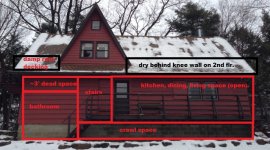
The bathroom is in fact under the damp area. The damp wood was on the front and back of the cabin although the bathroom is only on the front portion. The ~3' space above the ceiling of the bathroom extends to the room behind it. (Both rooms are on slab vs. the rest of the living space which is above a crawl space). I suppose moisture could have migrated through that ~3' space to affect both the front and back. The bathroom does have an exhaust fan that is vented through the west end wall of the building. Remember that in these two places the fiberglass insulation extended down to the wall below unlike the east end where it did not (and the wood wasn't damp). Here is a very rough layout sketch from the front:
layout.jpg
 
   / Condensation in eaves with non-vented soffit #15  
Well, best thing to do now, with the damp insulation out, is to monitor the situation and see what happens I think.

My best guess is it is either moisture from the bathroom migrating through the 3' ceiling area, or that side of the dormer leaks. Moisture will migrate through painted wallboard, wood, etc. Most bathroom fans eventually clear shower steam but are generally on the wimpy side in terms of cfm's.

You could lay plastic down on the 3' knee wall floor for a few days, check it for condensation on the underside.
 
   / Condensation in eaves with non-vented soffit
  • Thread Starter
#16  
Ok, thanks for your suggestions. I will do that and see what happens. The contractor that did the roof in '08 is coming out today or tomorrow to take a look and see what route to go down. I'll try to update with my findings.
 
   / Condensation in eaves with non-vented soffit #17  
Sounds like a plan. Good luck!

Any moisture that makes it into that unvented soffit and eave really has no good way to leave. It probably accumulates over time. The fiberglass insulation soaks it up and holds it like a sponge.
 
   / Condensation in eaves with non-vented soffit
  • Thread Starter
#18  
Contractor came out yesterday. He suggested trying to seal off air leaks and the eaves from the living space with foam board, caulk, etc. I neglected to ask, but what kind of foam board should I get? I would think the foil faced ISO as it that serves as the vapor barrier? I think this is what I am trying to achieve with the eaves, although at this time I can't run the rigid foam all the way up the walls inside : http://www.finehomebuilding.com/CMS/uploadedimages/Fine_Homebuilding/Articles/221/021221071-1.jpg


I also am getting quote on drywalling the bathroom. Right now it is all plywood paneling and I suspect moisture is getting through the seams.
 
Last edited:
   / Condensation in eaves with non-vented soffit #19  
If you drywall the Bath Rm be sure to use the blue drywall board that is made just for that.(might also be green).
Best still is a cement board but that's pricy and generally only used behind shower and bath tiles.
 
   / Condensation in eaves with non-vented soffit
  • Thread Starter
#20  
Well here we are in the spring. We decided to rip out all of the paneling and fiberglass insulation and have spray foam and drywall installed to address our issue. After monitoring and thinking all winter, I decided the issue wasn't a moisture leak but just inadequate insulation. Most all of the roof deck was frosty on the underside at times because the insulation was way weak to keep the hot air in and the cold air out, so the dew point was reached. Lots of ice dams on the shady side of the roof. So after quite a bit of research, we went with open cell foam from the soffit to the peak, including the gable end walls, dormers etc. essentially everything above the first floor. We will also be replacing all windows with Andersen 400 series. And then some work in the bathroom including foam on the outside walls, drywall, tile floor with heat below it. Definitely some $, but it's time.


image-3493226668.jpg
 

Attachments

  • image-3160296850.jpg
    image-3160296850.jpg
    532.9 KB · Views: 109

Marketplace Items

(INOPERABLE) DYNAPAC DOUBLE DRUM ROLLER (A58214)
(INOPERABLE)...
5004 (A55851)
5004 (A55851)
2014 AMERITRAIL LAY FLAT HOSE TUGGER TRAILER (A58214)
2014 AMERITRAIL...
CATERPILLAR TH255C TELESCOPIC FORKLIFT (A60429)
CATERPILLAR TH255C...
2007 Ford F-350 9ft. Stakebody Flatbed Truck (A55852)
2007 Ford F-350...
2020 CATERPILLAR D5 LGP HIGH TRACK CRAWLER DOZER (A60429)
2020 CATERPILLAR...
 
Top