Connecting Rod Balance

   / Connecting Rod Balance #1  

TimberHole

Platinum Member
Joined
Jul 17, 2017
Messages
524
Location
Missouri
Tractor
JD9504WD w/ 75 Loader, JD345, Bobcat S150
I am rebuilding a 3 cylinder Yanmar and will be replacing one connecting rod. I purchased a used rod which I believe was cast 10 or 15 years later than the originals. This rod is heavier, I'm thinking 14 grams give or take but I need to re-weigh all the components. These rods do not have balance pads for grinding. Even if I buy a new Rod it isn't necessarily going to weigh the same.

How important is Rod balance in these relatively slow turning diesels? How close is close enough?
 
   / Connecting Rod Balance #2  
Does John Deere parts list different connecting rods? I'm assuming it's a Deere.
 
   / Connecting Rod Balance #3  
Weigh both ends is one end heavier then the other or is the weight equal across?

Are you having the assembly balanced?
 
   / Connecting Rod Balance #5  
I am rebuilding a 3 cylinder Yanmar and will be replacing one connecting rod. I purchased a used rod which I believe was cast 10 or 15 years later than the originals. This rod is heavier, I'm thinking 14 grams give or take but I need to re-weigh all the components. These rods do not have balance pads for grinding. Even if I buy a new Rod it isn't necessarily going to weigh the same.

How important is Rod balance in these relatively slow turning diesels? How close is close enough?

How much does the rods weigh? Can you tell where the extra weight is?

There are several ways to balance crank/rod/piston assemblies. One way is what you are doing - which is to assume the crank is balanced and that only the rods are different. That may or may not be true, but it's a pretty good bet that it is. And anyway, that assumption is the only choice you have if you don't want to take the crank out of the block, or if the old rod can't be weighed for some reason.

I have a pretty good Yanmar 3 cylinder rebuild manual and there's nothing in there about balance. If you want to grind a little on the big end - mostly around the big end cap - then I can't see that hurting anything. Hopefully that's where the extra weigh is. But without taking the whole crank out and doing a dynamic balance on all the parts I think you don't have much choice but to bolt it together as is. That's a stout engine & turning slowly. I think you are overthinking the importance of doing that much balance on this engine. My bet is that you never notice whatever imbalance. How far do you take this? Do you balance your injector spray?
best of luck,
rScotty
 
   / Connecting Rod Balance #6  
Not a Yanmar expert but 14 grams isn’t all that much for a relatively slow speed engine and I don’t think your engine will know the difference. Especially since the extra weight is probably spread over the length of the rod and not all concentrated at the big end. What happened to the original rod? Is it too far gone to have it machined?
 
   / Connecting Rod Balance
  • Thread Starter
#7  
Thanks for the great responses.

This is a Yanmar 3T90J out of a John Deere 950. I did pull the crank to have it turned. This engine ate a rod bearing and buggered a journal. I don't think the original rod can be repaired and additionally the rod shows signs of heat. I'm not comfortable using that rod.

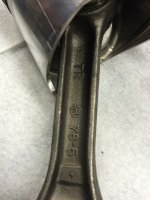
The rod part number is CH10683. Beyond the part number each rod has a casting number on the rod. I believe only rods from the same casting number were installed on each engine. Was this to introduce some very basic, crude balance to the assembly? I'm not sure.

Here is a pic of an original rod. I believe the casting number 78-5 indicates this rod was manufactured in 1978 and was the 5th batch.

002 (4).JPG

This is the best image I have with me of the replacement rod. It came out of a 950 and is dimensionally correct. The casting number is different. I'll have to look at it tonight but it has a boss with 94 stamped on it. I'm assuming this is a much later rod.

036 (3).JPG

As far as overthinking this..........I've been accused of that before but I don't think that is the case here. Understand that I'm not trying to build a "balanced" engine, just wanting to make sure I'm not using components that are far beyond a reasonable out of balance condition. I will try to reweigh the rods tonight and report back the results.

Thanks again for the help.
 
   / Connecting Rod Balance #8  
It is most likely not critical, but if you have an accurate enough scale to weigh the big and small ends of the other two and and have enough material to bring the new rod to the same weight at both ends as the average of the others it shouldn't hurt and I would be tempted to do the same.
 
   / Connecting Rod Balance #9  
Don't think you are overthinking this. It's a lot better to get everything right the first time. Most guys probably wouldn't even have weighed the replacement rod. You're being smart and conscientious, not overthinking.
 
   / Connecting Rod Balance
  • Thread Starter
#10  
Weighed the rods tonight. The 78-5 rods are original and the 47-2 is from the salvage yard.

Total Crank end Piston end

No. 1 (78-5) 2# 137.5g 1# 207g 445g

No. 2 (47-2) 2# 154.5g 1# 215.4g 455g

No. 3 (78-5) 2# 131.8g 1# 205.5g 439.4g


Total difference 22.7 grams
Crank end difference 9.9 grams
Piston end difference 15.6 grams


I am surprised the larger difference was at the small end of the rod. Should be able to help that by weighing the pistons. If I do that I think it looks ok. What do you guys think?
 
   / Connecting Rod Balance #11  
Have balanced a few engines. Made all the pistons weight the same by removing material under the piston from the wrist pin boss. Then also balanced the connecting rods by removing most of the material from the connecting rod big end, and by using the rod balance fixture shaved the small end until they were in balance big end to small end, then made all connecting rods weight the same. I would finish up with just taking a single stroke off the rod with a file, then re-weighting then until all weighted the same to within 1/4 gram. It does make a difference. Did a Porsche 2.7liter engine 911 engine this way also. Hot rod friend commented on how the engine spooled up like it was electric. Used 906 sprint cams, 296 duration, 444 lift, 107 overlap I remember. Opened the ports up to 37.5mm also. All flowed and matched ports. 5 angle valve job, all new valves. All 6 assemblies weighted to within 1/4 gram of each other, and to within 1/4 gram to each bank. Heaviest assembles go closest to flywheel, then next heaviest, finally the two last lightest assemblies. Good luck on whatever you decide. Mostly all production rods should be within 10 grams of each other.
 
   / Connecting Rod Balance #12  
I am trying to become a little less OCD as I age but it doesn't always work out for me. How much was the salvage rod? Were it's matching rods available and in like condition? These are the first two questions I would consider before moving forward.

Here is a listing with 3 available on that auction site for around a 100 bucks each. You might ask this seller if they have matching casting numbers and are all good.
 
   / Connecting Rod Balance #13  
I am trying to become a little less OCD as I age but it doesn't always work out for me. How much was the salvage rod? Were it's matching rods available and in like condition? These are the first two questions I would consider before moving forward.

I was thinking exactly that; snag the rest of the set, maybe the pistons, etc. We always balanced things—even for low-speed engines ("truck cams")—quite a bit more closely than 11 grams.
 
   / Connecting Rod Balance
  • Thread Starter
#14  
An interesting development in my quest for rods which are reasonably close in balance. I’ve been studying the parts diagrams to see if the 1050 uses the same rod because the salvage yard has a 1050. It appears the early 850, 950 and 1050 all use a CH10683 rod and the later machines all use a CH10682 rod. I need a CH10683 but am starting to wonder if my salvage rod is a CH10682. It is dimensionally correct but a touch heavier. Hmmmmm. I don’t suppose anyone knows the difference in the early/late rods or engines?
 
   / Connecting Rod Balance #15  
An interesting development in my quest for rods which are reasonably close in balance. I’ve been studying the parts diagrams to see if the 1050 uses the same rod because the salvage yard has a 1050. It appears the early 850, 950 and 1050 all use a CH10683 rod and the later machines all use a CH10682 rod. I need a CH10683 but am starting to wonder if my salvage rod is a CH10682. It is dimensionally correct but a touch heavier. Hmmmmm. I don’t suppose anyone knows the difference in the early/late rods or engines?
Go look again- 682 is for 850 only
 
Last edited:
   / Connecting Rod Balance
  • Thread Starter
#16  
Go look again- 682 is for 850 only


I don't think I misread it. There are 3 parts diagrams:

Early 850
Early 950 and 1050
Late 850,950, and 1050

The 682 Rod was used on the early 850 and all late models. Still don't know what the difference in the rods is. Went back to the salvage yard today and found a Rod that is very close in weight but a different casting number. I'll have to inspect it but I'm pretty sure it is my solution. After all, even if I buy a new Rod the casting number isn't going to match.

I'll report back after firther research.
 
   / Connecting Rod Balance #17  
My deceased FIL was a master mechanic specializing in engine rebuilds. He would never replace only one rod or piston. He always procured a balanced set. Said labor wise it was cheaper to buy the set that mess around trying to match up stuff by trimilation (my dad's word for trimming till it fit).

In my industrial machinery days I overhauled/rebuilt large air and refrigeration compressors. Even in the days of hand fitted babbitt bearings for 1 and 2 cylinder compressors running at 300-500 RPM we balanced pieces by weight. Most of those had a 3 piece rod; journal box, wrist pin box, and the rod with a flange on each end. Shim packs for each bearing box and the flanges. A lot of heavy hand work. A 2 cyl 24" X 24" compressor each component had to be moved and handled with a chain fall. Crank shafts had 3 bearings within the body plus 1 or 2 outside on both sides of a huge flywheel. A lot of stuff to balance and align before the days of lasers and computers. Cost of labor finally pushed that work from the field into machine shops. Still had to fir and align it all on site.

Those were the days when craftsmen were proud of there work and abilities. We enjoyed what we were doing and loved to hear a smooth running machine when done instead of whump! whump!. When high speed machines; rotary and piston type the whole industry changed. A rebuild was a complete kit from the factory. All pre balanced and fit.

Ron
 
   / Connecting Rod Balance
  • Thread Starter
#18  
I am trying to become a little less OCD as I age but it doesn't always work out for me. How much was the salvage rod? Were it's matching rods available and in like condition? These are the first two questions I would consider before moving forward.

Here is a listing with 3 available on that auction site for around a 100 bucks each. You might ask this seller if they have matching casting numbers and are all good.

The salvage Rod was $50.00. As mentioned I found a Rod that weighs between the two original rods being reused. All rods are within 6 or 7 grams. I'm calling that good. The guy at the salvage yard offered to trade this new Rod for the heavy Rod. I intended to purchase the second Rod but he insisted trading rods was ok. Good people! I pressed out the old bushings tonight. Hopefully install the liners, pistons and rods this week. Should go fast after that.
 

Tractor & Equipment Auctions

207279 (A52708)
207279 (A52708)
John Deere 6125R (A60462)
John Deere 6125R...
2004 VE ENTERPRISES 500BBL FRAC TANK (A58214)
2004 VE...
DECORATIVE METAL GATE (A58214)
DECORATIVE METAL...
John Deere 855DXUV Gator (A57148)
John Deere 855DXUV...
2007 FREIGHTLINER M2 26FT CDL REQUIRED BOX TRUCK (A59905)
2007 FREIGHTLINER...
 
Top
