Cordwood

/ Cordwood #41  
cmhyland said:
Harry,

Your a man on a mission... Do you want to fly up to Connecticut and help me stack some wood?

As for all woods putting out the same btus per pound that makes some sense.. Dense woods weigh more and burn longer....

Regards,
Chris

Well, a mission sorta. I am working out about a 5 acre patch that a fire went through several years ago. Willow that is left standing after it dies goes to pot in a hurry so I have been cutting a _lot_ more than I normally would to salvage it first. Just about done with that patch and will have to look for another one someplace.

Yeah, that btu/pound thing - first time I saw it I had to scratch my head and think about it before I got it.

You spring for the ticket or the beer and I'll be there. The ticket would probably be cheaper in the long run :).

I am heavily retired and 'wooding' is my recreation and physical excercise. If it werent' for that I would probably be dead by now. Most of that stack of wood you saw was split the old way by hand. I only use the splitter for the diffictult stuff, knots, crotches, etc. or when I have to get the truck unloaded so I can use it. I was real concerned a few years ago (4?) when the doc told me I needed two artificial hips. That has been taken care of and it didn't slow me down at all.

bullridin_fool: Thanks. That was my guess and even went back to check but you had thrown in "full cords" prior so....

Harry K
 
/ Cordwood #42  
Here are my comments on firewood management.

This summer, I’ll be revamping my firewood management technique. I’m moving to a pallet based system. The pallets will be custom made - 4’ wide, 4’ deep and 4’ high – which will hold 64cu ft or half a cord of wood. I’ll move the pallets around with my tractor and FEL pallet forks.

Sometimes I cut and split my wood where it falls. If not, I haul it to a common area where I split my wood. Either way, I plan to load the pallet by hand right off the log splitter, then move it to my covered storage area. When it comes time to burn it in the fireplace, I’ll move the pallet to my back porch with the tractor.

My objective is to eliminate as much of the manual handling of the firewood as possible. In the past, I’ve always done too much loading, unloading, stacking, and re-stacking as I move the firewood from the field to the fireplace. Of course, the drawback to this method is you have to have a tractor or forklift capable of moving a pallet loaded with ½ a cord of firewood. If the wood is green, it can be pretty heavy.

Regarding the firewood pallets, they will have a floor and sides, but no front or back which is a pretty common design. This allows the firewood to be slightly over or under 24” in length as it can hang over the front or back by a bit. I also plan to make them stackable. I don’t plan to stack them more than two high for safety reasons. I’ll post a new thread with some pictures this summer when I get them built.

I also purchased a pallet jack which I use around the shop. I put as much stuff as I can on pallets so I can move things around. For instance, I drop all my seldom used tractor implements on pallets and move them with the pallet jack for storage. I can pack things into the back corner of the shed and make it look fairly neat. But I think it will be hard to move firewood pallets around with a pallet jack because you have “firewood crumbs” (pieces of bark that fall off the wood) under the pallets and pallet jacks have small wheels that don’t roll well over debris.
 
/ Cordwood #43  
I like your thoughts on handling wood. My FIL used a similar system. He said it worked great.
It would be interesting to hear comments on how many times a stick of wood is handled before it gets burned. I think it would be easy to handle it 10 times if you keep track of every touch from the forest to the wood stove.
 
/ Cordwood #44  
cmhyland said:
Schmism,

The people who burn a fire in the fireplace on a weekend here or there don't use enough to care about the price.

They are also the people who either take fallen tree limbs to the dump or pay to have them taken away.... Guess they haven't figured where firewood comes from...

Regards,
Chris

Afternoon Chris,
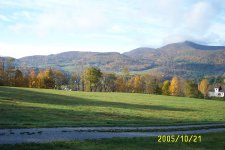
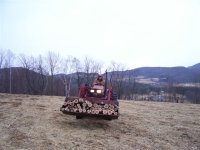
I manage to get a bunch of firewood just from trees that die along the hedgerows along the field. Drop it in the field cut it up and put it in the loader bucket and haul to the house :) Its not that hard of work and its usually pretty easy to get the tree to fall where I want ;) Then just clean up the mess !
 

Attachments

  • Fall 2005.jpg
    Fall 2005.jpg
    301.9 KB · Views: 266
  • field3.JPG
    field3.JPG
    83.3 KB · Views: 236
  • MF1.JPG
    MF1.JPG
    61.3 KB · Views: 287
/ Cordwood #45  
Gary,

I have been palletizing my firewood for a couple years.

A "Euro" pallet is 33" wide and 49" long and very heavily built. I put lightweight angle iron uprights on the corners up 5 feet and tied the four corners together. I then added wooden supports about 8 inches inside from the corners on the ends. This gives me 50 cubic feet, which is a bit more manageable than 64. With the support coming from uprights, rather than sides, air circulation (and therefore, seasoning) is better. I get these pallets free, since they're what my inventory comes in on. Of course, part of the reason for my choice of size is that my stove fires best with 16" wood. If you are burning 24" lengths, then your 4 x 4 x 4 might be better. Think about framing with angles instead of solid sides -- gotta keep that air moving to get that stuff dry.

I have a spot on my back porch that is just perfect for the pallets. It sure is nice to drop off a full one, and spot it in place with my pallet jack, then just move on to the next chore.

One more note on handling wood by the pallet load. My JD 4410 will pick up my pallets loaded with wood, but it is approaching its limits (particularly when the wood is fresh cut). I have a set of 3 pt forks, too. The 3 pt can handle a lot more weight and it seems to distribute it better, too.
 
/ Cordwood #46  
Tig said:
I like your thoughts on handling wood. My FIL used a similar system. He said it worked great.
It would be interesting to hear comments on how many times a stick of wood is handled before it gets burned. I think it would be easy to handle it 10 times if you keep track of every touch from the forest to the wood stove.

Here's my workflow.

Drop tree, cut into 4 foot lengths, stack on pallet forks. By hauling out of the woods in cord wood length, allowing that the average round will be split in thirds, this means I have handled each piece of firewood .11 times so far.

Now I put the cord wood in a saw buck and make two saw cuts. Add another .11.

Next, I pick up the 16 inch lengths and carry them to my splitter. Again, assuming an average of 3 pieces per round, this is .33 per piece.

Off the splitter and onto the pallet is the first full handle. Off the pallet and into the fire is the last. So, until I run out of pallet space, I handle my firewood 2.55 times from woods to hearth.

This sort of came up a few weeks ago, when someone said he was handling his wood less by splitting it in the woods. I pointed out that he was handling every piece (to the splitter then off the ground and into the FEL) while I was moving 9 at once coming out of the woods. Today I took the division a little further, and am even more convinced that bringing it out of the woods as cord wood saves effort -- not to mention that doing most of the sawing in a saw buck saves my back.
 
/ Cordwood #47  
Sounds like a good system Jeff.
I see that counting "touches" could be a statistical science in it's self.
Your method of counting seems to come up with a meaningful number.
 
/ Cordwood #48  
It’s good to know others are using this type of firewood management system.

Here in Texas, our trees don't seem straight enough to cut up into logging pieces. Instead, we usually cut to firewood length where the tree falls. If there is enough wood on the ground, we sometimes take the log splitter and split it right there. For those instances, I plan on also taking a firewood pallet so I can load it directly off the log splitter. Of course, it all depends on how accessible the area is. Wherever I split, I’m going to load the pallet as I take the wood off the log splitter.

For my pallet racks, I’m planning on the floor and sides being an open frame work so I’ll have good air flow.

One more tool I have in my toy box is my hydraulic dump trailer. It’s great for hauling firewood. I have to load it by hand, but unloading is a matter of pushing a button. I have a trailer hitch on the back of it that I can hook the log splitter to. Here, I can legally pull two trailers in tandem. I just open the back doors of the dump trailer and throw the wood in as I split it. I don’t even unhook the log splitter. I do this when I go to a site where there is a large tree that I can have – for instance, a friend of mine had a large tree cut down at his house. I showed up with the trailer and splitter and went home with a split load.
 
/ Cordwood #49  
GaryBDavis said:
For my pallet racks, I’m planning on the floor and sides being an open frame work so I’ll have good air flow.

OK, I misunderstood. From your first post I thought you were using solid ends and floor -- like plywood.

If there is a flaw in my system, it is the wooden pallets themselves. It would be a non-issue if I had enough inside storage, but sitting on the ground, I have had some ant and termite damage to my pallets. I need to either gravel my drying area or weld up some steel pallets.

During this whole discussion today, I have been looking out the window at dozens of my trees that have upper branches busted out of them from our ice storm. Some of these trees were never, ever supposed to be firewood, but fate has dealt them a losing hand. It's going to kill me to take out 75 to 100 year old trees. There's some very serious splitting coming up in my immediate future.
 
/ Cordwood #50  
Yeah, firewood racks need to be welded steel to last a decent amount of time. It's a lot of work up front and you'll have to paint them every few years, but still worth I think.
 
/ Cordwood #52  
My first two burning seasons, I would split the wood downhill in front of the house. The split wood was stacked on pallets I had left over from the house building or bought real cheap. I was going to build a structure on the pallets to help hold the wood in place but I found out that putting a tarp over the wood and tying it down worked pretty good.

Our roof overhands the back porch by about four feet. Its perfect to store the wood pallet that we are using to run the stove. The problem with the pallets where MICE. The little %^&* build nests in the stacked wood and pallets. Then they got into the house.....

Also due to soil wetness I could not always run the tractor to pick up the pallets. And we had to look at the piles of wood which was not good. Since I could not always use the tractor, I would have to use a wheelbarrow a couple times of week to bring the wood to the house. Uphill.

We deemed this system to be not optimum. :eek::D

This year I moved the wood splitting operation to the back of the house. This is uphill from the house. So I just fill up the wheel barrow and take the wood out of it to feed the stove. This has worked well since its easier to get the wood to the house and no mice.

The wood I'm burning this year I cut into rounds in the woods and then moved back to the splitting area. I think that was a mistake. Too much work moving the rounds. This year I plan on cutting the trees into 6-8 foot lengths and hauling them out to be cut and split. A lot easier.

The 3ph log splitter really is better than splitting with a maul....

:D

Later,
Dan
 
/ Cordwood #53  
dmccarty said:
... This year I plan on cutting the trees into 6-8 foot lengths and hauling them out to be cut and split. A lot easier.

Depending on your equipment and your woods, 6-8 might be a challenge. The length you bring out of the woods needs to be a multiple of your preferred stove length, manageable to get it loaded, and it can't hang up on every sapling between your woods and your splitting area. 4 foot fills those requirements for me, and I always figured there was a reason that a "cord" was based on a length of 4 foot.
 
/ Cordwood #54  
jeffinsgf said:
Depending on your equipment and your woods, 6-8 might be a challenge. The length you bring out of the woods needs to be a multiple of your preferred stove length, manageable to get it load

Mornin Jeff,
Real good point ! The bigger logs I will tow to the house if I can and cut and split their rather than handle it extra ! Thats definitely the name of the game.
 
/ Cordwood #55  
jeffinsgf said:
Depending on your equipment and your woods, 6-8 might be a challenge. The length you bring out of the woods needs to be a multiple of your preferred stove length, manageable to get it loaded, and it can't hang up on every sapling between your woods and your splitting area. 4 foot fills those requirements for me, and I always figured there was a reason that a "cord" was based on a length of 4 foot.

Jeff,

The tractor is 5 feetinsh wide and with the box blade its 6 feet. So six feet of log is will work. Eight feet might be interesting. :D Some trees are going to be in the open so 8-10 feet of log will work. Others six feet might be a challenge to get out of the deep woods. :eek:

For how we run the stove, I don't care that much about the log length giving me a certain number of rounds. Our stove is wider than it is deep. I need a certain number of "long" pieces compared to "short" pieces. I have been trying to figure out the ratio without much success. :D

Somone mentioned a log buck. I built a log bench years ago to help me cut the log into rounds. It worked ok but in the end it just seemed easier to cut the log on the ground. Right now the bench is a canoe holder and needs some repairs to use it again to cut logs. :eek: The bench or a buck would make it easier to size the rounds....

Not sure what I'll do for next season... Need to get started though.

Later,
Dan
 
/ Cordwood #56  
How many times? A bunch. But then I look at it as my physical exercise as otherwise I would be sitting on my rear doing nothing. Lets see.

Cut rounds
Split down to loadable size and load on PU
Unload
Split
Stack for drying outside for at least a year.
Move to woodshed
Move to back porch for active use
Carry to stove

Then there is the falling, brushing out (limbing/stacking/cleaning up), burning. I figure I spend a lot more time just doing the 'brushing' than I do actually making wood.

Harry K
 
/ Cordwood #57  
cmhyland said:
What I would really like to see is some pics of posters Wood Sheds or methods for stacking,storing and covering cordwood.
 
/ Cordwood #58  
cmhyland said:
What I would really like to see is some pics of posters Wood Sheds or methods for stacking,storing and covering cordwood.

Sorry about the first post operator error.

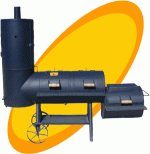
Chris a friend mine worked for a material handling company and had racks custom built to move bolts of cloth after they were dyed. The company he built them for went broke, and he got stuck with the racks. I going to put a plywood base in the bottom of the rack. The racks have steel slots for a forklift on the bottom for easy moving. He gave me a couple which I am going to use to store wood next to my bbq smoker. I had my wood stacked between two trees six feet high. We got a good wind storm last fall 50+ mph winds, and 3/4 of the wood fell on the ground. He was some left that could be probaly had cheap. If interested send me a pm. Year round residence in Pawtucket RI.

John
 

Attachments

  • IMG_ wood rack (Medium).JPG
    IMG_ wood rack (Medium).JPG
    124.5 KB · Views: 192
  • smoker.gif
    smoker.gif
    28.4 KB · Views: 217
/ Cordwood #59  
I used Chris's BTU/fuel oil and efficeincy ratings to try and figure how much a cord is worth b/4 it's better to just turn the thermostat up.

1 cord dry oak = 159 gal oil.

woodstove @ 50 % efficeincy = 2 cord & boiler @ 80 % = 200 gal oil. :confused: Is that right ?

1 cord = 100 gal @ 2.60/gal = $ 260.00

face cords are more common up here which would be $ 86.00 / face cord.

I jot down good bits of info from post for future reference. I had a note that said 1 cord = 100 gal oil. After Chris's post I crossed that out and wrote in 181 gal. then I crossed that off and wrote 1 cord DRY oak = 159 gal. Now after using Chris's efficeincy ratings I'm back to the original 100 gal. :)

Oh, and by the way, 2' of elevation = 1 psi and 1' of baseboard = 580 btu.
 
/ Cordwood
  • Thread Starter
#60  
Well the 80 effeciency of the boiler is the burn chamber efficiency. Then convert that heat to the cast iron and lose some, then to the water and lose some, then to the pipe and lose some, then to the fin-tube and lose some then to the air and lose some...


Wood stove convert to cast iron and lose cast iron to air and lose some and done. I have a Jotul stove... Se the efficiency below... Not too far off the boiler.

Technical data for Jøtul F 600 Firelight CB


Maximum heat output: 81,500 BTU/hr
Heating capacity: Up to 2,500 sq.ft
Overall efficiency: 71%
Log length: 24"
Burn time: Up to 10 hours
Finish options: Blue/Black, Ivory, and Jøtul Iron™ Enamel, or Matte Black Paint
Flue outlet: Top, and rear
Flue size: 6"
Weight: 465 lbs
Accessories: Fire screen, Floor bracket kit, Bottom and rear heatshield
Jøtul has a policy of constant improvement and upgrading. Products therefore may differ in specification, design, material or dimensions at any time without prior notice.
Technical documentation for Jøtul F 600 Firelight C
 

Marketplace Items

Firestone Bolt On Duals 14.8-38 (A65640)
Firestone Bolt On...
2022 EZ-GO ELITE ELECTRIC GOLF CART (A63276)
2022 EZ-GO ELITE...
2022 EZ-GO ELITE ELECTRIC GOLF CART (A63276)
2022 EZ-GO ELITE...
2008 Chevy Trail Blazer (A62679)
2008 Chevy Trail...
Great Dane Van Trailer (A63689)
Great Dane Van...
2019 P.J. Trailer Trailer, VIN # 4P5F82029K1307542 (A65563)
2019 P.J. Trailer...

Here are some similar links:

 
Top