Covered Slab Slope

   / Covered Slab Slope #1  

jrdepew

Silver Member
Joined
Dec 13, 2012
Messages
164
Location
Johns Island, SC
Tractor
Ford 1920, JD LT180
Hi All ,

I am about to start forming up a concrete slab at the back of the house for a screened in porch. I will likely hire the actual pour, and do all of the excavation, rebar, etc myself. How much slope should I have on the slab? Since it is covered, I was going to go with a very gentle slope, about 1/8" per foot. 1/4" per foot seems extreme because the roof will do most (all) of the water shedding.

Thanks,
Joe
 
   / Covered Slab Slope #2  
dimensions of porch?
shape of porch?

frost depth for your area?

any pictures?

account for footer, and any settling/ movement / cracking of the slab.

your local concrete companies / contractors. will more likely be better suited. to give you an idea of what you need to do. for footer width/depth if any, and how thick the pad needs to be. and if you need any "joints" were concrete can crack if it needs to crack. due to ground movement / settling issues.

if large area, perhaps a drain. so you can push any mop water, or like down the drain.
 
   / Covered Slab Slope #3  
Since it's going to be covered, there is no reason for a slope. Make it flat.
 
   / Covered Slab Slope #4  
Since it's going to be covered, there is no reason for a slope. Make it flat.

Agree...unless you're expecting "some" rain etc. blowing in through the screening and plan on having some sort of sill where it can drain out/off...
 
   / Covered Slab Slope #5  
Hi All ,

I am about to start forming up a concrete slab at the back of the house for a screened in porch. I will likely hire the actual pour, and do all of the excavation, rebar, etc myself. How much slope should I have on the slab? Since it is covered, I was going to go with a very gentle slope, about 1/8" per foot. 1/4" per foot seems extreme because the roof will do most (all) of the water shedding.

Thanks,
Joe

1/8" per foot is a lot of slope. 1/4" per foot can be hard to walk on especially for the elderly.

I would find some sloped slabs and walk on them and measure the fall and see what felt ok to walk on and still shed water. It isn't going to take very much to shed a little water.
 
   / Covered Slab Slope #6  
If you know how to read a level there is a secondary line on most bubbles that gives you angle for drainage.
I think it is 1%. ???
 
   / Covered Slab Slope #7  
Rain will get in unless the porch is walled and windowed. Unless you feel like mopping and squeegying it every time it rains, I would slope it at 1/8" per foot, or at least some slope.
 
   / Covered Slab Slope #8  
FWIW... a 1/8" to 1/4" pitch is typical for the average garage floor slab...
 
   / Covered Slab Slope #9  
Rain will get in unless the porch is walled and windowed. Unless you feel like mopping and squeegying it every time it rains, I would slope it at 1/8" per foot, or at least some slope.
And periodic hosing it down to clean will be easier to deal with as well.
 
   / Covered Slab Slope #10  
And periodic hosing it down to clean will be easier to deal with as well.

Most floor drains in a factory I worked at were higher than the floor.

Take into account that the floor contractor might not get it perfectly flat and may have a little dip or two that will hold water even if pitched correctly. So a little pitch will make that scenario more difficult.
 
   / Covered Slab Slope #11  
Fwiw, my front porch has a slight slope, barely noticeable. It rained pretty good today, it's bone dry. Just walked out with socks. Yea, a little will blow in, but it dries fast, no need for mops.
 
   / Covered Slab Slope #12  
Two other thoughts came to mind reading the various comments...
If there is any chance of water (rain blowing etc.) and the slab will be connected to the house?...the slab should be pitched away from the house...
The other thing is...pool deck drain tubes can be let down into the low end of the slab on the inside of the shoe plates of the screen enclosure...
 
   / Covered Slab Slope #13  
if you have a basement... might suggest putting in a 1/2" strip maybe a little wider strip between house and concrete pad. and then once concrete has cured / harden. pull the strip out. and fill with calking / close cell spray foam (great stuff red can), or like. so in a few years later. the concrete pad does not shift back into the home.

to large of a crack, and weeds grow. to small of a crack and concrete pad will expand/contract into the home foundation/wall. causing issues with the wall.

============
make sure you higher a good "concrete finisher" they are the folk/s that make concrete nice and smooth. i have yet to actually see a perfect flat concrete slab, once you toss say a 5 gallon bucket of water over entire concrete floor and wet it all down. you will see little puddles here or there. and then once ground heaves/hoes from ground movement and settling... the concrete will move about some. causing water to go towards a manufactured cracking area or like.

============
decided how you want water to run if it rains in. and account for it running between lumber seating/resting on the concrete. for the frame work of the screens and doors. or if you are going to hold the frames for screens say 1/4" or higher off the floor. and use some sort of foam / weather seal / calk to fill in voids or perhaps "open cell spray foam".

=============
use to have a old concrete pad front deck. and ended up sloping back towards home. so every time it rained, water ran back into the basement.

on many concrete driveways, going up to a garage. there always seems to be a spot were water collects and more so in cold areas. were water freezes. leaving a slip and fall. and many times this spot is between concrete driveway and right at edge of concrete for the garage.

=============
the drain comment, with it being enclosed, moping is one thing, but if just screened on all sides and rain water getting in. using a power washer / sprayer to clean the concrete from any sort of mild dew, and being about to sweep/mop/spray towards a drain, vs trying to get all the gunk to go between concrete and screen frames.
 
   / Covered Slab Slope #14  
1/4"/ft is typical slope on sidewalk
1/8" /ft slope away from house will be good for a porch
Expansion between porch and house is not common in Ohio
 
   / Covered Slab Slope
  • Thread Starter
#15  
Thanks for all the replies!

To answer some questions, the slab will be 12' x 14'.

Location is Charleston, SC...so no frost heaving worries. The house is on a slab...no basement. House was built on a large mound of heavy sand fill.

there is a big BUT here though that I didn't mention in the first post...

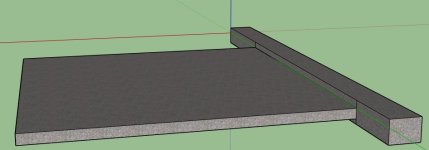
There is currently a 10'x10' slab in the location I want the 12'x14' slab. It is right off the back door, and is about a 3" step down from the threshold. This 10x10' slab was poured at the same time as the house slab, and I do not see an expansion joint present. Therefore, I believe that it is all monolithic. I measured the slope of this slab using a laser, and the pad actually slopes in 2 directions. The slope away from the house is ~1/5" per 12", and the slope towards the side of the house is 1/5" per 12". So, the difference between the highest corner and lowest corner is about 4".

My gut tells me to rent a saw, cut the slab as close to the house as possible, demo the 10x10' slab, then grind what is left attached to the house slab as much as possible using my angle grinder. Then I could drill the house slab, insert rebar, and tie that into my new slab's rebar work. I do not know if there is currently mesh/rebar present. Depending on how that works out, I may have to raise the new slab about 1" or so, making a 2" step between the house slab and porch slab. The 1" raise would give me a little thickness over the "stub" of slab that is likely to exist still attached to the house. It is hard to picture how well this idea will work, as I do not know how closely I can easily run a concrete saw to the house. I am guessing the stub I will have left over would be 3-6" wide.

Here are some drawings:

Current Slab and thickened edge of house slab (This is not showing the slope):
CurrentSlab.JPG

Current Slab, cut as close to the house as possible and ground to an angle:
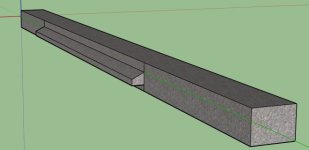
CurrentSlabCutGrind.JPG

Same image as above, showing the outline of the new slab in black. This shows how for a small section near the door, the slab would be thin, 1" or so tapering outwards:
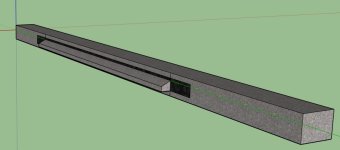
CurrentSlabCutGrindNewOutline.JPG

There is of course a chance that I can using a concrete cutting wheel on an angle grinder and cut more of the slab stub away, but it is hard to know until I start demo. I really wish they had used some sort of joint here, as that would make this a lot easier...but no such luck.

Thanks,
Joe
 
   / Covered Slab Slope #16  
Why wouldn't you pin the 10x10 slab and extend it to the desired size 12x14?
 
   / Covered Slab Slope
  • Thread Starter
#17  
Why wouldn't you pin the 10x10 slab and extend it to the desired size 12x14?

That was my original plan, but two things are stopping me from going down this path.

The first thing is that the current slab has a lot of slope, and it is sloped in two directions...away from the house at 1/5" per foot and along the house at the same rate. So two opposite corners measure 4" off from each other using a laser to measure the grade. This will complicate the process of building the screened in porch greatly.

The other reason is that I am not sure I will like the look of the pad with expansion joints and a "U" shaped pad poured around it.

Thanks,
Joe
 
   / Covered Slab Slope #18  
Can you add rebar into existing slab and then pour a topping slab when you extend the slab
 
   / Covered Slab Slope #19  
So you are adding 24" to each of the 3 open sides??
Why not just dig a footer all the way around and pour right over top of the existing slab to bring it up level with the house??
 
   / Covered Slab Slope
  • Thread Starter
#20  
So you are adding 24" to each of the 3 open sides??
Why not just dig a footer all the way around and pour right over top of the existing slab to bring it up level with the house??

1' on each side, and 4' longer. The 12' dimension is against the house, and the slab will go out 14'. I would go even bigger, but am restricted by septic/plumbing/corner of house.

That sure would save a lot of demo...

How much of a step should I keep between the house slab and the patio slab? I just measured...I have 3.5" between the top of the slab and the bottom of the door threshold.

So, if I poured a slab over/around the existing, and up to a height of 1.5" below the threshold...I think that could work. The slab would be 2" thick at its thinnest point. I could drill the current pad as well as the house pad and pin everything together and integrate it with my rebar...

Are there any special steps I would take when pouring new concrete over old? I plan on doing all of the excavation and form work myself, then hiring the pour done.

Thanks for the help all!!!

-Joe
 

Tractor & Equipment Auctions

2023 FORD F-150 XL CREW CAB TRUCK (A59823)
2023 FORD F-150 XL...
2014 Ford Explorer AWD SUV (A59231)
2014 Ford Explorer...
2014 FORD F-150 STX EXT CAB TRUCK (A60430)
2014 FORD F-150...
Hydraulic rail grinder (A61306)
Hydraulic rail...
2018 JOHN DEERE 333G SKID STEER (A60429)
2018 JOHN DEERE...
2016 INTERNATIONAL PROSTAR TANDEM AXLE DAY CAB (A59904)
2016 INTERNATIONAL...
 
Top
