Crop Dusting share your picture and stories.

   / Crop Dusting share your picture and stories. #41  
Not that it helps your friend particularly, but the adjacent farmer is liable for overspray in many areas. I'm not sure the few dollars would be worth the neighborly ill will to me, but I certainly wouldn't be putting in backyard veggies for sure.

@2LaneCruzer That's quite the story. The sodium chlorate would probably have been used as a desiccant, to defoliate and dry the plants out for harvest. They still use it today (defoliate-750).

All the best,

Peter
I spent one whole summer testing mixtures of Sodium Chlorate and Urea...besides thermal analysis, I ran explosive tests....put various mixtures in a 3" piece of pipe, inserted a blasting cap and set it off. Never had one go off, but was kinda scary.

I was the only Chemist who got to work in the back yard, in a hole in the ground. Can't recall the details now, it's been around 50 years ago, but the tests did show some partial explosions..., but we came out with a commercial product.
 
   / Crop Dusting share your picture and stories. #42  
I spent one whole summer testing mixtures of Sodium Chlorate and Urea..., but we came out with a commercial product.
To do what? Defoliant?

Boy that sounds like a bygone age of chemistry...

All the best, Peter
 
   / Crop Dusting share your picture and stories. #43  
Wife says I’m a crop duster.
She got me a t-shirt with this.
It gets a few laughs.

1722288342287.png
 
   / Crop Dusting share your picture and stories. #44  
To do what? Defoliant?

Boy that sounds like a bygone age of chemistry...

All the best, Peter
Yeah, they wanted something to spry on cotton that wouldn't blow up or set the world on fire. They called it "Tumbleaf", and was made by Kerr McGee Chemical Co.
 
   / Crop Dusting share your picture and stories. #45  
Yeah, they wanted something to spry on cotton that wouldn't blow up or set the world on fire. They called it "Tumbleaf", and was made by Kerr McGee Chemical Co.
Well that explains a lot about the casual approach to experimentation and safety!

Were you on deck for the PEPCON disaster?


(For thoswho aren't familiar with the company, Kerr-McGee, was a petrochemical, oil, gas, production that was a prime manufacturer of chlorate, and solid rocket fuels. The latter are always intended to be a controlled explosion, so manufacturing is/was always about reducing risk, rather like crop dusting, where closer is better, but leaves less room for error...)

All the best,

Peter
 
   / Crop Dusting share your picture and stories. #46  
Well that explains a lot about the casual approach to experimentation and safety!

Were you on deck for the PEPCON disaster?


(For thoswho aren't familiar with the company, Kerr-McGee, was a petrochemical, oil, gas, production that was a prime manufacturer of chlorate, and solid rocket fuels. The latter are always intended to be a controlled explosion, so manufacturing is/was always about reducing risk, rather like crop dusting, where closer is better, but leaves less room for error...)

All the best,

Peter
Silkwood....
 
   / Crop Dusting share your picture and stories. #47  
Silkwood....
I worked for Kerr Mcgee for 18 years; first as a technician and later as a Research Chemist at the Research Center in OKC, and after law school, as an Environmental Engineer for 2 years. I have been to Henderson, and to the Silkwood facility.
 
   / Crop Dusting share your picture and stories. #48  
We live on 10 acres that is surrounded by fields. Think of a U and my property is the inside of the U. I get to see crop dusters every couple of years. Here are a couple videos.


   / Crop Dusting share your picture and stories. #49  
We live on 10 acres that is surrounded by fields. Think of a U and my property is the inside of the U. I get to see crop dusters every couple of years. Here are a couple videos.


I'm curious what do your neighbors grow that they use crop dusters instead of sprayers? Do you know why? (Cost? Time?)

Just curious.

All the best,

Peter
 
   / Crop Dusting share your picture and stories. #50  
I'm curious what do your neighbors grow that they use crop dusters instead of sprayers? Do you know why? (Cost? Time?)

Just curious.

All the best,

Peter
Typically they are spraying soy beans with the plane. It is normally later in the season (mid August). I'd guess some type of pesticide, given the timing. It's not herbicide and probably not fert. They do also spray with a normal wheeled sprayer in early season post-emergence. Unsure if they use the crop duster for cost or some other reason. Maybe it is due to the fact the beans are pretty tall/full by then and a wheeled sprayer may crush more crop at that time of the season than early season.
 
   / Crop Dusting share your picture and stories. #51  
Wanting to avoid crushing plants makes sense to me. The area might have white mold, and need post canopy closure spraying of fungicide.

Thanks!

All the best,

Peter
 
   / Crop Dusting share your picture and stories. #52  
We see them spraying both corn and soybeans in our area. No idea what they're spraying for, but it's this time of year.
 
   / Crop Dusting share your picture and stories. #53  
I have a friend that rents out his famlily farmland. He doesn't farm. He said one day he was in his house and heard a plane fly over low, then a few seconds later it sounded like hail on his roof. He went out and found that the person leasing his land was having soybeans planted by crop duster plane in the winter wheat that was not yet harvested. He talked to the guy and they said dropping it in by air a few weeks before the wheat was harvested would allow for head start on the beans and they'd harvest the wheat before the beans were tall enough to get damaged by the combine.
 
   / Crop Dusting share your picture and stories. #54  
The diversity of farming practices never ceases to amaze me.

I'm not going to comment on the accuracy of that broadcast seeding. Ok, maybe. That pilot couldn't aim well enough to hit the broadside of a barn...oh wait, he probably did.

Some rice farms in Louisiana broadcast seed the rice from helicopters, and usually broadcast young crayfish at the same time. For many rice farmers there the net profit on the crayfish exceeds the gross sales on the rice...

All the best,

Peter
 
   / Crop Dusting share your picture and stories. #55  
The diversity of farming practices never ceases to amaze me.

I'm not going to comment on the accuracy of that broadcast seeding. Ok, maybe. That pilot couldn't aim well enough to hit the broadside of a barn...oh wait, he probably did.

Some rice farms in Louisiana broadcast seed the rice from helicopters, and usually broadcast young crayfish at the same time. For many rice farmers there the net profit on the crayfish exceeds the gross sales on the rice...

All the best,

Peter
There are a few videos out on youtube that show the process. The fields are not uniform like a planter would do, but the farmers seemed pleased with the process.
 
   / Crop Dusting share your picture and stories. #56  
I think they did beans into wheat right before wheat harvest, and wheat into beans right before bean harvest. Kinda interesting.
 
   / Crop Dusting share your picture and stories. #57  
They've come up with some pretty innovative ideas. The days of turning the sod twice per year are changing.
 
   / Crop Dusting share your picture and stories. #58  
Wanting to avoid crushing plants makes sense to me. The area might have white mold, and need post canopy closure spraying of fungicide.

Thanks!

All the best,

Peter
Yep ^^^

Two years ago, the soybeans in my field were aerial crop dusted with an insecticide, and fungicide. The planes are expensive, but sometimes soybeans are also. Wheeled sprayers can destroy a lot of beans, even with a 120' boom.

It's all a numbers game and the luckiest, sharpest pencil may get the most profit.
 
   / Crop Dusting share your picture and stories. #59  
Some rice farms in Louisiana broadcast seed the rice from helicopters, and usually broadcast young crayfish at the same time. For many rice farmers there the net profit on the crayfish exceeds the gross sales on the rice...
I live in the middle of rice and crawfish farms, and have been involved with both for all of my life. I have never seen or heard of seeding rice or crawfish with a helicopter. Rice is very often seeded with airplanes. I don't think crawfish has ever, or could ever be seeded with an airplane or helicopter.

And you are correct, many farmers grow rice to make a better crawfish crop and will accept a lesser rice crop in order to make a better crawfish crop.
 
   / Crop Dusting share your picture and stories. #60  
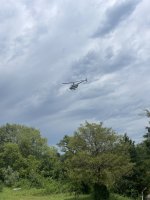
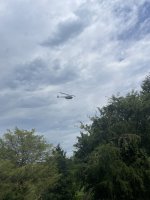
Still working the field next door. Approx 60 acres total. Tree lined.

IMG_8864.jpeg
IMG_8862.jpegIMG_8862.jpegIMG_8863.jpeg


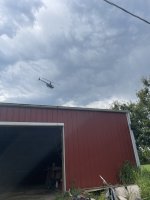
Here he is turning right next to our barn

IMG_8865.jpeg


Still working a couple hundred acres to our south now.
 
Last edited:

Marketplace Items

SWICT 72" SKID STEER BUCKET (A60430)
SWICT 72" SKID...
2003 FORD F150 HARLEY DAVIDSON EDITION PICKUP TRUCK (A59905)
2003 FORD F150...
JCB 507-42 TELESCOPIC FORKLIFT (A60429)
JCB 507-42...
2000 Hyster S50FT (A55973)
2000 Hyster S50FT...
WINCH CABLE DRUM (A58214)
WINCH CABLE DRUM...
2008 GMC C7500 CREW CAB FLATBED DUMP TRUCK (A57192)
2008 GMC C7500...
 
Top