Crossing Mud and Standing Water

   / Crossing Mud and Standing Water #1  

ransonjd

Bronze Member
Joined
Apr 16, 2017
Messages
53
Location
Rochester, NY
Tractor
BCS 605
How much standing water and mud can a tractor handle? I have an access trail on my property. There are spots that have been under a few inches of water since January. The soil underneath is sticky silty to clayey loam. I just planted a couple hundred willows and swamp roses along the trail. I would like to mow around them to keep down the weeds and brush. How do you judge whether it's safe to cross the wet spots with a tractor? I don't want getting stuck to be the first thing I do with my new DK4510HS. Also, are there any tricks for avoiding getting stuck in mud, when you have to cross it?

--John
 
   / Crossing Mud and Standing Water #2  
Tractors are prone to bogging all the way to the axles.

The only tips I can give are 1) 1/3 tank of fuel. 2) 4-WD helps. Removing the FEL entirely will lighten the tractor but I have used my FEL to claw my way out of near bogged conditions, so I leave mine on.

R1/ag tires give better traction in mud but not water saturated mud.

VIDEO: small tractor stuck in mud - YouTube
 
   / Crossing Mud and Standing Water #3  
If you just keep moving, you won't be stuck. :)

Bruce
 
   / Crossing Mud and Standing Water #4  
I can tell you from VERY recent experience, that even 4x4 tractors sink quickly when the ground turns soupy. LOL.
I didn't get stuck, but now have some 12"+ deep tracks thru what was supposed to be mama's future garden spot, and a very muddy tractor.
one trick, would be to try to avoid going over the same area repeatedly. The wet ground will get progressively more squishy and soupy the more you drive over it.
I would leave the bucket on the front, if you do get stuck, you can use it to assist in clawing the tractor out...
I am trying to get accustomed to the weather in Tennessee, where it seems to quit raining just long enough, to make it appear that I can get some work done, then it promptly pours buckets of rain for days again.
If you only have a few wet spots you HAVE to navigate, some old plywood or OSB put down will disperse the weight, but that is only practical for a spot or two.
Could dump some wood shavings on the wet spots. But again probably not practical for your purpose.
Safest advice is probably to wait until it dries up some, grass will still be able to be mowed later.
 
   / Crossing Mud and Standing Water #5  
How much standing water and mud can a tractor handle? I have an access trail on my property. There are spots that have been under a few inches of water since January. The soil underneath is sticky silty to clayey loam. I just planted a couple hundred willows and swamp roses along the trail. I would like to mow around them to keep down the weeds and brush. How do you judge whether it's safe to cross the wet spots with a tractor? I don't want getting stuck to be the first thing I do with my new DK4510HS. Also, are there any tricks for avoiding getting stuck in mud, when you have to cross it?

--John

Tractors will go in water usually until it's sucked into the intake but that's way extreme plus water will eventually get into your gearboxes doing that.

Mud is a different story but similar to water. Tractors will usually go in deeper mud than is good for them. Once you're rear diff starts dragging its pretty much over. Add an implement on back that's dragging in the mud and it will be stuck pretty good.

Most anyone that's ran a plow/disk/chisel has been stuck trying to get a field prepped. The smart operator stops before burying the tractor and gets help. Running one down into the mud onto the under belly is plain stupid and will almost guarantee damaged seals and mud intrusion into the running gear.

With that said, I ease into an area and when the tractor sinks to the rim I stop and back out. Past that point you not going to accomplish much except making ruts that will hold water longer and be deeper next time.

With a mower on back I'd stop soon as I started squishing mud up and wait for a better day.

With your new tractor I would be very cautious.
 
   / Crossing Mud and Standing Water #6  
if it is to wet and making ruts. just do not go out! end of story. kinda silly to go out and mow. and end up making ruts that will need to be repaired and end up as mud hole / ruts for the next year till grass grows back in after fixing the spots.

R1 tires i would more likely venture out within reason.
R4 tires i would still be on the porch waiting for it to dry out good.

if you walk out and your own shoes are making wet spots / mud holes / ruts. it is to wet for sure. no sense messing up more. weeds/grass can grow tall, and be cut down latter with a couple times mowing over it to mulch it up better. and then takes a couple times of mowing after the high mowing to get the grass back looking half way descent.

ruts are a pain to fix. waiting and mowing later simpler.

if you have a truck with some tow hooks on front and/or hitch on the rear. make sure you have the cable/chains already for 20 to 40 feet. and drive out on it with truck. if you get stuck use tractor to pull it out and call it to wet. truck less likely to make major rutting.

on other hand getting tractor stuck = waiting longer time seating out in the mud till it dries, and pending on how bad you got it stuck, a larger tractor needed to pull it out.

============
with others FEL = awesome way to push backwards to get back out many times, and or pull you out forwards

if you drive in with 4x4 / MFWD on and you get stuck. you are stuck pretty good. if you drive in with just 2WD and get stuck, chance 4x4/MFWD will get you out.

============
i like notation of cataclsym notation if mud gets to rim. time to stop and back out. a little rut ya. but field / wide area were there is no road/driveway. ya asking for sinking further.
 
   / Crossing Mud and Standing Water #7  
How much standing water and mud can a tractor handle?

You would be AMAZED... As with anything, perform your maintenance according to your usage. Manufacturer's guidelines are minimum requirements for basic usage. Extreme duty requires a higher level of maintenance and inspection. A tractor will generally go until it can go no more, and do so damage free. It can shorten the lifespan of various seals and components to operate in extreme conditions, but that is to be expected and part of the higher level of maintenance and inspections necessary to keep the equipment in good working order.

You could park it in a climate controlled garage and just start it for a few minutes a day and it would last forever with virtually no real maintenance ever needed besides wiping the dust off and polishing it every couple years. In fifty years or so you can enter it in antique tractor beauty contests at the county fair and drive it in parades too. :laughing:

I have an access trail on my property. There are spots that have been under a few inches of water since January. The soil underneath is sticky silty to clayey loam.

That sounds like fun ATV trail to get muddy on one hot day. :D

Would it be possible to add some stone to the path? Grass can grow up through the stone and the stone will eventually sink, but in the process it will firm up and raise up the path. Go over it a couple times a year with a box blade to level and smooth it back out as it settles.

This is what I've been doing for a couple years to build a new road on my property that was uneven, had mud holes in the low spots, and would get worse every time you drove across it. I added some larger stone to the larger holes, then spread some gravel. Drove over it trying to alternate my path slightly each time to mash everything I could as evenly as I could for several months. Once the tire paths were becoming the low points of the road, I set my box blade at a slight tilt and pulled it to direct the edge material toward the center. Then leveled it up and dragged it all out smooth and flat. First several times I was reworking it I also had to add additional stone to some areas, but now the past two times I've dragged the tire impressions out smooth, I've not had to add any gravel, all of my low/wet spots are gone, and the grass grows up through it like the rest of the lawn during the spring and summer months. Winter does wear it down to the gravel.

I just planted a couple hundred willows and swamp roses along the trail. I would like to mow around them to keep down the weeds and brush. How do you judge whether it's safe to cross the wet spots with a tractor?

If it is something you want to mow, it is likely not something you want muddy tire ruts in. If you can jump around on the area and not leave wet footprints as you climb on your tractor, then it's okay. If you leave wet footprints, wait for a better day.

I don't want getting stuck to be the first thing I do with my new DK4510HS.

It's called getting broken in properly. For both, the tractor and the new operator.

Also, are there any tricks for avoiding getting stuck in mud, when you have to cross it?

<In my best Jeremy Clarkson voice> SPEEEEEEED!
 
   / Crossing Mud and Standing Water #8  
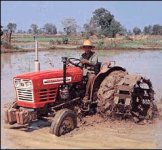
Rice tires!


Bruce
 
   / Crossing Mud and Standing Water #9  
How much standing water? I've gone to the bottom of the front & rear axle. I don't want to go any deeper and have to trust the breather tubes on the axles. This was a situation - fresh water, hard gravel bottom - where I knew there would be no difficulties getting out.

How much mud? I've had my tractor stuck on flat ground with around 3" to 4" of sticky mud. The R1 tires loaded up and were a little less useful than racing slicks. I was pulling a disk harrow - I raised the harrow on the 3-point and was able to drive out but I had to avoid the area until it dried out more.

If you have to cross a spot that is wet, muddy, swampy - and you manage to make it across - when you come back on the return trip - don't drive in the same tracks. Your first crossing tore the area up to some extent - coming back in the same tracks just might be your undoing.

If it were me - I'd be waiting for things to dry out before mowing. Why risk the aggravation........... Use your new tractor for some project that's on dry land.
 
   / Crossing Mud and Standing Water #10  
You are not really stuck in mud if you still have fuel in the tank. When you are in the mud and without fuel, then you are truly stuck.:)
 
   / Crossing Mud and Standing Water #11  
My first thought was like Sysop's: find some stone to add to the wet spots. I have some trails where I'm thinking of using the cordoroy road approach on wet spots; I don't think this would be desirable where aesthetics matter or if you wanted mowable grass cover, though.
 
   / Crossing Mud and Standing Water #12  
Also, are there any tricks for avoiding getting stuck in mud, when you have to cross it?

--John

Like been written: Just keep moving and you wont be stuck!

In seriousness, momentum does help. Also

Good tires (R1's) and/or chains.
Front end loader can help to get unstuck.
Using differential lock (or independently apply brake to tire that is spinning (to apply torque to tire that isn't)).
You'd be surprised where a tractor can go!

Also static friction his a higher coefficient than kinetic friction. That's a physicists fancy way of saying a tire making solid contact with the ground (or payment) has a stronger bite than a tire that is spinning/skidding. (Drag racers know this. Also the concept behind anti-lock brakes). Have some speed, but if possible control the torque so that tire's ground contact is static (i.e. not spinning). The problem is muddy ground can't withstand much torque so this becomes very, very difficult.
Then it becomes a race: Do you run out of momentum, speed, and torque (between tire and ground) before you travel the distance of the mud hole?
 
   / Crossing Mud and Standing Water #13  
Also static friction his a higher coefficient than kinetic friction. That's a physicists fancy way of saying a tire making solid contact with the ground (or payment) has a stronger bite than a tire that is spinning/skidding. (Drag racers know this. Also the concept behind anti-lock brakes). Have some speed, but if possible control the torque so that tire's ground contact is static (i.e. not spinning). The problem is muddy ground can't withstand much torque so this becomes very, very difficult.
Then it becomes a race: Do you run out of momentum, speed, and torque (between tire and ground) before you travel the distance of the mud hole?

adding to. from my own experience. instead of trying a higher gear, to cause the tires to spin...
goto a lower gear. and less throttle and work the split brakes (left and right rear tire brakes). the low gear, less throttle and the just working slowly on the brakes to keep both tires from not spinning.

diff lock is all good and all. but when ya get yourself in a hole the rear tires. one will want to see more force to get it turn while the other one just spins. and the need for one rear tire to barely spin while other tire spins just a little bit more. to bite on through the mud and get you up and out.

if you due end up in a hole and stuck. have found, grabbing a jack and board to place under the jack, lifting each tire up. and tossing some rock under each tire. tends to help the best. granted having rock is the issue many times. trying to place a board under the tires for like a bridge/ramp just eats the rubber off the tires is my experience. and you end up needing to dig the board back out of the mud. some how managed to have approx 5 gallon bucket of rock laying in some bag (bag you get from local hardware stores)

rocking tractor back and forth. has work for me as well. but it is keeping the tires from spinning as you rock back and forth (forward/reverse). if the tires begin to slip just a little bit back off. and go opposite direction. spinning tires just sink you further, at least in my experience. (kinda like turning on a tiller and just dropping it without moving, the tiller begins to sink down)

the rare times i actually let tires spin, is when i am just about out of (rocking) above. and tires are actually grabbing dirt/mud and tossing it behind the tires. vs the mud loading up the tires and loosing momentum and traction. but even then. i try my best to keep the spinning to bare min. and never punch the pedal as far as it will go to spin the tires as fast as they can.

=========

the back lake. the dam on it has a grass/trail going down into the pasture. if the grass is just a bit wet (morning dew), it can be a pain getting up it with a truck. 4WD actually hurts more than helps. has been my experience in different 4WD trucks. due to in 4WD once a tire begins loosing traction that tire will just speed up the RPM's and less power ends up going to the other wheels. and i just come to a stop and end up actually sliding back down. if i put truck/s in 2WD. i tend to "fish tail it" up as a tire slips rear end goes back and forth some. but even then. i am constantly fighting the tires and trying to keep them from spinning in first place. any spinning = lose of traction and reduction in momentum to get me back on top of the hill. after so many loss of traction you just kinda petter out. even though i get so close from getting to the top. most of it for me, is finding the dry spots, and learning how the truck handles. (getting other folks out of the pasture)

while above is not tractors per say. it is that keeping the wheels from spinning thing.
 
   / Crossing Mud and Standing Water #14  
Rochester NY? Whey to early to be on wet grounds or to mow anything.What is your hurry,things are going to be growing all summer.Wait until at least the end of May.
 
   / Crossing Mud and Standing Water #15  
...
Most anyone that's ran a plow/disk/chisel has been stuck trying to get a field prepped. The smart operator stops before burying the tractor and gets help. Running one down into the mud onto the under belly is plain stupid and will almost guarantee damaged seals and mud intrusion into the running gear....
Good point. Much easier to suck it up and get help early. I would much rather spend the time getting amother truck or tractor and drag it out than spend a few hours knee deep in mud with a shovel, boards, gravel, etc...
 
   / Crossing Mud and Standing Water #16  
Add a couple of rear wheel extensions like this and you won't have to worry till you need a snorkel!:laughing:
YanmarInternationalPhoto.jpg
 
   / Crossing Mud and Standing Water #17  
I hit it moving at a decent speed with the Diff lock depressed and in 4x4. If I do manage to get stuck once it becomes obvious I'm not driving out I stop and get help. My tractor had spent quite a bit of time in mud and it cost me both seals on the front axel.
 
   / Crossing Mud and Standing Water #18  
If I'm just driving through a muddy spot that is somewhat of a concern I will go through it backwards. I have found that the shorter, narrow front tires become stuck easier. If I go through backwards, the large rear tires have a better chance of pulling the rest of the tractor through. It also seems more natural use the loader to help push me along.
Of course, if you have an attachment on the 3 point this may not work as well.
 

Tractor & Equipment Auctions

INTERNATIONAL DUMP TRUCK (A52707)
INTERNATIONAL DUMP...
2022 Transcend Xplor 245RL 30ft. T/A Travel Trailer (A59231)
2022 Transcend...
2016 Bobcat E85 Midi Excavator (A56857)
2016 Bobcat E85...
2014 KOMATSU HM400-3 OFF ROAD DUMP TRUCK (A60429)
2014 KOMATSU...
2012 Chevrolet Traverse LT SUV (A59231)
2012 Chevrolet...
2015 Dodge Journey Van (A59231)
2015 Dodge Journey...
 
Top