custom made wheels ?

/ custom made wheels ? #1  

deepNdirt

Veteran Member
Joined
Sep 17, 2009
Messages
2,277
Location
Nth East Ga, USA
Tractor
yanmar YM-1700
I have tried mounting 12 car tires on the front rims and really still cannot get a larger enough of a tire that would help in this situation, I don't like the idea of having to reverse the front wheels to achieve the wider stance do to the effect it will have on the wheel bearings, The FEL I have is 4 ft
and the front wheels of the tractor if set in normal position set at 37". This leaves the center of gravity a bit shaky when the loader is up while turning the tractor sharp one way or the other, so I have went ahead and reversed the wheels for now giving it a 43" wide stance, but do not plan in leaving it this way......

So here is what I have on my mind in attempt to resolve the excessive wear on the bearings, If I can take the center part of the tractor wheel and cut it out I would have the correct bolt pattern needed ,I would then re-weld it into the center of a larger wheel this would then give me more choices in use of a larger tire,.........
Has anyone ever tried and successfully built their own wheels by doing it this way? from say cutting the center from 1 wheel and re-welding into the center of another?
I have took measurements of the wheel center of the 12" tractor wheel and is 10 1/4 .... then measured the area from which would remove the center of a particular 14" car wheel that I have and is 10 5/8 on a 14" wheel this is a difference of 3/8 of an inch, but to center the 10 1/4 up into the 10 5/8 opening would leave a 3/16 gap to weld in all the way around, anyone done this without any ill effects? a 13" wheel might have closer to the same inside fit although I have not yet measured a 13" to find out... anyone have a 13" wheel on hand they could measure for me? I think by me building my own wheels I can adjust the center offset to what ever will be needed for the size tire I will use, the wheel I plan to use would be 6" wide. I would hope that I could simply weld it in at center of the wheel that being 3" This should allow a much wider tires for the front, although I would still have to use a low profile tire such as a 65 or under in order to prevent rubbing against the frame while turning sharply, does all this make since? wouldn't this resolve the issue of the front bearing wear? I know the weight from the FEL is still factored in as a contributor of the bearings failure, but if I limit my use of not keeping the FEL on all the time I think I can prevent the wheel bearings from wearing out,
All input is welcome and took into consideration
Thanks Folks :)
 
/ custom made wheels ? #2  
Do yourself a favor, call Hey Wheel. He has made several sets of wheels for my Yanmars and Isekis. 785-594-3311.

That said, if you don't have power steering , you might be in for a surprise with wider tires and a front end loader. You better start going to the gym and get built up to handle the steering.
 
/ custom made wheels ?
  • Thread Starter
#3  
Do yourself a favor, call Hey Wheel. He has made several sets of wheels for my Yanmars and Isekis. 785-594-3311.

That said, if you don't have power steering , you might be in for a surprise with wider tires and a front end loader. You better start going to the gym and get built up to handle the steering.

OK Thanks I will give them a call, No problem about the going to the Gym :D
I used to spend a lot of time there when I was younger, although I do still keep in shape working out in my business lifting doors windows LVL beams etc, that still keeps me strong,;)
I can still bench 265 lb.s:D so turning the wheel of my tractor is no problem,
 
/ custom made wheels ? #4  
That's great that you are able to handle the load. One more thought. It may be tough to turn under a load but also be ready for the back spin. If you let go it can spin so fast backwards you can loose a thumb. Don't ask how I know.
 
/ custom made wheels ? #5  
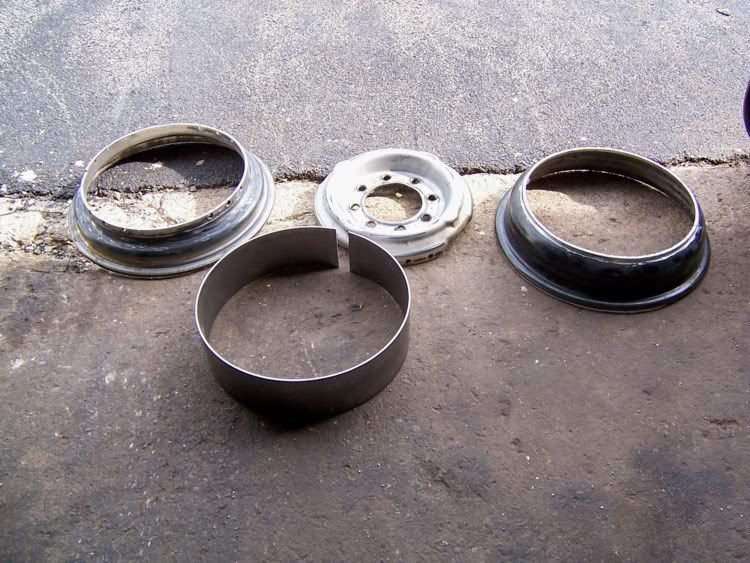
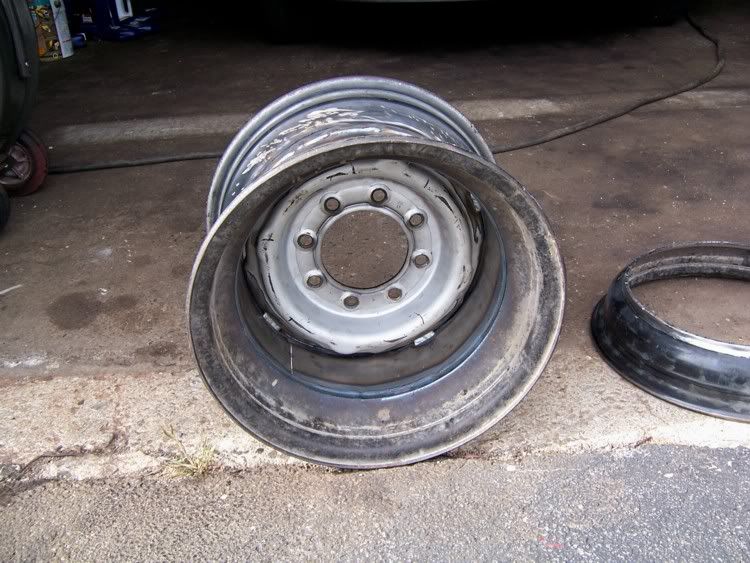
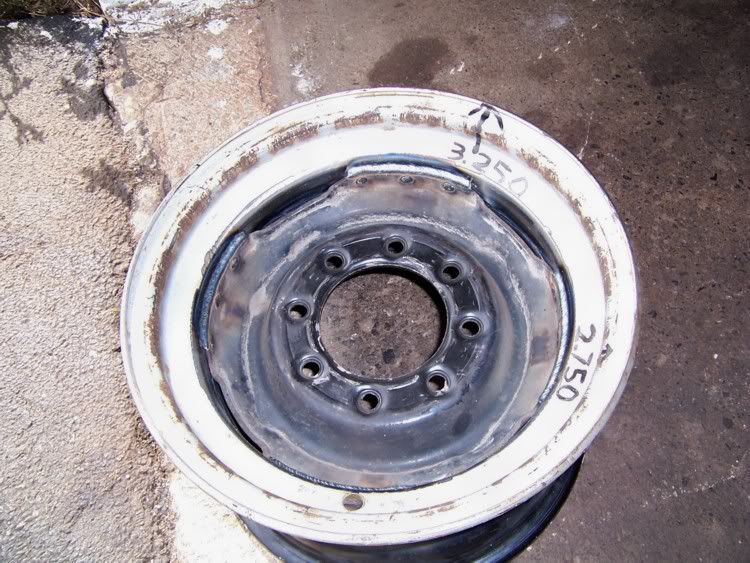
These arent tractor wheels there for a pickup, but here,s a set of wheels I made last summer.Wheels for a tractor would be a lot less fussy do to to the low speed.With a little patience it is very doable.(Here come the safety police :rolleyes:)

pieces.jpg


wheel.jpg


wheel1.jpg
 
/ custom made wheels ? #6  
Those rims look pretty good, Lil43. Good thick spacer, welds look great. What could go wrong? lol

deepNdirt, because the front axle pivots in exactly the same place, moving the wheels farther apart on the front end doesn't change the stability factor at all. It won't start to make a difference until you tip over far enough that you use up all available travel between the axle and the tractor frame, and by that time I think you will have already gone past the point of safe operation and will be well into pucker country. :D
About the only thing you can gain with a wider tire is better flotation in soft soil. If that's not a problem, stick with a similar sized tire to what you have now with maybe a heavier load carrying capability.
 
/ custom made wheels ? #7  
Mace Canute is right to a point but the added width could potentially make the difference between the tractor going over the center of gravity or staying up right when the axle has reached its maximum pivot point.The extra "length" that the wider tires/rims offer the front end should in essence lessen the angle of lean, over the "shorter" ( narrower) front end and could make the difference between a frightening experience and a life threatening one. Every little bit helps in this scenario but may not be enough in evey scenario.

I can also attest to the ill affects of wide tires and no P.S. with an FEL. I have found that the use of a spinner on the steering wheel makes a big difference and initiating turns while moving helps tremendously, you still have to watch out for your thumbs during the occasional wildly spinning steering wheel. Also, extra rear ballast goes a long way in both relieving stress on the front axle and steering effort. I see no reason why you couldn't cut two sets of rims to make one out of, sounds like a reasonable idea to me.

Lil43...great job on your rims. This would be an excellent option for someone wanting to convert from R1 to R4 tires ( like Kays Supply did on his iseki) as inexpensively as possible.

ON EDIT: I just went to Hey Wheels website, thats a great bit of information, thanks Reed... http://www.heywheel.com/
 
Last edited:
/ custom made wheels ?
  • Thread Starter
#8  
The pictures were quite helpful in showing the separate parts of a wheel,and you have done a great job, You are obviously a pro at this, ;)
actually I thought there were only 2 parts of a wheel,the center and the rim, or perhaps what the picture show are the parts to widen a rim? I wouldn't have any need of splitting the rim and adding to the width,as I think a 6" width be be plenty, the procedure I use will only take 2 part step, right? please correct me if I'm wrong....
1- simply welding of the center 2- back into the rim/wheel....
I have explored other possibilities of using wheels from a car that might perhaps fit and found that the older 4 lug V/W's are a direct bolt on however the wheel was 15" and still had the shallow offset which wouldn't help any, plus the center hole is much larger and I think would eventually cause problems to the stud bolts, I could just buy the wheels i need but will they be any larger diamiter?...13" 14" etc, so I could simply buy a tire off the shelf? or would they still be 12" wheels only wider? if this is the case then somewhere down the road I'll be buying the hard to find 12" tires again,
after all this is just for the front of the tractor and as long as I get a strong 6 or 8 ply tire I think a car tire would be alright to use,....................................................................................
as far as the front symmetric of the tractors center of balance it is evident that it helps some by widening the wheel/tire span and by me reversing the wheels has much improved the balance... Yes! there might be a trade off from maneuverability to balance but I think it would help on the bearings in the long run to build a wheel that does not put outward stress on the bearings, and if I need a tractor for more use other then its designed purpose? then of course things need to be modified and improved upon, Besides I'm only thinking in terms of 2 inches more to each tire totaling 6" rather then the 4" original tires, the real benefit is going to be from centering the hub part of the wheel in the rim,............ Although this is just my thinking and again please corect me if I'm wrong :)
 
/ custom made wheels ? #9  
The pictures were quite helpful in showing the separate parts of a wheel,and you have done a great job, You are obviously a pro at this, ;)
actually I thought there were only 2 parts of a wheel,the center and the rim, or perhaps what the picture show are the parts to widen a rim? I wouldn't have any need of splitting the rim and adding to the width,as I think a 6" width be be plenty, the procedure I use will only take 2 part step, right? please correct me if I'm wrong....
1- simply welding of the center 2- back into the rim/wheel....
I have explored other possibilities of using wheels from a car that might perhaps fit and found that the older 4 lug V/W's are a direct bolt on however the wheel was 15" and still had the shallow offset which wouldn't help any, plus the center hole is much larger and I think would eventually cause problems to the stud bolts, I could just buy the wheels i need but will they be any larger diamiter?...13" 14" etc, so I could simply buy a tire off the shelf? or would they still be 12" wheels only wider? if this is the case then somewhere down the road I'll be buying the hard to find 12" tires again,
after all this is just for the front of the tractor and as long as I get a strong 6 or 8 ply tire I think a car tire would be alright to use,....................................................................................
as far as the front symmetric of the tractors center of balance it is evident that it helps some by widening the wheel/tire span and by me reversing the wheels has much improved the balance... Yes! there might be a trade off from maneuverability to balance but I think it would help on the bearings in the long run to build a wheel that does not put outward stress on the bearings, and if I need a tractor for more use other then its designed purpose? then of course things need to be modified and improved upon, Besides I'm only thinking in terms of 2 inches more to each tire totaling 6" rather then the 4" original tires, the real benefit is going to be from centering the hub part of the wheel in the rim,............ Although this is just my thinking and again please corect me if I'm wrong :)


Ya Deep your correct about the three pieces, you only need to pop the center out (which by the way is challenging there in pretty tight you,ll need a press and lots a heat), not cut the outer piece in half like I did.
Just to let everyone know I dont use these on public highways there offroad use only.Had I been able to buy a wheel for the application I WOULD have but they dont make any with the back spacing I need.
As far as the wheel locating on the hub and not relying on the studs I agree with you ,but on truck sites I frequent this is an often spoke about topic and many tend to believe the studs are sufficent but I prefer to locate on the hub.
About the center positioning in the outer rim, having centered will obviously put the least amount of stress on your hubs but isn,t always necessary.If you wanted to keep your front end geometry perfect (which most tractors aren,t when new from the factory).Your camber should meet the ground at the center of the tire.Meaning when looking at the front of your axle, the axis that the spindle pivots on should be slanted out.If you draw a staight line continueing that axis to the ground ,it should hit the ground at the center of your tire.This will give you the least amount of steering effort and best wear on tires,but like I said before front end geometry on tractors usually arent that good from the factory anyways (My JD 4300 is terrible) so its not that critical.
I hope this makes sense Im not that good at explaining things.

Jeff
 
/ custom made wheels ? #10  
DeepNdirt,
I think you are going to so much work for a problem that doesn't exist. Turning the wheels around doesn't put any more wear or fatigue on the bearings than keeping them in the narrow position. Here's why. When you bolt the wheel to the hub the leverage is still in the same place as before right next to the hub. The attachment place does not change, it stays right next to the hub in either narrow or wide stance. Now if you put 3 inch spacers in between the wheel and the hub then it would put added stress on the bearings because the mounting of the wheel would be out another 3 inches from the hub.

I moved my wheels to the wider position the day I bought my JD 4310 and have over a 1000 hrs and have had no problems with the wheel bearings.
 
/ custom made wheels ?
  • Thread Starter
#11  
DeepNdirt,
I think you are going to so much work for a problem that doesn't exist. Turning the wheels around doesn't put any more wear or fatigue on the bearings than keeping them in the narrow position. Here's why. When you bolt the wheel to the hub the leverage is still in the same place as before right next to the hub. The attachment place does not change, it stays right next to the hub in either narrow or wide stance. Now if you put 3 inch spacers in between the wheel and the hub then it would put added stress on the bearings because the mounting of the wheel would be out another 3 inches from the hub.

I moved my wheels to the wider position the day I bought my JD 4310 and have over a 1000 hrs and have had no problems with the wheel bearings.

Hello,
Yes I can can sort of understand what your saying, I had already made inquiry with concern of the extra weight put on the front axle when installing the FEL, this person who rebuilds Yanmar's and many other CUT tractors advised that reversing the wheels on the front would be OK but not to over exceed the weight load capacity of the FEL,
but then after reading many threads here on TBN about the damage being done to the bearing/axel's by reversing the wheels I decided to come up with a simi-solution, the wider wheels with a center/equal point of mount
Actually there is a few reason for wanting to go with larger rims,
1- being to have a wider front stance to help with balancing the FEL
2- to be able to use a wider tire so's not to trench the yard using the AG tires
3- can buy standard size car tires from any tire store without speacial order
4- and the theory I had in saving the bearings by the use of a wheel that would carry the weight load thruout the center of the wheel .......

as much as I try to think in the theory of it not having any effects on the bearings after reversing the wheel the less I can see this theroy:cool:
example, if while holding a pencil in between you finger and thumb at the eraser end of the pencilo try pulling up on the other end with enough lift pressure the pencil will start to break close to where you are holding it, How ever if you hold the pencil in the middle and try again to lift the end you'll find that the pencil will not be so susceptible to break or will require much more force in order to break it, this may not be a very good example but does give an idea of why I have this theroy,:D
 
/ custom made wheels ? #12  
:pMy two cents worth.The way rims are designed on tractors is to keep them
as close as possible to the pivot point on the front axle,to reduce stress on the hubs,rims,and axle pivots.If you look at bigger tractors they compensate for widening and narrowing of the front axle by moving each end of the axle in or out of the main axle frame.Not by putting rims on that are dished in more or less then the original rims.In my opinion any time you move the center of your tire further away from where the hub pivots you automatically add more stress to these parts.Larry:D
 
/ custom made wheels ?
  • Thread Starter
#13  
:pMy two cents worth.The way rims are designed on tractors is to keep them
as close as possible to the pivot point on the front axle,to reduce stress on the hubs,rims,and axle pivots.If you look at bigger tractors they compensate for widening and narrowing of the front axle by moving each end of the axle in or out of the main axle frame.Not by putting rims on that are dished in more or less then the original rims.In my opinion any time you move the center of your tire further away from where the hub pivots you automatically add more stress to these parts.Larry:D

Yes another good point made, and I have seen the larger tractors as you say having the adjustments in the front axle, although with the cut tractors given no provision to adjust other then the reversing the front wheels, and I'm sure their not intended to be reversed.... Because My previous tractor ( Kubota) Had wheels weights mounted to the inside and no way you could reverse them without eliminating the weights,
again in my theory for what ever its worth:cool: I am only adding 2 inches to the total width of the rim and tire and then I would be dividing this 2 " up equally on the spindle,........... currently with the wheels being 4" wide and it having roughly only 1" back-set that is putting 3" to the rear of the spindle and off center, Now if I go ahead with the 6" wheel and have the mounting area center of the wheel it will still be the same 3" to the inside but now will be 3" to the outside as well ;) theoretically speaking :rolleyes:
So? will this be putting excessive wear or will it in fact be equalizing the weight out over the axle?:confused:
 
Last edited:
/ custom made wheels ? #14  
Hello
I would give it a try.
The most that will happen is it will damage the wheel bearings.
Tractors are available with either R1 or R4 tires and use the same bearings.
You are not talking high speed, you need stability and less ruts.
Keep an eye on them, wheel bearings fail more often due to lack of service than anything I have seen.
Bill
 
/ custom made wheels ? #15  
If my tractor didn't have the spreadable type axle, then I'd opt to put spacers on instead of altering rims-Even if I had to make them.

Skinny tires are better with a loader on a tractor without power steering, and spinback happens FAST-I'D NEVER PUT A SUICIDE KNOB ON THESE!
 
/ custom made wheels ? #16  
Not to shoot a hole in your theory, but the front axle pivots in the middle , not like a car. and a little wider stance won't help stability with a loader much at all. What does work is wider rear end stance and loaded rear tires and a big counter weight low down on the rear. This helped my 4wd tractor a lot, because I cannot always be on perfectly level ground. If you have a 2wd tractor they are not built as strong as a 4wd in the front end and they are capable of handling more weight. If I did not have 4wd my compact tractor would be next to useless at times because of traction issues. With all the added weight on the rear not so much of an issue. By the way my tractor has 6 X 14" front tires and they do have good load carrying capacity. If that is what you are after then try to find a car rim from a Datsun, Toyota, older ones and see if you might find a good rim fit. My trailer has 4 bolt 12" rims and an industrial tire and can support a lot of weight, but are only 4" wide. Still they might work for you.
 
/ custom made wheels ?
  • Thread Starter
#17  
:confused:
well I guess My theory has a big Hole in it,:) I know the tractor pivots on the center, which I think causes some of the instability problems, if I was real brave I would hack off the front axle and build a wider one for it,
who knows what I'd be getting in to?
but really! I don't think its necessary to do that, when simply adding another 2 inch of wheel & tire to each front would help with the balancing issue, maybe the term theory is too strongly taken, perhaps I should use another term, how bout ( for instance ) :D on my '66 mustang I used to run the skinny 6x14" wheels all the way around and the car drove terrible,
it was loose in curves and just did not feel stable at high speeds, I first rebuilt the front end. new Control arms ball joints, shocks etc,etc, this helped a little but still not as I would have hopped for, so rather then to spend mega bucks to rebuild with tubular control arms and rack-n-P steering etc, I tried something, I swap over wheels/tires from my '68 GTS ( 8" x 15" the rear are 295 50's the front 225 60's)
after driving the mustang just a short distance I could feel the handling improvement,
the car simply held to the ground , was better in the curves and not quite as much body roll as before with having the skinny tires, the tires alone helped more then anything, ................... although we are not talking about Cars, speed and handling, just trying to achieve a little more stability on the front of a tractor, and I guess the wheel and tire idea is the less expensive attempt to do so.. ;)
 
/ custom made wheels ? #18  
What I was trying to say, yes width on a car that has a suspension that pivots near the tire can respond with wider width, a tractor on the other hand tips from the center , the old farm tractors with a tricycle front end close together had no less stability than a similar tractor with wide front. Your tractor has no suspension springs hence it is almost the same as a tractor with a single front wheel. An old Farmall M with a tricycle front end was almost impossible to tip, but the rear tread was about 7 feet wide. The only reason why wide fronts were put on farm tractors were to space them for row crops or for a loader as the tricycle front end would ball up in mud.
 
/ custom made wheels ? #19  
What I was trying to say, yes width on a car that has a suspension that pivots near the tire can respond with wider width, a tractor on the other hand tips from the center , the old farm tractors with a tricycle front end close together had no less stability than a similar tractor with wide front. Your tractor has no suspension springs hence it is almost the same as a tractor with a single front wheel. An old Farmall M with a tricycle front end was almost impossible to tip, but the rear tread was about 7 feet wide. The only reason why wide fronts were put on farm tractors were to space them for row crops or for a loader as the tricycle front end would ball up in mud.

This is true. Try putting your heaviest implement on the back and check the difference in front stability. That is going to be your greatest gain in stability and it also helps ofset some of the weight in the FEL. It is the same reason so many people suggest a weight box when using a FEL.
 
/ custom made wheels ? #20  
Can't agree with the theory that a tricycle set-up is just as stable as a wide front axle, when both have the same width rear. If one rear wheel goes up over a bump, the opposite front wheel will stabilize the tractor, but if the fronts are in the center they can't. This is why the ATV companys quit making three wheelers.
While the wider rims might give a bit more stability, the bearing load change will be nothing compared to the change in steering effort that you will get with wheels set farther out than stock widths. My BIL runs his 2wd 60hp Massey with the front axle WIDE, plus rims reversed. He can't keep ball joints in the rig and it is nerve wracking to drive at road speeds, even with power steering...but with a loaded bucket it is stable as a rock.
 

Marketplace Items

2012 International WorkStar 7300 AWD Altec DC47TR Insulated Digger Derrick Truck (A60460)
2012 International...
2005 GMC C7500 24FT BOX TRUCK (A59904)
2005 GMC C7500...
1995 NEWTON CROUCH PULL SPREADER (A57192)
1995 NEWTON CROUCH...
2022 John Deere 1025R (A53317)
2022 John Deere...
1995 Peterbilt 379 Tri-Axle Dump Truck (A59230)
1995 Peterbilt 379...
KNOW BEFORE YOU BID - DO YOUR HOMEWORK AND BE HAPPY WITH YOUR PURCHASE (A59823)
KNOW BEFORE YOU...
 
Top