Diesel differences

   / Diesel differences #41  
I've also got a couple Iseki's with 3cly Mitsubishi's in them and the run smooth through the power range. Only little smoke when working hard with Gov kicking in. Not sure on age but hours are just over 1k on the 15hp and just under 700 on the 17hp. Block heaters make the real cold starting a breeze! Old school without any computers!

But of course . . .
 
   / Diesel differences #42  
I've also got a couple Iseki's with 3cly Mitsubishi's in them and the run smooth through the power range. Only little smoke when working hard with Gov kicking in. ... Old school without any computers!
Love my Old School Yanmars. No fuel shutoff solenoid. No fuel lift pump. On the older YM240 the only safety switch is on the clutch, and its slightly smaller near-twin YM1700 doesn't even have a water pump. Valve cover gasket is reusable, rubber, so you can maintain clearances without needing to buy anything. Owner's manual says if fuel has more than a tablespoon of debris or wate per tank, expect to clean the fuel filter more frequently, and it also discusses running without a battery as if that's a common thing for a tractor used only seasonally. Owner's manual recommends flushing the cooling system after it was drained for the winter. (Drain out the ditch water debris?) These elderly Yanmars have modern hydraulics, lighting, over-run clutch inside the pto, all the essential stuff but they were designed to be elegantly simple, and maintainable by anyone with a screwdriver and pliers :))) anywhere in the world. In nearly 20 years I've never needed the help of a professional mechanic. New models are impressive - but so are these.
 
   / Diesel differences #43  
My jury is still out on the electric lift pumps. Another thing to go wrong and they do, but it makes priming so much easier and also doesnt torture your starter motor.
 
   / Diesel differences #44  
Priming? A couple of bleed screws to get the air out if you ran it out of fuel, then it's ready to go again. No long cranking, a couple of revolutions with the compression released then drop the release and off it goes.
 
   / Diesel differences #45  
You are fortunate if the tracor has a gravity fed tank. I remember being impressed when travelling on a Japanese made ocean freighter. I had just bought my JD770 with the Yanmar and noticed they had three Yanmar Generators. One for spare. No generators and that boat is dead in the water.
 
   / Diesel differences #46  
My 97 5.9 Cummins is consistent at 18-19. If I get it on the open highway, and set the cruise control, it will hit 22-24 consistently. Every time I pull into a 7-11, or somewhere, there's nearly always someone offering me money for it. Not for sale!!

George

An unmodified 12V cummins is worth quite a bit of $. When I sold my 98 the guy bought it just because of the engine. He was going to build it into a competition motor.

I've owned a Kubota BX 0.9 liters, and currently own a JD 2025R with a 1.3 liter Yanmar. The Yanmar smokes like a son of a gun on start up and runs rough, but after just a few seconds it smooth. Idles very high, almost 1500 rpms. The Kubota idled at something like 1250 rpms, still pretty high. For being smaller the Kubota made pretty good power and used less fuel then the Yanmar but wasn't as smooth and quiet.

I owned a 2004 Ram with a Cummins (no "G" in that word) and had 4.10 gears. I'm guessing the newer trucks have a little deeper overdrive because mine was humming down the road at 70 mph but I don't remember the exact RPM's. I never saw 20 mpg with that truck but towing didn't seem to lower the mpg by very much.

Both the 12V and 24V 5.9 cummins were very insensitive to towing. My 98 was never more than a 1mpg drop towing.
 
   / Diesel differences #47  
Trying to reconcile all this with what I know about diesel combustion and on road emissions from my various Cummins engines.

Tractor designs only utilizing a DPF, the engineers have probably decided to run relatively rich mixtures and/or are running LOTS of exhaust gas re-circulation (EGR). Those factors reduce combustion temperatures, reducing both NOX and CO at the expense of soot production, which they then clean up with the DPF.

A design utilizing a DOC without DPF is probably running a relatively lean mixture with less EGR, reducing soot and hydrocarbon emissions at the expense of CO and NOX, the CO being cleaned up by the DOC. In the case of the Mahindra with the common rail direct injection, they're probably using multiple injection events to control the combustion process and thus emissions. As I understand their system it's roughly equivalent to an on road truck of the early to mid 2000s vintange. The 03-07 5.9L cummins was a common rail direct injection system with EGR and DOC.

The thing I"m seeing that I guess allows for just using a DOC or DPF and not both is that Tier IV has a combined standard for NOX and hydrocarbons instead of being separate values as in on road requirements. It gives a lot more flexibility in meeting the standards.

I'd also hesitate in directly comparing a DOC with a DPF in their operation. A DOC operates effectively at 300*C+ when a typical diesel EGT is in the 700-800*C range, with bursts over 1000*C. A DOC will operate all day every day just by operating the engine, they don't require any extra fuel.

A DPF in comparison typically requires 900*C just to start consuming soot and requires much higher to consume soot faster than it's produced. That's why they have regen cycles at all. Diesel is injected late in the exhaust stroke where it combusts in the exhaust effectively, driving up the temp to burn the soot. Even then the things still plug up eventually.

Given my experience with on road engines, I'd take a common rail direct injection engine with a DOC over a DPF equipped vehicle all day every day. DPFs are the most problematic emissions component on modern on road diesels. On top of that I wouldn't want a DPF without SCR to allow combustion parameters that minimize soot production to start with.

That's just my general view of the various methods, I don't have any experience with the Mahindra system. All my experience comes from the on road world.

Thank you for this readable, informative post.
 
   / Diesel differences #49  
Trying to reconcile all this with what I know about diesel combustion and on road emissions from my various Cummins engines.

Tractor designs only utilizing a DPF, the engineers have probably decided to run relatively rich mixtures and/or are running LOTS of exhaust gas re-circulation (EGR). Those factors reduce combustion temperatures, reducing both NOX and CO at the expense of soot production, which they then clean up with the DPF.

A design utilizing a DOC without DPF is probably running a relatively lean mixture with less EGR, reducing soot and hydrocarbon emissions at the expense of CO and NOX, the CO being cleaned up by the DOC. In the case of the Mahindra with the common rail direct injection, they're probably using multiple injection events to control the combustion process and thus emissions. As I understand their system it's roughly equivalent to an on road truck of the early to mid 2000s vintange. The 03-07 5.9L cummins was a common rail direct injection system with EGR and DOC.

The thing I"m seeing that I guess allows for just using a DOC or DPF and not both is that Tier IV has a combined standard for NOX and hydrocarbons instead of being separate values as in on road requirements. It gives a lot more flexibility in meeting the standards.

I'd also hesitate in directly comparing a DOC with a DPF in their operation. A DOC operates effectively at 300*C+ when a typical diesel EGT is in the 700-800*C range, with bursts over 1000*C. A DOC will operate all day every day just by operating the engine, they don't require any extra fuel.

A DPF in comparison typically requires 900*C just to start consuming soot and requires much higher to consume soot faster than it's produced. That's why they have regen cycles at all. Diesel is injected late in the exhaust stroke where it combusts in the exhaust effectively, driving up the temp to burn the soot. Even then the things still plug up eventually.

Given my experience with on road engines, I'd take a common rail direct injection engine with a DOC over a DPF equipped vehicle all day every day. DPFs are the most problematic emissions component on modern on road diesels. On top of that I wouldn't want a DPF without SCR to allow combustion parameters that minimize soot production to start with.

That's just my general view of the various methods, I don't have any experience with the Mahindra system. All my experience comes from the on road world.
I absolutely agree with your statement to choose a DOC over a DPF.

I'm running a 06 Pete with a CAT C 13 Acert in it. Due to the EPA 2004 emissions standard, CAT used the Acert system in combination with the DOC while most other manufacturers went with EGR.
I only had one issue with that whole system when the DOC plugged up after some 40000 hours. No sensors involved. So it got straight piped.
Owners with engines of the same timeframe had a continuous battle with EGR valves.

Now to the Yanmar engine vs others. Some older reefers that are operated in our fleet of trailers are equipped with Thermo King reefer units ran by Yanmar engines. Those are nice and smooth. I did like them.
The newer batch of trailers were ordered with Carrier reefer units ran by Kubota engines. They are a PITA. Noisy, rough running, uncomfortable. I quit in the reefer fleet, I couldn't sleep anymore with those rattlecans back there.

Both engines, Yanmar and Kubota are great starters in the cold. No issues there. But me too would choose a Yanmar over anything.
 
   / Diesel differences #50  
Hi RalphVa,

I think you're concentrating too much on brands and need to analyze the diesel engine characteristics more. I don't think you're making apples-to-apples comparisons.

The Yanmar in your 2025R is a mechanical indirect injection. It does not squirt fuel directly into the combustion chamber.

My Yanmar is mechanical direct injection. While easy starting and smooth running, I would not compliment it as being quiet at working rpms.

Blue14's Yanmar is common rail direct injection, like a VW TDI.

These are going to have different starting and sounding characteristics. Most Yanmars are also shorter stroke engines, so they are capable of faster RPMs.

Yes, emissions requirements have changed the characteristics of newer diesels too.

Look up your diesel engine specs sheets and do a detailed comparison and you'll see what I mean.
 
   / Diesel differences
  • Thread Starter
#51  
This is what is mysterious about the little gem Izuzu diesel engine driving my 12.5 kw generator. It appears to be an injection engine virtually identical to the Yanmar. Yet, it really emits no diesel-like shudders (in the cold) nor any clatter. If you were around when it is running, you'd never know it was a diesel. You MIGHT possibly pick up a very faint hint of diesel for about a 1/2 second at startup after that glow period. No smoke; not much smell; certainly no real diesel smoke smell. It's a honey.

Really would like to hear from tractor owners that have Isuzu engines in them or maybe past Isuzu pickup owners when they had diesels.

Ralph
 
   / Diesel differences #52  
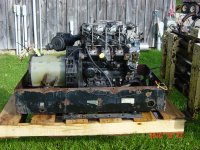
I'm looking forward to resuming work on my 12.5 KW Isuzu project.

DSC04384.JPG
 
Last edited:
   / Diesel differences #53  
It is no secret Yanmar supplies smaller displacement engines to Isuzu, they have been doing so since 2002.
 
Last edited:
   / Diesel differences #54  
So.....I looked up 12KW Isuzu generators. That is a direct-injection engine, like mine.

Your John Deere 2025R is not direct-injection, so there you have one difference between two Yanmar built diesel engines.
 
   / Diesel differences #55  
There's also a big compression difference:

The Isuzu generator engine is 19:1 compression, which seems normal.

The JD 2025R engine is 23.5:1, which seems crazy high to me.

I don't have any experience with high compression indirect injection engines to compare, but that is the type of diesel engine you seem to be unhappy with.
 
   / Diesel differences #56  
There's also a big compression difference:

The Isuzu generator engine is 19:1 compression, which seems normal.

The JD 2025R engine is 23.5:1, which seems crazy high to me.

Indirect injection diesels normally have a higher compression ratio that direct injection. Also as soon as you install a turbocharger the compression goes down some more.
 
   / Diesel differences #57  
Most interesting application I've seen for a small Isuzu diesel is for this cable car in rural Ecuador. It's under the canopy to the right of this photo. Noisy!

Photo source: this guy's travel diary. We did a similar trip by car in 2005 down the back side of the Andes to Puerto Misahualli, the end of the road where travel by dugout on the upper Amazon tributaries begins. Yes we went across here on the cable car! I can't imagine how the Incas got around in this terrain but they had intercity cobblestone routes everywhere like the Roman Empire.

2001-04-11.jpg


More pix: Google 'Ecuador cable car' and Rio Pastaza, also Banos.
 
   / Diesel differences #59  
My only experiences have been with one in a 2010 Ford dually. It ran well and never an issue with it.

The new LS is much better than the JD855 (Yanmar) I do not have a block heater on the LS. I wanted one and the dealer told me "save your money, you do not need one with these engines". The JD855 would not start without the heater plugged in and even then it belched smoked and ran rough until it warmed up.

Coldest I have had the LS operating is 10* and it was effortless. I idle it about 10 minutes to warm up the oil, but it runs smooth from the get go.

I have no idea what type of diesel it is but it works well.
 
   / Diesel differences #60  
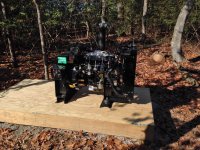
Here's my 21kW Isuzu! Had it for 6 years, never needed to use it yet (knock on wood). Just gave her a maintenance run yesterday.

IMG_4046.jpg
 

Tractor & Equipment Auctions

KJ 20' Metal Farm Driveway Gate (A53314)
KJ 20' Metal Farm...
2022 FORD F-250 STV CREW CAB TRUCK (A59823)
2022 FORD F-250...
excavator trenching bucket- one bucket per lot (A56438)
excavator...
Preliminary Listing / Full Catalog Coming Soon! (A53317)
Preliminary...
2014 KENWORTH T800 HYDRO EXC VACUUM TRUCK (A59823)
2014 KENWORTH T800...
2001 CATERPILLAR CB-634C SMOOTH DBL DRUM ROLLER (A60429)
2001 CATERPILLAR...
 
Top