I'm new to three point hitches as you can tell. I've got 5 hours on my new Kubota BX24 and the instruction I received from the dealer was just OK. I've seen descriptions of drawbars and stablizers for the tree point hitch system but I don't know what they should be used for or if I even need them. I use a 42" woods rotary cutter, balast box and eventually a rear end snowblower (not sure ont he size yet....but will take some advice here too). Thanks.
You are using an out of date browser. It may not display this or other websites correctly.
You should upgrade or use an alternative browser.
You should upgrade or use an alternative browser.
drawbar 101
- Thread starter dghecas
- Start date
- Views: 26702
More options
Who Replied?
/ drawbar 101
#1

firemanpat2910
Platinum Member
Drawbars on the 3 point hitch, theres alot of opinions and here is mine. If you have a fixed draw bar on the tractor always use it, not the 3pt. If you use the 3pt draw bar there are some safety concerns. If you try and pull something it turns out to be more than your tractor can pull with a 3pt drawbar positioned above the rear axle you might flip over. If you have a trailer on a 3pt draw bar there is nothing keeping the bars from raising unexpectedly
there are several safety videos on this site that show some backflips and some threads that discuss chaining the drawbar to keep it down
there are several safety videos on this site that show some backflips and some threads that discuss chaining the drawbar to keep it down

jbrumberg
Elite Member
- Joined
- Jan 22, 2006
- Messages
- 4,903
- Location
- Cummington, MA
- Tractor
- New Holland TC29DA, John Deere D130
dghecas:
Firemanpat2910 is correct in his advise. If you need to pull something heavy and/or resistant towards movement always use the drawbar. I would suggest that you look at all your 3PH attachments as it relates to the drawbar. The drawbar can get in the way of PTO's, etc. I remove my drawbar when I am using attachments. Jay
Firemanpat2910 is correct in his advise. If you need to pull something heavy and/or resistant towards movement always use the drawbar. I would suggest that you look at all your 3PH attachments as it relates to the drawbar. The drawbar can get in the way of PTO's, etc. I remove my drawbar when I am using attachments. Jay
To answer the question on what a draw bar is used for...
The 3 point draw bar is the simple bar with holes that connect the lower lift arms. Most of the time you want to prevent it from spinning, so a stabilizer is needed. Now you can mount a ball hitch in one of the center holes of the draw bar and use it to move trailers around the yard. Once the bar is stable, it make hitching a breeze, just back up to the hitch and raise the 3pt, put in gear and go. That is all I use the drawbar for. When towing the sprayer or heavy trailers I always use the fixed drawbar connected under the tractor as Pat and Jay mentioned. There is no down force on your 3pt hitch, so if negative tonge weight is possible, never use 3pt.
For towing stuck tractors or trucks, be sure to read that safety book and never connect a cable/chain to the top link, tractor tip-over everytime.
The 3 point draw bar is the simple bar with holes that connect the lower lift arms. Most of the time you want to prevent it from spinning, so a stabilizer is needed. Now you can mount a ball hitch in one of the center holes of the draw bar and use it to move trailers around the yard. Once the bar is stable, it make hitching a breeze, just back up to the hitch and raise the 3pt, put in gear and go. That is all I use the drawbar for. When towing the sprayer or heavy trailers I always use the fixed drawbar connected under the tractor as Pat and Jay mentioned. There is no down force on your 3pt hitch, so if negative tonge weight is possible, never use 3pt.
For towing stuck tractors or trucks, be sure to read that safety book and never connect a cable/chain to the top link, tractor tip-over everytime.
MikeD74T
Veteran Member
dghecas You've just entered probably one of the most opinionated subjects on TBN, not referring to or disputing any of the above posters. I'll just try to answer your question and then give my opinion.
3pt hitch parts defined (sort of)
You probably know what the lift arms are - heavy bars with ball socket attachments at each end for connecting to the tractor & implements. extend rearwards from the tractor. These are also attached to the 3pt lift mechanism by rigid or adjustable links.
Drawbar- 2 definitions;
the first is a rigid solid bar, straight or offset vertically, attached under the
differential & thru a bracket under the pto also extending rearward from the tractor but not as far as the lift arms. Sometimes called a swinging drawbar.
the second is a flat bar about 2 1/2 " x 1' thick x 26"+/- long with pin ends & several 7/8" holes that attaches between the lift arm ends.
Stays - again multiple types
Lateral stays attach to the pin ends of a drawbar at the lift arm and to pivot points under the rear axle just inboard of the brake backing plates. May be telescoping tube stock, rigid flat bars, turnbuckles, or chains in tension. All limit lateral movement of the implement but allow vertical movement. They form a triangle(s) with the rear axle housing & the drawbar pin ends.
Vertical stays also attach to the drawbar pins but the top attaches to the toplink pin at the tractor and limit any verticle or horizontal motion as they form a rigid triangle. These appear to be uncommon & unknown to many TBN members but common on older tractors & older TBNers. Must leave the 3pt lift levers in the down position when using these stays.
Drawbar locks prevent rotation of the second type of drawbar, by providing mechanical interference between the drawbar and the lift arms, when applying a load unequally to the top or bottom side ( like a hitch ball mounted on top of the drawbar). Some antirotation devices also connect a vertical member via toplink to provide a member parallel to the lift arms.
I tried to find a picture of an assembly but couldn't. Hopefully the definitions will help if you search parts sources and view the parts.
Now for my opinion. Common sense should prevail when hooking a tractor to any load but common sense comes from knowledge, lack of which can be fatal. The rigid "swinging" drawbar is highly recommended for pulling loads because of it's rigidity and placement below the axle. Pulling loads tend to pulll the front wheels downward and rear wheel slippage should occur before a wheelie does. This is not absolute because the distance from the axle back to the point of attachment is short and with sufficient traction a rearward overturn can occur. The higher the rear tractor wheels the more likely this situation.
The other type of drawbar is often shunned because the 3pt lift mechanism has no downpressure. It will lift a lot but does not resist lifting loads. For example if you were pulling a single axle trailer that had negative tongue weight the 3pt would rise up and the load could push the tractor sideways. Also if a wheelie should occur the tongue hitting the ground would not stop the upward rotation of the front of the tractor. This is where the vertical stays come in to play as they resist the upward motion of the lift arms. This application is more subject to excessive tongue load wheelies than a swinging drawbar because of the distance to the rear axle pivot point.
With each application any pull should be aligned below the tractor rear axle, NEVER above. On this site there are many drawbar adaptations that have potential negative safety flaws. IMO One of the most common is used to move gooseneck trailers, because in the travel position the ball coupling may be at or near the axle height. Take the time to gain an understanding of the forces in play & you'll stay safe, just understand that no method is absolutely safe. MikeD74T
3pt hitch parts defined (sort of)
You probably know what the lift arms are - heavy bars with ball socket attachments at each end for connecting to the tractor & implements. extend rearwards from the tractor. These are also attached to the 3pt lift mechanism by rigid or adjustable links.
Drawbar- 2 definitions;
the first is a rigid solid bar, straight or offset vertically, attached under the
differential & thru a bracket under the pto also extending rearward from the tractor but not as far as the lift arms. Sometimes called a swinging drawbar.
the second is a flat bar about 2 1/2 " x 1' thick x 26"+/- long with pin ends & several 7/8" holes that attaches between the lift arm ends.
Stays - again multiple types
Lateral stays attach to the pin ends of a drawbar at the lift arm and to pivot points under the rear axle just inboard of the brake backing plates. May be telescoping tube stock, rigid flat bars, turnbuckles, or chains in tension. All limit lateral movement of the implement but allow vertical movement. They form a triangle(s) with the rear axle housing & the drawbar pin ends.
Vertical stays also attach to the drawbar pins but the top attaches to the toplink pin at the tractor and limit any verticle or horizontal motion as they form a rigid triangle. These appear to be uncommon & unknown to many TBN members but common on older tractors & older TBNers. Must leave the 3pt lift levers in the down position when using these stays.
Drawbar locks prevent rotation of the second type of drawbar, by providing mechanical interference between the drawbar and the lift arms, when applying a load unequally to the top or bottom side ( like a hitch ball mounted on top of the drawbar). Some antirotation devices also connect a vertical member via toplink to provide a member parallel to the lift arms.
I tried to find a picture of an assembly but couldn't. Hopefully the definitions will help if you search parts sources and view the parts.
Now for my opinion. Common sense should prevail when hooking a tractor to any load but common sense comes from knowledge, lack of which can be fatal. The rigid "swinging" drawbar is highly recommended for pulling loads because of it's rigidity and placement below the axle. Pulling loads tend to pulll the front wheels downward and rear wheel slippage should occur before a wheelie does. This is not absolute because the distance from the axle back to the point of attachment is short and with sufficient traction a rearward overturn can occur. The higher the rear tractor wheels the more likely this situation.
The other type of drawbar is often shunned because the 3pt lift mechanism has no downpressure. It will lift a lot but does not resist lifting loads. For example if you were pulling a single axle trailer that had negative tongue weight the 3pt would rise up and the load could push the tractor sideways. Also if a wheelie should occur the tongue hitting the ground would not stop the upward rotation of the front of the tractor. This is where the vertical stays come in to play as they resist the upward motion of the lift arms. This application is more subject to excessive tongue load wheelies than a swinging drawbar because of the distance to the rear axle pivot point.
With each application any pull should be aligned below the tractor rear axle, NEVER above. On this site there are many drawbar adaptations that have potential negative safety flaws. IMO One of the most common is used to move gooseneck trailers, because in the travel position the ball coupling may be at or near the axle height. Take the time to gain an understanding of the forces in play & you'll stay safe, just understand that no method is absolutely safe. MikeD74T
Thanks for a detailed and helpful description. I will search for some pictures to help. I'm most interested in towing a 6'x10' trailer around the property and occasionally a small lawn/garden trailer. Would the swinging drawbar or the straight drawbar be more appropriate on my subcompact tractor? I do understand that I would need to remove it to use the three point hitch with other implements.

RoyJackson
Rest in Peace
- Joined
- Nov 17, 2001
- Messages
- 24,646
- Location
- Bethel, Vermont
- Tractor
- John Deere 4052R Cab,, Deere 855D UTV, Z920A Zero Turn Mower and assorted implements
dghecas said:Thanks for a detailed and helpful description. I will search for some pictures to help. I'm most interested in towing a 6'x10' trailer around the property and occasionally a small lawn/garden trailer. Would the swinging drawbar or the straight drawbar be more appropriate on my subcompact tractor? I do understand that I would need to remove it to use the three point hitch with other implements.
The straight draw bar with a ball hitch or pintle hitch will do fine. Just watch the tongue weight, especially using the bigger trailer.
I do suggest you use a spring or bungee to keep the lower links from flopping around too much. There may even be loops welded to the lower links for this.
And, watch your speed going down hill if you have a load on that trailer. tractor brakes aren't so good.
Also, there's no reason to remove the tractor draw bar when using the 3PH. If you extend the draw bar, you may have to reposition it, that's all
MikeD74T
Veteran Member
dghecas Since you have a 3pt drawbar capacity of 670 lbs at 24" behind the axle you can use either provided you maintain adequate tongue weight. If there's any possibility of negative tongue weight (ie loading/unloading something heavy at the rear of the trailer) use the swinging drawbar. MikeD74T

Dougster
Veteran Member
I will boldly go one step farther than the others with my 2 cents and recommend that you forget entirely about the old-fashioned style straight drawbar (i.e., 3-point hitch drawbar) and stick with the swinging drawbar assuming you have one. If you do wish or need to move trailers with the 3-point hitch, I would recommend you do so with a purpose-built 3-point implement. They are not expensive.dghecas said:I'm most interested in towing a 6'x10' trailer around the property and occasionally a small lawn/garden trailer. Would the swinging drawbar or the straight drawbar be more appropriate on my subcompact tractor?

Dougster
MikeD74T
Veteran Member
Dougster said:I will boldly go one step farther than the others with my 2 cents and recommend that you forget entirely about the old-fashioned style straight drawbar (i.e., 3-point hitch drawbar) and stick with the swinging drawbar assuming you have one. If you do wish or need to move trailers with the 3-point hitch, I would recommend you do so with a purpose-built 3-point implement. They are not expensive.
Dougster, Please go one step further and provide an example of the purpose built implement & explain why it's better. dghecas is thirsting for knowledge and understanding as well as opinion. MikeD74T
jbrumberg
Elite Member
- Joined
- Jan 22, 2006
- Messages
- 4,903
- Location
- Cummington, MA
- Tractor
- New Holland TC29DA, John Deere D130
I think Dougster is talking about a lower link crossbar. They are cheap, commonly available, and come in various lengths. They have predrilled holes that are compatible with your common garden cart hitch. They also have stabilizer bars available, but they are a PITA to deal with. Jay
gemini5362
Veteran Member
There are some very good explanations here. I have always heard what every one is calling a swinging drawbar as a belly bar. Not to confuse the issue but the swinging drawbar is a specialty item because you can remove a pin and swing the drawbar to one side. Not all drawbars have this capability.
The problem with using the swinging drawbar with implements is usually when you use it with something that works off of the PTO as you raise or lower the PTO the shaft can hit the drawbar or if you have a trailer ball on it then you can hit that ball.
To maybe add a bit to the explanation. If you think of your 3 point hitch as a lever and your wheels/axle/differential as the fulcrum. You do not have to put a weight equal to the front weight of the tractor on the end of the lifting arms (lever) to be able to lift the front of the tractor off of the ground. The higher you have the 3 point hitch off of the ground the more room you have to lift the other end of the tractor. The wheels make a really nice pivot point to do the lifting with. If you were to get the front end up high enough for it to continue rotating on its own ( flip over backwards) The lifting arms do not have anything stopping them from rotating up and saving you from the tractor flipping over backwards. The swinging drawbar mounts underneath the axle but more importantly it mounts in front of the axle. You could still put enough weight on that bar to flip the tractor over but since you do not have the leverl fulcrum situation it would require a lot more weight. Before you can generate enough force to do that with the tires they probably will lose traction and stop the process. Anyone that has put something on the 3 point lift drawbar and gotten it stuck or tried to pull something too heavy etc will attest to how fast and how easy it is to get that front end to come off of the ground.
The bottom line is that the advice given in this thread is very very good. Use the swinging drawbar for hooking up items to pull. If you do want to use the 3ph with a drawbar then only use it for light items that are lightly loaded and pull easily.
The problem with using the swinging drawbar with implements is usually when you use it with something that works off of the PTO as you raise or lower the PTO the shaft can hit the drawbar or if you have a trailer ball on it then you can hit that ball.
To maybe add a bit to the explanation. If you think of your 3 point hitch as a lever and your wheels/axle/differential as the fulcrum. You do not have to put a weight equal to the front weight of the tractor on the end of the lifting arms (lever) to be able to lift the front of the tractor off of the ground. The higher you have the 3 point hitch off of the ground the more room you have to lift the other end of the tractor. The wheels make a really nice pivot point to do the lifting with. If you were to get the front end up high enough for it to continue rotating on its own ( flip over backwards) The lifting arms do not have anything stopping them from rotating up and saving you from the tractor flipping over backwards. The swinging drawbar mounts underneath the axle but more importantly it mounts in front of the axle. You could still put enough weight on that bar to flip the tractor over but since you do not have the leverl fulcrum situation it would require a lot more weight. Before you can generate enough force to do that with the tires they probably will lose traction and stop the process. Anyone that has put something on the 3 point lift drawbar and gotten it stuck or tried to pull something too heavy etc will attest to how fast and how easy it is to get that front end to come off of the ground.
The bottom line is that the advice given in this thread is very very good. Use the swinging drawbar for hooking up items to pull. If you do want to use the 3ph with a drawbar then only use it for light items that are lightly loaded and pull easily.
Dougster
Veteran Member
There are dozens of them out there to choose from similar to this:MikeD74T said:Dougster, Please go one step further and provide an example of the purpose built implement & explain why it's better. dghecas is thirsting for knowledge and understanding as well as opinion. MikeD74T

Flexpoint Adapter Turns Your 3-Point Hitch into Versatile 2in. Receiver, Model# FPHS-1 | 3-Point Hitch Accessories | Northern Tool + Equipment
I simply believe they are stronger, safer, easier to adjust and control... and far better suited for use with a relatively heavy dump or equipment trailer. That being said, I still prefer to use the swinging drawbar (or whatever others choose to call it) for moving large, heavy trailers.
Dougster
jbrumberg
Elite Member
- Joined
- Jan 22, 2006
- Messages
- 4,903
- Location
- Cummington, MA
- Tractor
- New Holland TC29DA, John Deere D130
Dougster:
Thanks for the picture. I had a different "visual". Jay
Thanks for the picture
. I had a different "visual". Jay
OhioGuy
Platinum Member
- Joined
- Jul 23, 2003
- Messages
- 595
- Location
- Northeast Ohio
- Tractor
- Ford 1220, Case 245, Cub SZ60, Cub 2284
Egon said:I made a slightly different three point drawbar for my little B7100. Picture attached.
Wow, now that's a drawbar, nice!
Curt

LarryD
Veteran Member
jbrumberg
Elite Member
- Joined
- Jan 22, 2006
- Messages
- 4,903
- Location
- Cummington, MA
- Tractor
- New Holland TC29DA, John Deere D130
LarryD:
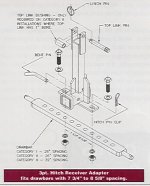
Yout attachment is close to my "visual". I purchased a very cheap and weak stabilizing system with my lower link cross bar. I could literally bend the side supports in my bare hands, and I am definately no gorilla ! Jay
Yout attachment is close to my "visual". I purchased a very cheap and weak stabilizing system with my lower link cross bar
. I could literally bend the side supports in my bare hands, and I am definately no gorilla ! Jay


