Electrolytic Rust Removal

   / Electrolytic Rust Removal #1  

Iplayfarmer

Super Member
Joined
Jul 11, 2005
Messages
5,326
Location
Idaho
Tractor
Massey Ferguson 1215, Case 801B
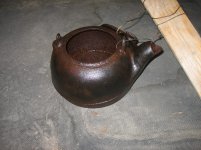
Due in large part to comments and suggestions here, I have decided to try my hand at electrolytic rust removal. I have a pair of cast iron kettles that I bought the other day at a yard sale. I got them to match my antique wood fired cook stove that I am planning to put in my little shop after it is built. The kettles have a lot of rust in them. I buffed the outside a bit, but I just can't get to the inside with any that will efficiently take the rust and scale off. The inside is what matters most because I'd like to be comfortable drinking the water that comes out of these kettles. So, I have decided to try my hand at removing the rust by electrolysis.

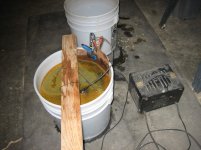
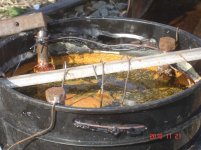
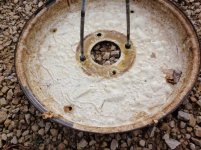
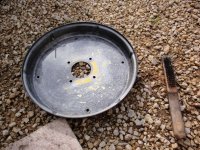
I've posted a before picture of the first kettle. I wish I would have taken a picture before I started buffing the rust off the outside. It was pretty bad. I have the kettle suspended in about 4 gallons of water and 1/2 cup of Arm and Hammer washing soda. I have a 1/16" plate of steel bent to fit the countour of the bucket, and the positive terminal of a 6 amp 12 volt charger is connected to this plate. The negative terminal is connected directly to the kettle. I left this concoction to stew for about 3 hours and checked it. The water was very murky, but the pot hadn't changed much. I changed the water and started again. The second picture is the second batch of water after about an hour. I'm going to let it stew overnight and I'll check it in the morning.
 

Attachments

  • IMG_0469.jpg
    IMG_0469.jpg
    688.7 KB · Views: 704
  • IMG_0470.jpg
    IMG_0470.jpg
    467.4 KB · Views: 897
   / Electrolytic Rust Removal #2  
Please keep posting your progress. I have a lot stuff to de-rust.
Good luck & have Fun.
 
   / Electrolytic Rust Removal #3  
I've had good luck with the couple of times I tried it. I used a 10 amp charger, and water was bubbling within a couple of minutes. I found best results were attained after 24 hrs.

I did some horseshoes the first time, then a David Bradley planter frame in a 35 gal. plastic trash can. It even loosened most of what was left of the old paint. Best to hose off, and clean right away. A Scotch Brite pad may be the answer to cleaning the inside.

In the link I found on it, it said you could clean items internally, by using an internal anode. Just have to watch about it contacting the sides.

This is what heppens if it does... oops...

DSC01445.jpg
 
   / Electrolytic Rust Removal #4  
I have seen over on hotrodding forums where molassass can be used for rust removal. Maybe try that for the other kettle?
 
   / Electrolytic Rust Removal #5  
I would suggest for better results, to have a clean anode, nice shiny steel and suspend the anode in the center of the kettle with the anode sticking up out of the solution where you will attach the + terminal. Since you are mostly concerned about the inside of the kettle, you will have better results with the anode inside of the kettle.

James K0UA
 
   / Electrolytic Rust Removal #6  
Just don't use stainless steel... I thought I had the perfect way to utilize some submersdible pump jackets, but it is a no-no. Produces a toxic gas, of which the name escapes me at the moment...
 
   / Electrolytic Rust Removal #7  
quit dumping your water.. it's a waste.

and as the other poster said.

if the rust is on the inside.. put the anode on the inside.

won't do any good on the outside!

it's line of site!
 
   / Electrolytic Rust Removal
  • Thread Starter
#8  
I looked again this morning, and there is some progress on the outside of the kettle, but very little on the inside. I changed the water again (that was before I read the words of wisdom from Soundguy), and rigged a system to have an anode on the inside of the kettle. I'll leave it for the day while I'm at work and see how it looks.

Does temperature have anything to do with the rate of the process? It got pretty cold overnight.
 
   / Electrolytic Rust Removal #9  
Buddy of mine has a large tank that he does this in.... It takes probably a week to remove the level of scale you are showing.
 
   / Electrolytic Rust Removal #10  
Seems one of the threads I read on it, warm temps did seem to work better. By the time I got around to doing mine, it was in the low 70's, so don't really know.

Another no-no... Do not do it inside, as the process produces hydrogen gas. Just think..., "Remember the Hindenberg"
 
   / Electrolytic Rust Removal #11  
P9170526.jpgP9050207.JPGP9110238.jpgP9110240.JPGP9110241.JPGI have done some of this too, and have found that "more is better". Higher current and voltage makes the process work faster and more aggressively. Use caution if you have anything higher than about 40 volts DC though, as you can be electrocuted by as little as 45 volts or so.
 
   / Electrolytic Rust Removal #12  
Iplayfarmer said:
Does temperature have anything to do with the rate of the process? It got pretty cold overnight.

Yep. Chemical reactions are faster at higher temps.
 
   / Electrolytic Rust Removal #13  
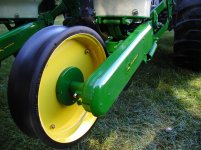
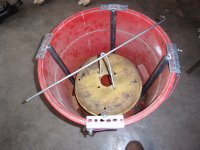
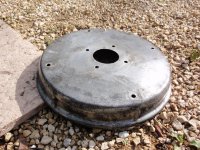
It's an amazing process. No need to use clean water as stated. Process is "line of sight" so must use multiple electrodes on all sides including the inside. Item cannot touch the container, electrodes, or sediment. I used a battery charger (2/10/50 amp) and used the middle setting. Let it sit overnight, remove, brush with a stiff bristle brush, and repeat if necessary. You can tell it is working by the thousands of tiny bubbles rising to the surface. And sodium carbonate is what to use, not bicarbonate.
 

Attachments

  • phone pix of planter disc 013.jpg
    phone pix of planter disc 013.jpg
    429.9 KB · Views: 431
  • phone pix of planter disc 016.jpg
    phone pix of planter disc 016.jpg
    497.2 KB · Views: 777
   / Electrolytic Rust Removal #14  
I dont know what is in Arm and Hammer washing soap, but the mineral you want to use is borax, not sodium carbonate or bicarbonate of soda. Twenty Mule Team Borax washing soap would my suggested alternative to the Arm and Hammer, unless the Arm and Hammer also contains borax.

Just to note, I have not tried sodium carbonate so I cant say if it will or will not work. I suspect it might as there are a lot of minerals that will increase conductivity to water and will work to some degree, some better than others and some not so good. My experiences are that I have had good luck with the borax cleaning the inside of a 1000 gal hydroseeding tank using a welder, (DC),as a power source. Dont remember what setting the welder was on but I started low and dont remember raiseing the setting.
 
   / Electrolytic Rust Removal #15  
All info I have read and researched from multiple places calls for sodium carbonate. I can't speak for borax, but have used the sodium carbonate and know it works. I bought it online in a 5 lb. quantity. It's used in some cooking techniques ( pretzels, I think), also available from what I have read at swimming pool chemical stores, and in the form of "washing powder" from Arm and hammer, but I never found that product locally. All sources emphasize not to use standard baking soda (sodium bicarbonate). I googled it and found it easily and it is cheap! I agree that other chemical solutions that are conductive may also work, but I can attest to the effectiveness of Na carbonate. There's lots of info on this technique if you google "electrolytic rust removal."

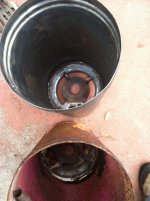
It is an amazing process and is so simple . Rig a plastic drum or trash can like the one in a previous post. I used rebar connected with copper wire as my sacrificial electrodes. The rust and old paint can be just wiped off with almost no effort. The before/after pix I posted of those old hoppers, although soaked overnight for 2 days, took me less than 5 minutes of easy brushing get looking like that. And it doesn't harm chrome (unless undermined by rust). Best of all, it costs only pennies, and produces no chemical waste, just rusty water.
 
   / Electrolytic Rust Removal
  • Thread Starter
#16  
I tried to upload some pictures from yesterday morning, but I'm having issues. The sacrificial piece was covered in a loose scaly rust, so I'm getting rust from somewhere. I think the pot is just so corroded that it's going to take some time. I tried putting a bolt down into the middle of the pot to be my anode. After all day at work, there was very little change. I think it may have something to do with the smaller surface area of the bolt vs. the larger plate. I went back to the plate for now and I'll leave it for another day or so and see what kind of change I see on the outside of the kettle.

I may see if I can rig a piece of tube or pipe to be my internal electrode. That would give me more surface area.
 
   / Electrolytic Rust Removal #17  
yes.. sodium carbonate is the prefered electrolyte.

( bicarb can pit the metal )

( lye is too dangerous to use )


as was stated.. more is better.

12v is better than 6.

10a seems to be a great start. I have used 20


distance from ANODES to work piece matters as well. closer = more current flow.
 
   / Electrolytic Rust Removal #18  
I agree you need way more surface area on the inside. You want lots of electrodes, spaced evenly, on all sides. And let it work overnight, then remove, brush and rinse the item, and use a long handle wire brush (like a grill cleaning brush) to quickly clean off the electrodes somewhat just to refresh them. Then repeat. My pictures of the seed hoppers took two overnight soakings to get that clean. Sounds like you need to improve your tub and make sure all the connections are good, and that there is more surface area of electrodes, and that they are more closely spaced. And perhaps some battery chargers may work better than others. I know some don't put out continuous current if they have internal "brains" that may be shutting off current when they sense weird flow. Mine is just a simple Schumaker manual one without an auto shut off feature. The key is the bubbles. If it's not bubbling, it's not working. (but bubbles are tiny, but profuse)
 
   / Electrolytic Rust Removal #19  
yup.. 'dumb' chargers are the ones to use.
 
   / Electrolytic Rust Removal #20  
Or a DC welder, if you are impatient like I am. When the bubbling is fierce and the solution is getting warm in the tank, you know you are doing a good job.
 

Tractor & Equipment Auctions

1969 VOLKSWAGEN BUG (A59905)
1969 VOLKSWAGEN...
2010 Ford Fusion Sedan (A59231)
2010 Ford Fusion...
2005 INTERNATIONAL 4200 24FT BOX TRUCK (A59905)
2005 INTERNATIONAL...
JOHN DEERE 7210 TRACTOR (A60430)
JOHN DEERE 7210...
2022 JOHN DEERE 744L WHEEL LOADER (A60429)
2022 JOHN DEERE...
2017 KOMATSU HM400-5 OFF ROAD WATER TRUCK (A60429)
2017 KOMATSU...
 
Top