Considering all these bad side effects, and already having full-time all-wheel drive, how much of an advantage are filled tires!??!
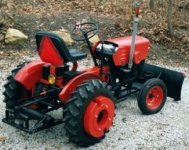
However, the judicious use of weigh can bring startling results. My 1976 14hp Power King 2WD tractor came from the factory weighing 850# with 8.00x16 AG rear tires. It often spun the tires when 48" mowing on lawn slopes or trying to push snow with the 48" dozer blade.
Completely filling the tires would have added 250#, but the tractor would ride like on concrete wheels. No thanks!
Instead I added: 2 steel wheel weighs of 135# each, a steel chassis weight below the frame of 130#, a steel 3 point hitch weigh of 70#, and a 50# steel scale weigh over the axle near the 1000AH car battery! The tractor now weighs 1400#, a 65% increase, with most of it centered (H&V) at the rear axle!!!
After studding the AGs with #6 hex head crown screws and dropping tire pressure to 7#, the Power King is **** near unstoppable for a 2WD! Wet grass, mud, ice, snow, slippery logs, and steep slopes (forward 25 degrees on dry loose clay)can be laughed at! Plowing into a snow bank at the end of our hard-packed snow covered parking lot in high gear, the Power King would actually slip it's clutch rather than spin a tire! Comfortable ride with a big footprint that is gentle on dry clay grass is another plus.
If my new PT-425 runs out of traction, or wants to lift it's tail, I will carefully consider all my other options before filling the tires.
PS: Based upon the new Power Trac Product Catalogue, "PT-425" and "Power Trac" are correct - not "PT425" and "Power-Trac". But then again, "catalogue" is used for the more common word "catalog"! Strange, but true!!