Flaring tubing

   / Flaring tubing #1  

crazyal

Super Member
Joined
Dec 12, 2003
Messages
7,749
Location
Northern Vermont
Tractor
Kubota, Case, Deere
I had a chance to get a Mastercool hydraulic flaring tool for a lot less than the price of a new one ($100). Since I needed and didn't have the tool to make the bubble type ends on brake lines I bought it. It comes with the dies to make brake lines and some gas lines.

While looking around the internet I see they also make a set of dies for it that will do 37 degree flares. I was wondering if anyone used one of these for hydraulic lines and if it's worth buying the dies to do them.

In the past I have tried to make a 45 degree double flare with the simpler kind of flaring tool on 3/8 brake line with little luck. The tool was the kind where you clamp it and then use a screw thing to flare it. It was nearly impossible to get the kind of force needed to do the flare. I'm guessing that hydraulic tubing is harder to flare than brake line. I would hate to spend $100 for a set of dies that can't do hydraulic lines.

71475.gif
 
   / Flaring tubing #2  
I have the same set and have made dozens of SAE flares, installed them on JIC and never had a problem with leaks. The industry recognizes the two flares as being interchangeable.
 
   / Flaring tubing
  • Thread Starter
#3  
I found the dies last night for $51 plus shipping so I bought them hoping they would work. Now I just need to add a couple of remotes and plumb the lines.
 
   / Flaring tubing #4  
I have the same set and have made dozens of SAE flares, installed them on JIC and never had a problem with leaks. The industry recognizes the two flares as being interchangeable.

Are you saying that 37 deg flares are interchangeable with 45 deg flares.

DRL
 
   / Flaring tubing #5  
I do not believe the two are interchangeable.

There are different sets of dies for 45 degrees and 37 degrees.

Jic Fitting

I believe these are the standards.

Quote:

Ultimately four flared joint standards will be covered by Flaretite's product range:

- JIC 37 degree; (Joint Industial Conference) SAE J514.

- JIS 30 degree; Japanese Industrial Standard.

- SAE 45 degree; Automotive SAE J512.

- SAE 45 degree; Refrigeration SEA J513.

Another quote:

IC fittings, or SAE J514, or MIL-F-18866, are a type of flare fitting having 37-degree flare seating surfaces and are widely used in hydraulic applications. The SAE J514 standard replaces the MS16142 mil-spec standard; some tooling is still listed under the old mil-spec name. JIC fittings are similar in size and threading to AN fittings.

45-degree flare SAE fittings are similar in thread, but not angle and are not interchangeable
 
Last edited:
   / Flaring tubing #6  
I have the same set and have made dozens of SAE flares, installed them on JIC and never had a problem with leaks. The industry recognizes the two flares as being interchangeable.

While not completely interchangeable, there are some commonalities that allow you to interchange SOME flare fittings.

In the sizes -02, -03, -05, -08 and -10 only, the threads of SAE 37° flare (JIC) and SAE 45° flare are the same. However, the sealing surface angles are not.

Some female swivel fittings in these sizes are actually dual seat, with two sealing surfaces (one at 37° and one at 45°), allowing the female to mate with either a 37° male OR a 45° male.

If you're mating a male flare fitting with flared tubing, it is always preferable to have the angles match. However, if your tubing is not hardened steel (such as stainless) it may conform to the new angle just enough to seal in some applications where the pressure is not excessive.

I apologize for the vagueness of that last paragraph, but I don't have any hard data to indicate where the line should be drawn here. People who have worked with specific materials in specific applications probably know how much they can bend the rules on those specific situations. Just be aware that not ALL flares are interchangeable in all sizes or all applications, so you may run into problems if you assume this works in ALL applications. It more than likely does not.
 
   / Flaring tubing #8  
I'm not an expert but I assumed that AN and JIC flares could be interchanged. SAE is both 37 and 45 degrees. Here's a link to a Rigid 37 SAE flare tool.

37ー SAE Flaring Tool for 3/16 - 3/4" Pipe (377)

They have two different angles for the flare and seat. You might do it with force, but it is not a good idea.

They make a flare tool kit for 45 degrees also.

http://www.toolbarn.com/ridgid-83037.html?refpage=ridgid-41162&type=related_view

They are not interchangeable.
 
   / Flaring tubing
  • Thread Starter
#9  
Going back to my original post, Mastercool makes several sets of dies for their hydraulic flaring tool. The universal kit I got contains only 45° dies. They do sell a set of 37° dies for their tool (which I ordered). I'm a little worried that the 37° set they sell is for doing thinner pipe typically used in AN applications for fuel lines.

I've been told that for 3/8" hydraulic tubing for a tractor should be .065" wall, maybe .049 would would work but it's cutting it close depending on what my Kubota's pressure is set at. I've done some flares on 1/4" brake line with a simple screw type flare tool and found that the force needed was extreme. To do them I had to mount the clamp part in a vice and put an extension on the flaring part to apply enough force. I expect the hydraulic flare tool will be able to achieve greater force, but will it be enough to handle the thicker wall tubing?
 
   / Flaring tubing #10  
I've been told that for 3/8" hydraulic tubing for a tractor should be .065" wall, maybe .049 would would work but it's cutting it close depending on what my Kubota's pressure is set at. I've done some flares on 1/4" brake line with a simple screw type flare tool and found that the force needed was extreme. To do them I had to mount the clamp part in a vice and put an extension on the flaring part to apply enough force. I expect the hydraulic flare tool will be able to achieve greater force, but will it be enough to handle the thicker wall tubing?

I choose to stay with the .065". It is a little harder to work with but when you start putting bends in tubing the outside of the turn gets "drawn" and the wall thickness reduces. I've never cut one in half to see how much, but it does weaken it. The added safety is worth it in my mind.
As far as making the flare on the thicker stuff, lubrication seems to help alot. I use anti-sieze compound. Just a light coating on the anvil of the flare tool and on the threads of the screw. (I have the cheap screw type, I've never used a nice hydraulic one like in your picture!) It stays where you put it and seems to do a good job. I'm sure there is something better and more appropriate out there but this has worked for me so I've never really looked.
 
   / Flaring tubing #11  
Reading the descriptions at Mastercool Inc., Flaring Tools it appears that all of the Mastercool flaring tools use the same yoke with different sets of attachments for 45 or 37 degree flares.

The flier says "handheld hydraulic pump operates easily with all steal (sic) and light stainless tubing." If you need more specific information about the wall thickness, etc. you can flare with this, I suggest contacting Mastercool. Technical support is available at 888-825-6989.
 
   / Flaring tubing #12  
Reading the descriptions at Mastercool Inc., Flaring Tools it appears that all of the Mastercool flaring tools use the same yoke with different sets of attachments for 45 or 37 degree flares.

The flier says "handheld hydraulic pump operates easily with all steal (sic) and light stainless tubing." If you need more specific information about the wall thickness, etc. you can flare with this, I suggest contacting Mastercool. Technical support is available at 888-825-6989.

Ken,

What reference do you have for the same flare using both 37 degree and 45 degree on the same flare? Otherwise, is the flare capable of seating both 37 and 45 degree fittings? I have never seen this.

My opinion is that all JIC fittings are 37 degrees, and a 45 degree fitting will not fit correctly.

SAE and AN/JIC fittings are completely incompatible due to the different flare angle. Further, AN fittings (or those complying with subsequent standards) and JIC fittings are not interchangeable for design-controlled applications due to differing quality standards.


Just some additional data.

http://weislake.com/sig/mucker/an-vs-jic.pdf
 
Last edited:
   / Flaring tubing
  • Thread Starter
#13  
The dies I'm talking about are 37°. I've included a picture. I don't think anyone is talking about trying to use tube flared to 45° on a JIC 37° fitting (or vise versa).
yhst-73908290599399_2180_269065964

J_J thanks for the link. As I said I'm still trying to learn. I'm under the impression that the differences between AN and JIC are the fittings, things like thread pitch. I assumed, correct me if I'm wrong, that as long as I use all JIC fittings and tube nuts and flare the steel tube at 37° then there shouldn't be any compatibility issues.

I've been using this image as a guide. The gold color is the fitting, the blue is the tube nut, the pink is the sleeve, and the gray is the flared tubing.
JIC-E-2-700.jpg
 
   / Flaring tubing #14  
Good info here but want to point out that JIC 37 and AN are completely interchangable unless you are building a commercial Aircraft or working under a contract for the Government that requires the use of AN fittings. For hydraulic or automotive use they are COMPLETELY interchangable. AN fiitings simply conform to a higher materials and thread dimension tolerance. From J_J's link above:

"As a result JIC or SAE 37 degree fittings are perfectly interchangeable with AN fittings, and while this may not be acceptable for military aviation use, for automotive use there is no downside other than perhaps mismatched color coordination as JIC fittings are not available in the pretty anodize aluminum colors. However this may be a worthy tradeoff considering the JIC fittings are a fraction of the price of their true "AN" counterparts"

I do A LOT of work with both JIC and AN fittings and the true AN stuff is expensive. The hose fitting in the picture is a 20AN for teflon hose and cost about $160 each.

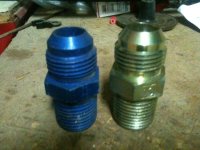
The blue and gold fittings are both 1/2" NPTM to -8 AN the blue one is a true AN fitting (~$11) and the gold is a JIC 37 (~$1.50). They will physically, completely interchange!

The middle pic is of my fittings bin. 95% are true AN and the rest JIC, ORB, and even some Dyna Tube.

I didn't read this on the internet, I just took these pics in my shop. - JIC 37 and AN will completely interchange unless your design/contract criteria call for the more stringent standards of the AN. You will find VERY few true AN components in any hydraulic shop, they are insanely expensive compared to their JIC counterparts. The 45 deg stuff IS completely different and WILL NOT interchange safely.
 

Attachments

  • JIC 1.JPG
    JIC 1.JPG
    434.5 KB · Views: 406
  • JIC 2.JPG
    JIC 2.JPG
    515.3 KB · Views: 264
  • Fittings.JPG
    Fittings.JPG
    505.2 KB · Views: 1,056
   / Flaring tubing #15  
Ken,

What reference do you have for the same flare using both 37 degree and 45 degree on the same flare? Otherwise, is the flare capable of seating both 37 and 45 degree fittings? I have never seen this.

My opinion is that all JIC fittings are 37 degrees, and a 45 degree fitting will not fit correctly.

SAE and AN/JIC fittings are completely incompatible due to the different flare angle. Further, AN fittings (or those complying with subsequent standards) and JIC fittings are not interchangeable for design-controlled applications due to differing quality standards.


Just some additional data.

http://weislake.com/sig/mucker/an-vs-jic.pdf


My post that you copied was not about the flare angles, but about Mastercool tool and was intented to answer the question of whether or not the original poster could use his tool (with the additional 37° adapters) to flare hydraulic tubing.

http://www.mastercool.com/pages/flaring_tools.html

The link above shows half a dozen different flaring tool sets from Mastercool. All of the descriptions include parts list, and for each set, the yoke and pump assembly have the same part number (71201).

It appears to me that if he buys the additional adapters, he's going to have the exact same tool he would have if he originally bought the 37 degree tool set.
 
   / Flaring tubing #16  
KML said:
Good info here but want to point out that JIC 37 and AN are completely interchangable unless you are building a commercial Aircraft or working under a contract for the Government that requires the use of AN fittings. For hydraulic or automotive use they are COMPLETELY interchangable. AN fiitings simply conform to a higher materials and thread dimension tolerance. From J_J's link above:

"As a result JIC or SAE 37 degree fittings are perfectly interchangeable with AN fittings, and while this may not be acceptable for military aviation use, for automotive use there is no downside other than perhaps mismatched color coordination as JIC fittings are not available in the pretty anodize aluminum colors. However this may be a worthy tradeoff considering the JIC fittings are a fraction of the price of their true "AN" counterparts"

I do A LOT of work with both JIC and AN fittings and the true AN stuff is expensive. The hose fitting in the picture is a 20AN for teflon hose and cost about $160 each.

The blue and gold fittings are both 1/2" NPTM to -8 AN the blue one is a true AN fitting (~$11) and the gold is a JIC 37 (~$1.50). They will physically, completely interchange!

The middle pic is of my fittings bin. 95% are true AN and the rest JIC, ORB, and even some Dyna Tube.

I didn't read this on the internet, I just took these pics in my shop. - JIC 37 and AN will completely interchange unless your design/contract criteria call for the more stringent standards of the AN. You will find VERY few true AN components in any hydraulic shop, they are insanely expensive compared to their JIC counterparts. The 45 deg stuff IS completely different and WILL NOT interchange safely.

Thank-you. If it comes from me, it is automatically questioned. If it comes from somebody else, then it is believable.
 
   / Flaring tubing #17  
Thank-you. If it comes from me, it is automatically questioned. If it comes from somebody else, then it is believable.

Here's your original quote.

"I have the same set and have made dozens of SAE flares, installed them on JIC and never had a problem with leaks. The industry recognizes the two flares as being interchangeable."

This was questioned, not because YOU said it, but because it implied that 45 degree flares (SAE) are interchangeable with 37 degree flares (JIC). In most cases, they are not. That has been clarified in several other posts now, as it should be.

Where I think some people are confused is that AN fittings have been brought into the discussion. For industrial purposes, AN fittings and JIC fittings can be interchanged. They both have the same flare angle and approx. thread dimensions. SAE 45 fittings are different, though, and NOT completely interchangeable, as your first post suggested.

We could go over the details forever. Depending on how technical one wants to get, we likely have only scratched the surface in discussing this flare or that flare. What I hope none of us do is to take any of this personally. That would be a shame, and a detriment to this forum.
 
   / Flaring tubing #18  
Ken,

You are right in that we have just scratched the surface. I agree that the important thing is that folks reading this understand that JIC 37 is all that is needed and justified for hydraulics and the flare tool the OP was asking about will work fine for both AN and JIC with the the 37 degree inserrts.

45 deg is not intended for hydraulics and is often more expensive than the proper JIC fitting so there is no good reason to use them.

BTW, I buy most of my JIC stuff from you:thumbsup:
 
   / Flaring tubing #19  
While not completely interchangeable, there are some commonalities that allow you to interchange SOME flare fittings.

In the sizes -02, -03, -05, -08 and -10 only, the threads of SAE 37ï½° flare (JIC) and SAE 45ï½° flare are the same. However, the sealing surface angles are not.

Some female swivel fittings in these sizes are actually dual seat, with two sealing surfaces (one at 37ï½° and one at 45ï½°), allowing the female to mate with either a 37ï½° male OR a 45ï½° male.

If you're mating a male flare fitting with flared tubing, it is always preferable to have the angles match. However, if your tubing is not hardened steel (such as stainless) it may conform to the new angle just enough to seal in some applications where the pressure is not excessive.

I apologize for the vagueness of that last paragraph, but I don't have any hard data to indicate where the line should be drawn here. People who have worked with specific materials in specific applications probably know how much they can bend the rules on those specific situations. Just be aware that not ALL flares are interchangeable in all sizes or all applications, so you may run into problems if you assume this works in ALL applications. It more than likely does not.

Is this what you are talking about,

http://www.parker.com/literature/Tube Fittings Division/4300 Catalog Cover.pdf


Triple lock swivel connection.

Higher pressure ratings and greater reliability are among the valuable advantages
of our enhanced Triple-Lok female connection design. It features a dual-angle
seat that accepts both 37° and 45° flare fittings – and repositions the sealing location away from the tip of the male nose. Compared with the previous
swivel design, the resulting benefits include:
■ Increased pressure ratings in most sizes (in fact, 72% higher than competitive product)
■ Sealing position that helps protect cone and nose, and improves connection reliability
■ Dual seat acceptance of 37° (all sizes) and 45° flare fittings (sizes 4, 5, 8, 10)
■ No difference in overall swivel nut or fitting body size, no change in torque or assembly metho
 
   / Flaring tubing #20  
The dual angle seat, yes. Among our lower pressure fittings (brass hose barbs and push-lock hose barbs, for example), some fittings are specified as dual seat and will accept a male 37 degree or 45 degree flare.

A couple of years ago, I got to look at the CAD drawings for some of our FJX (female JIC Swivel) hose fittings, and I noticed many of them actually had this dual angle seat.

It does allow these fittings to be used in other applications, but for tractor hydraulics JIC 37ー is the only flare you should need.

Unless, of course, you have equipment from Japan that uses JIS 30ー or Komatsu (metric JIS 30ー) fittings. :cool:
 

Tractor & Equipment Auctions

500 BBL FRAC TANK (A58214)
500 BBL FRAC TANK...
2018 Dodge 5500 Bucket Truck 4WD (A56438)
2018 Dodge 5500...
2013 Freightliner M2 106 16ft Stakebody Flatbed Truck with Liftgate (A55852)
2013 Freightliner...
2014 F-150 STX (A56438)
2014 F-150 STX...
2015 Peterbilt 389 T/A Sleeper Cab Truck Tractor (A56858)
2015 Peterbilt 389...
2003 Big Tex 10PI 16ft. T/A Pipe Top Utility Trailer (A55973)
2003 Big Tex 10PI...
 
Top