Ford 3910 Clutch Replacement

/ Ford 3910 Clutch Replacement #21  
Thanks Happy. With your Ford experience I'm surprised you've not been into one. :)

Not yet, but I try and soak up whatever info I can for when the day might come.
 
/ Ford 3910 Clutch Replacement
  • Thread Starter
#22  
I hear ya. I try to do that too. Then by the time I need the info I've forgotten most of it and can't remember how to find it. I envy those members on here who can find stuff like that.
 
/ Ford 3910 Clutch Replacement
  • Thread Starter
#23  
UPDATE.....

I finally got to use the tractor for a couple hours the other day. Parked it in the shop, satisfied with how everything was working. Came out the next morning to find the same type of oil puddle under the clutch housing as before....... :(

So I disassembled again. Good part is I'm a lot faster at it now and had it apart in an hour.

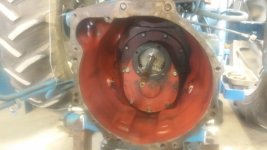
What I found was that the two seals in the front of the transmission were also leaking. Actually, now I'm thinking my rear main seal wasn't leaking at all. The mess was coming from the trans seals. Problem is that leak is spilled into the center of the clutch assembly and gets tossed everywhere. So, as in my case, when the leak has been going on for awhile there's oil on everything inside the clutch housing and you can't pinpoint where it originates from.

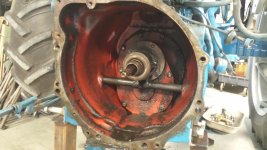
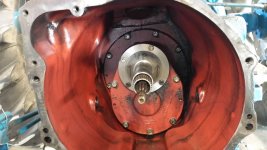
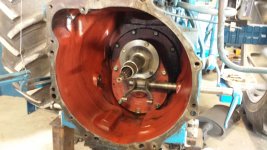
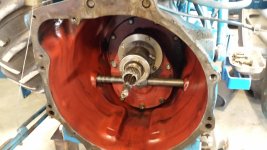
When looking at the transmission shafts you see the inner, solid, splined shaft which is the transmission input shaft. You also see the larger, hollow, splined shaft which is the Independent PTO shaft which the trans shaft extends thru. This larger shaft extends thru the throwout bearing horn. The throwout bearing horn is bolted to the front of the transmission with 4 bolts and sealed with a gasket.

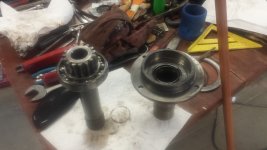
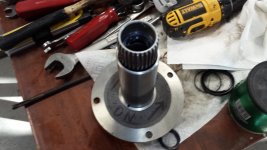
I think the smallest seal which seals the trans input shaft was the culprit. But, not wanting to do this again, I removed the throwout bearing horn and disassembled it to replace both seals. To get the horn off you must unhook the clutch pedal shaft from the throwout bearing assembly. This is done by removing a bolt/nut that clamps the throwout bearing "finger assembly" to the shaft. Once that bolt is out you can rotate the fingers on the shaft which allows you to pull the bearing assembly off the horn. Now you can slide the pedal shaft out of the clutch housing and set all that aside. Then remove the 4 bolts and the horn easily comes off. Be careful to not destroy the gasket. It's not glued on either side so it's easy to remove. Once you have the horn assembly removed a couple taps with a small hammer and the two parts come apart. If you look at the flange end of the horn you can see the seal which seals the PTO shaft. If you look into the splined end of that assembly you can see the smaller seal that seals the transmission input shaft. Both are easy to remove and replace.

20150131_115532 (1280x720) (1280x720).jpg20150217_122133 (1280x720).jpg20150217_122217 (1280x720).jpg20150217_122237 (1280x720).jpg


The horn assembly has a weep hole in it to allow any oil the gets into the cavity between the two shaft to escape back into the transmission. I was very concerned about reattaching the horn with that hole down!!! So I marked the horn with arrows and the words "up" and "down" with a marker. When I reassembled I realized Ford had dummied this down for me. The bolt holes are unevenly spaced and it will only bolt on with that hole down!!! Cool!!! :)

20150221_081528 (1280x720).jpg20150221_082158 (1280x720).jpg


Once you've reattached the horn with the four bolts you can reassemble the throwout bearing and clutch pedal shaft.

20150221_082445 (1280x720).jpg20150221_084109 (1280x720).jpg

Replacing these two seals takes about 30 minutes. Cost is $18.50 for both seals.

When you do your clutch, do the seals, even if they aren't leaking. I was SO stupid to not do that the first time. I let the tractor run at full throttle for 90 minutes yesterday with no leaks. FINALLY...... When I do something stupid like this I wonder how I even know enough to dress myself in the mornings. :(
 
/ Ford 3910 Clutch Replacement #24  
UPDATE..... I finally got to use the tractor for a couple hours the other day. Parked it in the shop, satisfied with how everything was working. Came out the next morning to find the same type of oil puddle under the clutch housing as before....... :( So I disassembled again. Good part is I'm a lot faster at it now and had it apart in an hour. What I found was that the two seals in the front of the transmission were also leaking. Actually, now I'm thinking my rear main seal wasn't leaking at all. The mess was coming from the trans seals. Problem is that leak is spilled into the center of the clutch assembly and gets tossed everywhere. So, as in my case, when the leak has been going on for awhile there's oil on everything inside the clutch housing and you can't pinpoint where it originates from. When looking at the transmission shafts you see the inner, solid, splined shaft which is the transmission input shaft. You also see the larger, hollow, splined shaft which is the Independent PTO shaft which the trans shaft extends thru. This larger shaft extends thru the throwout bearing horn. The throwout bearing horn is bolted to the front of the transmission with 4 bolts and sealed with a gasket. I think the smallest seal which seals the trans input shaft was the culprit. But, not wanting to do this again, I removed the throwout bearing horn and disassembled it to replace both seals. To get the horn off you must unhook the clutch pedal shaft from the throwout bearing assembly. This is done by removing a bolt/nut that clamps the throwout bearing "finger assembly" to the shaft. Once that bolt is out you can rotate the fingers on the shaft which allows you to pull the bearing assembly off the horn. Now you can slide the pedal shaft out of the clutch housing and set all that aside. Then remove the 4 bolts and the horn easily comes off. Be careful to not destroy the gasket. It's not glued on either side so it's easy to remove. Once you have the horn assembly removed a couple taps with a small hammer and the two parts come apart. If you look at the flange end of the horn you can see the seal which seals the PTO shaft. If you look into the splined end of that assembly you can see the smaller seal that seals the transmission input shaft. Both are easy to remove and replace. <img src="http://www.tractorbynet.com/forums/files/new-holland-owning-operating/413391-ford-3910-clutch-replacement-20150131_115532-1280x720-1280x720-jpg"/><img src="http://www.tractorbynet.com/forums/files/new-holland-owning-operating/413392-ford-3910-clutch-replacement-20150217_122133-1280x720-jpg"/><img src="http://www.tractorbynet.com/forums/files/new-holland-owning-operating/413393-ford-3910-clutch-replacement-20150217_122217-1280x720-jpg"/><img src="http://www.tractorbynet.com/forums/files/new-holland-owning-operating/413394-ford-3910-clutch-replacement-20150217_122237-1280x720-jpg"/> The horn assembly has a weep hole in it to allow any oil the gets into the cavity between the two shaft to escape back into the transmission. I was very concerned about reattaching the horn with that hole down!!! So I marked the horn with arrows and the words "up" and "down" with a marker. When I reassembled I realized Ford had dummied this down for me. The bolt holes are unevenly spaced and it will only bolt on with that hole down!!! Cool!!! :) <img src="http://www.tractorbynet.com/forums/files/new-holland-owning-operating/413396-ford-3910-clutch-replacement-20150221_081528-1280x720-jpg"/><img src="http://www.tractorbynet.com/forums/files/new-holland-owning-operating/413397-ford-3910-clutch-replacement-20150221_082158-1280x720-jpg"/> Once you've reattached the horn with the four bolts you can reassemble the throwout bearing and clutch pedal shaft. <img src="http://www.tractorbynet.com/forums/files/new-holland-owning-operating/413398-ford-3910-clutch-replacement-20150221_082445-1280x720-jpg"/><img src="http://www.tractorbynet.com/forums/files/new-holland-owning-operating/413399-ford-3910-clutch-replacement-20150221_084109-1280x720-jpg"/> Replacing these two seals takes about 30 minutes. Cost is $18.50 for both seals. When you do your clutch, do the seals, even if they aren't leaking. I was SO stupid to not do that the first time. I let the tractor run at full throttle for 90 minutes yesterday with no leaks. FINALLY...... When I do something stupid like this I wonder how I even know enough to dress myself in the mornings. :(

Nicely done!
 
/ Ford 3910 Clutch Replacement #25  
Wow. What a sinking feeling to have to go back in and fix something a second time. Great job and you get the Oscar for doing the dirty work first and then telling the tale afterwards. What a great and informative thread this has been and I've really learned a lot. Your son may be able to do it faster but I'll bet you can do it better.
 
/ Ford 3910 Clutch Replacement
  • Thread Starter
#26  
Thanks for the compliments Happy and Six. I fall on my sword a lot. Best part about it, if there is one, is I discovered the problem before Spring hit and I'm needing to use the tractor. I'm blessed with a nice warm shop and I got plenty of time. So it didn't stress me too bad. Just disappointed me that I overlooked that. Especially when it only cost $18.50. If it was a hundred dollar fix I could justified trying to get by, but not 18 bucks..... :D

Yesterday I swapped out the alternator. It was weak and would not charge unless you revved up the engine a little. I had a Delco alternator off a chevy pickup laying on the shelf so installed it. Eliminated the external voltage regulator in the process. Now I just have a wire running to the battery and a wire running to the idiot light.

This tractor does a great job of keeping me off the streets. :)
 
/ Ford 3910 Clutch Replacement #27  
This tractor does a great job of keeping me off the streets. :)

I'm not sure if you've thought of this Richard, but with your great write-ups and photos of the repairs you're tackling, there's a possibility that you're increasing the value of the 3910. I don't mean your 3910. I mean all of them. I know that if I was looking for a tractor in that size range, I'd like a 3910 pretty well. Not just because they are a pretty well regarded tractor, but also because I know where to find some nice photos and directions for some internal repairs. No way to know for sure, of course, but I thought I'd share that thought with you. Keep up the good work.
 
/ Ford 3910 Clutch Replacement
  • Thread Starter
#28  
I certainly don't start threads looking for anything in return. And I know you didn't mean it that way.

I do it to share for reasons similar to what you expressed. I know how much I appreciate searching for a solution to a problem or guidance on a repair when I find an informative thread. Then the bonus comes when someone chimes in with "shortcut" ideas or "improvement" ideas from their own experiences.

There are several Ford owners on TBN. They tend to be quiet and in the shadows. But they are there. In the last couple months I've had some great exchange of "Ford" ideas with several of them. Looks like a win/win to me. Thanks for the compliment. :)
 
/ Ford 3910 Clutch Replacement #29  
Nice job and description of your work.

Is there anything else that be replaced on that engine when clutch is being worked on, I'm thinking maybe freeze-out plug?
 
/ Ford 3910 Clutch Replacement
  • Thread Starter
#30  
Nice job and description of your work.

Is there anything else that be replaced on that engine when clutch is being worked on, I'm thinking maybe freeze-out plug?

Thanks for the compliment.

I didn't touch anything on the engine other than the main seal. Everything looked healthy on the block. No corrosion or signs of leakage.
 
/ Ford 3910 Clutch Replacement #31  
Our dealership routinely changes the freezeplugs at the rear of the block and head along with the rear main seal when doing clutch jobs. Freezeplugs can corrode from the inside so outer appearance can deceive. The rear cam cover is inspected, that will corrode more from the outside.
 
/ Ford 3910 Clutch Replacement #32  
Thought I would share my experience swapping the clutch disc in my 1986 Ford 3910 (13" Clutch with IPTO). First off, thank you to member ovrszd for his thread, the photographs and advice were a big help. Overall the job went smoothly and was not nearly as intimidating as it appears. It took about 4 hours on a Saturday to get it split and the clutch apart (I am not a pro).

The problem I was having with my machine was most noticeable at high throttle it was very difficult to shift. You could push in the clutch and it didn't want to disengage, like something was dragging. I tried adjusting it as far as it would go and it still would not disengage fully. Problem turned out to be a defective clutch disc, the rivets were all loose, the friction surfaces had cracks in them and looked like in spots they were dragging on the flywheel. Total cost for parts was $580 CDN for clutch disc, 3 seals (1 engine/2 tranny), new radius arm bolts/axle bushing, cork gasket, pilot bearing, throwout bearing).

Some advice I thought I'd share for others relating to a few specific parts of the process. (Some of this has been said before and some things may seem really basic/obvious to some)

1. Radius Arm Bolts
The bolts that attach the radius arms to the front axle were a fight and a half to get out. My tractor has been used as a loader tractor and the front axle pivot bushing had worn which puts a big load on these bolts and creates a bit of a shoulder in them which is hard to drive out. One technique I discovered that made this a bit easier was to put a bar through one of the unused axle bolt holes and try to twist the axle back to its normal alignment (i.e. as if the pivot bushing wasn't worn).

2. Splitting Supports
My supports were a lot less slick than ovrszd's (very nice job btw), but they did the trick and were quick and easy to build out of scrap lumber. I built a simple box frame that straddled the oil pan and allowed me good flexibility to use a trolley jack and blocks as required. I also pounded two hardwood shims between the front axle and the frame to keep the front end rigid so it didn't want to flop when torqueing bolts, etc.. I just used an axle stand/bottle jack on the rear end.

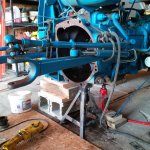
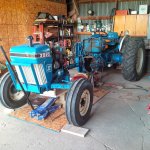
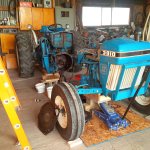
Some pictures post-split when I had the front end dropped onto blocks for working.
Front Support.jpgRear Support.jpgSplit1.jpgSplit2.jpg

3. Watch your gap when separating
When you are at the point where you have all the bolts out and are trying to roll the two sections apart, take a look at the gap and make sure it is even at the top and bottom. I found I had to adjust my supports a bit as I was wider at the bottom than the top. Once adjusted it rolled apart really easily. Shouldn't need to put any real muscle into it.

4. Pulling the Rear Main Seal
I've never pulled a seal that size before. I watched a youtube video where a guy drilled two diametrically-opposed holes in the centre of the seal and drove two wood screws through them to drive the seal out. This technique does kinda work, but your wood screws end up going in the gap between the crank and the end cap which isn't great. I decided to put two pan head screws in just so they bit the metal plate in the seal, then used a claw hammer to rock the seal out gently. Worked like a charm and didn't damage anything!

5. Clutch Alignment Tool Not Needed
I spent some time trying to source a clutch alignment tool locally, had no luck. Turned out you really don't need one. Itエs pretty easy to eyeball and I had no issues on re-assembly.

6. Don't forget the cork gasket!
Good advice given to me...thought I'd repeat it. This is the gasket the seals the main bearing end cap and is sandwiched behind the metal backing plate.

7. Don't forget to grease the guide tube that the throwout bearing slides on. Also grease the phenolic bushings where the clutch shaft penetrates the bell housing on each side. I used anti-seize on the input shaft splines (lots of debate online about whether to do that or not..)


Hope some of this is helpful to others looking to do this job. If anyone has any questions about the job, just ask.

Thanks,
Brad
 
/ Ford 3910 Clutch Replacement
  • Thread Starter
#33  
Good stuff Brad.

Thank you very much for adding it to this thread. Puts all the information in a central location for anyone searching in the future!!!!!

All of your tips are right on. I didn't use an alignment tool either.

I like your block setup!!! So by using the floor jack under the engine block you could lift enough to roll the front end on the jack and front tires. Very good idea.

I'm a metal guy and am always intrigued by what "wood" guys come up with. Looks like a professional setup to me. Bottom line is if it works, it's perfect!!!

The mental preparedness of a project like this is very important. Sounds like you, like me, got thru it fine once you got over the mental hurdle of tackling it. Good work. Thanks again for the post along with pictures. Pictures say a thousand words. :)
 
/ Ford 3910 Clutch Replacement #34  
I know this is an old thread but how did you remove the drive shaft for the 4x4 I can’t figure mine out?
 

Marketplace Items

2020 FREIGHTLINER CASCADIA TANDEM AXLE SLEEPER (A59905)
2020 FREIGHTLINER...
2016 Dodge Charger Sedan (A59231)
2016 Dodge Charger...
Kubota RTV X1140 (A60462)
Kubota RTV X1140...
2015 DODGE RAM 3500 4X4 CREW CAB PICKUP TRUCK (A59904)
2015 DODGE RAM...
2010 Specialized Structure 1456 (A56858)
2010 Specialized...
2004 Saturn VUE SUV (A59231)
2004 Saturn VUE...
 
Top