Ford 4000 Industrial - Alternator Problem

/ Ford 4000 Industrial - Alternator Problem #1  

whats this for

New member
Joined
Sep 3, 2019
Messages
6
Tractor
Ford 4000 Industrial & Ford 1910
Hi,

I'm new to TBN, and I'm a fairly new tractor owner. Actually, I currently have 2 tractors:
1964 Ford 4000 Industrial
1986 Ford 1910

I'm writing about the 4000. I bought it in July, when I knew even less than I do now. It was a mistake for a few reasons, leading me to buy the 1910 recently. I will be selling the 4000, but a few things need repair before I do that -- radiator, alternator, and oil leak. I'm writing hoping for help regarding the alternator.

The specific problem is that the pulley on the alternator broke.

I have an idea why it may have happened, but I could be wrong of course. The oil leak I mentioned above is somewhere on the front of the engine. The previous owner said it was minimal enough that he would just add a few ounces every 10 hours or so. I'm wondering if that leak led to oil splattering on the belt, which led to the belt slipping, which then led him to tighten the belt too far, and that was enough pressure to weaken, and eventually break, the pulley. (It broke a few months after I bought the tractor.) If that all makes sense, then I would want to fix that oil leak so I'm not passing the same problem on to the next guy.

Specifically regarding the alternator, it would be nice if I could use the same one, and just replace the pulley (and perhaps the fan that sits between the pulley and the alternator body). However, I am not having much success with that.

Originally, the 4000 had:
- generator & voltage regulator
- 6-volt system
- positive ground
The previous owner replaced the generator with an alternator. (The voltage regulator is still present, but not used.) It is still 6-volt with positive ground.

I figured that replacing the pulley would be easy. I brought the alternator and pulley to NAPA. Not so easy. He was not able to determine the brand/model of the alternator, although he did point out the following stamped into the back end of the shaft:
USA
INA
BCH 06604
The pulley itself doesn't seem to have any markings on it.

He spent probably 20 minutes searching online for information, but found nothing. And apparently he didn't simply have a number of pulleys in back that we could try to eyeball it. I got the impression from him that it is important to get the exact right pulley. I guess I thought it would be as simple as looking at V-belt-type pulleys that have the specific shaft hole diameter, and approximately the same outer diameter. But he said it is more complicated than that. Do you agree?

Another note on the pulley -- both it and the fan have a slot for a square key, but the alternator shaft does not. A friend pointed out a hint of yellow paint on the pulley, and suggested the idea that perhaps the pulley and fan are not the ones that came with the alternator, but instead are the ones from the original generator. Another note -- there is no set-screw to secure the pulley to the shaft. So the only thing that keeps the pulley from slipping on the shaft is the main nut. Is that normal? Or is that more likely the result of taking the pulley from the original generator and (inappropriately) using it on the new alternator? Should I be looking for a pulley that includes a set-screw? If I were to find the correct pulley, would it include a fan -- perhaps factory-attached to the pulley?

If I (with your input) am able to find a pulley (and fan?) that will work, then great. Otherwise, I would need to consider replacing the alternator, and would value any help you have in how to select the right one.

Thanks for your time!
 
/ Ford 4000 Industrial - Alternator Problem #3  
It's normal to just have the nut holding the pulley and fan to the alternator shaft, most of them turn so that the nut is trying to tighten during operation. There is probably a hex hole in the front of the shaft to get on it with an allen wrench to hold it, but I've never had any problem taking a pulley off with a rattle gun, just hold the fan with a gloved hand or heavy rag.
You should be able to get a rough idea of the diameter and get a replacement; I probably have three or four out in the shop that would work. If you can't find the exact size it shouldn't matter as long as it's not so drastic as to require a different belt size.
I'd be curious to know how it broke; I can sort of imagine how one would fail if it was too tight, but I would have thought that the bearings would fail first.
 
/ Ford 4000 Industrial - Alternator Problem #4  
Yeah, the belt being too tight didn't break the pulley.

Might try to find a replacement alternator first just to verify cost of that route. Then you'll know how hard you want to look for a pulley.
 
/ Ford 4000 Industrial - Alternator Problem #5  
Yeah, the belt being too tight didn't break the pulley.

Might try to find a replacement alternator first just to verify cost of that route. Then you'll know how hard you want to look for a pulley.
If it's a standard GM 3 wire alternator, a reman one is currently $50 on Amazon: https://www.amazon.com/dp/B000C9NN5S/
I have one on our David Brown project and have been very happy with it in the little time I've used it so far.

Aaron Z
 
/ Ford 4000 Industrial - Alternator Problem #6  
/ Ford 4000 Industrial - Alternator Problem #7  
He said it's still 6V Positive Ground. That might limit his choices??
Good point, I misread his post as saying that it had been converted to 12v.
I would start with converting it to 12v (unless it's a show tractor).

Aaron Z
 
/ Ford 4000 Industrial - Alternator Problem #8  
Good point, I misread his post as saying that it had been converted to 12v.
I would start with converting it to 12v (unless it's a show tractor).

Aaron Z

Me too, but to do it right that would require buying a starter. I think he's just wanting to sell it.
 
/ Ford 4000 Industrial - Alternator Problem #9  
Me too, but to do it right that would require buying a starter. I think he's just wanting to sell it.
Nah, starter will be fine. Would need to replace all light bulbs though.
Again, with a picture of the alternator and the shaft in question, it might be possible to find a pulley.

Aaron Z
 
/ Ford 4000 Industrial - Alternator Problem
  • Thread Starter
#10  
Do you have a picture of the alternator and shaft?

Aaron Z

Aaron Z,

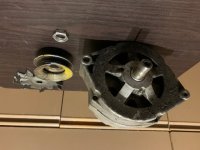
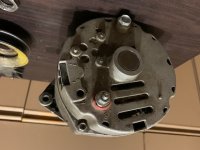
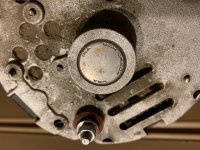
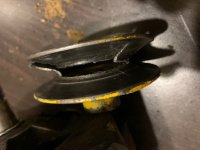
I'm attempting to attach 4 pictures of the alternator.

You mentioned that you wanted to see the shaft - perhaps because I mentioned the characters stamped into the back -- so I included that. Other than that, the front end of the shaft is fully round -- no flat sides, no groove for the square key I mentioned that the pulley seems to allow for.

One picture shows that it is a one-wire configuration. Given that the electrical system is positive ground, that one wire would actually be for the negative, I guess.

And the other picture shows the break in the pulley.

Thanks.

IMG_1015.jpgIMG_1016.jpgIMG_1017.jpgIMG_1019.jpg
 
/ Ford 4000 Industrial - Alternator Problem
  • Thread Starter
#11  
It's normal to just have the nut holding the pulley and fan to the alternator shaft, most of them turn so that the nut is trying to tighten during operation. There is probably a hex hole in the front of the shaft to get on it with an allen wrench to hold it, but I've never had any problem taking a pulley off with a rattle gun, just hold the fan with a gloved hand or heavy rag.
You should be able to get a rough idea of the diameter and get a replacement; I probably have three or four out in the shop that would work. If you can't find the exact size it shouldn't matter as long as it's not so drastic as to require a different belt size.
I'd be curious to know how it broke; I can sort of imagine how one would fail if it was too tight, but I would have thought that the bearings would fail first.

flyerdan,

I was able to remove the nut. Although there is a hole in the front end of the shaft as you mentioned, it doesn't seem to be hex. But I was able to remove it by hanging on to the fan blades.

I couldn't tell you for sure what made it break. I do know that it occurred while I owned it. That belt also drives the water pump, and, no surprise, the tractor overheats in just a few minutes with nothing to push the coolant around. That behavior only started recently. The only diagnosis I could come up with is that the belt was oily, and so it probably made the belt slip, leading to the over-tightening. But what you said makes sense too, i.e. that the bearings would take the abuse initially. The shaft seems to spin smoothly as near as my fingers can tell.

It's good to hear that I should be able to find a pulley by simple steps (shaft hole size, V-belt type, belt-width, and getting reasonably close to the outer diameter). Maybe I'll try a different auto parts store.

Thanks!
 
/ Ford 4000 Industrial - Alternator Problem
  • Thread Starter
#12  
ovrszd and aczlan (and all),

I imagine you're right that the belt being too tight didn't break the pulley. I just don't know of any other causes (yet).

You mentioned that I should consider buying a new alternator, and that I should consider converting to 12-volt. Originally, when I was figuring I'd keep this tractor, I had considered that conversion. And, in fact, I still would consider it even though my intent is to sell it -- as long as it didn't cost a ton, and as long as it is within my capabilities.

Here is a list of the issues/questions I came across. Feel free to stop reading whenever you like. :)

Q1: I assume that, as I'm converting from 6 to 12 volt, I would also convert from positive-ground to negative-ground -- agree? If so, that leads to additional questions below.
Q2: Would I go with one of those kits that are for converting from 6-volt to 12-volt? I imagine yes. However, as I look at the various kits, there are a number of questions, ambiguities, and inconsistencies. Examples listed below, with questions.
Q3: I found a kit that might apply, but, in the lengthy list of which tractor models & years it applies to, although it includes 1964 Ford 4000, it then says "does not apply to Industrial models", which is what I have. Do you know what difference there is between an Industrial and a non-Industrial, such that this electrical conversion kit would not apply? (FYI - that product page did not happen to include a link to a kit that would apply to Industrial.)
Q4: One kit includes the alternator, wire harness, and mounting brackets, but nothing else. That kit specifically states that it doesn't include the coil because "the ignition system remains at 6 volts". Meanwhile, another kit (different manufacturer, different seller) includes the coil. How would I decide if I should change the coil or not?
Q5: At least one kit refers to the question of whether my tractor's proofmeter is driven off my generator. My guess is that, since the current one is a one-wire alternator, it does not drive my proofmeter. Correct?
Q6: My search also introduced me to the term "self-exciting alternator", with one forum member stating something about requiring the engine to be running at higher RPMs in order for the alternator to actually charge the battery, and the response was that the 3-wire versions were better in that respect. Is that true? And should I care about that and change to a 3-wire alternator? Here's a basic question demonstrating my lack of experience in this area: Given that the current configuration expects a 1-wire alternator, if I were to convert to a 3-wire alternator, where do the other 2 wires go?
Q7: When talking with a friend about converting to 12-volt with negative ground, he also mentioned the starter. A number of people in forums have said that sending 12 volts to a 6-volt starter is okay -- it'll just spin faster. But even if true, he asks if the conversion from positive-ground to negative-ground would cause the starter to run backward, such that I would need to replace that too. And yet, none of the "kits" or the forum discussions that I've found mention that concept. What do you think?
Q8: Along those same lines, I'm guessing that alternators themselves are also specific to positive-ground vs. negative ground. Is that right?
Q9: Going back to question 7 regarding the starter: My friend said that perhaps it makes sense to convert from 6-volt to 12-volt, but leave it at positive-ground. His point was that I could avoid buying a starter. Of course, by making that decision, that would affect the other things too, e.g. the alternator would need to be positive-ground, and I'm not sure how easy it would be to find one like that.
Q10: One kit mentioned the need to change the gas gauge to 12-volt, but the kit did not include it. Would I therefore need to look for the sending unit, the instrument panel gauge, or both? Is the change just due to the conversion to 12-volt, or also due to the conversion to negative-ground?
Q11: How about the other 2 gauges -- temp and oil pressure: Are they driven electrically, such that I need to replace those either because of the 6v to 12v change or because of the positive-ground to negative-ground change?
Q12: Are there other electrical components to be considered? Light bulbs, of course. Others?

Those are all the questions I could think of, but I would not be surprised to learn that there are more.

Cost: I'm seeing 6-volt to 12-volt conversion kits for about $175. On top of that would be a 12-volt battery ($80?) and light bulbs (probably negligible), plus some of the "oh, by the way" items (e.g. starter, coil, gas gauge, etc., depending on the answers to those questions above). Depending on those answers, this project sounds like it could push its way into the $400 range. I'd even be okay with that if I thought the tractor would sell better and be worth most of that additional money. I'd consider it a learning experience. But as you can see by my questions, there are some fairly basic things I just don't understand yet -- like "Will the current starter run backward?", and "Which gauges would be impacted by the conversion?"

In case you're interested, here's a bit more info on the tractor:

Model: 41301 S
Serial: 57788
The engine is gas, 4-cylinder.
It has about 4100 hours.
The transmission is 4-speed with fwd/rev shuttle.

Thanks again for all your input.
 
/ Ford 4000 Industrial - Alternator Problem #13  
ovrszd and aczlan (and all),

I imagine you're right that the belt being too tight didn't break the pulley. I just don't know of any other causes (yet).
That looks like a "standard" GM 3 wire or 1 wire alternator that has been modified to run on 6v Positive Ground.
If the non-threaded portion of the shaft is 5/8" in diameter, a pulley such as: https://www.amazon.com/DB-Electrical-APL5000-Alternator-Prestolite/dp/B00Q8LRT72/ should fit (that pulley is for a 5/8" wide belt)

Q1: I assume that, as I'm converting from 6 to 12 volt, I would also convert from positive-ground to negative-ground -- agree? If so, that leads to additional questions below.
Yes.
Q2: Would I go with one of those kits that are for converting from 6-volt to 12-volt? I imagine yes. However, as I look at the various kits, there are a number of questions, ambiguities, and inconsistencies. Examples listed below, with questions.
Those kits should work.
Q3: I found a kit that might apply, but, in the lengthy list of which tractor models & years it applies to, although it includes 1964 Ford 4000, it then says "does not apply to Industrial models", which is what I have. Do you know what difference there is between an Industrial and a non-Industrial, such that this electrical conversion kit would not apply? (FYI - that product page did not happen to include a link to a kit that would apply to Industrial.)
I am not sure.

Q4: One kit includes the alternator, wire harness, and mounting brackets, but nothing else. That kit specifically states that it doesn't include the coil because "the ignition system remains at 6 volts". Meanwhile, another kit (different manufacturer, different seller) includes the coil. How would I decide if I should change the coil or not?
It is a good idea to replace the coil, you can use the 6V coil with a ballast resistor (to drop the voltage that the coil sees from 12V to 6V), but IMO you are probbaly better off putting in a new coil.

Q5: At least one kit refers to the question of whether my tractor's proofmeter is driven off my generator. My guess is that, since the current one is a one-wire alternator, it does not drive my proofmeter. Correct?
Correct, the alternator pictured does not have provision to run a tachometer drive.

Q6: My search also introduced me to the term "self-exciting alternator", with one forum member stating something about requiring the engine to be running at higher RPMs in order for the alternator to actually charge the battery, and the response was that the 3-wire versions were better in that respect. Is that true? And should I care about that and change to a 3-wire alternator? Here's a basic question demonstrating my lack of experience in this area: Given that the current configuration expects a 1-wire alternator, if I were to convert to a 3-wire alternator, where do the other 2 wires go?
The biggest wire is the charge cable, then there is a 2 wire plug (where the 1R and 2F terminals are on your alternator), 1 wire is the voltage sensing wire (would go to the fusebox on a car, to make sure that the alternator knows better what voltage the electrical system is at. On my David Brown project, they just ran it to the charge terminal). The last wire is the excitation wire, that goes to key switched power (often through a lightbulb so that it will glow to warn if the alternator fails).
Q7: When talking with a friend about converting to 12-volt with negative ground, he also mentioned the starter. A number of people in forums have said that sending 12 volts to a 6-volt starter is okay -- it'll just spin faster. But even if true, he asks if the conversion from positive-ground to negative-ground would cause the starter to run backward, such that I would need to replace that too. And yet, none of the "kits" or the forum discussions that I've found mention that concept. What do you think?
You can use the same starter, switching voltage and polarity doesn't make it spin backwards. Not sure why, but it doesnt.

Q8: Along those same lines, I'm guessing that alternators themselves are also specific to positive-ground vs. negative ground. Is that right?
Correct.

Q9: Going back to question 7 regarding the starter: My friend said that perhaps it makes sense to convert from 6-volt to 12-volt, but leave it at positive-ground. His point was that I could avoid buying a starter. Of course, by making that decision, that would affect the other things too, e.g. the alternator would need to be positive-ground, and I'm not sure how easy it would be to find one like that.
I wouldn't, IMO if you are going to put the work into converting it, you will find it easier to sell if it is a "modern standard" like 12V negative ground.

Q10: One kit mentioned the need to change the gas gauge to 12-volt, but the kit did not include it. Would I therefore need to look for the sending unit, the instrument panel gauge, or both? Is the change just due to the conversion to 12-volt, or also due to the conversion to negative-ground?
That depends on who you talk to, here is a discussion and they seem to have no problem running 6v fuel gauges on 12v: 6-12 volt fuel guage/sender theory ?? - The Stovebolt Forums and Making a 6v to 12v Conversion Easy! echos that sentiment.

Q11: How about the other 2 gauges -- temp and oil pressure: Are they driven electrically, such that I need to replace those either because of the 6v to 12v change or because of the positive-ground to negative-ground change?
They are probbaly mechanical, you will need to look at the back of them, if they are mechanical you will see a line (probbaly copper) going from the oil pressure gauge to a port on the engine and a copper line with a metal coil around it going from the temp gauge to the engine to read temperatures.

Q12: Are there other electrical components to be considered? Light bulbs, of course. Others?
You will want to take the old voltage regulator out completely.

Those are all the questions I could think of, but I would not be surprised to learn that there are more.

Cost: I'm seeing 6-volt to 12-volt conversion kits for about $175. On top of that would be a 12-volt battery ($80?) and light bulbs (probably negligible), plus some of the "oh, by the way" items (e.g. starter, coil, gas gauge, etc., depending on the answers to those questions above). Depending on those answers, this project sounds like it could push its way into the $400 range. I'd even be okay with that if I thought the tractor would sell better and be worth most of that additional money. I'd consider it a learning experience. But as you can see by my questions, there are some fairly basic things I just don't understand yet -- like "Will the current starter run backward?", and "Which gauges would be impacted by the conversion?"

In case you're interested, here's a bit more info on the tractor:

Model: 41301 S
Serial: 57788
The engine is gas, 4-cylinder.
It has about 4100 hours.
The transmission is 4-speed with fwd/rev shuttle.

Thanks again for all your input.
Your conclusion sounds correct.

Aaron Z
 
/ Ford 4000 Industrial - Alternator Problem #14  
flyerdan,

I was able to remove the nut. Although there is a hole in the front end of the shaft as you mentioned, it doesn't seem to be hex. But I was able to remove it by hanging on to the fan blades.

I couldn't tell you for sure what made it break. I do know that it occurred while I owned it. That belt also drives the water pump, and, no surprise, the tractor overheats in just a few minutes with nothing to push the coolant around. That behavior only started recently. The only diagnosis I could come up with is that the belt was oily, and so it probably made the belt slip, leading to the over-tightening. But what you said makes sense too, i.e. that the bearings would take the abuse initially. The shaft seems to spin smoothly as near as my fingers can tell.

It's good to hear that I should be able to find a pulley by simple steps (shaft hole size, V-belt type, belt-width, and getting reasonably close to the outer diameter). Maybe I'll try a different auto parts store.

Thanks!
Don’t waste time in the auto parts store. Measure out the puller needed and then go to an industrial supply place and get one that matches your needs.
 
/ Ford 4000 Industrial - Alternator Problem
  • Thread Starter
#15  
Thanks for your input guys. I have some thinking to do. It's winter here, and my shed is not heated, so if I'm going to do the conversion, I may wait for warmer weather.

A few follow-up comments:
- I contacted the vendor for the kit that said "Not for Industrial type tractors", asking what the reason was. He essentially said he doesn't know the answer. He thought it may be a physical conflict between the alternator and the framework for the loader. I tend to doubt that, based on what I am seeing on my tractor. Also, I mainly wanted to know if there was some electrical reason for the statement -- like the Industrials require some additional doodad, or maybe the specs (e.g. amps) of the alternator are different. (Oh the joys of putting non-original equipment on a non-vanilla version of a tractor that is comparatively hard to work on.)
- Regarding the gas gauge question -- I guess I just don't understand electricity well enough to come to a conclusion. I read through the discussion on both of the links you included, and I didn't understand the details. More to the point, however, is that those folks do understand what they are talking about, and yet still don't come to a definite conclusion. I'm not sure what happens when you provide 12 volts to something that was expecting 6 volts -- sparks? heat? If so, then that doesn't sound like a good thing to do inside a gas tank. (I fully admit that my statements are based on my ignorance, but I nevertheless am not in a position to make confident, knowledgeable decisions in this area.)
- The second link you provided for the gas gauge discussion also mentioned other aspects of the conversion. Regarding the starter, they said the 6v one would be just fine, as you stated. However, they mentioned that the solenoid would need to be changed to 12v. They said a 6v solenoid could work in an emergency, but would burn out quickly, and possibly start a fire.

I may still try to give it a go, but I get the impression that this project is significantly into the "figure it out as you go" category. When you start with a good understanding of vehicle electronics, then a decision between "try it and see if it works" vs. "don't try it because it may cause a fire" becomes elementary. But without that understanding, that makes me pretty uncomfortable.

Thanks.
Brad
 

Marketplace Items

2014 Acura MDX SUV (A59231)
2014 Acura MDX SUV...
2023 Kubota M4-061 Deluxe MFWD Utility Tractor with LA1154 Front Loader (A55315)
2023 Kubota M4-061...
UNUSED FUTURE SB45 EXCAVATOR HYD SILENT BREAKER (A60432)
UNUSED FUTURE SB45...
2016 Ford F-550 Venturo HT40KXX 3 Ton Crane Mechanics Truck (A59230)
2016 Ford F-550...
TANK MANIFOLD (A55745)
Unused 2025 CFG Industrial QH12R Mini Excavator (A59228)
Unused 2025 CFG...
 
Top