GC1715 Overheating

/ GC1715 Overheating #1  

FolkBear

New member
Joined
Jul 13, 2020
Messages
3
Tractor
LS MT240h
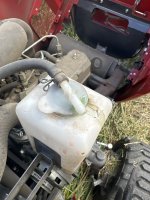
Been brush hogging for the past several days and today, I noticed that the engine was overheating. I immediately dropped the throttle and opened the hood to find coolant spuing out of the reservoir. I shut the engine down so that it hopefully wouldn’t run out of coolant. The reservoir boiled for a while and is now low on coolant. I’m not an engine guy, but is there supposed to be another hose attached to this cap? Or is this open side on the cap just for steam release? Been trying to find a parts diagram with no luck.
 

Attachments

  • image.jpg
    image.jpg
    1.9 MB · Views: 795
/ GC1715 Overheating #2  
no other hose attached. cap itself should have hose that drops into tank.
pull the screen in front of radiator (metal screen may need to move air filter intake tube) and clean it.

edit: missed the fact that the overflow tube that exits near frame of tractor was missing, sorry about that.
 
Last edited:
/ GC1715 Overheating #3  
The overflow looks fine.

You probably have a radiator that is full of grass chafe.

Blow it out really well and make sure you have airflow through it.

It's good you shut it down quick.
 
/ GC1715 Overheating #4  
no other hose attached. cap itself should have hose that drops into tank.
pull the screen in front of radiator (metal screen may need to move air filter intake tube) and clean it.
Dave is right. Some of these have the overflow hose from the base just beneath the radiator cap going into the overflow jug bottom and then the hose leaving the jug at/near the top goes down and out to the atmosphere under the tractor as waste. Of course you need to refill your coolant with the 50/50 antifreeze/water mix. Most importantly find out why it boiled over. VERY likely as Dave said you have the screen in front of the radiator or the radiator itself plugged up with chaff, grass, dust and crud. I find compressed air and a spray nozzle handy for cleanout. Unlikely it is anything else but if the problem persists after cleaning it is a real necessity to get to the bottom of the issue.
 
/ GC1715 Overheating #5  
My GC 1715 has a over flow tube going from cap of catch reservoir down to below tractor chassis....

MF overflow.jpg


Also I would check the screen in front of radiator to see if plugged with grass and debris....


MF Screen.jpg
 
/ GC1715 Overheating #6  
crap I missed the overflow hose missing, sorry
 
/ GC1715 Overheating #7  
By the way, there are many automotive "overflow tanks" that are pressurized and some even have the radiator cap screwed onto the plastic tank. Some of my older VWs were that way. I know of no tractors made that way but there might be some.
 
/ GC1715 Overheating #8  
The engine will overheat before it can take water from the overflow back into the system, so -- of course, after it's totally cooled down-- remove the radiator cap and fill the radiator to the top first. Then adjust coolant level in the overflow tank.
 
/ GC1715 Overheating #9  
The engine will overheat before it can take water from the overflow back into the system, so -- of course, after it's totally cooled down-- remove the radiator cap and fill the radiator to the top first. Then adjust coolant level in the overflow tank.
Aaaah.. It's a expansion tank.... As water heats up it expands and flows into expansion tank, after engine cools a vacuum in radiator/engine block should draw water from expansion tank back into block/radiator.... If system is functioning properly you should never have to remove radiator cap....

The real issue here is why did engine over heat....Maybe loose (or non existent-broken) fan belt not turning water pump or blocked airflow in radiator or thermostat gone defective?
 
/ GC1715 Overheating #10  
Aaaah.. It's a expansion tank.... As water heats up it expands and flows into expansion tank, after engine cools a vacuum in radiator/engine block should draw water from expansion tank back into block/radiator.... If system is functioning properly you should never have to remove radiator cap....

The real issue here is why did engine over heat....Maybe loose (or non existent-broken) fan belt not turning water pump or blocked airflow in radiator or thermostat gone defective?
Agree (except that water does NOT expand or contract.) Water is not a compressible substance. When the engine gets hot in normal operation other things containing and moving the water expand and some steam bubbles form in the water when it reaches the boiling point. That boiling point is higher temp than 212 because of the pressure set by the radiator cap. The combo of water and steam bubbles requires more space. So the water is forced past the radiator cap (when it exceeds the pressure rating of the cap) and moves into the expansion tank. When the water in the radiator cools, after the engine is shut off, the steam bubbles contract and the combo returns to near original volume which creates a partial vacuum and "sucks" the water from the expansion tank back into the radiator. Geeze what a mouthful... anyway that is the way it works.

As Wrangler said -- the REAL ISSUE is why did the engine overheat.
 
/ GC1715 Overheating #11  
<snip> Maybe loose (or non existent-broken) fan belt not turning water pump
most likely would have seen the battery light on and heard the belt slapping the radiator as it flies off, GC series VERY tight there. rad is mounted on "rear" side of engine and fan/alternator very close to stuff.

I'm betting the metal screen (slides up and out of rear of radiator) plugged. been there few times myself.
 
  • Good Post
Reactions: JWR
/ GC1715 Overheating #12  
Yes, clean your radiator screen, but don't stop there. The screen doesn't stop that tiny **** and it will clog your radiator solid. I know this from experience.

Dave
 
/ GC1715 Overheating #14  
I agree with the term "weird science" which this group mentions as a title. Weird enough to be Questionable Science. They do not state quantitatively how much water volume changes with temperature (which I would want to do more research and quantify.) [Done, see below] The camel sized item they fail to mention (compared to the straw sized item they do mention) is that water expands when it cools and gets down to about 32.4 deg F and significantly so. Breaks open rocks. Cracks engine blocks. You know how that works. With regard to internal combustion engine cooling systems, radiators, etc. I stand by my original statement as written.
But thanks to Wrangler for raising the point. Water in liquid state is NOT compressible but it does expand with temp from 4 deg C. on up to 212 deg (or higher when under pressure) while it stays a liquid. After more study I am surprised to learn that water volume does increase with temperature (above 4 deg C.) though it is a small amount. From room temp to 212 deg F volume changes by about 4%. That works out to around 0.12 gal for a 3 gal cooling system. Roughly a pint. In the context of this thread, if the coolant is just slightly below the bottom surface of the radiator cap that extra pint is mostly contained inside the cooling system as it heats up with very little being forced out into the overflow tank. I think that coolant coming into contact with very hot metal inside the coolant paths in the block and heads is going to form bubbles of steam which will make up the majority of the amount of overflow. Those bubbles will be short-lived as the coolant circulates and stablizes in average temperature. Interesting to study. Thanks again to Wrangler for tweeking our tech interest.
 
Last edited:
/ GC1715 Overheating #15  
I'm betting the metal screen (slides up and out of rear of radiator) plugged. been there few times myself.
heh heh
guess what happened to me today :LOL:
 
/ GC1715 Overheating #16  
My MF1533 has two removable screens, one in front of the transmission cooler and the other in front of the radiator. I don't know if this applies to your model but you may want to check. It's still necessary to hose off the radiator fins occasionally, also.
 
/ GC1715 Overheating #17  
Yes, clean your radiator screen, but don't stop there. The screen doesn't stop that tiny **** and it will clog your radiator solid. I know this from experience.

Dave
YES!!! Use a light to look through the radiator fins to see if it is blocked. If air can't pass through, it will overheat.
 
/ GC1715 Overheating #18  
GC series only have the one and so far I have not seen crap get past that screen into actual radiator.
I always check when I pull screen
 
/ GC1715 Overheating #19  
GC series only have the one and so far I have not seen crap get past that screen into actual radiator.
I always check when I pull screen
I agree, it appears that anything small enough to get through the screen is also small enough to pass through the radiator as well.

During the summer I clean the screen before each use, but I also don't use it much in the summer because I just use it for mowing and I only do that every 2 weeks. In the winter I don't check every use because I use it to move snow almost daily and sometimes multiple times a day. But I have not seen anything build up on the screen in the winter.
 
/ GC1715 Overheating #20  
I agree, it appears that anything small enough to get through the screen is also small enough to pass through the radiator as well.

During the summer I clean the screen before each use, but I also don't use it much in the summer because I just use it for mowing and I only do that every 2 weeks. In the winter I don't check every use because I use it to move snow almost daily and sometimes multiple times a day. But I have not seen anything build up on the screen in the winter.
I use mine pretty much daily even if it's just to run to end of road to check mail.
I have, in winter, had sleet plug screen. Shut unit off wait 10 minutes and heat from radiator clears the issue but that is VERY rare.
But it's good practice to check radiator every time screen pulled I figure.
Yesterday noticed temp gage that normally is lower 1/3 of gage range suddenly spiked into upper range.
Shut it off let it cool a few then 5 minutes of work and screen cleared and 3+ more hours of mowing done
 
 
Top