dcyrilc
Super Member
My power steering is a closed center CC system. Does this mean that the rest of the system has to be CC? Or are some systems hybred using both CC and OC?

My power steering is a closed center CC system. Does this mean that the rest of the system has to be CC? Or are some systems hybred using both CC and OC?
CC, Closed Center system also, usually, means that there is a Constant Pressure, CP. Benefit is that a CP system operates more distinct and is more independent of the load pressure. Also can extra control valves be added easily. CP systems usually need a variable displacement pump, like an axial piston pump.
OC, open Center system, means that a fixed displacement pump, ciculates oil thru the open center in the valve. means that there is a Constant Flow, CF. When control valve is operated, center will close down while work port opens. A OC valve needs a power beyond port if extra valves need to be added.
Simplified we can say that, in a CP system, power is regulated by a variable flow, and in a CF system, power is regulated by a variable pressure.
CF systems usually waste more energy at stand by, than CP systems.
There are two other similar variants of CP systems, CPU, Constant Pressure Unloaded, and LS, Load Sensing.
In a CPU system, the pump turn down to a low pressure, 400-500 psi, at stand by. That lower the losses at stand by. It also reduce the crank torque at start up.
LS system, is a constant pressure system that varies the constant pressure whento the load pressure varies. That lower the losses at high pressure. LS system unloads the same way as CPU systems.
There are also LS systems that uses a fixed dipalcement pump, closed center valves, and a dump valve that by pass flow at stand by. These systems are std on the HIAB truck cranes today, valve and system design from Swedens Olsbergs Hydraulic. See this interesting video about casting these valves.
Thanks AKKAMAAN,
Though I didn't really figure out an answer out of that. I suppose I should have given more info...
I'm working on a 1980 JD2240 tractor. I'm not digging into the hydraulics yet, but that will be next after I finish rebuilding the power steering. The tech manual has sections on both OC and CC hydraulic systems and valves for loader, etc...
My power steering is definately CC and I was wondering if this meant the rest of the system would be CC also or if they have been known to hybredize systems. Everything runs off one pump.
I think I just found my answer since you said that OC and CC systems use different types of pumps.
My system should be all CC. Is this correct?
If so, this will eliminate 1/2 the systems in the tech manual for me to dig through to ID the system my tractor is using. My first step for troubleshooting the hydraulic system will have to ID the system in the manual.
I think the type of system, OC or CC, is optional when you buy the JD new, that could be the reason both are in the book, CC better but more $$$. But I need more info to tell whats up. I know that JD has TOP NOTCH documentation so it should be possible to figure everything out.
Would be interesting to see a detailed picture of the pump, maybe we can determine if it's a fixed or variable displacement pump.
Is there any symbol drawings on the systems?

Maybe this will explain it to your satisfaction. For the most part, closed center systems are only used for short term operatons. The variable speed pumps on the Power-Tracs are closed center, and do not maintain the high pressure as some other closed center system , and only provides the pressure/volume when the swash plate is shifted.
Quote:
The principal of close center hydraulic systems is to provide oil flow on demand it enables simultaneous operation of many users connected to one pump.
These systems almost always use variable flow piston pump with swash plate.
There are few exceptions where gear pump is used with special LS dump valve.
These systems offer significant benefits in reducing engine power loss if compared with open center systems where full capacity of the pump, almost always gear pump, is continuously pumped round the hydraulic circuit even when it is not operated.
The unused fluid goes to tank.
What is the normal flow for fluid on a CC system when all valves are closed? The pump is pushing fluid into the system which has to go somewhere. Does fluid return to the resivoir through the main relief valve or is there another means for fluid movement and preventing overpressurization when the system is operating normally and no control valves are being operated?
If I'm understanding correctly, it sounds like there should be a means for controlling pump speed or pressure so that the system doesn't overpressurize and blow off the main relief valve when no controls are being operated. Is this correct?

Pump speed can be constant, preesure will be constant, almost no flow at stand by. (almost= only internal leakage)
so Power = pressure x flow.....if flow is almost Zero, then used power is almost zero. Pump has a pressure compensator that is set at a maximum allowed pressure. ususally there is an extra PRV that is set on a slightly higher pressure in case compensator fails. But that have never happened to me in 25 years of these systems....

Some JD's have 2 pumps the one in the belly is a gear pump(charge pump) open center and feeds the the second pump variable displacement pump(closed center) the first pump also feeds the power steering and brakes

Charge pumps are usually used in CLOSED LOOP circuits, type hydrostatic transmission.......
Never heard of a charge pump in a regeluar OPEN LOOP system, but it do make sense having a small fixed displacement pump for powersteering and brakes, together with a bigger pump for all the extras like FEL, 3ph etc.....
Open Loop vs Closed Loop in this pic from Wikipedia, see charge pump in closed loop system, charge pump necessary to extarct fluid from the closed loop for filtering and cooling.....
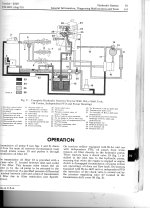
kenstrac nailed it. That is indeed how my system works. Didn't pick up on the charge pump portion being open center. Power steering works off the main pump though. Tranny lubrication, Independent PTO, and brakes off the charge pump.
Good drawing...but I like symbol drawings better though, they tell in detail how everything wroks...
there is nothing in the drawing verifying that the "charge pump" (your book name it transmission pump) supplies the main pump....
The "charge pump" system is a CP (the transmissionvalve #30, is a CC), and CF at the same time, which means max power taken out constantly....we can call it Constant Power system....this is the same princip as a engine pressure lubrication system....pos 32 in drawing shows flow path to pressure lube....
systems like this usually have a low flow and low pressure.....drawing says "#34=medium pressure oil", 300-500psi is my guess....book should say...and flow a few gpm....
Main pump is probably a variable displacement pump and main system seems to be a CC/CP system.