Generator and electricity flow

   / Generator and electricity flow #41  
The issue is the wire in the wall, which is sized for the service breaker, but which is being driven by the generator over its capacity, by appliances on the same circuit. Because the appliances are on the same circuit as the genny, there is no current flow through the breaker, and the wire is unprotected, except by the genny's breaker which is too large.

Winner, winner, chicken dinner.:thumbsup:
 
   / Generator and electricity flow #42  
The issue is the wire in the wall, which is sized for the service breaker, but which is being driven by the generator over its capacity, by appliances on the same circuit. Because the appliances are on the same circuit as the genny, there is no current flow through the breaker, and the wire is unprotected, except by the genny's breaker which is too large.

You have a good point. It would be wrong and dangerous (fire wise) to backfeed a (house) branch circuit with anything more than a 2000 watt generator (or from a generator outlet with more than a 20a breaker on it.) Even then one should make sure they are feeding a 20a rated house outlet.

I'll admit that I don't have much experience with a wide range of generators but all that I have seen only have 15 or 20 amp outlets for 110v. Beyond that, you need to go to a heavier rated 220v outlet and 220v connection which is not what you can feed a typical house branch circuit. Hopefully anyone feeding their house via such a generator connection realizes that they need special wiring and hookup if they want more than 110v 20 amp service or they need the proper wiring and plug to feed a range or dryer outlet.

Bottom line, if you want more than 110v 20 amp (2000 watts), you really need to get a proper connection into your breaker box.
 
   / Generator and electricity flow #43  
I'm interested in installing a safe and approved method of plugging my portable generator into my house.
All of the schemes and transfer switches I've found seem to require that I have room for additional breakers.
It looks like all my spaces have been used up. Is there a simple solution for me or do I have to buy a new house?

:eek::eek:

Thanks for any advice.

View attachment 296419

We have the generlink referenced above, it was installed by our local electrical co-op. They unplugged the meter installed the generlink and replaced the meter. No wiring or breakers were changed. Your panel also has a rating for the number of circuits which may be exceeded if double circuits up, just another spec. to be aware of.

GenerLink.com - About GenerLink - The easy way to connect a home generator

Through the Co-op they installed it for about the same as the online pricing I found.
 
   / Generator and electricity flow #44  
That Generlink device looks pretty slick but If I'm not mistaken it costs about $700.00.
That's a little too nice for me.
 
   / Generator and electricity flow #45  
We have the generlink referenced above, it was installed by our local electrical co-op. They unplugged the meter installed the generlink and replaced the meter. No wiring or breakers were changed. Your panel also has a rating for the number of circuits which may be exceeded if double circuits up, just another spec. to be aware of.

GenerLink.com - About GenerLink - The easy way to connect a home generator

Through the Co-op they installed it for about the same as the online pricing I found.

That sounded really good.....until I saw the $700 price! :eek: I think I'll stick to running extension cords to the few things that really need power.

But thanks for passing along another idea.

Ken
 
   / Generator and electricity flow #46  
You have a good point. It would be wrong and dangerous (fire wise) to backfeed a (house) branch circuit with anything more than a 2000 watt generator (or from a generator outlet with more than a 20a breaker on it.) Even then one should make sure they are feeding a 20a rated house outlet.

They say a little knowledge is a dangerous thing. I think we're firmly in that territory now. Assuming that you're backfeeding via a 110v receptacle, which would only feed half the circuits in the house, by the way, you would want to make sure that your supply current was less than the breaker on the circuit you're backfeeding, since the wire on that circuit will have been sized to match the breaker. You say a 2000W genny, but bear in mind that most generators are 240v, and will have two separate 120v legs, each carrying half the generator's rated wattage. So assuming a 20A breaker on a 120v circuit (equals 2400W), you could have up to a 4800W generator without overloading the wiring.

I'll admit that I don't have much experience with a wide range of generators but all that I have seen only have 15 or 20 amp outlets for 110v.

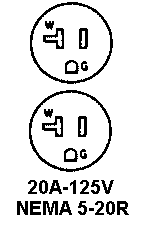
That's my experience too. Standard 120v receptacles are almost always rated for 10 or 15 amps. The 20-amp receptacles have one of the prongs at a right angle, as shown here:

5-20rd.gif


So even if the generator was more than 4800W, it probably won't be putting more than 15 or 20 amps on a single 120v leg. BTW, there is a 30-amp 120v plug and receptacle, but you hardly ever see them.

Beyond that, you need to go to a heavier rated 220v outlet and 220v connection which is not what you can feed a typical house branch circuit. Hopefully anyone feeding their house via such a generator connection realizes that they need special wiring and hookup if they want more than 110v 20 amp service or they need the proper wiring and plug to feed a range or dryer outlet.

No. Hopefully anyone feeding their house this way realizes that the whole idea of backfeeding via a suicide cord is dumb and dangerous and they will think better of it. The reasons we have laid out here are just some of the things that can go wrong. There are many more. If the power is out and your sainted grandmother needs her dialysis machine to live, and the only way to run it is to backfeed, then it might be worth it. But really, you should plan ahead for these things and get an interlock or transfer switch and do it right.

Bottom line, if you want more than 110v 20 amp (2000 watts), you really need to get a proper connection into your breaker box.

Bottom line: you really need to get a proper connection into your breaker box, PERIOD.
 
   / Generator and electricity flow #47  
That Generlink device looks pretty slick but If I'm not mistaken it costs about $700.00.
That's a little too nice for me.

I figured $700 or $600 (2 years ago) would be gone quickly when I started looking at other options like moving ciruits etc.
 
   / Generator and electricity flow #48  
I figured $700 or $600 (2 years ago) would be gone quickly when I started looking at other options like moving ciruits etc.

IMO, backflow breaker with interlock kit is the cheapest and most versatile option. About $200 for the interlock kit, and whatever a new breaker costs you. If your service panel is full, then you have some additional cost to buy half-width breakers and some hassle of re-wiring the panel to incorporate them, but overall, you'll come out way cheaper than a transfer switch and you can power whichever circuits you want, instead of having to pre-select a few.
 
   / Generator and electricity flow #49  
The Generlink device allows all circuits to be available as well. For me, the expense is the issue.
I've ordered a genuine Square D interlock kit for $79. That seems sensible to me.
I still need to buy a few breakers but The total cost will be bearable.
 
   / Generator and electricity flow #50  
I'm interested in installing a safe and approved method of plugging my portable generator into my house.
All of the schemes and transfer switches I've found seem to require that I have room for additional breakers.
It looks like all my spaces have been used up. Is there a simple solution for me or do I have to buy a new house?

:eek::eek:

Thanks for any advice.

View attachment 296419

If you get a new subpanel for the generator that has saftey interlock - you will be freeing up space in your old panel from whatever circuits you pick. all the black wires needs to be "moved" over to new subpanel. You can just pull out the old breakers for the new transfer switch breaker. If you have other breakers to pull- but no safety plug to back in the door to cover hole - leave them in until you get blanks. Its not safe or to code to have a empty slot and metal slots removed.
 
   / Generator and electricity flow #51  
We all agree a transfer switch is idea but an interlock is better than nothing.

This morning the question popped in my mind is back feeding a grid by accident or intent even possible in the real world more than a micro second with the typical home back up generator used in a hacked fashion in a storm?

We have access to 7KW, 6KW, 3KW and .8 KW generator if needed during a storm. They all have rated circuit breaks that work really really fast when over loaded. Would not a grid load look so HUGE that the generator breaker system trip instantly or kill the engine. If the grid became live from the power company I could see it frying the typical back up generator but it seems to me the breakers would open fast if the generator was seen as a direct short to the grid source.

I really have not experience on this subject but know if I over load any generator that we have access to the breakers pop very fast.

I read the warnings about back feeding dangers but have not found a "confirmed" case of a lineman dying from it but I am sure someone has a confirmed case(s) they can post links concerning such cases.

It seems it is technically impossible for backing feeding to kill a lineman if the lineman is working as directed per lineman codes.

There is no defense for a home owner that would connect a home generator to the power grid period. I am just asking is there a proven case when a lineman died from back feeding where a home generator was the cause. It seems in the legal case linemen are to trip transformers feeding the homes or at least create a dead short of the grid on both sides of where they are doing line repairs.

Pike Electric, Inc., Docket No. 01-0166

Electric Company lineman dies
 
   / Generator and electricity flow #52  
This morning the question popped in my mind is back feeding a grid by accident or intent even possible in the real world more than a micro second with the typical home back up generator used in a hacked fashion in a storm?
We have access to 7KW, 6KW, 3KW and .8 KW generator if needed during a storm. They all have rated circuit breaks that work really really fast when over loaded. Would not a grid load look so HUGE that the generator breaker system trip instantly or kill the engine. If the grid became live from the power company I could see it frying the typical back up generator but it seems to me the breakers would open fast if the generator was seen as a direct short to the grid source.
If your transformer has a short in it or if you only are connected to a couple of houses (due to lines being down) it is possible that your genset could handle the load of the part fo the grid that it is connected to.

Aaron Z
 
   / Generator and electricity flow #53  
If your transformer has a short in it or if you only are connected to a couple of houses (due to lines being down) it is possible that your genset could handle the load of the part fo the grid that it is connected to.

Aaron Z

"If your transformer has a short in it" part of your reply I do not follow.
 
   / Generator and electricity flow #54  
Fact is there isn't a lineman worth his pay that doesn't treat every line like it is live at all times. Ones that don't end up dead and it isn't because of home generators. The entire backfeed story is nothing more then a folktale that won't die. Yes, people shouldn't be screwing with power because it is dangerous. I challenge anyone tyo publish a single electrocution event of a linesman attributed to a home generator.
(ducks and runs for cover)
 
   / Generator and electricity flow #55  
sdkubota I was taken back when could not find one 'confirmed' lineman death from a home generator. Not sure why I woke this morning with the BS detector going off on this subject. I can not see an 8000 watt generator boosting 120 volts to 7200 volt with ease or amperage.

I think some would be surprise how some linemen power their whole house during a long outage. :)
 
   / Generator and electricity flow #56  
Fact is there isn't a lineman worth his pay that doesn't treat every line like it is live at all times. Ones that don't end up dead and it isn't because of home generators. The entire backfeed story is nothing more then a folktale that won't die. Yes, people shouldn't be screwing with power because it is dangerous. I challenge anyone tyo publish a single electrocution event of a linesman attributed to a home generator.
(ducks and runs for cover)

First hit with google:
Lineman killed by customer generator
 
   / Generator and electricity flow #58  
"If your transformer has a short in it" part of your reply I do not follow.
Sorry, wrote short, meant open winding or loose wire inside.
sdkubota I was taken back when could not find one 'confirmed' lineman death from a home generator. Not sure why I woke this morning with the BS detector going off on this subject. I can not see an 8000 watt generator boosting 120 volts to 7200 volt with ease or amperage.
8000 Watts (33 amps) of 240VAC boosted to 7200VAC would give you 1.1 amps (1100 mA). Per OSHA's formula you only need 7.2 mA at 7200VAC to cause vfib

Aaron Z
 
   / Generator and electricity flow #59  
I think it is possible to happen but we are still looking for the first confirmed report of a lineman being killed by a home generator. Lawyers for a utility company is interested in finding a "cause" not related to the company's policies or the failure to follow them. We know home generators can not kill linemen following policies in print and taught in lineman training classes.
 
   / Generator and electricity flow
  • Thread Starter
#60  
WOW. I never thought this thread would take on a life of its own. A lot of good advice has been offered and I have always felt that you must respect electricity and NOT take chances/short cuts to wire something that can kill you or burn your house down.

Again I say thank-you to all who commented/offered advice.
 

Tractor & Equipment Auctions

2012 INTERNATIONAL 4300 26 FT BOX TRUCK (A59904)
2012 INTERNATIONAL...
2018 KOMATSU WA200-8 WHEEL LOADER (A60429)
2018 KOMATSU...
5' MOWER (A52706)
5' MOWER (A52706)
2006 Nissan Murano AWD SUV (A59231)
2006 Nissan Murano...
2016 Chevrolet Tahoe SUV (A59231)
2016 Chevrolet...
2015 Peterbilt 389 T/A Sleeper Cab Truck Tractor (A56858)
2015 Peterbilt 389...
 
Top