Got torque?

/ Got torque? #1  

Big Wave D

Platinum Member
Joined
May 13, 2010
Messages
538
Tractor
Kubota L35, Kubota B6200E
This question has to do with torque wrenches.

I know that to do a truly proper repair on a mechanical device, let's say a tractor :))); a person should perform the repair and use the proper torque on all the bolts and nuts set forth by the shop manual.

So when the rubber meets the road, where do you all stand on this?

In my case, 1) I don't even own a torque wrench. (Which is probably the cardinal first sin of calling oneself a person of mechanical aptitude.) 2) I work on to many different projects to own a manual for them all is really not feasible. (Lot's of helping others with their stuff.) So, I don't even have any factory specified numbers to go by in those cases, even if I did own a torque wrench. 3) I am not rebuilding engines or transmissions. I have enough common sense to know that very complex machines need to have critical components torqued to very specific values; therefore, I steer clear of undertaking projects that I am not equipped for either by being limited on skill/knowledge or tools. Leave that to the pros. 4) Over the many years, I have a very good success rate on the repairs that I have performed. The item is returned to working order and doesn't explode or implode while being used.

Curious to hear how the rest of you decide how and when you break out the 'golden' t.w. :laughing:

What are your methods for deciding whether something is properly 'torqued' when no torque wrench is being used? (Keep tightening the fastener until it snaps, then back off a 1/4 turn :D)
 
/ Got torque? #2  
got one but use it seldomly. Though just replaced chipper blades and even the Manufactured recommended not to over torque as the blades could crack when using. So I used a TW. otherwise on the big nuts like truck or wheels I go as tight as I can get um and don't back off. Though I gotta say a 1/4" drive tw would be nice
 
/ Got torque? #3  
i can admit that i don't go by the book a lot times also. After turning wrenches for many years on all sorts of equipment from electrical connections to general maintenance you get a feel for it. Building an engine or transmission and not using a torque wrench would be insane thou. one thing i do like to check are wheel lug nuts! you get a feel for impact wrenches too but i still like to check with torque wrench.:thumbsup:
 
/ Got torque?
  • Thread Starter
#4  
I do have a neighbor who is a professional mechanic and has accumulated a massive amount of tools and specialty items. If I am really needing to do something "correct", I am fortunate that he will permit me use of his vast collection. I do not abuse his generosity and therefore don't ask often and do treat any item with extreme care. :thumbsup:
 
/ Got torque?
  • Thread Starter
#5  
I am with you, wthompson.

I guess after all of these years; I to have a certain sense of "calibration" or feel, but I doubt that if checked by an actual torque wrench I'd be +/- 4%. (Harbour Freight, $10 special, :laughing::laughing:)
 
/ Got torque? #6  
At my age my elbow clicks at the percise torque I need.
 
/ Got torque? #7  
Those that believe they have developed a sense of feel for torque would be surprised at how far off their sense of feel is. I have tested my "sense of feel" against a torque wrench calibrator. Yes I can get it close but then what about the different positions you are in and the different lengths of wrenches? What if you are pulling on an 8 inch wrench versus a 12 inch wrench. You would have to pull 50% more on the 8 inch wrench compared to the 12 inch wrench to get the same torque.
 
/ Got torque?
  • Thread Starter
#8  
At my age my elbow clicks at the percise torque I need.


:laughing::laughing::laughing::laughing:

That's FUNNY! Thanks for a good laugh this evening. :thumbsup:
 
/ Got torque? #9  
Big Wave D - sounds like you are okay with your approach. When you get into anything critical, you go see your neighbor and get the TW.

Getting the right torque on most bolts means getting enough torque that the bolt won't loosen and drop out, but not so much that you snap the bolt off or deform or crack the things being bolted together. This is where a "mechanic's feel" is helpful.

Getting the right torque on critical components requires using a TW to be sure. You may get lucky without one, but you're really casting dice if you don't use it. As wrenchturner said, the scatter in the applied torque is too much to insure that a flange won't separate under load and start fretting or a cylinder head won't be unevenly loaded and overstressed to the point of cracking or failing the gasket.

If the bolt or nut preload is super important, then you want to measure angle of turn, not torque, but that is rare in consumer type products.
 
/ Got torque? #10  
I rarely use a torque wrench except for engine work. I am also one who estimates torque when I do wheels and the like. Wheels are easy. I know how much I weigh and I can calculate torque based on the distance I stand (or a knee) on the wrench from the nut/bolt. Accurate enough for my work. But usually I just crank on wheel securement. I tend to over torque because I use anti-seize Other wrenching usually has more tolerant specs so I guesstimate.
 
/ Got torque?
  • Thread Starter
#11  
I have never had a wheel come of because of lugs nuts loosening up. I always use a crossing pattern when tightening them. I also do this with my 1/2" impact, but I don't use the highest of the 3 settings. I start with the lowest, 1. Then when it won't tighten any more, I go up to setting 2. I don't however, just let it hammer away until it stops turning. Instead, I watch the socket for a small amount of what I'd call "final seating" torque. My wife could take the lug nuts off if she needed to. I have helped many a person on the side of the road, usually women, that I don't think would have a prayer of being able to change their flat tire. The lug nuts seem like they were tightened to the max torque that the impact could generate and had Red Loc-Tite (sarcasm) applied to boot.

I also judge what I think will hold on a fastener by the size of the fastener. Small bolts, I am using 1/4" sockets or smaller wrenches. Medium gets 3/8"s sized sockets, and the larger get 1/2" or 3/4" depending on how large they are.
 
/ Got torque? #12  
This question has to do with torque wrenches.

I know that to do a truly proper repair on a mechanical device, let's say a tractor :))); a person should perform the repair and use the proper torque on all the bolts and nuts set forth by the shop manual.

So when the rubber meets the road, where do you all stand on this?

I've done about a million hours of motorcycle work, which is full of small metric fasteners with relatively low torque specs. I have an inch-lb click torque wrench, and a cheepie beam wrench that I use torques higher than the 20 ft-lbs the the clicker can handle. I used to use a torque wrench on just about everything, until I learned what the various torques felt like with specific wrench lengths. Most nuts/bolts are properly tightened WAY before it "feels" right to most. I rarely use a torque wrench any more, still break it out whenever I feel like I might not have a good feel for the particular fastener.

JayC
 
/ Got torque? #13  
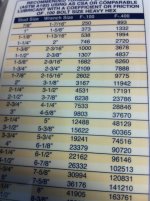
I spend roughly 50% of my time at work torquing high pressure lines etc. generally speaking we use a torque wrench for everything above 7/8" studs. We always use an anti-seize of some sort( as per client requirement), for example a 7/8" stud properly torqued is at 250ft/lbs with anti seize . That same stud torque dry requires 893ft-lbs of torque to do the same seize.

image-1866837873.jpg
 
/ Got torque?
  • Thread Starter
#14  
We always use an anti-seize of some sort( as per client requirement), for example a 7/8" stud properly torqued is at 250ft/lbs with anti seize . That same stud torque dry requires 893ft-lbs of torque to do the same seize.


Wow, that is quite a difference. Much more than I would have expected.

Does un-set loc-tite have any lubricating properties at the time of assembly? Just wondered if it was giving you a truer reading, or are those torque values listed in a shop manual expected to be dry?

Thanks
 
/ Got torque? #15  
What product number is in-set or it's properties? I looked at the loctite web site and couldn't find it!
 
/ Got torque? #16  
I restore old tractors. I use a torque wrench on head bolts for sure. Also on bolts that are threaded into other cast iron parts of the tractor (bolster, axle housings, tranny and differential case, etc).

It's a real pain to over-torque in a situation like that and strip out the threads. Then you have to use a Helicoil, which can be another headache. I replace nearly all the bolts during a restoration, so you have to be careful since you're running new bolts into old threads that may have lost a considerable amount of their original strength (metals age by crystallation, etc).

Of course, for head bolts you have to torque them down enough to get the head gasket to seal properly. This can be exciting when you're reassembling a 60+ year old engine and pulling hard on your torque wrench--waiting on pins and needles for the bolt to start spinning in the hole after the threads fail:eek:.
 
/ Got torque? #17  
I use a torque wrench whenever I have a torque value. I come from a family of mechanics and I guess it is sort of ingrained in me.

As to being able to "feel" the right torque, I don't doubt some can, I am just not one of them.
 
/ Got torque? #18  
flusher said:
I restore old tractors. I use a torque wrench on head bolts for sure. Also on bolts that are threaded into other cast iron parts of the tractor (bolster, axle housings, tranny and differential case, etc).

It's a real pain to over-torque in a situation like that and strip out the threads. Then you have to use a Helicoil, which can be another headache. I replace nearly all the bolts during a restoration, so you have to be careful since you're running new bolts into old threads that may have lost a considerable amount of their original strength (metals age by crystallation, etc).

Of course, for head bolts you have to torque them down enough to get the head gasket to seal properly. This can be exciting when you're reassembling a 60+ year old engine and pulling hard on your torque wrench--waiting on pins and needles for the bolt to start spinning in the hole after the threads fail:eek:.

Take your torquing in stages and give time to "settle" between stages. Pay attention to material temperature cold steel is not very friendly to work with. Keep in mind that I am in Canada
 
/ Got torque? #19  
Using a torque wrench for lug nuts is less to prevent them from falling off but from over tightening. In the old days people thought the tighter the better but now things like warping the rotors and breaking the studs are more likey results from not using a TW.

I have three and use them when needed but not as often as I should. First lesson is never use them for anything but torquing bolts and nuts, they aren't replacements for breaker bars. Secondly it's hard to have just one size, my Craftsman 1/2" goes up to 250ft/lbs. It's almost worthless for anything small. So I have a 3/8" ratchet and a 1/4" screwdriver style.

Most bolt sizes and grades have standard torque values that should be followed when a specific number isn't given. Yes I also have the calibrated arm and too often use it when I shouldn't. So just having them and knowing that you should use them doesn't mean that you will.
 
/ Got torque?
  • Thread Starter
#20  
If one needs a variety to much all of the different ranges you might deal with, how good is good? I can't afford $1,000 just in _____________ (insert favorite brand) torque wrenches.

Does a $10 Harbor Freight special get the job done or is +/- 4 percent to much gray area? :confused:
 

Marketplace Items

2007 JLG SKYPOWER 800S BOOM LIFT (A62129)
2007 JLG SKYPOWER...
2023 HANGCHA CPYD30-XW71F STRAIGHT MAST FORKLIFT (A62129)
2023 HANGCHA...
UNUSED KJ 20' BI-PARTING GALVANIZED GATE (A62131)
UNUSED KJ 20'...
Bobcat T66 (A60462)
Bobcat T66 (A60462)
UNUSED JCT HYD AUGER (A62131)
UNUSED JCT HYD...
DECKED TRUCK BED SLIDING TOOLBOX (A62131)
DECKED TRUCK BED...
 
Top