Help, No forward motion!

   / Help, No forward motion! #21  
One more thought on these repeated failures. The pump and wheel motor circuit is "closed." This means the oil in the circuit never returns to the tank and is NEVER filtered (ignoring makeup oil from the charge pump, which is minimal). So...if you have a pump failure and the motor circuit is contaminated (which is very likely), then the contamination will stay in the circuit and damage the "new" pump over time. More contamination in the circuit means much lower pump life. I'm simplifying here but this is the basic situation.

As a best practice, the wheel motor circuit should be filtered EVERY time it's opened (for example, to replace a leaking wheel motor or bad pump). At one time, PT even recommended periodic filtration of the wheel motor circuit and sold a kit for this purpose. I built a 3 micron filter kit, using a high pressure filter, and posted the design on here some time ago. When I added larger wheel motors and a new pump to my 425, I connected this filter inline at one of the wheel motors and ran the tractor, with the tram engaged, for several minutes (without going into math, 15 minutes run time is a good start IF you haven't experienced a significant failure...which you have).

Here's the bad news...if this circuit is badly contaminated, you will not be able to sufficiently remove the contamination with a filter kit alone. In general, the filter kit is used when there was no catastrophic failure...i.e., just replacing a leaking wheel motor or degraded but working pump. A catastrophic failure will deposit material in the lines that will be impossible to properly clean (industrial solutions exist for this but it's not practical for our small machines). From time to time, this material will "break loose" and recontaminate the filtered circuit. You "could" add a permanent high pressure filter to the circuit I suppose but it wouldn't be easy.

So, what would I do in your situation? You won't like the answer. I suspect you have a lot of contamination in this circuit and it's causing the multiple failures. Keep in mind...I don't know EXACTLY what's failing in your pump and I could be wrong. But if I'm right, you won't be able to easily solve this problem permanently without a very significant rebuild (new pump, new wheel motors and all new plumbing in the wheel motor circuit...plus, you'll need to properly prime the circuit before startup). Depending on your mechanical skill and patience, this is ether a very daunting job or a very easy, but expensive job. Either way, I'd do a lot more investigation on the root cause of these failures before I bought another pump (I guess your only option is to press Terry for his opinion on the subject). If you want total piece of mind, a new tractor purchase might not be a bad idea. Building an all new wheel motor circuit would cost something in the range of $6K or so...much more if you buy the parts from PT. Plus, if you don't do it right, you could damage the new parts too.

I'm not trying to scare you. But if you want a permanent solution, you've got figure out what is really going on, what's the total damage, and then make your decision.
 
   / Help, No forward motion! #22  
Marrt I thought the charge pump was about 4 gallons a minute. I am not disagreeing with what you said otherwise.
 
   / Help, No forward motion! #23  
Marrt I thought the charge pump was about 4 gallons a minute. I am not disagreeing with what you said otherwise.

Hey Bob. I'm not sure of the flow rate of the charge pump on the 425...but does it matter?

To summarize for new owners reading this (not you Bob)...the charge pump is there to supply make up oil related to wheel motor bypass, pressurize the circuit to avoid/limit cavitation, provide a constant back pressure for the VD pump and provide some cooling for the VD pump under operation. On the PT, the charge pump pulls through the suction filter to ensure the oil is clean before it can be potentially introduced into the wheel motor circuit. Most industrial equipment uses a high pressure filter on the outlet side of the charge pump to avoid the potential problems I mentioned earlier (air bypass on the suction filter or cavitation from too much vacuum when the oil is cold). However, in that setup, care is needed to ensure the hydraulic oil in the tank is clean from all return sources. This requires additional filtration not present on the PT. Since the oil in the tank on the PT is returned from hydraulic cylinders and attachments, it could be dirty...so PT opts for the simpler suction side filter.

Anyway, back to the question above, most of the time very little oil is supplied the the wheel motor circuit and most of the oil is just returned to the tank. So, the charge pump is not supplying 4 gmp INTO the wheel motor circuit. This is just the flow rate necessary to create the 200-350 PSI charge pressure required for the specific pump design.

It would be real interesting to know exactly how much flow enters the wheel motor circuit. Of course this will vary greatly depending on the condition of circuit components. A new PT should have very little oil entering the circuit and, therefore, a higher charge pump pressure. A damaged circuit will have a lower charge pump pressure due to bypass (less resistance, more flow). This is the reason one measures charge pump pressure as a first diagnostic step to access the condition of the wheel motor circuit (particularly the VD pump).
 
   / Help, No forward motion! #24  
I notice that all of the oil from the oil cooler goes back to the oil tank. If this has very little flow then there will not be much cooling. I don稚 see the charge pump in the diagram that I have. Just curious here. I do think that the main problem here is material left in the wheel circuit. It would be good to see what Terry says.
 
   / Help, No forward motion! #25  
I read somewhere that the charge pump is 4GPM. It's a fixed displacement pump, so it's volume can only change with RPMs. It constantly pump and supplies makeup oil to the variable volume pump as oil slips past the seals as well as back pressure, keeping the closed loop of the VVP and wheel motors full of oil all the time. My guess is, anything that is not injected as makeup oil gets routed back to the tank, and that constant flow probably supplies a cooling function as well. gotta go tornado warning.....
 
   / Help, No forward motion! #26  
Well it's gonna miss us....

My guess is that's why the oil cooler is plumbed in line with the charge pump.
 
   / Help, No forward motion! #28  
Anyone notice how much heat these things build up just sitting still? I noticed it my first winter. I started it up and let it run for about 20 minutes at 1/3 throttle while I hand shoveled the steps and narrow walkways and brushed off the cars. I went back and the cooling fan was on in the dead of winter. Not only the charge pump moving fluid around, but the main and aux PTO pumps are always running, circulating fluid and generating heat.
 
   / Help, No forward motion!
  • Thread Starter
#29  
As a best practice, the wheel motor circuit should be filtered EVERY time it's opened (for example, to replace a leaking wheel motor or bad pump). At one time, PT even recommended periodic filtration of the wheel motor circuit and sold a kit for this purpose. I built a 3 micron filter kit, using a high pressure filter, and posted the design on here some time ago. When I added larger wheel motors and a new pump to my 425, I connected this filter inline at one of the wheel motors and ran the tractor, with the tram engaged, for several minutes (without going into math, 15 minutes run time is a good start IF you haven't experienced a significant failure...which you have).
You "could" add a permanent high pressure filter to the circuit I suppose but it wouldn't be easy.

Thank you everyone, I have the tram pump off and had it sent back to PT. I talked to Terry and he said your not even close to be in panic mode. The wheel motors do eventually drain back into the holding take he said. I was raised to respect peoples thoughts and make my own decisions and keep them to myself. I have read what everyone has posted and came up with some ideas. At this time I really don't want to buy a new tractor but it is really fun to look. I just can't get past how versatile this tractor is for me. The standard tractors just don't measure up to my tasks.
I do like the idea of some type of filtration in the wheel motor system at least for awhile. Marrt I am go to try to see what you did for that inline filter if I can find it. Tomorrow Terry should give me a call since the tram pump was suppose to be there today according to ups tracking. I am going to bring this up to him. I called a place that would basically do what an inline filter would do and it was really expensive. Money don't grow on trees around here but I really like that idea of another filter in that circuit even if it is just a small one. I don't know if it could be permanent, does the oil go both directions in the lines going from forward to reverse. I am replacing all the oil with fresh (old oil is really dark now) and the reservoir is drained and completely wiped down. Anyone know how to get all or the majority of the oil out of all the lines. Blow it out?
Again thanks for all the replies. I will update you all as things start to happen.
 
   / Help, No forward motion! #30  
As I understand it, and this could be incorrect, the oil goes from the tank, through the existing filter, to the charge pump, to the variable volume pump as makeup oil. Any oil that slips past the VVP goes to the oil cooler, then back to the tank.

The VVP itself is reversible, depending on the angle of the swash plate. Neutral when pedals are centered. Press the forward pedal and fluid flows out to the wheel motors. Let up and it stops. Push down on the reverse pedal and the fluid flows the other way.

I don't see how you could filter the wheel motor circuits under operation, as it would backflush the filter each time you reversed direction.

You could filter them with a temporary filter placed in-line right at the input or output of the VVP and running the machine up on blocks in one direction only.

At least, that's the way I understand it.
 
   / Help, No forward motion!
  • Thread Starter
#31  
As I understand it, and this could be incorrect, the oil goes from the tank, through the existing filter, to the charge pump, to the variable volume pump as makeup oil. Any oil that slips past the VVP goes to the oil cooler, then back to the tank.

The VVP itself is reversible, depending on the angle of the swash plate. Neutral when pedals are centered. Press the forward pedal and fluid flows out to the wheel motors. Let up and it stops. Push down on the reverse pedal and the fluid flows the other way.

I don't see how you could filter the wheel motor circuits under operation, as it would backflush the filter each time you reversed direction.

You could filter them with a temporary filter placed in-line right at the input or output of the VVP and running the machine up on blocks in one direction only.

At least, that's the way I understand it.

Yeah, that is what I was thinking and that don't sound to bad. Now to get the parts. I can put it up on blocks and run it for awhile in one direction. I'm not in a big hury to get it running but I do want to do it so no more problems pop up.The company I found that would flush it wants over $400 just off the bat and it will go up.
 
   / Help, No forward motion! #32  
On the 1850 series I have there is a high pressure filter on the lift tilt dump circuit. I think it is pretty porous but it is something. I believe it was discontinued on the latest model.
 
   / Help, No forward motion! #33  
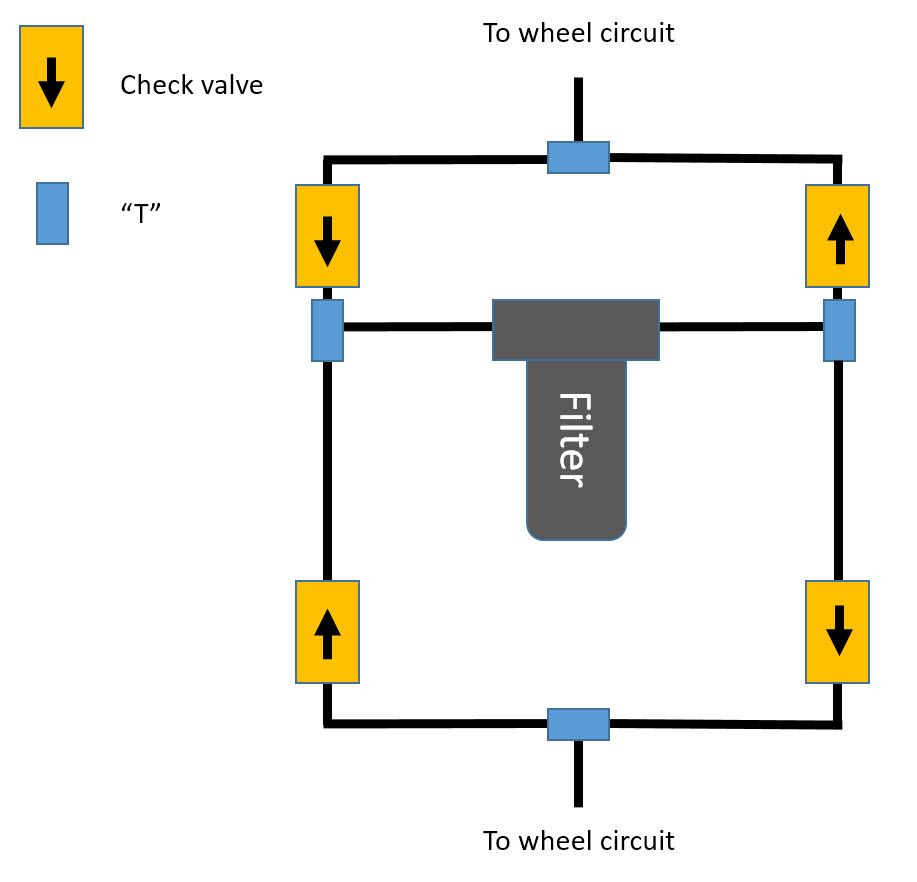
They do make filters that are designed for two way oil flow. Not cheap, but they do exist. Think sets of check valves that let the oil flow from a to b or b to a, but always the same way across the filter.

All the best, Peter

As I understand it, and this could be incorrect, the oil goes from the tank, through the existing filter, to the charge pump, to the variable volume pump as makeup oil. Any oil that slips past the VVP goes to the oil cooler, then back to the tank.

The VVP itself is reversible, depending on the angle of the swash plate. Neutral when pedals are centered. Press the forward pedal and fluid flows out to the wheel motors. Let up and it stops. Push down on the reverse pedal and the fluid flows the other way.

I don't see how you could filter the wheel motor circuits under operation, as it would backflush the filter each time you reversed direction.

You could filter them with a temporary filter placed in-line right at the input or output of the VVP and running the machine up on blocks in one direction only.

At least, that's the way I understand it.
 
   / Help, No forward motion!
  • Thread Starter
#34  
Got of the phone with Terry and my pump is on its way back. I asked about cleaning the lines. He said don't worry about it the pump was very clean inside. He said when I hook everything back up the filter will take care of anything left in the lines. The cause was I broke both bolt heads off that hold the swash plate on. He said all the parts were still in there. I asked what could cause that to happen. Just a fluke, he couldn't tell me. In reality it is just my crappy luck I guess. Either way I am going to do my best to flush anything out of there I can because I am replaceing all the oil with new fresh liquid gold. Thanks for all your help and suggestions. This still is the best forum on the internet. Helpful and knowledgable people not to mention nice as well.
 
   / Help, No forward motion! #35  
So, I've been following this thread hoping to gain some clarity but I have to show off my ignorance and ask some questions about terminology. I've read no fewer than 5 "pumps" called out in this thread: Main; Charge; Variable Volume; Tram; VD.

My manual (which has pictures of completely different mechanics and pumps than I have on my machine) provides schematics for just 2 pumps: System; and PTO/Steering. They do show pictures and/or make reference to a tram pump and variable volume pump but no guidance as to what they do - and as I mentioned, the pictures look nothing like what I have on my machine (which is unfortunate because I still can't tell which valve to turn should I ever need to tow it)

More to the point of this thread - I'm trying to get my head around how/why the wheel motors would be in a "closed system". I attached 2 schematics of the system pump (is this what's been referred to as the Main or Charge pump?) Seems like the oil flows through the filter and into the system pump, then on to the wheel motors. If that were it, I could see where the system is closed but the treadle valve schematic, which presumably modulates the flow of oil to the wheel motors shows oil flowing through the system pump and back to the oil tank.

I'm sure I'm missing something but I do find it odd that some members report increased power to the wheels when they've changed the hydraulic fluid to synthetic oil. If it's a closed system, that new synthetic oil would not replace the oil the machine came with unless the wheel motor system were bled.

Mostly just looking for some guidance on the terms used so I can try to follow along.

Thanks


View attachment System Pump pt425.pdf

View attachment Treadle valve.pdf
 
Last edited by a moderator:
   / Help, No forward motion! #36  
I'll give it a shot.

There are three pumps.

- 1 pump is for directional travel. It is called a variable displacement pump. Variable volume pump. Tram pump.

- 1 pump is for the main PTO. It powers implements like the mower decks, brush cutter, sump grinder, broom, etc...

- 1 pump is for steering, Front End Loader arms, and the quick attach system. The quick attach system is disconnected from the QA cylinder and attached to other cylinders on implements like the power angle cylinder on the snow plow. This is called the AUX PTO and is operated by the lever by the operator's right knee. The flow for this pump goes from the pump, to the steering valve, out a power-beyond port, and to the 3 valve bank for the FEL/AUX PTO lever (sometimes called the quick attach lever).
 
   / Help, No forward motion! #37  
I'll give it a shot.

There are three pumps.

- 1 pump is for directional travel. It is called a variable displacement pump. Variable volume pump. Tram pump.

- 1 pump is for the main PTO. It powers implements like the mower decks, brush cutter, sump grinder, broom, etc...

- 1 pump is for steering, Front End Loader arms, and the quick attach system. The quick attach system is disconnected from the QA cylinder and attached to other cylinders on implements like the power angle cylinder on the snow plow. This is called the AUX PTO and is operated by the lever by the operator's right knee. The flow for this pump goes from the pump, to the steering valve, out a power-beyond port, and to the 3 valve bank for the FEL/AUX PTO lever (sometimes called the quick attach lever).

To add one thing...the charge pump is INSIDE the VD (Variable Displacement) pump. In the first diagram, the VD pump is item 1, "System Pump." On your tractor, charge pressure is also used, through the treadle, to regulate the angle of the swash plate, and therefore, the direction of the tractor. This isn't unusual.
 
   / Help, No forward motion! #38  
I talked to Terry and he said your not even close to be in panic mode. The wheel motors do eventually drain back into the holding take he said.

What is the definition of "eventually" in this context? That's what I was talking about at the end of my last post...how much "leakage" is normal in these circuits. Further, the White motors in the 425 do not have a dedicated case drain. So, from a practical perspective, how could this circuit ever be filtered? Regarding your oil and condition of the pump, the particles that cause the most damage are too small to see. If your oil is dark, it's more likely from thermal breakdown IMHO. Definitely replace it though. All hydraulic machines require the hydraulic oil to be changed periodically. I replaced it in my Kubota's at 50 hours. My Takeuchi track loader also uses motor oil for hydraulic oil and the replacement cycle is every 1000 hours. For the Takeuchi mini-x, it's every 2000 hours depending on attachment use. Just to give you an idea of the range. Keep in mind, a commercial machine will reach these cycles every 1 or 2 years.

I've been curious for a while as to why these pumps from Power Trac fail so often. I've had one fail at <400 hours and another one on a different machine at <700 hours. This is crazy. A few people get a lot of hours out of them but that seems fairly rare, just going by this forum. For a lot of equipment used commercially, a failure rate this high would mean replacing the pump once or twice PER YEAR. To solve my curiosity, I hired a hydraulic consultant who's written several books on hydraulic maintenance to help me understand what is going on. What I've written is based on his advice.

The diagram for the filter I built is below. It uses a 3 micron filter (special order) and a filter case like this one (SAE 12 3 GPM High Pressure Filter | Filters | Hydraulic Filters | Hydraulics | www.surpluscenter.com). I added some gauges and a flow meter as well but they aren't needed for the basic setup in personal use. I probably wouldn't try to plumb this in permanently because there's not really enough room in the tub and it's hard to find an affordable high pressure filter that will take the pressure full time. I'm using a high pressure filter that's rated for about 3K PSI but I filter the tractor on blocks with the wheels off. Some pumps will generate over 5K intermittently under load. With the wheels off the ground, the circuit generated about 700 PSI if I remember correctly. This is plumbed IN LINE at the wheel motor....meaning you remove any line that's convenient and connect it to any line on the filter. Connect the remaining line from the filter back to the motor. When connected, you can reverse direction of the tram to reverse flow in the circuit (this is even advisable). I'm going to filter the circuit on my 1845 this week and I'll try to get a picture.

SNAG-0217_zpsbwezduan.jpg
 
   / Help, No forward motion! #39  
I guess I should add...coolconnection, I'm not trying to scare you with any of my comments. I'm just trying to give you the full picture so you can decide how much time and money (and hassle) you want to invest for more peace of mind. Something sounds fishy about the two bolts that broke, along with your previous problems. You could end up doing a lot of work on the filter or whatever only to find out later there's another problem. If it were me, I'd probably do the least possible now or I'd completely rebuild the thing. So there's nothing wrong with throwing the old pump back in, replacing the oil, and seeing what happens. If it breaks again, then you'll know for sure you need to do something more drastic.
 
   / Help, No forward motion!
  • Thread Starter
#40  
I've heard I'm not the only one with these problems. I asked Terry can I get a pump like what on the new ones. He said no because they don't use that pump in the new ones anymore. They have a totally different setup and it's cast iron now. Still thinking about running a temporary filter in the lines. I like your idea marrt.
 

Tractor & Equipment Auctions

2021 Kubota RTV-X1140 4x4 Diesel Utility Cart (A59228)
2021 Kubota...
2015 GENIE GTH-1056 TELESCOPIC FORKLIFT (A59823)
2015 GENIE...
2021 MULTIQUIP 25 WHISPERWATT AC GENERATOR (A59823)
2021 MULTIQUIP 25...
V.E. ENTERPRISES 500 BBL FRAC TANK (A58214)
V.E. ENTERPRISES...
2023 Ford F-150 Crew Cab Pickup Truck (A59230)
2023 Ford F-150...
MASSAGE CHAIR (A58214)
 
Top