Help with Brush Fire Water Rig

   / Help with Brush Fire Water Rig #21  
lets be clear ...brush fire fighting and structure fire fighting are entirely diffrent.

do not confuse the min requirements for structure fire fighting with that of wildland firefighting.

The following list is presented in smallest to largest (size /heat out put of wildland firefighting)

-protective gear. long pants (carhart- denim... not zip off plastic REI hikeing pants), a leather winter jacket, face shield, wristed leather gloves.

a flat shovel is a good first tool to attack small short grass fires.
an upgrade is a flapper, aka a hunk of semi-mudflap bolted to the end of a shovel handle.

A flapper can be effectivly used in med tall thick grass although takes effort and good protective gear.

backpack sprayer or Indian pack. generally tall thick grass is to hot to work with mechanical methods, but even a small spritz of water will quickly knock down the grass fire. the standard backpack sprayer can cover 300+ feet of flame front when working with another person.

From here you can step up to a 20 gal sprayer on the back of a atv/utv 12v powered, covers 4-5 times the space as a backpack

and from that to a large 200+ gal tank on the back of a truck/tractor with a 1" hose and pump capable of 60psi.


The point is if your out with the brush pile, and watching things, small hot spots can be put out quickly with minimal tools before they turn into mulipul acer fires.

 
   / Help with Brush Fire Water Rig #22  
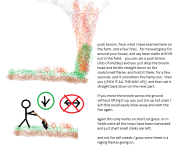
seeing schmism post.thought i best give a bit more explanation on push broom. remind you, i am no fire fighter or ever was trained. just having to call 911 enough times. and then being out there to help put out fire on the farm.

i never saw bush brooms being used. until a couple years back. when next thing i saw, everyone from fire department had bush brooms in there hand vs a garden metal rake, or shovel or 2 to 3 gallon air less sprayer. and within matter of minutes fire in fields (no crop just stalks remained) and fire that was going through finished mowed grass was put out, vs trying to use other things. that would of taken longer.

and then the big guns (tanker trucks) were down in pasture, dealing with the higher / taller / thicker taller weeds. and flames 6 to 15 feet high.

i am not saying a bush broom is correct tool of choice, but here on the farm, it has become poplar choice to keep on hand. along with a sprayer. vs shovels, and metal rakes

those after reading schmism note about a mud flap on end of a pole vs push broom.... i might have to rig something up. and hope i do not have to try it out.

fire fighting1.png
 
   / Help with Brush Fire Water Rig #23  
snip
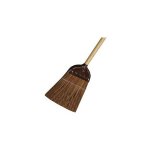
part of my arsenal, is a "bush broom" a 1 to 2 feet wide, and has tons of bristles in it. to smoother fire out.

snip.


"Bush Broom" I did a search for that and got squat...except this;

photo__5_.JPG


Is this what you refer to boggen?
 
   / Help with Brush Fire Water Rig #24  
   / Help with Brush Fire Water Rig #25  
Hypro - Hypro 4001C-A Roller Pump - Sprayer Depot

I too am looking for a similar setup. Around here most homes produce about 10 GMP. For small brush fires I figure it will do the trick. I have been looking at the Hypro 4001 that produces 9.1 GMP. (see link above) It also runs at 1800 RPMs which is what my 7hp engine produces. After reading this I am second guessing my decision to use a 9-10 gpm pump. With 250 gallons the simi-trash pumps will deplete my water in less than a minute. Please help me understand if I am under powering my system.
 
   / Help with Brush Fire Water Rig #26  
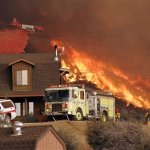
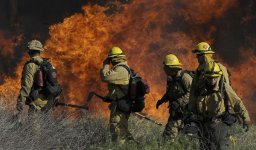
I suppose that there is a difference based upon experience and perspective regarding the term "brush fire".

I have never used a broom on a "brush fire". Here are a few photos of what I think of when someone uses that term:
 

Attachments

  • fire.jpg
    fire.jpg
    520.8 KB · Views: 386
  • fire2.jpg
    fire2.jpg
    83.6 KB · Views: 262
   / Help with Brush Fire Water Rig #27  
This is more in line with what I am dealing with.
burn pile[1].jpeg

Just trying to not let "my version of brush fire" not turn into "your version of brush fire".
 
Last edited:
   / Help with Brush Fire Water Rig #28  
Can you even get permits to burn any more. I mean even if you can if an ember blows off an ignites, you will be liable for the price of putting out the fire.
I'd chip it no matter what the cost. It will still be cheaper than if it gets out of control. Oh, and they do get out of control. The last several fires that got out of control were set by professional Forestry Fire fighters.

Just mu .02 cents.

I just looked up rules in your are - YEP, your responsible if it runs.

A Burning permit, 9-13-11 of the 1975 Code of Alabama, is required for all forestry and agricultural burns. In general, the permit means the burner has the manpower and equipment to control the fire and agrees to stay with the fire until it is out. Burning permits may be obtained by calling the Alabama Forestry Commission. Even though the burner has a permit, he/she is still responsible for any damage to others that may be caused by the fire or smoke. Alabama has a Certified Burner Law designed to reduce burner liability.

Even though the law requires a permit for all "wood & field" fires, the AFC has administratively exempted fires smaller than 1/4 acre if it is more than 25 feet from a forested area. However, the burner is still responsible for the fire.

Upon requesting a permit, the burner will be asked about the burn. The approximate size will be needed along with what is to be burned, i.e. grassland/fields/forests, and the general purpose of the burn such as fire hazard reduction, regeneration, wildlife benefit, etc. The burn must not contain material such as vehicle tires, construction material, household garbage or other material prohibited by ADEM (Alabama Department of Environmental management)

There are some County and City Laws that also restrict outdoor burning. Burners are responsible for contacting their local government for additional information.

The permit may be canceled by the AFC for failure to comply with the terms of the permit, weather condition change which cause erratic and dangerous fire behavior, or if the burn produces smoke which becomes a hazard to others or contributes to a degradation of air quality.
 
   / Help with Brush Fire Water Rig #29  
I'm sure some of you already know this but a backpack leaf blower makes a really good brush fire fighting tool and you don't have to tote water or drag a hose. Of course I wouldn't try it on over your head type fire, in a 20 mph wind or as a replacement for water at some point. But for containing smaller blazes before they become taller ones it's quite usefull. You actually blow the fuel back into the already burned area.
 
   / Help with Brush Fire Water Rig #30  
Lots of great suggestions here, interesting dialogue, it's apparent we have more than a few firefighters on the forum. I couldn't resist adding my .02c to the mix. For pump priming issues place the water tank above the pump and allow gravity to maintain prime. For pump dead head or heating issues when not flowing water put a tee in just off the pump discharge with a quarter turn valve, run a short smaller diameter hose back into the tank to move water when the nozzle is closed. Best idea is to wait for rain and then burn if you are not in the drought zone. And last, rather than spend a lot of money on a water delivery system, just buy a grapple and transport your brush piles to your pond where you have an unlimited water supply.
 
   / Help with Brush Fire Water Rig #31  
These are all great comments and points to help with burning and permits and such. But the original post by TROOK is concerning pump size and water volume. I too have questions about this but the most common feedback is concerning issues other than water and pump questions. Again, it is all good information but if someone can contribute to the original question I would be interested to hear what is recommended.

TO_Bud - Do you have a picture of your "quarter turn valve"? I was wondering how you allow water to bypass the hose when the nozzle is closed. Is there some sort of pressure relief valve that will allow the water to be diverted with the open and closing of a hand nozzle?
 
   / Help with Brush Fire Water Rig #32  
These are all great comments and points to help with burning and permits and such. But the original post by TROOK is concerning pump size and water volume. I too have questions about this but the most common feedback is concerning issues other than water and pump questions. Again, it is all good information but if someone can contribute to the original question I would be interested to hear what is recommended.

TO_Bud - Do you have a picture of your "quarter turn valve"? I was wondering how you allow water to bypass the hose when the nozzle is closed. Is there some sort of pressure relief valve that will allow the water to be diverted with the open and closing of a hand nozzle?

The quarter turn valve would go on the tee'd off short hose and would remain closed when flowing water through the nozzle. When the nozzle is shut down the quarter turn valve is opened to allow water to circulate back to the tank. The tank water would eventually heat up if this was carried on for too long a period but I think in the OPs case it would be fine.
Fire apparatus do have pressure relief valves built in but you are getting into an expensive technical setup now. The relief valves are also on the intake side of the pump for the fire truck to relieve pressure when the supply rises too much say from another piece of apparatus. These valves don't assist in keeping heat down in the pump when the nozzle is closed.
 
Last edited:
   / Help with Brush Fire Water Rig #33  
A pressure relief valve used in staying rigs would work for bypassing also.
 
   / Help with Brush Fire Water Rig #34  
TO_Bud is correct in his assessment of creating an alternative flow path to prevent pump overheating. A worst case scenario of pump overheat is boiling and then cavitation resulting in loss of prime if occurring during a draft operation. All multiple combination fire engines have a "tank-to-pump" (sometimes called a tank dump) valve. When using low flow,high pressure operations, it is very common to "crack" the tank dump valve to create a recirculation path to reduce pump overheating.
 
   / Help with Brush Fire Water Rig #35  
TO_Bud is correct in his assessment of creating an alternative flow path to prevent pump overheating. A worst case scenario of pump overheat is boiling and then cavitation resulting in loss of prime if occurring during a draft operation. All multiple combination fire engines have a "tank-to-pump" (sometimes called a tank dump) valve. When using low flow,high pressure operations, it is very common to "crack" the tank dump valve to create a recirculation path to reduce pump overheating.

"Tank Fill" valve is used to recirculate or top off the booster tank- comes off the output side. Both need to be open if circulating off the booster tank only. If running off a supply line, you can crack the tank fill and let it flow over.

For trash pumps, having the water level above the impeller will allow water to flow to self prime- just need a bleeder valve to let air out. When drafting, sometimes we would open the tank to pump with the rpm down, wait for the suction tube to back fill with water (till no more bubbles)- then quickly shut the valve and throttle up to achieve prime. Handy trick to practice in case the priming pump failed.
 
   / Help with Brush Fire Water Rig #36  
HPIM0702.jpg

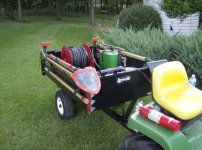
I built a "fire cart" out of a heavy duty lawn and garden cart, Fimco 15 GL spot sprayer with the 1 GPM pump replaced with the bigger 3.8GPM 12V electric pump. I plumbed it into a sprayer hose reel with 100' of 5/8 inch garden hose & nozzle. I mounted tools, portable pump can, etc. It can tow behind an ATV or lawn tractor, with the electric pump plugging into a pigtail ans switch on the lawn tractor.

Go out 10' or more and brush/mow out a wide fire break to burn out to secure your pile. Burn when the relative humidity is at least 40%, and secure the downwind side of the fire break first with a "black line".
 
   / Help with Brush Fire Water Rig #37  
View attachment 288232

I built a "fire cart" out of a heavy duty lawn and garden cart, Fimco 15 GL spot sprayer with the 1 GPM pump replaced with the bigger 3.8GPM 12V electric pump. I plumbed it into a sprayer hose reel with 100' of 5/8 inch garden hose & nozzle. I mounted tools, portable pump can, etc. It can tow behind an ATV or lawn tractor, with the electric pump plugging into a pigtail ans switch on the lawn tractor.

Go out 10' or more and brush/mow out a wide fire break to burn out to secure your pile. Burn when the relative humidity is at least 40%, and secure the downwind side of the fire break first with a "black line".

I like what you put together, seems pretty complete. Several fire departments have essentially done the same thing to tow behind ATV's.

Question about the round point shovel- did you re enforce the edge or is the red metal just the tool holder?
 
   / Help with Brush Fire Water Rig #38  
I might suggest that you do not forget about the man who
is using all those tools and pre-load some drinking water, maybe
have a pair of gloves and dust masks etc in place ready to go as well...
(a fire shelter or two would be very wise too.)

The pull carts are very cool, great job.
 
   / Help with Brush Fire Water Rig #39  
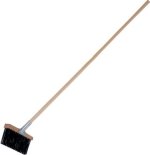
Firefighting professionals shop for helmets, flashlights, boots, badges and shields at TheFireStore.com - Brush Fire Broom, 5 Ft Length

This is what he is talking about. Heavy duty bristles that you wet down before using. We used them to sweep the edge back into the burned area on smaller fires/smoldering stuff. Not too useful on anything free burning.

View attachment 278262

There is also another version of the "fire broom" that is available from Cascade Fire Equipment that is essentially a "push broom" with metal bristles. It is used similar to the Perfex fire fighting broom of rattan fibers, but is pushed instead of "swept". cascade fire broom.jpg

As with all the "brooms" and "flaps", they work good on creeping fires in light fuels. For hotter fires, you need someone to cool it down with water spray from a backpack pump or small spray hose.

I use a heavy-duty "broom rake" or heavy-tined "leaf rake" to sweep in the flames and debris wen cleaning up along a mowed fire break that has been burned out. Next to a leaf blower, this is the fastest portable hand-carried tool for putting in a fast fire break in hardwood leaf litter. Don't try the cheap rakes. Get one with heavy reinforced steel tines. I found mine at a farm supply store and the Forestry supply catalogs stock the same rake, made by some company in Missouri.
 
   / Help with Brush Fire Water Rig #40  
That is just a rubber tool guard to protect the edge and avoid cutting someone.

The edge of the "fire shovel" is sparpened within 1.5 inches of the step on either side, for scraping and cutting very light brush. It is a bit different from the standard hardware store shovel.


Marketplace Items

16ft T/A Utility Trailer (A59231)
16ft T/A Utility...
2014 Dodge Grand Caravan Van (A59231)
2014 Dodge Grand...
2015 Ford F-250 Service Truck w/ Liftgate (A59230)
2015 Ford F-250...
2014 CATERPILLAR 308E2 CR EXCAVATOR (A60429)
2014 CATERPILLAR...
CATERPILLAR 627K SCRAPER (A52707)
CATERPILLAR 627K...
MASSAGE CHAIR (A58214)
 
Top