Home brew boom pole

/ Home brew boom pole #21  
patrick_g said:
The pessimist thinks the glass is half empty. The optimist thinks it is half full. Engineers, scientists, and economists think the container is twice as big as it needs to be wasting material and money.

Properly guyed, braced by spreaders and tension members (guy wires), a rather small diameter light weight boom pole is of sufficient strength to take anything a moderate tractor can put out. Total weight can be significantly less but strength and lift capacity more than the HD pole approach.

The trick is to keep the pole in compression and "IN COLUMN." If you allow the pole to bend then it will rapidly destruct under max forces.

Pat


The only thing I have to add to that is if you are a frugal (not cheap I emphasize) engineer type like yours truly will look at the pile of junk and imagines the possibility. Other than time and my welder the rest was collected of a junk pile. The pipes came from and old Low pressure condensate return that was old 40 years. The pipe structurally was alright but had such a blockage than no amount of angioplasty could have saved it. The pipee were destined to a land fill when I intercepted it, same goes for the rest of material. I could keep it a bit lighter and still as structurally sound but then I just used what was at hand. I am very much advocate of saving our resources and it irks me at the amount of waste we produce in U.S just simply because we can.

jc
 
/ Home brew boom pole
  • Thread Starter
#22  
When I started this thread,I never expected so much response. It has all been of interest. The original bent brackets were a result of forces trying to move the lift arms apart. At no time was there any problem with the actual pole part of the project. I have read and noted the comments re stretching and compressing and agree totally.

My modification to the lift brackets was to straighten the brackets and weld a length of angle between the two brackets. Welding the inside of the angle to two sides of the bracket has given it a much greater resistance to bending.

When I originally tried out the pole, I used the end position to pull. On one of the better rooted trees, the lift stopped as the 3ph went into bypass of the hydraulics. Obviously out so far was too much. When I try again, I will be trying the halfway position. I will also try using some of the other ideas such as the v shape to wedge onto the tree and lift via 3ph. When I have a working system I will post pictures.

Cityfarma
 
/ Home brew boom pole #23  
JC, I sure don't quarrel with using "used" materials. My insulated pop can cover is an ad for Handy Metal Mart in San Diego. They are a used and secondary metals dealer and recycle yard. They were my first choice when buying metal when in San Diego. Here in Oklahoma there is a lot of "old used" pipe and some other materials trickling down from the oil field industry. I have "pickin' rights in the scrap dumpster at a nearby trailer manufacturer where I do business. One mans junk (scrap) is DEFINITELY another man's (MY) treasure. LITERALLY!

Previously I was waxing theoretical, a bit. If the choice is between available cheap or free materials that may be inefficient or over sized vs new materials "right sized" for the job/design but at significant cost... Well, FRUGAL WINS HERE!!

Pat
 
/ Home brew boom pole #24  
patrick_g said:
JC, I sure don't quarrel with using "used" materials.
Previously I was waxing theoretical, a bit. If the choice is between available cheap or free materials that may be inefficient or over sized vs new materials "right sized" for the job/design but at significant cost... Well, FRUGAL WINS HERE!!

Pat

Yes Sir... I concur fully.

JC:)
 
/ Home brew boom pole #25  
cityfarma said:
The original bent brackets were a result of forces trying to move the lift arms apart. At no time was there any problem with the actual pole part of the project.
Actually the bend was caused by the crossbar trying to move forward because of the load on the boom. The lift pins in the flat plate were in shear(bending force) so they bent and the 3PH lift arms accomidated this bend by moving outward easilly.

cityfarma said:
When I originally tried out the pole, I used the end position to pull. On one of the better rooted trees, the lift stopped as the 3ph went into bypass of the hydraulics. Obviously out so far was too much. When I try again, I will be trying the halfway position. I will also try using some of the other ideas such as the v shape to wedge onto the tree and lift via 3ph. When I have a working system I will post pictures.Cityfarma

Even at half boom length, I don't think you will find it too productive. The 3PH lift arms pivot where they attach to the tractor when lifted by the links to the upper lift arms, attached somewhere along their length. This geometry combined with the 3PH piston size and available hydraulic pressure yield a certain lifting force at the end of the lift arms. IF you double the length of the 3PH lift arms, you will half the available lift force(only takes half as much weight to open the 3PH hydraulic safety valve). If you double the arm length again, you will again half the lift force. So an arm 4 times as long yields 1/4 the original lift force. How long is it to the tip of your boom from where the 3PH arms attach to the tractor? Divide this by the length of the lift arms and you will have an idea of the available lift force at the end of your boom pole. Your greatest lift force will be achieved along the bar between the ends of the 3PH lift arms, and in my experience, vertically is the best way to pull out most brush/shrubs/trees.

I have a boom pole which came as part of my posthole auger. I find it tremendously usefull and I use it a lot. In fact, it hasn't been off the tractor in nearly a year. I use it to move around impliments that other light items that arn't too heavy for it to lift(but too heavy for me to lift:)). I use it to keep my chain harrow behind the tractor and out of the rear wheels when I turn and to lift it for transport over areas I don't want to drag. I use it to keep the front end of bundles of branches and small logs I am dragging by the drawbar, up off the ground so they don't dig in on my rough terrrain.

I wouldn't bother using it to pull brush as it is a big waste of the tractor's potential 3PH lift capacity. It is also not particularly safe to pull with as it is attached too high on the tractor. When I pull with a chain or cable, I pull from the drawbar located well down below the rear axle. I never pull from any higher than the 3PH lift arms and when I use them, it is with an impliment(box blade or single shank ripper).
 
/ Home brew boom pole #26  
Ron, While I am in agreement with virtually every word you wrote, I think you may have misspoken or overlooked a small thing.


You said. "Your greatest lift force will be achieved along the bar between the ends of the 3PH lift arms..."

If, for example, you were to place a bar across the top of the lower arms of a 3PH between the tractor proper and the ends of the arms and attach a chain to it to attach to a small tree or whatever you would experience a mechanical advantage, a multiplication of lift force above the max rating for the ends of the arms. Same math and logic you mentioned. If your attachment point were 1/2 way out to the end you would get double the lift force, 1/3 of the way is 3 times the lift force, etc. A down side is the reduced range of motion but if you can lift a tree a few inches and get another grip and lift it a few more you may very well loosen it enough to move your attachment farther back to get a greater range of motion.

I find that the initial few inches are often the hardest when removing brush and trees and that once the root's hold on mama earth is substantially broken the removal gets easier (but sometimes it doesn't seem so.)

Pat
 
/ Home brew boom pole #27  
patrick_g said:
Ron, While I am in agreement with virtually every word you wrote, I think you may have misspoken or overlooked a small thing.


You said. "Your greatest lift force will be achieved along the bar between the ends of the 3PH lift arms..."

If, for example, you were to place a bar across the top of the lower arms of a 3PH between the tractor proper and the ends of the arms and attach a chain to it to attach to a small tree or whatever you would experience a mechanical advantage, a multiplication of lift force above the max rating for the ends of the arms. Same math and logic you mentioned. If your attachment point were 1/2 way out to the end you would get double the lift force, 1/3 of the way is 3 times the lift force, etc. A down side is the reduced range of motion but if you can lift a tree a few inches and get another grip and lift it a few more you may very well loosen it enough to move your attachment farther back to get a greater range of motion.

I find that the initial few inches are often the hardest when removing brush and trees and that once the root's hold on mama earth is substantially broken the removal gets easier (but sometimes it doesn't seem so.)

Pat

Yes, you are correct, if you want to go shorter than the stock 3PH lift arms, you will get greater force with less movement. The only problem I usually run into when using a chain to pull something is taking all the slack out of the attachment. The tractor will sink a little, the tires will flex a little, the chain will slip a little and before you know it you have used up all your available travel before you bring any real force to bear on your intended target.

I kicked around a few ideas for a hydraulc "stump popper", but as it got more involved to account for most of the variables, the ammount of work it would take to build started to approach that of a backhoe. I think I would rather build the backhoe and am making plans in that direction as it will digout and remove the stumps and have other uses.
 
/ Home brew boom pole #28  
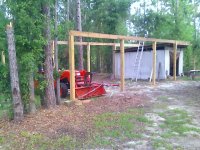
Talk about cheap. Just had to shout out my solution to installing beams with a boom pole. I just chained the boom pole (normally designed for the 3ph) into the bucket and lifted away. Worked great.
 

Attachments

  • Finished beams 05-07-07_0639.jpg
    Finished beams 05-07-07_0639.jpg
    159.8 KB · Views: 535
/ Home brew boom pole #29  
Cool, Uphill, now hurry up and finish so you can come help me do mine!

Pat
 
/ Home brew boom pole
  • Thread Starter
#30  
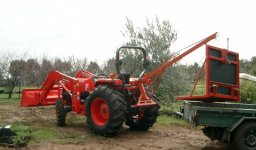
After an initial failure due to under engineering, I have now finished the pole. The 3ph brackets have been braced and a strap welded along the top.

It was certainly a lot easier unloading the home brew carryall I have also just completed.:) Like most stuff I make, both were mostly recycled material. Work has been having a major equipment upgrade and the steel recycle bin has been a great source of steel. Unfortunately this has just about finished so I may have to buy :( some steel.

I will be building a garage to store the tractor in so I am now working on making some brackets to adapt the pole to the FEL. This will allow me to lift beams and support them while I bolt them in place. I acknowledge the previous posts that mention the reduced load capacity of the FEL with loads way out front. I will only be lifting relatively light loads and supporting them.

Cityfarma
 

Attachments

  • Putting it all together.jpg
    Putting it all together.jpg
    92.9 KB · Views: 486
/ Home brew boom pole #31  
Citifarma, What you loose in max load capability out at the end of the pole will be more than made up in the greater utility of the extra height of reach and enhanced dexterity with curl and lift.

Pat
 
/ Home brew boom pole
  • Thread Starter
#32  
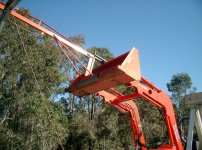
I have finally got my pole adapted for the FEL as well as the 3PH. The actual pole is changed from one adapter to the other.

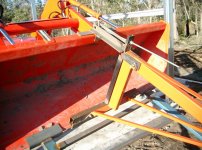
On the FEL, the bracket sits on the bucket edge and the top hooks into the top lip of the bucket. The picture shows a length of all thread. This is only a temporary fitting to test out the length of the top section. The top hook is to be a separate section to the main bracket to allow the hook to be put behind the lip then a pin will be inserted to join them. The hook consists of a length of square tube with a piece of angle welded on.

It certainly made it a lot easier to build the frame of my garage.

Cityfarma
 

Attachments

  • Bucket pole test.jpg
    Bucket pole test.jpg
    309.1 KB · Views: 491
  • Bucket pole in use.jpg
    Bucket pole in use.jpg
    364.7 KB · Views: 540
/ Home brew boom pole #33  
cityfarma said:
I have finally got my pole adapted for the FEL as well as the 3PH. The actual pole is changed from one adapter to the other.

On the FEL, the bracket sits on the bucket edge and the top hooks into the top lip of the bucket. The picture shows a length of all thread. This is only a temporary fitting to test out the length of the top section. The top hook is to be a separate section to the main bracket to allow the hook to be put behind the lip then a pin will be inserted to join them. The hook consists of a length of square tube with a piece of angle welded on.

It certainly made it a lot easier to build the frame of my garage.

Cityfarma

Neat. I tried to describe something like what you did over the phone to a friend who wanted to put a pipe over his hay spike and use it to lift trusses (BAD IDEA) but with your pix I can easily make what I was talking about more clear. I suspect he tried anyway and probably bent his hay spike.

Just curious but I would have thought the "spreader" holding the upper guy rod out from the boom would have been better co-located with the attachment point of the lower braces (or vice versa.)

Pat
 
/ Home brew boom pole
  • Thread Starter
#34  
"Just curious but I would have thought the "spreader" holding the upper guy rod out from the boom would have been better co-located with the attachment point of the lower braces (or vice versa.)
"

Not sure what you mean. The orange part is my original pole made to attach to the bracket made for the 3PH. The new brackets were then made to adapt the pole to the bucket. As the pole and adapters where made from pre loved metal, I was constrained to the existing lengths. The pole was already welded rightangle. If designed for new steel, then it would have been done slightly different as I could then cut and weld as required.

Cityfarma
 
/ Home brew boom pole #35  
citifarma, It might not matter if the strength of your assy is high compared to the max load you will lift.

Anyway what I mean is the piece of steel at right angles to the pole which separates the pole from the guy wire (rod) which in sailor talk is a "spreader" because it spreads out the guy wire/rod from the mast/pole.

The two braces that support the pole from the bottom would have made for a stronger assy if they connected to the pole right below where the spreader is connected.

It isn't a big deal if the assy isn't overstressed. If it is overstressed the pole will bend at the location where the lower braces attach.

Pat.
 
/ Home brew boom pole #36  
I think in this application the vertical is refered to as a kingpost. That on the main beam and the top wire/support forms a kingpost truss common in many bridge designs.

I agree that the lower angled supports should meet the beam below the kingpost. This way the upward forces go up thru the beam and along the post and spread out along the upper diagonals which are in tension. like this attached .BMP. Basically you are trying to bend the beam below the post and the the post and wires prevent this.
 

Attachments

  • boompole.bmp
    114 KB · Views: 348
/ Home brew boom pole
  • Thread Starter
#37  
Pat & Ron thanks for your comments. As they say "A picture saves a thousand words."

The reason for this arrangement is that the original pole did not have a spreader on top and I detected a slight bend when tested. I added the spreader later. I will consider replacing the lower braces as you suggest when I get some spare time. I was thinking that they probably should be heavier to strengthen the pole anyway. At this time it is only being used for fairly light work.

Cityfarma
 
/ Home brew boom pole #38  
RonMar said:
I think in this application the vertical is refered to as a kingpost. That on the main beam and the top wire/support forms a kingpost truss common in many bridge designs.

Thanks for the lesson Ron. I'm not a mechanical engineer type nor am I conversant with a lot of the terminology. My applicable background is physics (and related vector analysis) and sailboats, both of which of course calls the same things by different names than proper engineers.

Your drawing illustrates the concept very well. It is easy to see what happens when the lower supports are not co-located with the kingpost. A torque is generated that is unopposed except for the resistance to bending of the boom pole and if it is sufficient will start to bend the pole there.

Of course there are alternatives such as stiffening gussets or whatever in the plane formed by the wire/rod and the pole to beef up the region otherwise subject to being bent.

Pat


Marketplace Items

2022 EZ-GO ELITE ELECTRIC GOLF CART (A63276)
2022 EZ-GO ELITE...
Barrel (A64557)
Barrel (A64557)
2022 EZ-GO ELITE ELECTRIC GOLF CART (A63276)
2022 EZ-GO ELITE...
2016 WEILER P385A ASPHALT PAVER (A63276)
2016 WEILER P385A...
SHOPBUILT T/A TRAILER (A64278)
SHOPBUILT T/A...
Star (A64557)
Star (A64557)
 
Top