Homemade quick attach

   / Homemade quick attach #161  
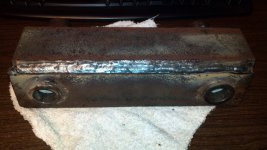
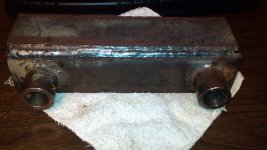
A bit more progress to show. When I realized that I was going to have to put a front plate on the loader-side of the adapter, I looked around for pieces of metal that I could use. I had two 11"-and-change drops of the same 3/8" thick 2 1/2" wide flat stock that I made the side plates out of. It would do perfectly, except for one thing. If I put the front plate inside the two side plates, then the front plate would rub up against the loader arms. If I put the front plate outside the two side plates, the side plates would be too narrow to fit the loader arms. Therefore, I fit the joint up as a non-overlapping corner. I set the plate vertically on the table and used magnetic welding "clamps" to hold the alignment. There was about 1/16" or less of gap between the side and front plates. This allowed me to have full confidence that I was getting 100% penetration on the joint, since I could see it from the back side. A single bead would probably have been more than adequate, but for aesthetics' sake, I ran three beads to fill out the joint. For completeness, I went ahead and welded up the fillet on the back side as well.
2013-02-08_21-56-49_646.jpg

2013-02-08_21-56-34_835.jpg

Don't ask me what happened right around a quarter of the way into the bottom-most photo, where the bead suddenly zigs upwards. I have no idea. I thought that I was carefully following the edge of the plate the whole way. I'm guessing that I was actually slightly nipping off the edge, and then unconsciously fixed it and began actually following it. I dislike welding at night (by a halogen work lamp) because it makes it that much harder to see the work piece. Sometimes I'll be off my intended path for three inches of bead before I realize it.
 
   / Homemade quick attach #162  
In retrospect, this could all have been avoided if I had drilled the holes, then built the adapter, then aligned and welded in the bushings. However, this would have prevented me from welding up the back side of the bushings, which is one reason I did it the way I did. I'm not sure which would be more desirable: easily aligning the bushings or having full-pen welds. Because the bushing holes were drilled oversized, not welding up the back side would leave an ugly gap.

I think you answered your own question. Fun to align, was it?:no: No. You need to account for distortion in welding, as it will happen. So figure a way to align it to death or bore it after welding.
 
   / Homemade quick attach #163  
I think you answered your own question. Fun to align, was it?:no: No. You need to account for distortion in welding, as it will happen. So figure a way to align it to death or bore it after welding.

Indeed. Unfortunately, I lack the tooling to bore, so I'm trying to muddle through. I sure have learned a lot about welding in bushings on this project, though. Learned what not to do anyway...

I just came in from doing the final alignment after filling out the joint with bead, and I'm really in a pickle now. Before I put the last two beads in, both sets of bushings were sufficiently aligned to allow the pins to be inserted by hand, if a little stiffly. After I put the last two beads in, one set of bushings is misaligned such that, if I spread the side plates to center the pin on the receiving bushing, the pin is at such an angle that it won't enter the bushing. And if the plates are aligned such that the pin is parallel to the receiving bushing's axis, it's not centered. I'm really puzzled as to how putting the last two beads on caused this type of misalignment, but it is what it is.

At the moment, I don't see any other approach than to cut out one of the bushings with an over-sized hole saw, grind the outside down a bit, and weld it back in properly aligned.
 
   / Homemade quick attach #164  
Well, if you can locate a bridge reamer, it would work. It is made to align in one side and ream the other to fit. They are typically 8-12" long. I have bought them used off eBay at reasonable (<$20) prices even for 1.25" holes.
 
   / Homemade quick attach #165  
Every time you add a bead of weld to something, it changes the stresses on the base metal and you get more distortion. It's a big part of the reason why most pro-built attachments like this aren't welded to death, but are done enough to give the desired strength without twisting too badly. Long continuous beads look good, but add a lot of heat on one side. I've cheated a bit before by angling parts slightly apart before I weld, knowing they'll get sucked togather when the weld cools. Without a lot of experience which I don't have, that's pretty much hit or miss. Sometimes you get it right, other times you don't.

I'm learning a lot from this project.. I'm glad you're doing yours first, I make enough mistakes as I go without breaking trail.

I've learned that I'm going to need a reamer ( I have access to most sizes I need through work), and I'm going to finish all my welding, THEN ream the holes to finish size as my last step before cleanup and paint.

I'm also learning that if I overbuild it, I'll be making a lot more work for myself in trying to get things straight again.

Thanks for the progress reports, it IS interesting watching it go together and learning as we go.

I looked at a pic of a Kubota pin-style QA a couple days ago and noticed the step in the bucket-side of the adapter.. about the same time you noticed you needed one. Most of the ones I've seen before are the SSQA style.

Sean
 
   / Homemade quick attach #166  
Folks, I am this close to calling this project a learning experience and tossing it in the scrap bin. I'm sure I'm just frustrated and will get over it, but I can see that I have gone about this totally the wrong way, and now I feel like I am just banging around trying to correct my mistakes with more mistakes. Yes, I have learned a lot, but I'm not sure if at this point, what I'm really learning is how to put band-aids on dumb mistakes, instead of learning to do things properly in the first place. The true essence of a "hobby welder." Ugh.

I made up the second loader-side bracket, this time taking every precaution I could think of to keep the holes aligned through welding, and at the end of it, both of the sets of bushings are so out of alignment that no amount of spreading or squeezing will bring them back. My best guess is that the weld caused a slight cupping of the side plates. Getting out a straight-edge to confirm this wouldn't tell me anything, as the side-plates were not dead-straight to begin with, but that's my best guess.

Another thing that is confusing to me is that the side plates squeezed in narrower after welding up the outside fillet. This is opposite to what I expected: I expected the weld metal to cool and contract, pulling the side plates outwards. Can anybody explain what happened?

At this point, the next step would be to take the two loader-side brackets back to the machine shop and ask them to ream them out. The problem I forsee with this is that they may be so far out of alignment that they would have to be opened up way too far to get the pins to go through, resulting in sloppy fitup and eventual wear and wallowing out of the holes.

As I think about it, I suppose another alternative would be to cut out half of the bushings and weld them back in. Which, frankly, would not be too onerous, and would salvage the project. Dang it. Here I was looking forward to forgetting about the whole thing.
 
   / Homemade quick attach #167  
Ahhh.. you've come this far, no point in stopping now. How bad could it really be? If it were me, I'd finish the welding, then take them back in to get reamed as you said. If they're a little sloppy, they're a little sloppy. It's a loader bucket or a set of forks, they bounce around a bit anyway once they wear in. If it's too bad, you can fill in the low spots with a bit of weld then grind the excess away. I'm enough of a hacker that I'd use a rat-tail file to get clearance and not worry about it a bit.

Good learning experience.

Sean
 
   / Homemade quick attach #168  
Well, folks, I've got good news and bad news. The good news is that I used a hole saw to cut out three of the four outside bushings and welded them back in, properly aligned. I chose the outside bushings because they are only 1/2" long and it was easier to get the hole saw over them, versus the inside bushings, which are like 2" long. Anyway, after welding them back in, the alignment was perfect. Well, I'm sure a real machinist would have criticized it, but the pins slid in freely and dropped out under their own weight, so I call that pretty darn good. In fact, the only one that binds at all is the one that would just barely work without cutting it out. I was tempted to cut it out to get from "sticks a little" to "doesn't stick at all", but I decided it wasn't worth it.

I considered how I might weld up the back side. I realized that, if I stuck the rod through the inside bushing, I could access the back of the outside bushing with acceptable rod angle. I ultimately passed on that, for two reasons. First, I wouldn't have been able to see what I was doing very well, and might have screwed things up. Second, I was pretty tight on clearance for the loader arms on the inside, and I didn't want to lay down any weld bead that would eat that up. This would all have been moot if I had a larger grinder than my 4.25", but my grinder is unable to get to the back/inside of the bracket, so I figured better leave well enough alone. As far as penetration, I wasn't too worried. The factory bushings on my bucket are only welded on the outside. On top of that, there was about 1/16" or more of gap where the hole saw's kerf was, so I figured I was probably okay to go on penetration.

The bad news pertains to that inside clearance for the loader arms. When I dry-fit everything, I determined that I would have about 1/8" of clearance on the inside of the bracket, as long as I did a non-overlapping corner joint--in other words, touch the corners of the pieces together, with neither one inside the other one, and weld it up like a fillet. Why didn't I just use a wider piece of stock? Well, I had two drops of the same stock I used for the side plates, and they were just the right length, so I decided to try to use them. Unfortunately, when the welding was done, I lost a lot of that clearance as the weld pushed the side walls closer together. With my spreaders and liberal application of a mallet, I was able to get the side walls back more or less parallel with each other, and there was enough spacing for the loader arms, so I considered myself to have succeeded. I went and welded the bushings back in and happily put the loader-side brackets on my tractor. They're on there now!

And that's when I realized my mistake: the bucket level indicator. It needs to go inside the bracket, and there simply isn't enough clearance between the side plates to fit it in. Not at all. Like, there's maybe less than 1/32 of clearance, total. The bracket goes onto the loader arms without any forcing, but once it's there, it's basically lightly touching at all times. There's no way that I can think of to make enough room for the level indicator.

My only option, as I see it, is to cut off the front plate and make it wider. Of course, I'll also have to cut out the bushings again and re-align them. At which point, I may as well just start from scratch, which is what I may do at some point. For now, I'm going to work on something else.
 
   / Homemade quick attach #169  
Seriously? You're going to let a bucket level indicator stop you? I've been following your progress, and you have overcome a lot of problems/mistakes. I don't know how your level indicator works that it needs to go inside a bracket, but that would be the last thing I would be concerned about. There are lots of ways to do that, from sliding rod in a tube dealies to the Kubota method of an angle plate welded to the top edge of the bucket with the top parallel to the bottom. My previous tractor had the simplest of all, just look at the bucket and see if it's level, (or wherever you want it).

Don't let a little thing like that stop you, you're almost done. Clean it up, paint it, install it and use it. Figure out an indicator later. I bet it takes you about an hour to figure one out and make it and install it.

For what it's worth, we've all been there, gotten discouraged when things don't seem to be going just right. Just keep plugging away and when you finally get it done and it works you'll forget the frustrations and stand back and say "Now that's pretty cool."
 
   / Homemade quick attach #170  
I took the indicator off mine because it always needed to be lubed to keep from screeching. It took about 3 times operating to get used to it.
 
   / Homemade quick attach #171  
I'm with RBA50.. I've used the Kubota MM (Mickey Mouse) level indicator for years. Granted it's not an ideal situation, you have to be able to see the top of the bucket and the little piece of steel to have any idea if the bucket is level. But, it works.

If you're that picky about fit and finish, you can work on my gear anytime you like! I find the older I get the more practical I am about stuff I build, it doesn't have to be perfect anymore, it just has to be safe and work. If I'm paying for it things are a little different, but still..

Sure you haven't got a touch of OCD going on here??:) Ooops.. I spelled that wrong, it's CDO, because "O" does NOT come before"C"!

Sean
 
   / Homemade quick attach #172  
I took the indicator off mine because it always needed to be lubed to keep from screeching. It took about 3 times operating to get used to it.

Mine hasn't screeched yet. Then again, it's only a little piece of steel welded to the top of the bucket, so I suppose it wouldn't screech anyway :) Have you considered adding a Kubota-type indicator to the Deere? They're Mickey Mouse but do work, you can even paint it green if you like!

Sean
 
   / Homemade quick attach #173  
Mine hasn't screeched yet. Then again, it's only a little piece of steel welded to the top of the bucket, so I suppose it wouldn't screech anyway :) Have you considered adding a Kubota-type indicator to the Deere? They're Mickey Mouse but do work, you can even paint it green if you like!

Sean

I'm used to it now. I never even think about needing one. Funny how that works eh? Lift capacity on the other hand...
 
   / Homemade quick attach #174  
I've always hated the rod type indicators. I find they always in the way, noisy or bent. Never mind the fact that you can't judge cutting angle below flat. I don't mind the MM (as it's been called here) on my Kubota but it's really not hard to figure it out without one. I, like probably many others on here have spent more hrs/yrs using buckets without indicators than with.

Set the heel of the bucket on the ground, watch the top lip of the bucket as you roll down. When the "roll" changes to "lift" is when you pass the "flat on the ground point". Or do the same thing watching the heel of the bucket and you will see when it just lifts off the ground.

Can yours not simply be mounted on the outside of the bracket???
 
   / Homemade quick attach #175  
I didn't want to pay for shipping, so I had the bushings come in on the bi-monthly stock order to my dealer. That was today! Here are a couple of the bushings.

<img src="http://www.tractorbynet.com/forums/attachment.php?attachmentid=298035"/>

For the side plates, I'm working with 3/8" thick by 2 1/2" flat stock. I cut the stock to 12" length using a my new Harbor Freight 4x6 bandsaw, which was the tool that I used this job as an excuse to finally buy. The final straw on the chop saw was that it always arced out at the end of the cut, meaning my ends were never straight.

I drilled pilot holes 8" apart, using the first piece as a jig for the subsequent ones. I hand-aligned the blank with the cut piece and drilled the first hole in the blank, then I stuck a 1/4" bolt through the two holes and drilled through the cut piece's second hole into the blank. This guarantees that the spacing between the pieces is the same.

Next, I went at it with a hole saw. I prefer to pre-drill my pilot holes when using a hole saw in metal because it ensures that the hole is exactly where I want it, and also because the pilot bits that come with hole saws aren't stellar drill bits.

<img src="http://www.tractorbynet.com/forums/attachment.php?attachmentid=298037"/>

My 1.5" hole saw fit the bushings perfectly, but unfortunately, my holes were not precisely positioned enough to exactly match the pin spacing on the bucket. So I ran to the hardware store and got a 1 5/8" hole saw. This should give just enough slop to allow positioning the bushings, while not leaving so much gap that it ends up being hard to weld the bushings in. I had to go back and enlarge the 1" holes that I drilled, which took some figuring out, since there was nothing to hold the pilot bit in place and keep the hole saw from skipping all over. I ended up putting a second piece of metal underneath and aligning the two so that the pilot hole on the bottom piece caused the hole saw to line up correctly on the top piece.
.

Ive had this happen in the past as well. You did ok with your second pilot hole plate underneath.

I have used a piece of hardwood slightly bigger that the hole 1 1/2 bit use 1-5/8 and sand to fit tight.

You now have a good pilot hole jig and the hole saw will cut its new groove before the jig gives up!

Obviously you can use steel also but much harder to get a tight fit.
 
   / Homemade quick attach #176  
I would agree with Chilly, In some ways the MM Kubota indicator is better than the fancy smancy rod and tube one on the Kioti Which I wadded up in the first 10 hours on the Kioti, I did repair it and not had any more trouble with it, but like someone said you cannot judge tilt less than horizontal anyway as the rod disappears down the tube. And that rod sticking up and brush and tree limbs seem to have an affinity for each other.:)

James K0UA
 
   / Homemade quick attach #177  
Yes, exactly. At least the areas that will be welded. It's surplus steel, so it's pretty rusty even after I've run over it with a wire wheel. I plan to try electrolytic rust removal on the two brackets before welding the rod in between them and then painting. That should be pretty cool!

Do a search on You Tube Molasses and water to dissolve rust. Tried it and much more effective than commercially available rust dissolvers
 
   / Homemade quick attach
  • Thread Starter
#178  
If you're having this many issues your money is probably well spent just buying an SSQA quick attach and being done with it. I know my time is worth something, Im sure yours is too. That titan attachments on here is selling the pin boxes pretty cheap, all you'd need to do is cut off your bucket ears and weld those onto the pin boxes then of course weld the SSQA plate onto the bucket. I didnt have this cheap of an alernative when i built my quick attach, if I did I would've went with the ssqa right off the bat.
 
   / Homemade quick attach #179  
I appreciate the encouragement, folks. Part of my motivation for starting over is that getting a working QA has always been my secondary goal. My primary goal has always been to hone my fabrication skills. The incorrect spacing of the side plates, and the fact that the side plates are way out of square, is an indication that those are skills that I need to work on. Getting your finished product to the intended dimensions and alignment is a pretty basic fabrication skill. If I was to have a shop teacher looking over my shoulder, he'd be saying, "Grind out those welds and get it right," not, "Ahh... it's fine. Go on to the next step."

Yeah, getting a working QA is in there somewhere, but for me, at this point, the number of mistakes has crossed a threshold where there's too much opportunity to continue to learn. I'd really feel like I was letting myself down if I just charged ahead and produced a finished piece that was full of mistakes and that I couldn't feel proud of. If I thought that I couldn't do any better, then I might decide to just git-r-done, but I know that I can do better.

I do hope that the lessons I've learned so far are helpful, or at least entertaining to others.

If you're having this many issues your money is probably well spent just buying an SSQA quick attach and being done with it. I know my time is worth something, Im sure yours is too. That titan attachments on here is selling the pin boxes pretty cheap, all you'd need to do is cut off your bucket ears and weld those onto the pin boxes then of course weld the SSQA plate onto the bucket. I didnt have this cheap of an alernative when i built my quick attach, if I did I would've went with the ssqa right off the bat.

Thanks. I'll look into that. SSQA would, of course, be preferable to pin-style QA. If this project ever crosses the line from, "learning experience in fabrication," to, "I just want a QA right now, darn it," I'll look into it. I'm not too worried about the time, because welding and fabrication is currently just what I do for fun. So if I wasn't doing this, I'd be sitting in front of the Xbox. The money I've spent on materials is a little harder to shrug off, but this has been a lot more interesting that welding coupons, so it's probably still money well spent even if it doesn't produce a working QA at the end.
 
   / Homemade quick attach
  • Thread Starter
#180  
There are two options you can go with and I linked the thread to you. You can get both pin boxes (left and right) and then somehow get your loader to hook up to that. Or like I mentioned to them is make a boxed in version so all the customer would have to do is cut off the bucket ears and transfer those to the boxed in version (which had to be done anyhow) and then obviously weld on the SSQA plate to the back of the bucket.

I had planned on doing this untill i looked up pricing on all this stuff. At the time NO WAY in **** was I spending that much on an SSQA. Thats precisely why i made this thead and built my own pin on QA. In the meantime this product came out at a very awesome price point, at least in my eyes its well worth it and would have definatly went that direction rather than building one.

Dont get me wrong i learned quite a bit but could have came out ahead just buying one and doing some minor fabrication.

Heres' the link:

http://stores.palletforks.com/-strs...k?xcategory=Acessories and other attachments#


When reasearching I couldnt find anything close to them on this price range. Take advantage before it goes up!
 

Tractor & Equipment Auctions

1629 (A57192)
1629 (A57192)
Agri-X 5' 3pt Mower (A53317)
Agri-X 5' 3pt...
2018 CATERPILLAR 336F L (A58214)
2018 CATERPILLAR...
2016 Ram 4500 Chassis Ambulance (A59230)
2016 Ram 4500...
JOHN DEERE 750 GRAIN DRILL (A58216)
JOHN DEERE 750...
YanMar SV40 Mini Excavator
YanMar SV40 Mini...
 
Top