How-to ?- foundations

/ How-to ?- foundations #1  

weesa20

Silver Member
Joined
Oct 18, 2004
Messages
211
Location
North Carolina
My house has a block foundation with a brick veneer. I want to build an attached garage with a poured foundation with a brick veneer on the stem walls and slab floor. I don't know how to figure out the thickness of the walls to accomodate the brick. Also, does this require 2x6-8 framing to accomodate the width of the wall and the bricks? Do the anchor bolts go through the sill plate and the bottom plate or just the sill plate? What holds the sill plate to the bottom plate if the bolts don't go through both? (I call the sill plate the piece of pressure treated wood that sits directly on the foundation and the bottom plate the piece that the studs are connected to that sits on top of the sill plate)

Thanks for any help.

W
 
/ How-to ?- foundations #2  
Stick frame homes with brick vineer on a slab foundation is what I think your trying to do??

Figure out where you want you walls without the brick. It will be built stick frame as the brick is just for looks and siding. It has no structural purpose.

When you know how wide you want your walls, add 3 1/2 inches for the brick footing. When you form out your foundation, you will put a 2x4 flat into your form to create a cavity for the brick to rest on. It will be 1 1/2 inches below the surface of your slab when you remove the 2x4.

After the slab is dry, you remove your forms and the flat 2x4's. Then you frame up your walls on the edge of the slab, but not in the brick footing. Put a sheet of OSB or plywood at each corner on the outside of your framing, then fill in the rest with hard foam.

Don't do the brick work yourself. It takes years and years to be able to lay brick in a straight line. The brick layers will put down a few rows of brick, then use brick anchors to attach it to the studs as it goes up.

When it's all said and done, there will be a gap between the back of the bricks and the stick framing.

Eddie
 
/ How-to ?- foundations
  • Thread Starter
#3  
Thanks Eddie- I didn't make it clear but the veneer is only over the foundation- then it changes to stick frame with Hardiplank siding, so the bottom row of Hardiplank is like 24" above the ground level. So when you look at the house, you see ground, then bricks, then Hardiplank when you look from ground to midwall.

I am hoping to have poured walls for the garage, though I may do block. Either way, I would like it to match the house with transition from brick to siding. I think I will have somebody do the foundation for me.

W
 
/ How-to ?- foundations #4  
In that case, there's no need to pay for full sized bricks. You buy the thin bricks that you put on just like tile. They are made of the same material, but don't have the holes in them to lock them together and are allot cheaper.

With a concrete wall, you just put your morter right on the wall and attach the bricks. It's actualy something that you can do yourself if you go slow and use a level.

No need to do anything fancy with the foundation , but since you are pouring it, you might as well put in a small brick ledge. I'd only make it 1 1/2 inches to give you a starting point to work up from.

Eddie
 
/ How-to ?- foundations #5  
Weesa,
How it's done in PA is to step back the size of the concrete block. For example, if your foundation uses 10" block below grade, you would switch to 8" just before coming above ground level. This gives you a brick ledge that you can adjust to match your intended finish grade. The smaller block would also have the small metal masonry ties sticking out to tie into the brick veneer. I believe three courses of brick equals one course of block. .
 
/ How-to ?- foundations
  • Thread Starter
#6  
PA- I think that is how my house it built...but can this be done with a poured foundation instead of block?

does the sill plate have to be the same width as the foundation? and does the bottom plate need to be the same width as the sill plate?

thanks

W
 
/ How-to ?- foundations #7  
You could put the brick directly on the concrete, as long as the concrete was wide enough for the brick and the walls, usually not a problem. The main difference is the concrete would be a pain to form so it steps up and down to match terrain, if the terrain is graded level then this issue doesn't apply.

I'm not sure if I understand what you mean by the difference between a sill plate and bottom plate, thought they were two names for same thing. Are you saying you have two pieces of 2x wood at the bottom of the wall, one on top of the other, and calling one the sill plate and the other the bottom plate for the wall? If that's the case, it doesn't really matter if the concrete is wider than the wood, the wood just has to be at least the same size as the wall studs. The main concern for having a wider foundation than the bottom plate is that concrete is expensive.

The only time I've seen a wider plate than studs is in some specialized construction using staggered wall studs, i.e. 2x4's on a 2x6 plate, with the studs alternating being flush with the front, and then the back edge of the plate. This is done to give more of a thermal barrier between the inside and outside walls, no wall stud directly connects inside to outside, and you can use thicker insulation.
 
/ How-to ?- foundations
  • Thread Starter
#8  
Thanks for the response...i've attached a rough drawing of what I mean (it is in word format)

It is possible that I do not need the sill plate and the bottom plate, just one or the other. I thought that when we built my fathers garage, thee was were 2 pieces of flat, horizontal 2x between the bottom of the studs and the top of the concrete.

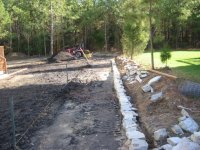
There is also a drawing of a slab-on-grade foundation with a stem wall---is this a possible configuration? The reason I want the stem all is because the house sits on the downhill edge of a hill and I think I would have a problem with drainage. The area that the garage would be is pretty much flat. I had previously built a retaining wall at the edge of the property but I took it back up and I won't have to rebuilt it if I use a stem wall. There is about a 12" different between my lawn and my neighbors lawn. (old picture)

W
 

Attachments

  • 538448-IMG_0829.JPG
    538448-IMG_0829.JPG
    85.3 KB · Views: 237
/ How-to ?- foundations #9  
You may want to get the code requirements from your local building commissioner. I always tend to do that and consider "code" as a bare minimum. I don't have anything that is just to code, but that's just me. I've been accused of overkill. However, I can't possibly stress enough that the foundation is the place to go overkill if you do so anywhere. You only get one shot, and if you undershoot, everything is shot.

My pool house has a concrete foundation that is 24" wide, 24" thick and has 4 runs of #6 rebar on rebar stands inside the footer. I also used 6000 psi concrete with fiber reinforcement for the pour. From there, the exterior walls are 2X8 walls (I get a great amount of insulation in them) with brick exterior all the way up, including the gable ends. My first floor in the pool house is just a concrete slab, but I went ahead and used 6" of 4000 psi fiber reinforced concrete along with 6 gauge wire matting. I almost screwed up too, because the stone floor I have all downstairs is a full 1/2" thick and my plumbing outlets (i.e. the toilet) were almost short after all that.

Anyway, after 4 years, nothing has settled, no walls have cracked, no floors have cracked; even over doors and windows have not cracked any. It really doesn't cost that much to do it right to start. It's only expensive to have to come back and try to brace something up or strengthen something.
 
/ How-to ?- foundations #10  
Those constructions are fine, two bottom 2x are fine, a little easier to assemble the walls on the ground and lift them up in sections and fasten to the sill plate that way. Only critical thing is that the bottom 2x is treated since it's sitting directly on the concrete. I would only recommend that you put a drain pipe and gravel along the base of the wall to keep any water from collecting there and freezing, thereby damaging the wall.
 
/ How-to ?- foundations #11  
I’ll second Eddie’s suggestion for the easiest way to get the finish profile you want. With the thin veneer brick you can attach then directly to the concrete foundation without having to form up a brick ledge and your sill plate will be bearing on the concrete foundation rather than partly on the brick. I also think the way you show it in your drawing you will not pass code on the foundation. The thickness of a full size brick with mortar is 4” which leaves 11/2” for the concrete if you want the foundation to be the width of a 2x6.

MarkV
 
/ How-to ?- foundations #12  
Consider insulated concrete form(ICF) with brick ledge. Check out manufacturers like Eco-block, Arxx, BuildBlock, etc. You can do this work yourself. In someways it is a complex leggo build.....
 
/ How-to ?- foundations #13  
weesa20, You don't say whether you're doing this yourself or contracting it out. I'm guessing you're contracting. Any form company can pour a brickshelf. A filler is simply inserted in the top of the wall to displace some concrete. An 8" wall with a 3 1/2" filler is common. When the brick is laid it will be flush with the top of concrete and be a bearing surface. The brick will carry as much weight as concrete or block. If you want block, & since there's no cellar involved, you could use 6" block up to the bottom of the brick & 1 1/2" block (called soaps) behind the brick the rest of the way up. A 6" block wall is plenty to support a garage. This gives you a foundation the same thickness as the stud wall. There's no ledge left over on the inside to catch dirt & get in the way and both interior/exterior sheathing extend over the joint making less drafts. MikeD74T
 
/ How-to ?- foundations #14  
Weesa,

I suggest that you get a copy of the North Carolina Residential Building code, it will answer your questions. There are a lot of different ways to build a foundation that will be perfectly acceptable. However, if you choose one that is not contained in the building code, then it will be up to you to prove to the code official that it is acceptable, which means hiring an engineer.

If you plan on doing much in the way of building around the house, you will find the code to be an invaluable reference. I know I have gotten a lot of use out of mine for various and sudried projects.

The residential code is available through the NC Department of Insurance.

Hope this helps.

Barry
 
/ How-to ?- foundations #15  
wilkesland said:
Weesa,

I suggest that you get a copy of the North Carolina Residential Building code, it will answer your questions. There are a lot of different ways to build a foundation that will be perfectly acceptable. However, if you choose one that is not contained in the building code, then it will be up to you to prove to the code official that it is acceptable, which means hiring an engineer.

If you plan on doing much in the way of building around the house, you will find the code to be an invaluable reference. I know I have gotten a lot of use out of mine for various and sudried projects.

The residential code is available through the NC Department of Insurance.

Hope this helps.

Barry

The NC Building Codes pertaining to Foundations can be found online here: http://ecodes.iccsafe.org/nxt/gateway.dll?f=templates$fn=contents-nf.htm$cp=Residential%2Fpart00382%2Fchapter00576$tt=main-nf.htm$3.0

Bob
 
/ How-to ?- foundations
  • Thread Starter
#16  
Thanks for all the replies...I will try to get a copy of the NC Code...I have read parts of it before but it has been awhile. I am trying to decide if I will try to tackle it myself with my family (lots of experience with concrete) and then get the brick part done by a mason or if I should just go with all block and brick.

I could use 2x8 for the sill plate and have 3 1/2 inches concrete and 4 inches brick...

I will probably just contract it all out and then I will focus on the stick part...but I hate to pay anyone to do anything because I can usually do it better myself and pay more attention to detail...I just want it done right so that the rest of the building turns out well

W
 
/ How-to ?- foundations #17  
Even if you get a contractor to do it, have the plans checked by an engineer, before you build anything. It is the best money you will ever spend.

I hae a neighbor who built his house at the top of a small knob, and put in a fairly steep driveway. He didn't believe in engineers, he just had his contractor do it.

Well, two years ago the retaining wall he had put in to hold the driveway in place failed -- fell over in the winter rains. No huge loss, the driveway was only gravel at that point.

So, he had it rebuilt and they did it a little better this time. A little better wasn't good enough, and last winter it fell over again. I tried to explain how retaining walls are designed to him, and how water behind the wall will frequently make it collapse.

So, this summer he got a different contractor to build a new one, but he still wouldn't get an engineer to design it. And, he decided that now was the time to asphalt the driveway.

Well, the rains have started, and there is serious trouble with the retaining wall. I hope he can get it stabilized in time to avoid losing 300' of asphalt driveway...
 
/ How-to ?- foundations #18  
Some people keep making the same mistakes, thinking that the results will be different next time. What he has paid for building the wall 3 times would have paid for the engineer and doing it right the first time, and probably would have had money left over.
Dusty
 

Marketplace Items

2021 TAKEUCHI TL12R2 SKID STEER (A64279)
2021 TAKEUCHI...
2020 Chevrolet Tahoe SUV (A64194)
2020 Chevrolet...
2018 CATERPILLAR TL1055D TELESCOPIC FORKLIFT (A65053)
2018 CATERPILLAR...
2023 73in Vibratory Roller Skid Steer Attachment (A61572)
2023 73in...
2019 JOHN DEERE 333G SKID STEER (A64279)
2019 JOHN DEERE...
2014 Ford Transit Connect Van (A61573)
2014 Ford Transit...
 
Top