How to hand test a NH268 knotter

   / How to hand test a NH268 knotter #1  

countryguy1225

Silver Member
Joined
Oct 24, 2012
Messages
119
Location
Fenton, Mi
Tractor
Kubota M6060 & L2550GST(4wd), W/ Backhoe attch. Mitsubhish MT160D (4wd) :- )
Newbie with a very long few weeks learning.

Somewhere along the first use, I Broke the knotter shear bolt, which busted a needle due to defective interlock. It is now all put back together. Spent the last two weeks going thru the manuals, I have completed knotter timing & alignments on both sides. Needle safety latch also repaired.

My question- how do you hand test the knotter with real twine loaded??

I have tried several ways and find results mixed. If you pull out a bales worth of string and tie it off.... The twine gets far too tight and shears the knotter bolt again.

If you pull out a bales worth of string and let lay loose you get slack and cross wraps and it will jam and shear the knotter or leave a mess...Or on occasion even tie a knot.

If you pull out a bales worth of string and then use a bungee cord to strap down in the chute you get the best results.... But I get also get knots that hang/stay on the bill hook tongue. But I did get multiple knots to tie and fall off too. Yea!

So.... Is it time to fire this baby up and feed hay? I understand that is what really counts. But if I shear and bust stuff again I will be really upset.

Couple items for anyone interested

I have the 268 baler manual in PDF form and the NHL knotter guide as a PDF. Willing to upload them here if I can find a files area.
This video was a big help in understanding how this all works
New holland official knotter video: Small Square Baler Knotter - YouTube

Thank you for taking the time to read and if possible : posting some help.
 
Last edited:
   / How to hand test a NH268 knotter #2  
I have a NH 310 ... Found that empty, the knotters aren't under load so they won't tie a knot.

I would check the timing of needles, plunger etc, and make sure the needle interlock is timed too. Then, feed it some hay...
 
   / How to hand test a NH268 knotter #3  
What was wrong with the interlock? That would be the next thing I'd make sure was working before you start the baler up. I too have a NH 268 and have found the only reliable way to test the knotters is to actually put hay through it.
 
   / How to hand test a NH268 knotter
  • Thread Starter
#4  
Thanks for the notes- The Interlock bolts were severly bent and the steel block (on rubber mount) was bent too far out to really HALT and shear the flywheel bolt. So it "skipped" off to the side and broke 1 of the needles it seems.

I've replaced the entire ASSY of bolts and insured it works w/ a hand test when I had needles in and removed the knotter bolt.

So.... As you said- I think it's time to run on low speed, put the PTO into the mix and see. I do have a question on PLUNGER location when the needles a just about to enter.... But will open a thread on this.

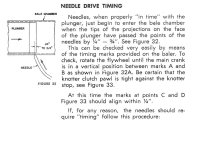
My Q on plunger timing- - As my needles are just about to enter the bottom, I see that the front plunger steel ribs are several inches out front of the needle slots. The lower main frame is around an inch. The Manual shows a diagram of 1/4" to 3/4" for the plunger to needle locations but fails to show if those ribs are part of the test. I'll review the NH baler knotter video agan too. What do you think?
 
   / How to hand test a NH268 knotter
  • Thread Starter
#5  
needleTiming1.JPG
OK... Back to the Manuals. As yesterday was the knotters- Next is the plunger timing (which I glanced upon). So that said, Attached is the NH Manual guide text which clearly states that you should be 1/4 to 3/4 of the front projections. so NEXT... ;-) Never a dull moment! I did attach the NH diagram and text if anyone is interested. I'd post the entire manual if the 1mb limits were lifted.... hinthint.
 
   / How to hand test a NH268 knotter #6  
OK I give up what's an interlock??? I've been around/used/worked on sq balers for 40+ years and don't have a clue what an interlock is!!!!!!!!
 
   / How to hand test a NH268 knotter #7  
OK I give up what's an interlock??? I've been around/used/worked on sq balers for 40+ years and don't have a clue what an interlock is!!!!!!!!

The only thing I can think that would fail and allow a needle to be broken would be the plunger stop. This would be the device that sticks out if the pluger is not in the right place (too far away) with the needles in the chamber. This would stop the plunger and shear the flywheel bolt.

I'm just guessing on the information given.
 
   / How to hand test a NH268 knotter #8  
The only thing I can think that would fail and allow a needle to be broken would be the plunger stop. This would be the device that sticks out if the pluger is not in the right place (too far away) with the needles in the chamber. This would stop the plunger and shear the flywheel bolt.

I'm just guessing on the information given.

This is it, I was using the wrong terminology. As per New Holland it is referred to as the "Needle Safety Latch". On these old NH balers it is a simple and obvious apparatus. I would assume our JD 337 baler has a similar function, but I haven't had to deal with it.
 
   / How to hand test a NH268 knotter #9  
Jeff: If the plunger has jumped out of time relative to the knotter drive engagement, then you risk engaging a needle. BUT, the plunger stop knows when the needles are up in the bale chamber. If its working correctly, the stop will lock out the plunger entry and you will/should be breaking the main shear pin. Since the needle lift link separated, this lockout was defeated. That's why I NEVER put a shear pin in my needle lift link. Its intended to break if you try to bale a tree limb or a big rock, but its the needle retraction that I ALWYS want.

As for position of the plunger when the knotter trips, on my baler, the plunger is well on its way out of the compaction area when the needles raise. Some people think that the needles ought to help push the final flake at the bale being formed, but it ain't supposed to be. That's what the hay resistors are for. Yes, there are slots in the plunger to allow some uncertainty in this position but it lowers the probability of needle survivability.

The bale forming and knot tying process ought to work properly at tractor idle speed with some small amount of hay in the case and with a tight bale in the chute. This is because (as you will often find out) the trip arm drops by itself after some stoppage and then you roll it over to begin another windrow when the tractor and pto are still just off idle.

Say Hi to C. J. ...
 
   / How to hand test a NH268 knotter #10  
Countryguy ... I may not have made it clear in the first post. You MUST make sure ALL timing is correct before running it under power. When you say the needles are entering the bale chamber several inches behind the tip of the plunger .. It means to me , the machine is completely out of time.

You have a manual... Check the needle penetration, needle drive timing, needle latch. (Needle latch is what you are calling the interlock) etc... There are several inter-related timing adjustments. Change one and another is mis-timed .... too many to write about here . A mis-timed baler is expensive parts broken... much less well tied bales.
 
   / How to hand test a NH268 knotter #11  
I would assume our JD 337 baler has a similar function, but I haven't had to deal with it.

Yes all JD sq balers have a plunger head safety stop. It is very important that sq baler operators check for proper operation of the PH safety stop to protect high $$$$$ needles from breakage. I've seen missing/broken springs and binding of mechanisms on PH stops in my hay baling experiences.
 
   / How to hand test a NH268 knotter #12  
As for position of the plunger when the knotter trips, on my baler, the plunger is well on its way out of the compaction area when the needles raise. Some people think that the needles ought to help push the final flake at the bale being formed, but it ain't supposed to be.

I've worked on both JD & NH sq balers. On each brand the needle to PH timing is similar. Needles aren't designed to help form bales but take twine/wire to knotter system. If the PH on your baler is "well on it's way away from compression stroke" then I think your baler is timed incorrectly. If timed as you describe this puts undue pressure on the twine/wire as knot is trying to be formed. That may not affect tying on light bales but will on 60-70# bales. I just stating from my experience of many years of repairing sq balers.
 
   / How to hand test a NH268 knotter #13  
I've worked on both JD & NH sq balers. On each brand the needle to PH timing is similar. Needles aren't designed to help form bales but take twine/wire to knotter system. If the PH on your baler is "well on it's way away from compression stroke" then I think your baler is timed incorrectly. If timed as you describe this puts undue pressure on the twine/wire as knot is trying to be formed. That may not affect tying on light bales but will on 60-70# bales. I just stating from my experience of many years of repairing sq balers.

You are corrent the needles should be just coming up into the chamber with the plunger still coming forward (compressing the hay) almost to the needles. As the needles rise they go through slots in the plunger face that allows them to be in the chamber and the plunger holding the hay. As the needles pull back so does the plunger (towards the tractor). Any sooner on the needles and they come up through the hay being compressed. Any later and the hay in the chamber will press against the needles, giving at least knotter issues, at worst broken needles.

I've never seen one but I have been told some of the early Deere 336 baler manuals either were poorly written or wrong. People would end up setting the needles with the plunger going backwards (towards the tractor) when it should be with the needles just entering the chamber and the plunger going forward (towards the back of the baler) and compressing the hay. I've fixed more than one 336 that a person timed wrong.
 
Last edited:
   / How to hand test a NH268 knotter
  • Thread Starter
#14  
Thank you everyone! This has been an adventure and a bit of a new phase in my life. I love the tinkering! And to see the equipment from 1967 come to life under my hands is pretty darn cool! The sickle mower I own is from 1957. Wow.
This stuff is built to last! The knotters need a few parts but I will get back to those over winter. The plunger timing is next as it does seem advanced forward when then needle pops thru.

The skins on this are in amazing shape. Almost zero dings and dents. I have this urge to go get this thing painted up locally and make it pretty again.
Someone tell me I am nuts here. Lol.

Love the forum and thanks to everyone. If someone needs the baler manuals in PDF form. Contact me here. Well figure out how to get them over to you via a few large email sites.

Thanks and have a great week.
 

Tractor & Equipment Auctions

John Deere 25A Flail Mower Tractor Attachment (A59228)
John Deere 25A...
Kubota KXO40-4 (A53317)
Kubota KXO40-4...
2019 MACK GRANITE (A58214)
2019 MACK GRANITE...
2014 International Maxxforce DT (A53317)
2014 International...
2017 Toro Sand Pro 5040 Bunker Rake (A59228)
2017 Toro Sand Pro...
2016 Freightliner M2 106 Ambulance (A59230)
2016 Freightliner...
 
Top
