Hydraulic PTO issues ..... flow divider???

   / Hydraulic PTO issues ..... flow divider???
  • Thread Starter
#21  
... but could there be a suction leak? Does your oil foam when it gets hot?
Hmmmm.... this has got me thinking.... and I do believe I have a way figured out to check (since there is no convenient "sight glass" to see the oil). However, I would think that if the oil was becoming entrained with air, it would affect the whole hydraulic system... not just one circuit. But I will investigate it anyway.
Sorry, I missed the schematic on post #5. In looking at that there is also the "Lube Relief" (Item 49) which is down stream of the delay relief. Assuming the schematic is drawn correctly this would also have some influence on PTO engagement pressure. I am not sure which one would have the most influence on actual operating pressure but I do know the company I work for sells lube reliefs in the 90 - 120 PSI range for ag and construction equipment. Some are even in 300 PSI range for larger high HP equipment.

I believe the best way to start eliminating possibilities is check the flow. If flow doesn't change and the pressure drops then you have a leak somewhere in the PTO circuit. If flow drops then you have a supply issue, pump, priority flow control or the flow divider, etc could be faulty.

Roy
The Lube Relief valve specification for my tractor is 6-11psi. I do not believe this would have an affect on my issue since when the main PTO valve is off, the Delay Relief Valve directs oil to the lube circuit. When the main PTO valve is on, the Delay Relief Valve shuts off oil to the lube circuit and directs it to the clutch/brake circuit. EDIT: wait a minute... that can't be true.... the oil still have to go somewhere. I re-read the theory and I was wrong on that. I guess the lube relief valve could affect things if it stuck open.

On another note, I talked to a different service tech today at the dealer and what immediatley popped into his mind was leaking clutch shaft or clutch piston seals.

Good thought on the flow.... I am trying to lay my hands on a flow meter.
 
   / Hydraulic PTO issues ..... flow divider??? #22  
The Lube Relief valve specification for my tractor is 6-11psi. I do not believe this would have an affect on my issue since when the main PTO valve is off, the Delay Relief Valve directs oil to the lube circuit. When the main PTO valve is on, the Delay Relief Valve shuts off oil to the lube circuit and directs it to the clutch/brake circuit.
Actually the delay relief just builds the pressure slowly and the oil should still be going to the lube relief once the clutch is engaged. When you engage the PTO it feeds oil through the orifice and pressure loads the spring chamber to increase the load to operate the clutch.
On another note, I talked to a different service tech today at the dealer and what immediatley popped into his mind was leaking clutch shaft or clutch piston seals.

Without doing any other diagnostics this is a good possibility.
Good thought on the flow.... I am trying to lay my hands on a flow meter.
Good luck

Roy
 
   / Hydraulic PTO issues ..... flow divider??? #23  
if the main scv's are seeing full pressure with oil hot.. then I don't think it is an oil or pump issue.. but rather what rickb mentioned earlier on page 1.. IE.. a leak int he circuit fo rthe pto clutch / brake..

soundguy
 
   / Hydraulic PTO issues ..... flow divider???
  • Thread Starter
#24  
More testing tonight.... installed a thermometer on the oil filter to see what temp the oil is operating at. Oil temp ranges between 100 and 110 degrees... book says 110 is normal operating temperature.

I also intalled a hose with a gauge on the end to the transaxle lube test port to see what the lube relief valve is doing. With the PTO off, lube test port pressure is about 12psi.... book says 6-11psi. When the PTO is engaged, the pressure at the lube relief port drops to 0. I'm not sure how the oil is returned to the tank when the PTO is engaged, but it does not appear to be passing the transaxle lube test port.

I let the tractor run at 3450 RPM and engaged the PTO. I let the tractor run until the pressure in the PTO circuit fell off to the point where the PTO disengaged. I then shut the tractor off and quickly removed the gauge from the end of the hose on the transaxle lube test port and routed the free end of the hose up to the transaxle fill port. Restarted the tractor and engaged the PTO lever to verify that the PTO would not engage. Then I disengaged the PTO lever and quickly drew a sample of oil from the free end of the hose attached to the lube test port in a clear plastic cup. Then shut the tractor off.

Looking at the oil in the cup againt a strong work light revealed that the oil if full of gazillions of tiny air bubbles. I let the cup of oil sit for a few minutes while I tinkered with other things and rechecked it. Clear as a bell.... no bubbles left after a few minutes. Restarted the tractor (oil is still warm at this point) and the PTO would engage for a little while, but again disengaged as the pressure dropped in it's circuit. This tends to support the theory that it is air in the oil and not related to oil temperature.

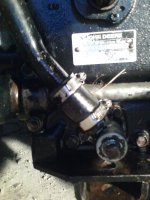
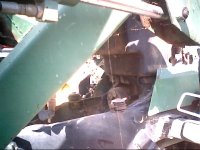
So I think I'm onto something here. As suggested by Stonehaller, there may be a suction leak. I can't think of any other way the oil would become entrained with air. These two couplers pictured below are my most likely culprits:

p_00122sm.jpgp_00123sm.jpg
 
   / Hydraulic PTO issues ..... flow divider??? #25  
(original 33hp engine was replaced with a 37hp engine).

Did you mention that before?

It is a testament to the reliability of the x55s that there has been little
written on TBN about failed PTO clutch and brake systems. I never
had any of mine apart at all.

Those rubber manifolds that JD uses on the suction lines are a good
source of pinhole leaks, as you noted.
 
   / Hydraulic PTO issues ..... flow divider???
  • Thread Starter
#26  
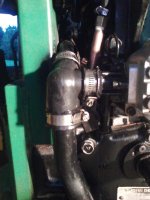
I guess I'll try replacing those rubber pieces next. Afterall, they are 20 years old. The lower one is pretty cheap, but the upper 3-pronged one is $52.
 
   / Hydraulic PTO issues ..... flow divider??? #27  
More testing tonight.... installed a thermometer on the oil filter to see what temp the oil is operating at. Oil temp ranges between 100 and 110 degrees... book says 110 is normal operating temperature.

I also intalled a hose with a gauge on the end to the transaxle lube test port to see what the lube relief valve is doing. With the PTO off, lube test port pressure is about 12psi.... book says 6-11psi. When the PTO is engaged, the pressure at the lube relief port drops to 0. I'm not sure how the oil is returned to the tank when the PTO is engaged, but it does not appear to be passing the transaxle lube test port.

If there is no lube pressure at this time you are potentially damaging the components that are supposed to be getting lubed.

I let the tractor run at 3450 RPM and engaged the PTO. I let the tractor run until the pressure in the PTO circuit fell off to the point where the PTO disengaged. I then shut the tractor off and quickly removed the gauge from the end of the hose on the transaxle lube test port and routed the free end of the hose up to the transaxle fill port. Restarted the tractor and engaged the PTO lever to verify that the PTO would not engage. Then I disengaged the PTO lever and quickly drew a sample of oil from the free end of the hose attached to the lube test port in a clear plastic cup. Then shut the tractor off.

Could you see into the tranny to see if it was also full of air bubbles?


Looking at the oil in the cup againt a strong work light revealed that the oil if full of gazillions of tiny air bubbles. I let the cup of oil sit for a few minutes while I tinkered with other things and rechecked it. Clear as a bell.... no bubbles left after a few minutes. Restarted the tractor (oil is still warm at this point) and the PTO would engage for a little while, but again disengaged as the pressure dropped in it's circuit. This tends to support the theory that it is air in the oil and not related to oil temperature.

So I think I'm onto something here. As suggested by Stonehaller, there may be a suction leak. I can't think of any other way the oil would become entrained with air. These two couplers pictured below are my most likely culprits:

View attachment 178872View attachment 178873
 
   / Hydraulic PTO issues ..... flow divider??? #28  
Any possibility that you're PTO selector valve is leaking by causing enough pressure loss to the tank return which causes the DRV to shift and disengage the clutch?
 
   / Hydraulic PTO issues ..... flow divider???
  • Thread Starter
#29  
...Could you see into the tranny to see if it was also full of air bubbles?

No way to see into the transaxle.... that is why I had to use the hose and a clear cup to extract a sample.
 
   / Hydraulic PTO issues ..... flow divider??? #30  
At first I simply thought about a leak at the pto valve.. but the air bubbles thing.. it's deffinately getting in on a suction side.. not on a pressurized leak / side.

soundguy
 
   / Hydraulic PTO issues ..... flow divider??? #31  
At first I simply thought about a leak at the pto valve.. but the air bubbles thing.. it's deffinately getting in on a suction side.. not on a pressurized leak / side.

soundguy

A vigorous leak from the clutch assembly spraying oil around the inside of the housing and agitating the oil will aerate it nearly as well as a suction leak.

If both the remote valves and PTO clutch supply is drawn through a common suction and remote flow is not affected materially, there isn't likely to be air getting into the suction circuit until the entire body of oil is aerated. A worn pump or leaking pressure circuit will be exacerbated by heated oil. A suction problem will likely exist at most all oil temps, and may well be worse with cold oil.
 
   / Hydraulic PTO issues ..... flow divider??? #32  
I think I might run a remote thru an open hose into a bucket at the point the pto fails to see if the remote has the bubbles too.

that should be telltale given your analysis.

soundguy
 
   / Hydraulic PTO issues ..... flow divider???
  • Thread Starter
#33  
I think I might run a remote thru an open hose into a bucket at the point the pto fails to see if the remote has the bubbles too.

that should be telltale given your analysis.

soundguy

I will try that this afternoon.

I am now leaning away from the oil temp having any affect on things since I can shut the tractor off and let it sit for a few minutes after the PTO quits and then fire it back up and the PTO will work for a while again. The oil is still virtually the same temp as it was when the PTO quit the first time. I am thinking that letting the tractor sit for a few minutes gives the air a chance to get of the oil. I sure hope this is it.... but I won't know until next week when the new rubber couplers come in and I have a chance to get them installed.
 
   / Hydraulic PTO issues ..... flow divider???
  • Thread Starter
#34  
The new rubber couplers for the suction line came in today. Picked them up after work. Drained the oil and pulled the old couplers off and installed the new ones. The old couplers were hard as a rock whereas the new ones were soft and flexible.

Since I had to drain the oil to change the couplers, I removed the strainer out habit.... anytime I drain the oil, there is no reason not to go ahead and check/clean the strainer. Since there is very, very little run time on this batch of oil... only an hour or two with most of that time spent diagnosing the PTO problem, I was quite shocked and concerned at the amount of tiny metal flakes found on the strainer and in the amount of oil that drained out of the transaxle after pulling the strainer. There was a fair amount. I know it's hard to quantify "quite a bit", but it is way more than should be ther after just an hour or two of operation. Other and one or two laps around the property, all of that time has been spent with the tractor sitting still while I worked on the PTO issue.

I went ahead and put it all back together and tried the PTO.... same results as always. Well, I guess there was one little twist that was different this time. Normally, the PTO would engage at around 100psi or above. I was reading 110psi on the gauge with the PTO turning. When I cycled the PTO lever off, it took an extended period of time for the pressure to drop to zero instead of dropping immediatly like it had been doing. When I cycled the PTO lever back to the ON position, the circuit built 110psi, but the PTO would not turn.

Based on my findings tonight, I'd say that there more than likely something internal that is jacked up. Given the amount of metal I found in the strainer, it has me thinking that the PTO clutch pack is wasted. I feel that I have no choice now but to remove the transaxle and disasseble it for inspection. :mur:
Either that or drive it off into the pond and forget I ever bought it. :laughing:
 
   / Hydraulic PTO issues ..... flow divider??? #35  
Given the amount of metal I found in the strainer, it has me thinking that the PTO clutch pack is wasted. I feel that I have no choice now but to remove the transaxle and disasseble it for inspection.

That's a good guess. At least you won't have to split the tractor in two,
in the conventional sense. The frame rails are just bolted to the sides of
the gearbox. I would like to see how the PTO clutch/brake system is built,
internally.
 
   / Hydraulic PTO issues ..... flow divider???
  • Thread Starter
#36  
That's a good guess. At least you won't have to split the tractor in two,
in the conventional sense. The frame rails are just bolted to the sides of
the gearbox. I would like to see how the PTO clutch/brake system is built,
internally.

Might as well consider it splitting the tractor in two....

Actually the frame rails are bolt to the sides and to the front of the transaxle. To get to the bolts on the front of the transaxle, I'll have to remove the hydro trans. To remove the hydro, I'll need to remove the driveshaft. To remove the driveshaft, I'll have to remove the fuel tank. Then there is every one of the linkages that connects to anything on the transaxle. I'm not sure ... but it might even be worse than splitting the tractor in the conventional sense. It's more like disassembling the tractor to remove the transaxle.

Since I don't have Japanese hands or Japanese tools, I'm probably looking at 15 to 20 manhours just to get the transaxle removed from the tractor. It definately going to take some time, test my resolve and test my ability to not to put a gun to my head.
 
   / Hydraulic PTO issues ..... flow divider??? #37  
To remove the driveshaft, I'll have to remove the fuel tank.

As I recall, when you remove all the sheet metal, you can detach the
driveshaft at the U-joint just above the filter between the frame rails. Or
you can disconnect the shaft at the rubber coupling below the fuel tank
without removing it. That allows you to keep the HST/gearbox all together.

If you take all the linkages out, you can toss the levers used as a
mechanical interlock system for the go-pedals.
 

Attachments

  • Aug27~07.JPG
    Aug27~07.JPG
    81 KB · Views: 167
   / Hydraulic PTO issues ..... flow divider??? #38  
Based on my findings tonight, I'd say that there more than likely something internal that is jacked up. Given the amount of metal I found in the strainer, it has me thinking that the PTO clutch pack is wasted. I feel that I have no choice now but to remove the transaxle and disasseble it for inspection.

Maybe I'm missing something, but how would a bad PTO clutch cause the PTO pressure to be low? If the service manual said to shim the PTO delay relief valve to increase the pressure setting why don't you try this first?
 
   / Hydraulic PTO issues ..... flow divider???
  • Thread Starter
#39  
Maybe I'm missing something, but how would a bad PTO clutch cause the PTO pressure to be low? If the service manual said to shim the PTO delay relief valve to increase the pressure setting why don't you try this first?
Hmmm..... now there's an idea. Oh yeah, I already tried that back in post #1. :laughing:
A worn out clutch could cause the pressure to drop if the friction disks have lost too much material. According to a service tech I talked to, he said that if the frictions are too thin, it can allow the clutch piston to travel too far out of it's bore and cause the o-ring to partially loose it seal and allow oil to bleed by.

As I recall, when you remove all the sheet metal, you can detach the
driveshaft at the U-joint just above the filter between the frame rails. Or
you can disconnect the shaft at the rubber coupling below the fuel tank
without removing it. That allows you to keep the HST/gearbox all together.

If you take all the linkages out, you can toss the levers used as a
mechanical interlock system for the go-pedals.
You have to loosen the clamp bolt on the u-joint yoke at the transmission, but you have to slide the d-shaft forward to slip it off the trans input shaft. In order to slide it forward you have to take it loose at the rubber coupler. With the engine still in place, the only way to slide it far enough forward is to angle it upwards and to the side. Even then, it has to angle up higher than the bottom of the fuel will allow, so I have to pull the tank. The HST has to be removed just to get to some of the bolts that hold the transaxle to the frame..... unless I could one of those nifty Japanese wrenches that those little handed guys must have had to put this thing together.

Believe me.... I just put half of those things back in the tractor. If I didn't have to remove all that stuff, I wouldn't. It was not fun putting it in.
 
   / Hydraulic PTO issues ..... flow divider??? #40  
Did you ever find out what the problem was?
 

Marketplace Items

FORD 8630 TRACTOR (A60430)
FORD 8630 TRACTOR...
2365 (A60432)
2365 (A60432)
Sterling AT (A61306)
BOMAG TRENCH COMPACTOR (A60429)
BOMAG TRENCH...
UNUSED FUTURE FT36C STAND ON SKID STEER (A52706)
UNUSED FUTURE...
500 BBL FRAC TANK (A58214)
500 BBL FRAC TANK...
 
Top