hydraulics help needed

   / hydraulics help needed #1  

jimmysisson

Veteran Member
Joined
Jul 11, 2005
Messages
2,358
Location
W.Mass
Tractor
1993 NH 2120 (the best), 1974 MF 135 (sold, but solid), 1947 Farmall A (bought, sold, bought back, sold again), 1956 MH50 lbt (sold, in 1980, darn it)
Hi all. I have a homemade trailer woodsplitter with a 4" x 36" cylinder, a 7 hp Briggs engine and a 13 gpm Barnes pump. I added a 2x18" cylinder for a log lift/takeoff platform. I have two logsplitter detent valves, one for each cylinder, with return hoses teed, then through a filter and back to the tank. I also plumbed in an hydraulic proportioning valve so the lift cylinder would get the proper volume (it's 'way too fast with full 13 gpm).
My problem is this: slow cycle times. With cold oil, a forward/return stroke takes over a minute. With warm oil, it's still 25 seconds. At low idle, it's about 40 seconds. I'm hoping for about 12-15.
This splitter started in life as a trailer model with no power, using a 22 gpm or so PTO pump on my old Farmall A. That had better cycle times. I decided to self-power it when the Farmall and pump went away and I had this almost-new Briggs engine. I started with a new 11 gpm pump, and it was too slow. 11 gpm was the recommendation from the chart for the 7 hp engine. I bought the 13 gpm pump, and it got a little faster. I made a mechanical stroke limiter for the ram that I can set when I have shorter logs, so that speeds things up a bit.
Here's really the question. The 7 horse Briggs barely sounds like it's under load when I'm using it. When it goes into the second stage of the pump (slower volume/higher pressure) it sounds like it is under no load at all. A lot of splitting is easy and would stay on the higher speed of the pump.
So, I can get (from Northern, source of all this stuff) a 16 gpm pump in the same form factor so it'll bolt right in. That's 'way above the rating for the 7 hp engine, yet at 13 gpm the engine sounds like it barely labors.
Does anyone know whether this little engine would just be bogged down all the time with a faster pump? I hate to spend the $180 (again!) if it won't run, but the slow cycle makes splitting tedious.
I use regular hydraulic oil in this machine. It's only used in the winter, so would synthetic be any better, maybe when it's still getting warm (REAL slow when oil is cold)? I presume that would not change the stroke time.
Any advice? Is there another way to get more speed?
Sorry for the long post. I could probably take a photo of this beast if that would help.
Thank you, Jim

 
   / hydraulics help needed #2  
</font><font color="blue" class="small">( Does anyone know whether this little engine would just be bogged down all the time with a faster pump? I hate to spend the $180 (again!) if it won't run, but the slow cycle makes splitting tedious. )</font>
No it wouldn't - when it's running under no load (resistance) it shouldn't bog down at all .... it's when it goes into the 2nd stage (high pressure/low volume) where you'll have a problem, if any.

I'd guess it would largely depend on what type of wood you are splitting - if it's stuff that has a tendency to "pop" open before it's completely split, like maple you may not have any problem. If it's something like oak which is real grainy and gnarly the engine could stall if it spending too much time working in the 2nd stage.
 
   / hydraulics help needed #3  
Well if I do my math right, that 4X36 cylinder has an internal volume of around 452 CU/IN(12.56 SQ/IN X 36") which equates to around 1.95 Gallons. 60 seconds divided by 13 gallons = a gallon every 4.6 seconds so that cylinder should move full travel in under 10 seconds with no load.

From your description it almost sounds like you are not getting full flow tho the cylinder. What gives me this impression was your use of the word "T". You said "with return hoses teed, then through a filter and back to the tank". That tells me that you used a "T" on the inlet port of the valves as well, placing the valves in parallel. What is happening is that as you work a cylinder, some of the flow is going through the open center of the other valve and not moving the desired cylinder I am not quite sure where you placed the proportioner in this, a picture or drawing would be helpfull.

Open Center Hydraulics 101: The fluid should flow as follows.
1. Tank
2. Pump
3. Inlet port on the valve
4. Outlet port on the valve
5. Filter
6. Tank

With the lever in the center position, the working ports are blocked and the cylinder is locked in place. The inlet port is connected directly to the outlet port and the fluid flows through the system relitively unobstructed(high flow, low pressure). When you move the lever, the inlet port is connected to one of the working ports and the other working port is connected to the outlet port. This causes the cylinder to move and flow is restricted based on the load on the cylinder(splitting wood) and pressure builds to perform this work. If you add another valve to your system, it needs to be added in series with the other valve IE: outlet of the first valve needs to go to inlet of the second or by the numbers above, 1-2-3-4-3-4-5-6. The parallel valves would explain why the engine dosn't sound like it is under any real load as a good portion of the fluid is bypassing the work.

As a quick test, see what happens when you run the lift cylinder to it's limit and hold it's control valve there(blocking flow through that valve), then try to cycle the split cylinder and see what happens.
 
   / hydraulics help needed #4  
I would agree with Ron, he said it well.
Your valves must be in series, NOT parallel for them to function properly.
It sounds like you have plenty of engine and GPM to do the job.
 
   / hydraulics help needed #5  
Not sure of plumbing sequence, but if it's splitting wood, you either have it plumbed correctly or flow divider is in wrong place ahead of both valves limiting flow to splitter cyl. You need to divide flow after splitter cyl valve.
Run splitter cyl valve with power beyond sleeve, plumbed to flow divider(excess to tank), plumbed to lift cyl valve.
If splitter is correctly plumbed. you can try a thinner oil (what ISO# is regular hyd oil?), or even ATF if mfg allows for it..
 
   / hydraulics help needed #6  
Ron.. I've got a question.. if he had the valves in parallel, and one was open.. ( open flow to tank ).to tank and the other was powering the splitter cyl.. as soon as the cyl loaded up.. wouldn't ALL the oil divert to the least resistance.. and simply flow to the tank via the other valve.. and not splitting the wood at all?

Soundguy
 
   / hydraulics help needed #7  
Is there any chance that we could see a pic of the setup?
 
   / hydraulics help needed #8  
</font><font color="blue" class="small">( Ron.. I've got a question.. if he had the valves in parallel, and one was open.. ( open flow to tank ).to tank and the other was powering the splitter cyl.. as soon as the cyl loaded up.. wouldn't ALL the oil divert to the least resistance.. and simply flow to the tank via the other valve.. and not splitting the wood at all?)</font>

I'll take a stab at this one. I just had a similar situation with my dozer and I can tell you the fluid will take the path of least resistance. On my dozer one of the springs on the spool relief broke. This caused the valve to go into relief as soon as a spool lever was actuated. The majority of fluid went back to tank via the relief but some small amount was available to the work port to sloooowwwly raise the loader.

The same will happen with the parallel setup. The fluid should take the path of least resistance, but depending on the flow some may be available to the other valve which will cause slow operation.
 
   / hydraulics help needed
  • Thread Starter
#9  
Thanks to all. I am trying to attach a pic with labels that you can actually read. Pressure goes from pump to proportioning valve set 90% ram, 10% lift. (Ram was no faster before I added the proportioning valve.) From prop. valve 1 line to ram valve, 1 to lift valve. Return lines come from both valves to a tee then to the filter and tank. 3/4" lines to valves from prop. valve. 1/2" lines to cylinders.
I don't know if this has anything to do with it, but every once in a while (rare) the ram cylinder chatters a little while stroking and runs a little slower. Also, so that the engine can start without load, and for maintenance, I have a shutoff valve between the tank and the intake line to the pump.
Thanks again for any ideas, this is buggin me. Jim
 

Attachments

  • 783819-1079with notes-2.jpg
    783819-1079with notes-2.jpg
    26.5 KB · Views: 204
   / hydraulics help needed #10  
You're ok, but not optimal with that setup due to fact
the splitter cylinder has to run slower than before with 10% less flow. As I stated earlier, there should be full flow to splitter cyl, out via PB sleeve, then to flow divider.
If a valve with adjustable spool travel for lift cyl is installed, you could even remove the flow divider, which heat up oil. I know as I use 2 adjustable pressure compensated dividers for remotes on my tractor
 
   / hydraulics help needed #11  
I agree with Ron. You need to be running in series on an open center system. You go from the pump to the inlet port on the ram cylinder valve and from the outlet on the ram valve to the inlet on the log lift valve. Then from the outlet on that valve to the sump.

There is no reason to try and run them parellel as you don't need to run both at the same time. The fluid is by-passing and taking the path of least resistance. This is why your cycle times are so slow.

This is my opinion for what that's worth.
 
   / hydraulics help needed #12  
That picture is worth a thousand words to me...
Your valves a definitely in parallel, it is still splitting because only so much fluid can go back through the proportioning valve.

IMHO, your best bet is to remove the proportioning valve altogether, plumb as stated above:
Pump OUT to
Ram valve IN
Ram valve OUT to
Lift valve IN
Lift valve OUT to
Filter then to the tank.

If the lift moves to fast as you stated in the original post, the just use a flow restrictor on the work ports (the kind that has a small orifice to slow the flow of fluid) as they are very inexpensive.
 
   / hydraulics help needed #13  
It isn't really a parallel circuit with seperate flows coming off divider (That's why they're built). It will flow 90% and 10% no matter the load and won't lose flow through divider.
You shouldn't just run 2 valves in series without 1st being rated for backpressure produced by 2nd, unless PB sleeve is installed. Might could adjust relief for 2nd valve under backpressure limit for 1st valve if it'll still do the work at lower pressure.
The restrictors will work in place of adjustable spool travel valve.
The chatter you experience is most likely due to not being pressure compensated divider
 
   / hydraulics help needed
  • Thread Starter
#14  
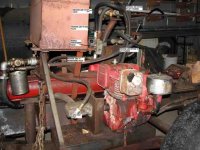
To complicate this a little more, when I move the proportioning valve all the way to the ram flow side, the ram is only slightly faster, probably about what it was before I added the second valve for the lift. I think MMM is right about the prop. valve separating the flows. If the lift valve is centered, oil might dump through the return but how would that affect the flow to the ram valve? I just don't know much about hydraulics. Does anyone think the shutoff in the return could be restricting the flow TO the pump? Here's a pic of the pump side of this clunker. Labels might be hard to read. Thanks, Jim
 

Attachments

  • 784084-IMG_1078text.JPG
    784084-IMG_1078text.JPG
    28.1 KB · Views: 133
   / hydraulics help needed #15  
You just got your 10% back and if that's not satisfactory, the only other thing you can do is try the thinner oil before going to larger displacement pump, (unless engine isn't running at max rpms).
Anyway for fastest cycle, you want full flow through splitter valve 1st.
Divide flow or restrict lift cyl 2nd, and you should have PB to do this to avoid blowing seals,... or turn down relief on lift valve to allowable level (wouldn't hurt to try and see if it'll still lift a log).
The PB sleeve is usually 20 to 30 bucks if your valve will accept one and restrictors are couple bucks.
I can't make out text on pic, but what shutoff in return?
 
   / hydraulics help needed
  • Thread Starter
#16  
It's right above the tin can that catches most of the drips from the shutoff. It makes me think, since I got this this splitter (ten years or so ago), and modified the hydraulics a couple of times I never found a strainer from the tank. Maybe there is one above the bottom fitting in the tank where the return line goes in? A plugged screen there might explain a lot. Probably wouldn't hurt to change the fluid again and find out. I hope (and hope not for prides sake) it's not something that stupid. Maybe there isn't a strainer there, since there is one on the filler neck. I'll find out in a day or two.
Jim
 
   / hydraulics help needed #17  
</font><font color="blue" class="small">( Ron.. I've got a question.. if he had the valves in parallel, and one was open.. ( open flow to tank ).to tank and the other was powering the splitter cyl.. as soon as the cyl loaded up.. wouldn't ALL the oil divert to the least resistance.. and simply flow to the tank via the other valve.. and not splitting the wood at all?

Soundguy )</font>

Soundguy, I wasn't sure where exactly the diverter/flow regulator he mentioned was in the circuit but I assumed it was how he split the flow to the valves and it was providing the resistance. That's why I suggested a picture:)
 
   / hydraulics help needed #18  
I think your getting good advice here. But before I got too carried away, I'd take the supply line to the ram cylinder valve and plumb it direct from the pump (eliminate the proportioning valve for a test). No need to change anything else to run that test, except maybe plugging the proportioning valve open port (where you disconnected ram valve supply), in the event you get some return backflow from the lift side of the circuit. You may have something going on with the pump or fluid that no amount of replumbing will fix. If it works OK in the test configuration, then correct the plumbing for a series arrangement and do a flow restrictor as others have mentioned for the lift valve. Or change that proportioning valve to a diverter. But that would force you to select one circuit or the other before you could activate it. /forums/images/graemlins/frown.gif Nah that's tooooooooo much inconvenience.

HTH
 
   / hydraulics help needed #19  
That's suction hose that valve is on. The strainer should be on suction (big one on pump) hose bulkhead fitting inside tank and not in the line.

Might also be possible inner core of suction hose is collapsing.

There is a formula for horsepower requirements, if you know cubic in/rev( for both stages), your relief setting pressure, rpms, and efficiency (usually.85 or so). I think it would work for 2 stage pump, but never tried it.
 
   / hydraulics help needed
  • Thread Starter
#20  
THanks to everyone for their help. The foot of snow yesterday just put the splitter problem to bed for a couple months. I'll be checking for strainers, collapsed hoses, bypassing the proportioning valve, etc. when I get back to it. I appreciate all the input. Jim


Marketplace Items

2016 Chevrolet Silverado 1500 4x4 Crew Cab Pickup Truck (A59230)
2016 Chevrolet...
207278 (A52708)
207278 (A52708)
2014 VOLVO VNL (A55745)
2014 VOLVO VNL...
Caterpillar D5G LGP (A53317)
Caterpillar D5G...
2015 Freightliner M2 106 AWD Altec AT37G Bucket Truck (A60460)
2015 Freightliner...
UNUSED MINI EXCAVATOR QUICK COUPLER (A60432)
UNUSED MINI...
 
Top