International 430 Baler Problem

/ International 430 Baler Problem #1  

CTPhil

Gold Member
Joined
Nov 25, 2009
Messages
282
Location
NW CT
I'm hoping the IH baler gurus can help me, I'm at my whit's end.

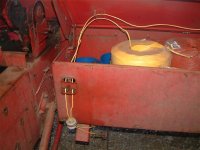
The knotter on the outside gets twine wrapped constantly lately, it's been acting up for a few years but really bad now. The twine knife is sharp and in the same position it's always been in. I've checked needle adjustment, it's good. Lately I'm suspecting twine tension. Now I'm wondering if the twine routing has been altered by the previous owner. Is there supposed to be a spring under the twine box? My Model 47 doesn't have one. I can't find one in the parts manual. Picture below.

Thank you in advance.

P1020307docsmall.jpg
 
/ International 430 Baler Problem #2  
That is clearly agroenginering at its worst.
 
/ International 430 Baler Problem #3  
Cool design change but not the right solution. You want a friction force to maintain tension in twine exiting the twine box, not a spring compliance. Friction gives it damping. Compliance gives you twine bounce, which make cause a few problems, among those being the tucker fingers miss the twine.

Now back to the original question. Do you mean that twine gets wrapped around the billhook several times? If so, Its not being scraped off by the wiper arm. Check the movement of the wiper arm by tripping the knotter and moving the flywheel VERY slowly to check on whether the wiper arm has any clearence when it passes by the billhook. If so, bend it until there is a scraping action across the billhook. That will push the completed knot off the jaw. The fact that you have one working OK makes the problem easy. Make the bad one just like the good one.
 
/ International 430 Baler Problem
  • Thread Starter
#4  
So the spring was not part of the original design? I'll take it off tomorrow! There was always one there and I never thought about it.

I'll also check the wiper arm. I'm not sure what that is, but I'll study the manual before I go to the field, thanks!
 
/ International 430 Baler Problem #5  
Don't have the 430, but I do have a Massey Ferguson 124. For what it's worth, here's the twine tensioner on the 124.

DSCF0020 (Small).JPG

It's just a simple clamp arrangement that is designed to tension both twines equally with one adjusting bolt.

Your setup looks like the tensioning is done differently on each twine so it's probably more difficult to get the tension set properly on your baler.

Good luck.
 
/ International 430 Baler Problem
  • Thread Starter
#6  
I took the spring off and there was a big improvement. It still wrapped a few times, but much less, making me think twine tension is the right ballpark for my problem. I noticed a couple of times there was slack in the twine between the twine box and the thimble on the bale chamber. I've got the tension adjustment in the twine box all the way down, maybe I need new springs and plates?

At any rate, your advice got my hay baled, I'm most grateful. :)
 
/ International 430 Baler Problem #7  
G'day check your tension plates for grooves worn by the twine if they are there then pull them off and build up with weld then you need to smooth them down flat. I find one of those flap type grinding discs great for this as they leave it nice and smooth. The grooves will stop you putting enoungh tension on the twine


Jon
 
/ International 430 Baler Problem
  • Thread Starter
#8  
Thanks, that's my next thing to do. :)
 
/ International 430 Baler Problem #9  
I have 2 springs on my 435 one for each roll. Same with the my 440. I can take a picture of the twine springs for you.
 
/ International 430 Baler Problem
  • Thread Starter
#10  
I took the twine plates off and they do have grooves in them. I ordered a pair from Case/IH, they should come tomorrow. Almost $25 each, wow! I priced a hay retainer plate for future reference, over $300 dollars! I guess they figure they can charge anything they want since they've got owners of older machinery over a barrel. :(
 
/ International 430 Baler Problem #11  
Here is a pic of the springs on my 435.
th_0719111826.jpg
 
/ International 430 Baler Problem #12  
Usually, when the twine gets wrapped on the billhook, a couple things are happening. One the initial tension is too loose, the twine gets slack and forms a loop when the needles cycle and allows the twine to wrap the bill hook. What happens is the knot forms, stays on the billhook and the twins breaks at the knot as the next bale advances and the twine can't stretch.

Two the wiper arm as it's referred to here, it's actually called the knife arm is clearing the billhook by too much. You want the knife arm to clear the billhook by 1/16th inch or less. It can even rub a bit. It's maleable and can be bent. It's purpose is to position the cutter knife to cut the twine and wipe the knot from the billhook.

Three, the actuator ball (that rides in the cam) has a flat spot. It's soft bronze and if the knotters aren't greased properly (I grease mine every day or a thousand bales), the ball will get a flat spot. That flat spot causes the knife arm clearance to change, usually moving away from the billhook and not wiping the knot.

Make suyre your twine knives are sharp and never sharpen the flat side, always the beveled side and always use a fine stone for a sharp edge.

Don't matter what brand of bailer, all the knotters are basically the same unless it's a wire twister.

Loose the spring and use the tension plate. Correct tension when using 170 poly is 2-3 pounds pull on the twine at the tension plate. Any more and the twine will hang when the balls change over and the knot tries to pass the plate and too little and the twine bows on the billhook as the billhook rotates to knot.

Finally, the needles at the top of the penetration stroke must be as close to the twine disc as possible or lightly touch it (on an older sloppy bailer). That's because the twine discs on older bailers (like yours) are designed for sisal, not poly and poly, even 170, is slippery and the twine disc must index the twine in the cutout as it rotates into the needle. That clearance is very important as the bailer ages....and you have an old one.:laughing:
 
/ International 430 Baler Problem
  • Thread Starter
#13  
I replaced the twine plates that tension the twine, it still wraps. I noticed a decal in the twine box showing the outside spring so I hooked it back up, no change. I'm using 9000 sisal twine.

P1020672docsmall.jpg


I looked at the twine stream every time I stopped to cut twine off the knotters, sometimes it was taut, sometimes not, I don't get it. Could cheap twine be a factor? I've been getting it at Tractor Supply the last couple of years, I'm noticing it isn't consistent in diameter.

I've looked for the wiper arm being mentioned, I don't think that IH uses them, I think the knot gets pulled off the bill hook.
 
/ International 430 Baler Problem #14  
I replaced the twine plates that tension the twine, it still wraps. I noticed a decal in the twine box showing the outside spring so I hooked it back up, no change. I'm using 9000 sisal twine.

P1020672docsmall.jpg


I looked at the twine stream every time I stopped to cut twine off the knotters, sometimes it was taut, sometimes not, I don't get it. Could cheap twine be a factor? I've been getting it at Tractor Supply the last couple of years, I'm noticing it isn't consistent in diameter.

I've looked for the wiper arm being mentioned, I don't think that IH uses them, I think the knot gets pulled off the bill hook.

First off, go to 170 Poly and forget the sisal. Actually, forget TSC. If you got sisal there it's probably at least 2 years old. There isn't much call for sisal anymore. What TSC has is old stuff.

Go to an implement dealer or a co-op and get some 170 poly. It's going to run about 40 bucks for 2 balls, each will be 7200 feet or about 500 average length bales (for 2 balls).

I buy 170 by the skid when I get a deal because it will keep for years inside the shop.

You have a wiper/knife arm, all knotters do. That's what the cutter knife attaches to. Pull the knotter mount pin (or bolt) and rotate the knotter upward in the cam until it's vertical. Look at the twine knife, the knife mounts to the wiper/knife arm and the end has a crescent shaped cutout. That cutout needs to be 1/16 of an inch or closer to the billhook's bottom. That is what wipes the knot from the billhook and allows the twine to move with the finished bale and the next bale to start. While you have it upward (knotter) check the wiper/knife arm to make sure it moves freely, the bottom of the billhook (between the cutout and the billhook itself) is free from burrs or gouges. If not, get some 400 grit emery and smooth it and then reset the clearance.

The bottom of the billhook must be smooth and burr free so the knot slides off.

A little tip. Rotate the knotters (check both) down and if you have a bolt, toss it and put in a pin and hairpin cotter. You want the knotter to float in the mount. Movement is necessary. If the knotter is tied down, it will miss ocassionally.

If the bronze follower ball (that rides in the cam plate) has a flat spot and the wiper arm comes to a rest with the flat on the cam, it will miss as well, because the clearance between the billhook and the wiper/knife arm is determined in part, by the bronze guide ball. If the ball is flat spotted, replace it. Don't attempt to make it round again. on older knotters, you'll have to remove the arm and grind the head off the end of the shaft that secures the ball. I believe all the manufacturers make a retrofit kit. New knotters have a hex cap screw securing the ball. So much simpler.

Finally, you need to check the knotter brake. The knotter must not move from the rest position. That's what the brake is for. Make sure it's working and not oily.

I've wrenched on bailers for years. I finally got smart and bought a new NH 575 high capacity that kicks butt, has centralized greasing and hydraulic bale tension. Life is good. Just did a 5000 bale straw job in 12 hours.

Get in the habit of rotating the knotters up, every day and inspecting the billhooks and knives. While you have it up, grease the knotters and make sure grease comes out the backside of the wiper/knife arm busing.

I grease my knotters every 1000 bales or everyday and the whole machine everyday as well. I run synthetic hypoid oil in the gearbox and everytimne I use the machine I do a walkaround prior to running the first bale.

With poly, especially 170 (which is the diameter you'll need for your twin (sisal) twine discs, you need to tie a double square knot (3 loops on each side, pull it tight and trim the tails close. if you don't the tails will foul on the billhook jaw and mistie.
 
/ International 430 Baler Problem #15  
I take it you are in New England, a bit too far for me to come with my bailer. At 22 mph, I might be there next spring...... Be a helluva traffic jam on the thruway.........:laughing:

I bale at 3mph with the 575 and that's not at capacity. At that spped, those knotters are whizzing and that brings up another point and that is, most bailers, even old ones are designed for close to 540 PTO speed. Running a bailer at reduced rpm causes two things, one, the bale length and density varies because you need a minumum 12 slices, I run at 14 as a rule and two, at lower rpm input, the knotters, if sloppy, can loop twine and mistie.
 
/ International 430 Baler Problem #16  
despite the mysterious nature of the knotter, it's really simple. It makes a square knot. However, everything must work in hatmony.
 
/ International 430 Baler Problem
  • Thread Starter
#17  
Thanks for all that, it's a lot to digest. I'll give it another go with a fresh pair of eyes.

I also want to revisit twine knife adjustment, last I checked they were out of spec but my attempts to adjust just made it worse. They're sharp, mine have replaceable spring steel tips. They are in the same location they always were, so I let it go.

The knotter brake seems to be doing it's job.

I'm still wondering if it's normal that sometimes there is slack in the twine feed.
 
/ International 430 Baler Problem #18  
It's not as normal condition. On my old NH and the new one, there is a twine eye mounted to the needle frame that allows the twine to pivot with the needles but is on the centerline of the of the needle arm so the tension remains constant. I'm wondering if the spring on your bailer is supposed to keep the tension on the twine as the needles cycle? Maybe the spring has lost some spring and is too slack?

The twine has to have a bit of tension as the knotter cycles so the new twine comes to rest over the billhook and in the twine disc. If the twine is slack, it won't lay properly over the top of the billhook upper jaw. The knot isnt tied until the cam plate rotates the assembly and the cam opens the billhook as it rotates, grabs the twine and closes and then forms the knot. The twine has to always lay over the billhook (not in it) as the bailer packs another bale. On;y when the knotter cycles is the twine INSIDE the billhook between the upper jaw and the base and only then.

You'll eliminate 90 percent of the problem by switching to 170 poly. Unlike sisal, it don't stretch at all and it's not effected by age so long as it don't get wet in storage.

You coud, very inexpensively, add an additional twine eye on the needle frame outboard of the needle arm at the centerline of the rotation. That would eliminate the spring altogether because the twine will stay tensioned because there is no whip induced from the needle rotation. Both twines will go through one eye at that point.

Other than initial tension (2-3 pounds drag) at the twine box, the tying is pretty simple. The follower balls (in the camplate) have to be round with no flat spots and of course the knotters timed properly but that's about it.

Finally, bale tension plays a big part. Trying to tie under a lot of clamping pressure (on the bale) tends to pull the twine from the twine disc and/or causes the billhook to tie to tightly and the twine won't strip from the billhook. The final tightening of the knot actually occurs after it leaves the billhook and the next bale is started.

I see guys get dizzy over knotters trying to figure out why it misses when the solution is simple.
 
/ International 430 Baler Problem
  • Thread Starter
#19  
Ha ha, the solution is simple to you.

I have an old model 47 that has a thimble on the needle yoke so I know what you're saying and could even rob it since I don't think it'll ever get back working. I'm using a new spring, but it's from the farm store so might not be the right tension. It's the second one I've tried the first was too stiff. The springs in the photo Dill posted seem to be pretty light, I have a lighter one I can try. Interesting that IH went from the needle yoke thimble (which they touted as a big innovation) to the single spring then to two springs, maybe my model had a design that didn't work so good.
 
/ International 430 Baler Problem #20  
I just sold my old NH 66 Hayliner last week. I kept it around because it was like an old friend. The paint was rough but I took really good care of it, kept it inside out of the weather and greased the heck out of it. It wasn't fast like my new 575 but it did a nice job for a 45 year old machine.

I probably should have put it on here (sell) but some people north of here wanted a small square bailer for a small holding and bought it.

It too, had a twine eye on the needle yoke centerline so 45 years of running it must be the right thing as all the new year NH's are just the same.... well, gear drive instead of chain.

I can't see the 'boinger' spring maintaining proper initial tension at all. Springs (without some type of dampening) are afterall, just springy.
 
 
Top