Just rebuilt Tram pump

   / Just rebuilt Tram pump #1  

Poorman1234

New member
Joined
Apr 24, 2014
Messages
23
Location
Nineveh, IN
Tractor
Power-Trac 422
Guys:

Just a word - Do not be afraid to tackle this one. There is help out there.

After about 2800 hours, my 2000 PT422 was beginning to suffer the ravages of time in the drive system hydraulics. It was slipping going down hill and needed a lot of treadle to make forward progress going up hill.

A quick call to the guys in VA suggested that in all likelihood it was the tram pump, not the wheel motors. Thus, I was offered the following options:
1) Do nothing and live with it
2) Remove the pump and send it to VA for a rebuild (worst case $1000, plus shipping with 2-day turn, including full testing)
3) Have it rebuilt locally ($500 plus parts which could total as much as $1250 - Thus telling me that PT is very fair with their pricing)
4) Attempt rebuild myself (tough to do since I could not find enough identifying characteristics on the pump to get to manufacturer and model number off the pump)

I went with #4, only because the shop that charges $500 does not actually want the work. All pumps at his shop leave fully tested and certified....a feature I did not require and thus did not wish to pay for. I was told that with practice, the rebuild takes less than an hour, but the testing ties up his machines keeping him from testing "much more valuable" and larger pumps.

The parts guy there told me to pull the pump and bring it partially disassembled to Nova Hydraulics on the north side of Indianapolis. Upon arrival I took it to the back where a technician, Rick, examined the pump components and recommended which deserve replacement. Doing this is like asking a barber, "Do I need a haircut?", I know, but they were very candid. He factored my desire for life, performance, quality vs. part cost into his recommendation. He also told me how to recondition parts I had, rather than replace.

The recommendation included lapping the rotating cylinder (holds 9 pistons) and the brass face sealed parts.....to which I asked if it could be done on site before I left. $57 for this service making these parts good as new! Payment and out the door, but not before I was given a few key recommendations on dis-assembly and re-assembly procedures. They even sent e-mailed documentation as to the whole procedure. Instructions included: "Don't lose or forget to install the little ball baring on the end of the shaft." Grease this and that...here and there, etc.

I left with about $300 in parts and $57 labor charges which included all new seals, new pistons replacing mine which were well worn, and most importantly a new spring-ring that holds the pistons and tensions the mating rotating parts, as well as the lapping completed.

Pump dis-assembly , new seals, and re-assembly took about two hours for me, the novice. It will probably take about 1/2 hour for an expert...me the next time in 15 years or so.

I put the pump back in the machine keeping everything clean and then refilled the pump.

Tested two days ago with the new tires Kenda Terra-Trac tires I had just put on (see recent tire post) and wow...LIKE NEW. I can idle up the steepest hills using a little treadle. The wear was indeed in the pump and not the wheel motors. (Thank you Tazewell for the point in the right direction)

Hope someone out there finds this useful and inspiring.


Rick
2000 PT-422
Starting the next 2800 hours with "new" pump and new tires
 
Last edited:
   / Just rebuilt Tram pump #2  
But you left out the best part.... what make and model is the pump??? hahahhaa

Good job on the rebuild.
 
   / Just rebuilt Tram pump
  • Thread Starter
#3  
Sunstrand 15series, left hand turn....

My tram pump is on the front side of the engine with the other hydraulic pumps on the back-side.

When disassembling the tram pump, pay attention to the LH or RH on the primer pump assembly so that you reassemble as needed.


Rick
 
   / Just rebuilt Tram pump #4  
Wonderful! Thanks for sharing.

All the best,

Peter
 
   / Just rebuilt Tram pump #6  
That's the same exact pump my steiners use...there isn't much to them, did you do a high pressure loop filtering after reassembly? That's the most important part once you open the system. .if not you will likely experience very fast deterioration in performance and likely be back to where you started after a few hrs running time.
 
   / Just rebuilt Tram pump #7  
Perhaps post the emailed directions for others that have the same setup?

Ken
 
   / Just rebuilt Tram pump #8  
Yeah, I seen them do that to my Steiner when it blew a hose on the front pump while it was still under warranty.
That's the same exact pump my steiners use...there isn't much to them, did you do a high pressure loop filtering after reassembly? That's the most important part once you open the system. .if not you will likely experience very fast deterioration in performance and likely be back to where you started after a few hrs running time.
 
   / Just rebuilt Tram pump #9  
Way to go:thumbsup:
Guys:

Just a word - Do not be afraid to tackle this one. There is help out there.

After about 2800 hours, my 2000 PT422 was beginning to suffer the ravages of time in the drive system hydraulics. It was slipping going down hill and needed a lot of treadle to make forward progress going up hill.

A quick call to the guys in VA suggested that in all likelihood it was the tram pump, not the wheel motors. Thus, I was offered the following options:
1) Do nothing and live with it
2) Remove the pump and send it to VA for a rebuild (worst case $1000, plus shipping with 2-day turn, including full testing)
3) Have it rebuilt locally ($500 plus parts which could total as much as $1250 - Thus telling me that PT is very fair with their pricing)
4) Attempt rebuild myself (tough to do since I could not find enough identifying characteristics on the pump to get to manufacturer and model number off the pump)

I went with #4, only because the shop that charges $500 does not actually want the work. All pumps at his shop leave fully tested and certified....a feature I did not require and thus did not wish to pay for. I was told that with practice, the rebuild takes less than an hour, but the testing ties up his machines keeping him from testing "much more valuable" and larger pumps.

The parts guy there told me to pull the pump and bring it partially disassembled to Nova Hydraulics on the north side of Indianapolis. Upon arrival I took it to the back where a technician, Rick, examined the pump components and recommended which deserve replacement. Doing this is like asking a barber, "Do I need a haircut?", I know, but they were very candid. He factored my desire for life, performance, quality vs. part cost into his recommendation. He also told me how to recondition parts I had, rather than replace.

The recommendation included lapping the rotating cylinder (holds 9 pistons) and the brass face sealed parts.....to which I asked if it could be done on site before I left. $57 for this service making these parts good as new! Payment and out the door, but not before I was given a few key recommendations on dis-assembly and re-assembly procedures. They even sent e-mailed documentation as to the whole procedure. Instructions included: "Don't lose or forget to install the little ball baring on the end of the shaft." Grease this and that...here and there, etc.

I left with about $300 in parts and $57 labor charges which included all new seals, new pistons replacing mine which were well worn, and most importantly a new spring-ring that holds the pistons and tensions the mating rotating parts, as well as the lapping completed.

Pump dis-assembly , new seals, and re-assembly took about two hours for me, the novice. It will probably take about 1/2 hour for an expert...me the next time in 15 years or so.

I put the pump back in the machine keeping everything clean and then refilled the pump.

Tested two days ago with the new tires Kenda Terra-Trac tires I had just put on (see recent tire post) and wow...LIKE NEW. I can idle up the steepest hills using a little treadle. The wear was indeed in the pump and not the wheel motors. (Thank you Tazewell for the point in the right direction)

Hope someone out there finds this useful and inspiring.


Rick
2000 PT-422
Starting the next 2800 hours with "new" pump and new tires
 
   / Just rebuilt Tram pump #10  
That's the same exact pump my steiners use...there isn't much to them, did you do a high pressure loop filtering after reassembly? That's the most important part once you open the system. .if not you will likely experience very fast deterioration in performance and likely be back to where you started after a few hrs running time.

It would definitely be "best" to filter the wheel motor loop. However, I don't know how a typical PT owner can get this done. PT used to offer a "kit" for high pressure filtration. However, I asked about it recently and they don't offer it anymore. I guess one could make up a filter package. However, I wouldn't know where to connect everything (maybe in place of a wheel motor?). I have a pump PT rebuilt that I need to install now. I'd love to filter the wheel loop after installation. But how?
 
   / Just rebuilt Tram pump
  • Thread Starter
#11  
Thanks for all the comments and the good thoughts.

When I had everything open, it looked as clean as can be, including the oil. I theorize that the oil in the wheel loops has been filtered as of late. Although the design does not call for this, and when working correctly, does not filter, I have been getting substantial filtering in the wheel loops because of the tram pump leakage.

I reason this: As the tram leaks pressured oil discharging from the tram pump pistons to its case, it returns to tank via the filter. The tram then makes up for this leaked oil with fresh oil from the tank via the charge pump in the tram pump case. I estimate that for the last year, as I drove, anywhere from 10 to 20 percent of the returning oil from the wheel loop went back to tank while new oil took its place.

I would guess that the oil in the tram wheel loops has changed over hundreds of times in the last year due to the leakage as I drove. It is the only way I can account for the complete and total lack of any signs of foreign matter in the wheel motor loops and the presence of oil that exactly matches tank oil in color and texture.

I was trying to figure a way to replace this oil prior to tearing it apart but came to the conclusion (mostly due to my observations), it was not necessary. Further, my pumps leakage was primarily caused by failure of the spring piston holder that tensions the pump cylinder against the valve plate within the pump. This would account for the leakage and facilitate transfer of oil from the tram wheel loops to case and the need for extra make-up oil.

Your posts above are appreciated.
 
   / Just rebuilt Tram pump #12  
You can almost bet that your wheel motors leak some and the charge pump keeps the fluid constant in the hyd circuit .

I actually have case drains on my 1445 to pass the fluid to the pump and back to the cooler and reservoir.

I believe the charge pump, pumps about 10% of tram pump volume and is either replacing the wheel motor fluid or passing the fluid through the pump for cooling. The charge pump pressure is about 300 to 500 psi.
 
   / Just rebuilt Tram pump #13  
It would definitely be "best" to filter the wheel motor loop. However, I don't know how a typical PT owner can get this done. PT used to offer a "kit" for high pressure filtration. However, I asked about it recently and they don't offer it anymore. I guess one could make up a filter package. However, I wouldn't know where to connect everything (maybe in place of a wheel motor?). I have a pump PT rebuilt that I need to install now. I'd love to filter the wheel loop after installation. But how?

Yes ,it would be best,in fact it's considered an essential part of the job. Sunstrand, Danfoss,and Hypro,and all the rebuilding shops will not warranty hydraulic pumps and wheel motors unless the systems been filtered.(They know in 10 seconds by the wear marks if it wasn't).Even if the fluid looks perfect,our eyes cannot see 25 micron debris and can't see all the oil in the loop.Oil in the loop does not ever get filtered until it leaves the loop at a very slow rate thru leakage. so even a small amount of debris,that got in when connecting the hoses or was in there from the worn pump will act like sandpaper and continously circulate possibly for 5-10 hrs or longer grinding away at the newly polished swash plate and plungers,before escaping as that happens it creates even more trash and pretty soon your performance is diminished....and your leakage rate is high again,the system starts running hot and at lower pressure...I made my own setup,buying a 5000psi high pressure filter off eBay,cost me 100,00, then 2 short hydraulic hoses,about 3 feet long each,with the same fittings your pt uses on one end and the fittings youn hydraulic filter has one the other end of one,.the last part you need is a one way check valve rated for at least 3000 pis.I used a Parker 3/4",again bought on eBay.the second fitting on the other hose should fit into the Parker check valve...you'll need a short half inch or 3/4" steel or brass threaded pipe to connect the filter to the check valve...I will,post a pic of mine when I find it.My filter is a 10 micron ,which I feel is ideal....install this wherever it's easiest,in the loop fire it up and run the system in forward or reverse,it will only go one way if the check valve is working...let it run until the fluid is war,about 20 minutes ,disconnect and carefully connect the system without getting anything in it and your done....
 
   / Just rebuilt Tram pump #14  
Because the pump and motors reverse flow, you would need high flow check valves to keep from blowing the dirt back off the filter, and a plumbing arrangement that enable the filter to bypass in say reverse...I would worry about the check valve failing, or failing to close completely, and allowing dirt to wash out in a slug, more than what might be circulating in the wheel motor circuit, but that's just me.

One possible place for the high pressure filter is before / after the steering circuit.

Have fun!

Peter
 
   / Just rebuilt Tram pump #15  
Because the pump and motors reverse flow, you would need high flow check valves to keep from blowing the dirt back off the filter, and a plumbing arrangement that enable the filter to bypass in say reverse...I would worry about the check valve failing, or failing to close completely, and allowing dirt to wash out in a slug, more than what might be circulating in the wheel motor circuit, but that's just me.

One possible place for the high pressure filter is before / after the steering circuit.

Have fun!

Peter

I have researched this and found a design that ensures a correct connection. I'll post a diagram tomorrow or the next day. I intend to make one of these right away.
 
   / Just rebuilt Tram pump #16  
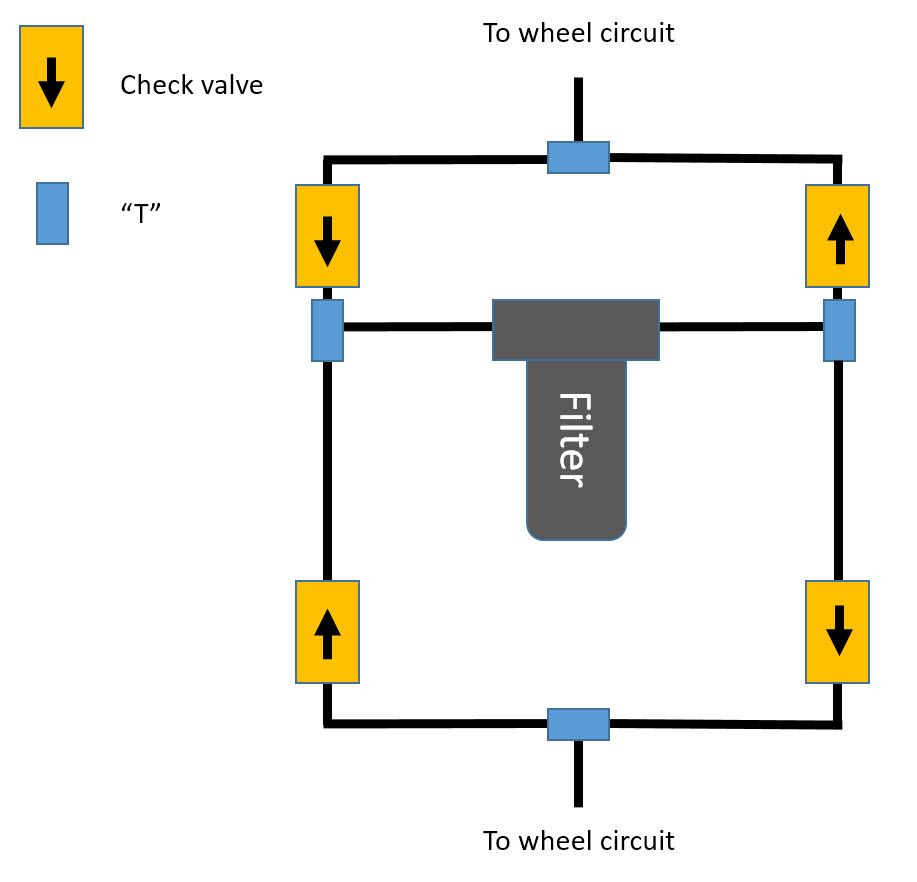
Here's an image of the filter loop I mentioned. With four check valves, you can connect the filter any way without worrying about reversing the flow and contaminating the circuit. Ideally, I'd want to add a pressure guage and flow meter just to ensure the filter is working properly. I wish someone offered these for sale.

SNAG-0217_zpsbwezduan.jpg
 
   / Just rebuilt Tram pump #17  
Yup, that would do it. (I think that it's a really nice full wave rectifier laid out in hydraulics.)

Could I raise a few concerns?
  • If those check valves wear, or break, the tractor would be in a heap of trouble.
  • If one check valve stutters, or malfunctions, the tractor would run the risk of back washing all the gunk in the filter into the pump or motors. Granted that the gunk would have been circulating, at least until it weeped through the case drains.
  • Minor detail: there is probably the need to ensure that the the filter has a bleed line to keep air out of the wheels and pump, and for the user to bleed any dust or debris from changing the filter out of the system.
  • Finally, don't forget that the filter itself will introduce add resistance, reducing the effective power of the engine, and increasing the heat load.

At some point the complexity of the system itself becomes a source of risk. For me, I would be happy if the charge pump had a precharge pump that further filtered everything to 2 microns and below. (But what if that failed? What if it cavitated and shed debris? What if the oil was cold? OK. Maybe not.)

I think that at some point, this is a bit of a hamster wheel. I think that you should do whatever helps you sleep at night.

Me? I take Terry at his world that pump/motor changes are like open heart surgery, and I try really, really, really hard to get all the fittings and parts clean and keep them that way when I have to repair that circuit. Beyond that, I operate the tractor at low engine speeds whenever the old is cold to limit cavitation, and change the oil filters on schedule, and all of the oil every five hundred hours or so. YMMV.

All the best,

Peter
 
   / Just rebuilt Tram pump #18  
Here's an image of the filter loop I mentioned. With four check valves, you can connect the filter any way without worrying about reversing the flow and contaminating the circuit. Ideally, I'd want to add a pressure guage and flow meter just to ensure the filter is working properly. I wish someone offered these for sale.

This is totally unnecessary ,and has the potential for more leaks and for a mess when a check valve eventually leaks...which may be why no one makes one...the system with one valve works great you don't need to run the motor in both directions,your just flushing it and your going to remove the filter....the instant you start it and try to move the forward reverse lever,you'll know which way to go,it won't go one way and works perfect the other,run the engine at half to 3/4 throttle and run the speed about the same half to 3/4 and let it run until the fluid is warm usually about 20 minutes....shutdown and remove the filter being sure nothing gets in ,this is the best way to do it...
 
   / Just rebuilt Tram pump #19  
Hey Raw Dodge, did you ever find that filter for the loop system in the tram pump? My PT pump leaked from the day I got it new, so Terry said it was from sitting in the warehouse for so long and that it would probably seal up before 100 hours of use. Well, I'm at 72 hrs and its not looking like the drip stopped. So, I'll probably end up taking it off and sending it back. This filter for the loop system would be nice to have when installing the new pump.
This is totally unnecessary ,and has the potential for more leaks and for a mess when a check valve eventually leaks...which may be why no one makes one...the system with one valve works great you don't need to run the motor in both directions,your just flushing it and your going to remove the filter....the instant you start it and try to move the forward reverse lever,you'll know which way to go,it won't go one way and works perfect the other,run the engine at half to 3/4 throttle and run the speed about the same half to 3/4 and let it run until the fluid is warm usually about 20 minutes....shutdown and remove the filter being sure nothing gets in ,this is the best way to do it...
 

Tractor & Equipment Auctions

2018 John Deere Z997R (A53317)
2018 John Deere...
Bobcat 435 FastTrack (A60462)
Bobcat 435...
MANIFOLD TRAILER (A58214)
MANIFOLD TRAILER...
(2) UNUSED 31" X 8 MM EXCAVATOR TRACKS W/ PINS (A60432)
(2) UNUSED 31" X 8...
8 TOOTHED BUCKET FOR MINI EXCAVATOR (A58214)
8 TOOTHED BUCKET...
UNUSED FUTURE FT-RR78 - 78" HYD ROCK RAKE (A52706)
UNUSED FUTURE...
 
Top