Laying Water pipe

   / Laying Water pipe #21  
That looks really well built Jim. Can I borrow it? ;)
 
   / Laying Water pipe #22  
I built this. Haven't tried it yet. It started out life as a KK middlebuster. I added the tooth, and conduit, etc.


Looks good for coiled pipe Jim, and I have the same stuff available including the galvinized conduit sweeps and subsoiler gathering dust. Think I will copy your design. Thanks for posting the pics.

Normally I use a backhoe and bury my lines about 24" deep using pvc pipe but I have two dry spots in my lawn that I would rather not dig up.
 
   / Laying Water pipe #23  
I built this. Haven't tried it yet. It started out life as a KK middlebuster. I added the tooth, and conduit, etc.

It's easier to just pull PVC pipe with a subsoiler plus PVC is better pipe with better fittings. I've done it with both types.
 
   / Laying Water pipe #24  
I built this. Haven't tried it yet. It started out life as a KK middlebuster. I added the tooth, and conduit, etc.

Looks nicely designed. Try running it before trying to install anything. I found with mine I needed to add weight to keep it running deep. There's a lot of drag created by the vertical shaft that might cause it to run up. Probably why the other pictures show the use of all the suitcase weights.
 
   / Laying Water pipe #25  
We actually named our road "Rocky Ridge Rd". The rock is even more of a problem when there's high winds like the tornados a few weeks ago. We figure we have about 300 trees down. They can only root a few feet deep at the most before they hit the rock. Over years, they gradually fracture it and send down little roots, but not strong enough to withstand 100mph or more.

But that rocksaw was really awesome! It would make about 2-3 ft/minute in most places at a depth of about 3-4 ft. Laying in 1/2 mile of 2" pipe with it cost about the same as drilling a well.

JRobyn,

You have any more info on the rocksaw? I am in the process of building in Wilson County TN and am going to have to lay about 1800' of 2" pvc.

Gosh I envy those of you who can just dig and it be DIRT!

Thanks,
Nick
 
   / Laying Water pipe #26  
JRobyn,

You have any more info on the rocksaw? I am in the process of building in Wilson County TN and am going to have to lay about 1800' of 2" pvc.

Gosh I envy those of you who can just dig and it be DIRT!

Thanks,
Nick

Hi Nick. Sent you a PM.
 
   / Laying Water pipe #27  
I was unable to locate my well near my garden. I tried, but could not find water by the garden. I ended up putting my well points (4 points) along a swamp about 350 feet from the garden. I'm using a sprinkler pump that can pump up to 45GPM. Now I need to run a water line about 350 feet.

My goal is to have as much water volume/pressure as possible because I want to be able to run all of my garden sprinklers at one time. 4 - 6 sprinklers and I need them to throw water as far as possible.

So...that being said...I'm going to run 2 inch water line from the pump to the garden. I was going to buy the black polyethylene tubing that comes in 100 foot rolls and is used for underground sprinklers. But I'm a bit concerned after reading this forum. Some folks were saying that the black stuff only lasts about 5 years and is prone to splitting? I am in Minnesota. I was thinking of burying it about 12 inches deep and then blowing the line out in the fall.

Some people were recommending trenching and running the white schedule 40 PVC (10 foot sections with couplers). Is it really worth doing that? Its a lot of extra work and time to run it that way. But I want it to last for 20+ years...

Would appreciate hearing your thoughts.

Thanks!
 
   / Laying Water pipe #28  
I was unable to locate my well near my garden. I tried, but could not find water by the garden. I ended up putting my well points (4 points) along a swamp about 350 feet from the garden. I'm using a sprinkler pump that can pump up to 45GPM. Now I need to run a water line about 350 feet.

My goal is to have as much water volume/pressure as possible because I want to be able to run all of my garden sprinklers at one time. 4 - 6 sprinklers and I need them to throw water as far as possible.

So...that being said...I'm going to run 2 inch water line from the pump to the garden. I was going to buy the black polyethylene tubing that comes in 100 foot rolls and is used for underground sprinklers. But I'm a bit concerned after reading this forum. Some folks were saying that the black stuff only lasts about 5 years and is prone to splitting? I am in Minnesota. I was thinking of burying it about 12 inches deep and then blowing the line out in the fall.

Some people were recommending trenching and running the white schedule 40 PVC (10 foot sections with couplers). Is it really worth doing that? Its a lot of extra work and time to run it that way. But I want it to last for 20+ years...

Would appreciate hearing your thoughts.

Thanks!
I would just use Black plastic pipe that comes in coils.
I put in over 350 feet of it in here when I set up my place in 1971 .
Have only had 3 leaks in it.
Thats not bad for 40 years of use.
 
   / Laying Water pipe #29  
Hey MNBobcat,

I would use PVC and plow it in. PVC is better pipe and most important - it has MUCH better fittings that don't leak.

Make a dry run or two with your subsoiler to loosen the soil. Then pre-assemble your pipe and plow away. Make a pulling head by drilling a hole in a PVC cap and run a rope through it and knot it to pull the pipe.

I've done it this way many times. First time I tried plowing pipe was with roll pipe and then I tried PVC and there's no contest.

gabby
 
   / Laying Water pipe #30  
Hey MNBobcat,

I would use PVC and plow it in. PVC is better pipe and most important - it has MUCH better fittings that don't leak.

Make a dry run or two with your subsoiler to loosen the soil. Then pre-assemble your pipe and plow away. Make a pulling head by drilling a hole in a PVC cap and run a rope through it and knot it to pull the pipe.

I've done it this way many times. First time I tried plowing pipe was with roll pipe and then I tried PVC and there's no contest.

gabby

Thanks guys.

Gabby -- I would have 3-4 splices with the black poly. The PVC would require about 35 couplings.

When you plow in the PVC, what keeps the couplings from getting hung up on the subsoiler as it feeds through the ring/guide? I'm having trouble envisioning how that would work.

What is it that you like about the PVC that makes it easier to plow in? Is it easier to handle because you're not dealing with a big roll?

Thanks! Really appreciate all of the replies and suggestions!
 
   / Laying Water pipe #31  
I would use the 2" pvc schedule 40 bell end pipe in 20' lengths, much easier to handle. I would also add that installing it below the frostline would be much better to eliminate movement. The contraction and expansion of the pipe is where most of the problems develop, bedding it lower helps to stabilize the pipe's temperature.
 
   / Laying Water pipe #32  
Thanks guys.

Gabby -- I would have 3-4 splices with the black poly. The PVC would require about 35 couplings.

When you plow in the PVC, what keeps the couplings from getting hung up on the subsoiler as it feeds through the ring/guide? I'm having trouble envisioning how that would work.

What is it that you like about the PVC that makes it easier to plow in? Is it easier to handle because you're not dealing with a big roll?

Thanks! Really appreciate all of the replies and suggestions!

MNBobcat,

I would look around more, our Menards has black poly in 100 and 250 foot rolls and some supply houses have 3-400 hundred foot rolls. The larger rolls can be a pain to man-handle, but it can be done easily with a helper. That would get you to 1-2 couplings.

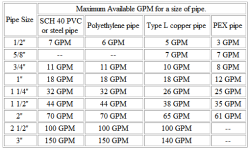
2" pipe is a lot of water and head pressure.....unless you need the maximum pipe output I'd consider maybe stepping down to 1-1/2", it's easier to handle if working with limited help. I've attached a volume chart for your reference. According to the chart (snagged on line) 2" will greatly exceed your pump capacity.

I've used black poly for years. Most problems I've seen were because of: 1) the use of the white plastic poly fittings that broke, and 2) the use of cheap hose clamps (not all stainless steel). I too have read about issues with plastic...but figure it comes with the territory. I used it 3 years ago on my house (450') ...no regrets thus far. Our local rural water company uses it for all taps from their main to their meter.

If you do use it there's a couple of things I do that make the joints really easy to get tight (and leak free :) )

Install the fittings with the pipe on the soil surface. Pick up "red brass" barbed fittings (as an example), our Menards carries a good supply of them. Use a small propane torch, heat the pipe gently around it's circumference. You know when it's "warm enough" as the pipe will look glossy, it makes slipping the fittings into the pipe (especially larger ones) in a cinch! Secure the fittings with 2 stainless steel clamps on each barbed end, pulling opposite directions and with the screws 180* opposite each other when the pipe still warm, don't over do it.

If you lay the pipe out on a "normal" sunny day and let it warm in the sun for a bit, it handles very easily. Trench the pipe below frost level, turn on the water purging the pipe of air, and to pressurize (looking for leaks) before back filling and you'll be good to go. Watch for stones; taking care to make sure you don't lay the pipe on or back fill with, large sharp rocks against the pipe.

Good luck with your decision....
 

Attachments

  • pipeflows.png
    pipeflows.png
    12.8 KB · Views: 484
   / Laying Water pipe #33  
MNBobcat,

2" pipe is a lot of water and head pressure.....unless you need the maximum pipe output I'd consider maybe stepping down to 1-1/2", it's easier to handle if working with limited help. I've attached a volume chart for your reference. According to the chart (snagged on line) 2" will greatly exceed your pump capacity.

Good luck with your decision....

Hi Rippy,

Thanks for the great info! I definitely want to make sure I size the pipe correctly. Is going too big on the pipe a bad thing? I don't need 70 GPM (which the 2" is rated for according to the chart). But the chart doesn't factor in distance. I thought the larger diameter would help given the long distance but if the larger size is actually a bad thing then I would want to go with the 1 1/2". I was trying to lower the losses over the distance.

Thanks again!
 
   / Laying Water pipe #34  
I was unable to locate my well near my garden. I tried, but could not find water by the garden. I ended up putting my well points (4 points) along a swamp about 350 feet from the garden. I'm using a sprinkler pump that can pump up to 45GPM. Now I need to run a water line about 350 feet.

Would appreciate hearing your thoughts.

Thanks!

I cannot imagine the work of trenching and then putting together and ultimately installing 35 sections of PVC. As you are concerned about pressure drop, you might want to calculate what, if any, the couplings cause.

I'd opt for black poly. Typically 1-1/2" is plenty for most residential uses, but with your 350' of length, you probably should do some calculations. Maybe 2" (whether poly or PVC) is really what you need/want.
 
   / Laying Water pipe #35  
djradz,

I'd have to be over 50 inches deep to get below the frost line. That's deeper than a trencher would go. Also, any sort of trenching would make a mess and require a lot of repair to the yard. I decided to run the pipe on the yard side rather than in the field so that I can plow the field if I ever decide to plant something more than a garden.


If I plow in the black poly I would think it wouldn't take me more than an hour and would have minimal mess. I'm really leaning towards the poly but want to make sure its going to last. If I do something I want to only have to do it once!
 
   / Laying Water pipe #36  
Hi Rippy,

Thanks for the great info! I definitely want to make sure I size the pipe correctly. Is going too big on the pipe a bad thing? I don't need 70 GPM (which the 2" is rated for according to the chart). But the chart doesn't factor in distance. I thought the larger diameter would help given the long distance but if the larger size is actually a bad thing then I would want to go with the 1 1/2". I was trying to lower the losses over the distance.

Thanks again!

Here's a series of tables that might help you.

http://www.hunterindustries.com/resources/pdfs/technical/domestic/lit091w.pdf
 
   / Laying Water pipe #37  
I've always run PVC and never any black poly, but I had a neighbor about 35 years ago that ran black poly about 400' up a fairly steep hill, and he had nothing but problems.
He had so much grief with leaks that he finally put in PVC and had no more problems.

We have no frost line here to speak of, but I'm sure he buried it well below the surface and was installed correctly, because he was a perfectionist.

He always said that he was certain the reason was that the poly couldn't stand the pressure going up the steep hill.
 
   / Laying Water pipe #38  
I have used both pvc and black poly pipe but the pvc pipe is more durable if you are dragging it thru a trench for 350'. Both types of pipe are good when properly installed.

Couplings are not needed with bell end pipe as it is formed into the end of the pipe itself, a stick of pvc 40 bell end is 20ft in length, not 10'.

If you use black poly pipe in IPS sizes you can use Mueller fittings which will push on with o ring seals, much easier to use and are the mainstay of public utilities everywhere.

Using a larger pipe size for instance 2" will reduce the friction loss dramatically which will allow for a higher flow and pressure at the garden end. It will not increase the pressure or flow above what you start with it will only allow you to maintain more of the pressure and flow that you have to work with.

Regardless of which pipe you choose you still have two choices. Put it in quick, cheap and shallow (12 inches) and fight with it forever. Put it below the frostline, more time and money and it will last the twenty years or longer that you wan't.
 
   / Laying Water pipe #39  
Thanks guys.

Gabby -- I would have 3-4 splices with the black poly. The PVC would require about 35 couplings.

When you plow in the PVC, what keeps the couplings from getting hung up on the subsoiler as it feeds through the ring/guide? I'm having trouble envisioning how that would work.

What is it that you like about the PVC that makes it easier to plow in? Is it easier to handle because you're not dealing with a big roll?

Thanks! Really appreciate all of the replies and suggestions!

Hay MNBobcat,

The PVC pipe is pre-glued and pulled underground behind the plow like a long underground rope. Dig a starter hole to drop the plow down into. Use a rope threaded through a hole in a PVC cap fitting and tie it to the plow foot to install the pipe.

It has very little friction resistance as you are pulling it. I have never pulled one apart even in long pulls. I've laid at least a couple of miles of PVC pipe this way.

Best of all, last time I checked PVC wasn't any more expensive than roll pipe, and you don't have to use barb fittings and ring clamps with PVC.

Coincidentally, I recently tried to patch a leak mid-run in an old roll pipe. Nothing worked no matter what I did with barb fittings. Finally had to get a real plumber to patch it and he had to use a compression type dresser coupling because the barb fittings always leaked. With PVC, all you need is a telescoping union to fix a leak and you're done in a flash compared to roll pipe.

Roll pipe sucks.

gabby
 
   / Laying Water pipe #40  
I would use the black poly, and bury it carefully (below frostline if appropriate). And I would suggest pressure testing it in the roll, before unwinding it, and before backfilling. I have seen two batches where the printing on the sidewall of the tube, telling manufacturer name and size and stuff, it leaked thru every letter. Like sprinkler hose. The first batch I saw do this was under 6 feet of dirt and 4 inches of concrete before I discovered it. Yea, I got to run a jackhammer that week.


Tractor & Equipment Auctions

2005 Kubota L3130 (A60462)
2005 Kubota L3130...
2019 Jeep Grand Cherokee SUV (A59231)
2019 Jeep Grand...
Pat's QH and hydraulic top-link.
Pat's QH and...
John Deere 6300 (A60462)
John Deere 6300...
CATERPILLAR 108" WHEEL LOADER RAKE (A52707)
CATERPILLAR 108"...
UNUSED RAYTREE RMSG29 HYD STUMP GRINDER (A60432)
UNUSED RAYTREE...
 
Top