Leaking hyd. cyl, 400X Loader

   / Leaking hyd. cyl, 400X Loader #1  

Red Horse

Veteran Member
Joined
Dec 12, 2010
Messages
1,193
Location
Bolton, MA
Tractor
Deere 655ZTrak, Deere 4720 Cab, 400 X LT 155
Well the 400X loader on my 4720 appears to have some packing issues on the loader boom cylinders. In a little over two hours, the arms dropped 8". Three days later, from a height of 48" the bucket is now on the concrete floor..

Any clue as to what typical cost is to replace packings? Not only does boom drop, but I tried to load a structure I was told weighed about 1200 pds on the back of a one ton and couldn't get load any higher than about 18". I think a 400X is rated for over 2000 lb.
 
   / Leaking hyd. cyl, 400X Loader #2  
I believe I have the answer for you as far as cost. I'll have to go find the receipt in my garage though later. I swear it was around 500 bucks. My 300cx dump cylinders were doing the same thing from day 1 and they repacked both cylinders. The cost was on the receipt however, it was under warranty. The problem still happened though about a week later and it turned out I got a bad batch of cylinders. They were defective inside so john deere had them replace both cylinders after that
 
   / Leaking hyd. cyl, 400X Loader
  • Thread Starter
#3  
I believe I have the answer for you as far as cost. I'll have to go find the receipt in my garage though later. I swear it was around 500 bucks. My 300cx dump cylinders were doing the same thing from day 1 and they repacked both cylinders. The cost was on the receipt however, it was under warranty. The problem still happened though about a week later and it turned out I got a bad batch of cylinders. They were defective inside so john deere had them replace both cylinders after that
THX Big M. I had heard it was pricey. I have worked on older machines with the typical packing nut on the ends and it was not rocket science but these "sealed" units are something else.
 
   / Leaking hyd. cyl, 400X Loader #4  
Redhorse
Have you looked at the breakdown of the parts shown in jdparts ? Doesn't look to be real difficult to remove the snap ring and pull the cylinders apart to get at the seals.
 
   / Leaking hyd. cyl, 400X Loader #5  
Well the 400X loader on my 4720 appears to have some packing issues on the loader
boom cylinders. In a little over two hours, the arms dropped 8". Three days later, from a height of 48" the bucket
is now on the concrete floor..

That's about normal for JD FEL valves with some hours on them.

On one of my 4300s, one FEL boom cylinder piston seal was completely blown out and the loader would still leak
down at about that speed...3 or 4 days to go from chest height to ground.

The other symptom you report (can't lift heavy loads) does indicate a bad boom piston seal or 2. I do
NOT buy from JD any more, however ($!). Measure the sizes and try Herculesus.com.

BTW, with a blown seal, my FEL could only lift its own weight (empty) about 4 or 5 feet high.
 
   / Leaking hyd. cyl, 400X Loader
  • Thread Starter
#6  
Guys- Thx for input- I will check out the schematic. Should not be rocket science.
 
   / Leaking hyd. cyl, 400X Loader #7  
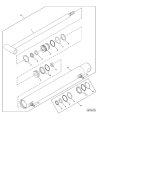
Here is a pic of the parts..
 

Attachments

  • 400X_lift_cyl.jpg
    400X_lift_cyl.jpg
    107 KB · Views: 140
   / Leaking hyd. cyl, 400X Loader
  • Thread Starter
#8  
Here is a pic of the parts..
Thx- just downloaded and printed off web site. 49 bucks and change per cylinder-so 100bucks and a lot of cussing on my part and I should be done......Stay tuned!
 
   / Leaking hyd. cyl, 400X Loader #9  
don't expect internal seals to fix a settling boom. The reason is that the extended cylinders can't retract even with NO seals (Unless fluid is going back through the valve, or oil is leaking externally). When a cylinder retracts, the rod has to displace oil. If there is no where for the oil to go, the rod can't retract. It's that simple.
Now, the lift capacity being reduced...that's a different story. That sounds like an internal seal. You will still have the settling issue when you are done.
In Big Mikes case, he had a problem with the internal seals of the DUMP cylinders. They EXTEND when they settle, so the rod exiting the cylinder increases the volume, and pulls air in from the external seals to take up the extra space. The external seals do a poor job of sealing a vacuum.
 
   / Leaking hyd. cyl, 400X Loader
  • Thread Starter
#10  
don't expect internal seals to fix a settling boom. The reason is that the extended cylinders can't retract even with NO seals (Unless fluid is going back through the valve, or oil is leaking externally). When a cylinder retracts, the rod has to displace oil. If there is no where for the oil to go, the rod can't retract. It's that simple.
Now, the lift capacity being reduced...that's a different story. That sounds like an internal seal. You will still have the settling issue when you are done.
In Big Mikes case, he had a problem with the internal seals of the DUMP cylinders. They EXTEND when they settle, so the rod exiting the cylinder increases the volume, and pulls air in from the external seals to take up the extra space. The external seals do a poor job of sealing a vacuum.
I'm confused. It is a double acting cylinder-not a single action. Thus if boom is raised , force is on the "down" side of the boom. If seals are bad, doesn't "x" volume of fluid simply take path of least resistance and push to other side of piston??? Same volume of oil is in the cylinder bore-it just is now on the other side. What am I missing??
 
   / Leaking hyd. cyl, 400X Loader #11  
The rod side has a smaller volume of oil because of the volume of the rod itself. So as a cylinder retracts, the total volume of oil in the cylinder goes down due to the steel rod retracting into the cylinder.
 
   / Leaking hyd. cyl, 400X Loader
  • Thread Starter
#12  
The rod side has a smaller volume of oil because of the volume of the rod itself. So as a cylinder retracts, the total volume of oil in the cylinder goes down due to the steel rod retracting into the cylinder.
Arlen- thx for the continuing education. I hear you on the rod "volume" or displacement. But as the piston retracts, and as the length of the rod in the opposite side increases, so does the length of the cylinder bore-so in essence does that not balance out (I suppose I should do the math)???

In any case, my biggest issue is the load lifting capability. Like I said, I had one of those embarrassing moments when I tried to load a structure on a one ton last week. I was told it weighed 1200 and I should hasve been able to handle it no sweat. Instead I got it about 18" or so off the ground and that's all she wrote. Had to be rescued by Cat yellow!
 
   / Leaking hyd. cyl, 400X Loader #13  
The cylinder bore length is fixed. The only thing changing as the cylinder retracts is the amount of steel rod you are shoving into it.
Seals should fix you right up on the lift issue.
 
   / Leaking hyd. cyl, 400X Loader
  • Thread Starter
#14  
The cylinder bore length is fixed. The only thing changing as the cylinder retracts is the amount of steel rod you are shoving into it.
Seals should fix you right up on the lift issue.
Arlen-I didn't do a good job of explaining my point. What I'm saying is, say rod is extended-cylinder fully open and piston is on far end of cylinder and unit is at max length. as packings leak, oil gets on other side and piston starts to drop. Correct on volume of the rod itself. However, the volume of the cavity increases as the piston drops- cavity on extended side of piston increases, while cavity on closed side decreases. If you as an example assume a cylinder internal bore of 2" , that is 3.14 sq. in. of area or 3.14 cu. in for each inch of length. Assume a rod diameter of 1.25". That amounts to 1.2265 sq. in. of rod "space" or 1.2265 cu.in. for each 1" of rod length. So on the piston end of the rod, each inch of cylinder holds 3.14 cu. in. of oil. on the "extended" end of the cylinder, each inch of cylinder holds 3.14 cu in- 1.2265 cu in or 1.9135 cu in of oil. Thus 3.14/1.9135= 1.64" of travel needed on "extended side to equal 1" of travel on the piston end of rod.

Bottom line, seal kit AH 17625 should solve the problem.
 
   / Leaking hyd. cyl, 400X Loader #15  
Thus 3.14/1.9135= 1.64" of travel needed on "extended side to equal 1" of travel on the piston end of rod.

Bottom line, seal kit AH 17625 should solve the problem.

Mr. Horse,
Maybe it was me that didn't do a good job explaining things. In your above statement you say that it takes 1.64" of travel on the rod end to equal 1" of travel on the cap end. To that, I would ask, how would you make them travel different distances since they are connected?

Consider this example:
Imagine a nice tall glass of water that is 2 inches in diameter and 12 inches tall. Make sure it is filled to the top. Now take a 1.25" wooden dowel rod and lower into the glass.

Would you agree that water immediately starts spilling over the glass as the dowel is lowered in?
Would you agree that the amount of water that is spilling out is exactly equal to the volume of rod that has been lowered into the glass?

Take the example one step further:

Let's refill the glass, then put a tight fitting lid on it. Next let's punch a hole in the lid, and fit it with a tight seal to go around our dowel. We may need to replace our wood dowel with a nice piece of machined metal so we get a nice tight seal.

Now, with it all sealed up, and the glass filled with water, do you think you would be able to shove the rod into the glass?

My point is this....You can't shove a rod into a cylinder full of fluid without a place for the fluid to exit the cylinder. The amount of fluid that needs to exit is going to be equal to the volume of the rod you are trying to push in. Internal seals have nothing to do with it.
If a hydraulic cylinder is retracting, then fluid is leaving the cylinder somewhere. If it is not leaking externally, then it is leaking back through the valve.

An extending cylinder is different, as in the case of the curl cylinders on a loader. If you have bad seals, the rod will begin to extend, the bucket starts to droop, and a vacuum starts to build as the rod continues to extend out of the bore. The rod external wiper seals will start to pull in some air at some point if there is enough weight on the bucket. The wiper seals do a poor job of sealing a vacuum.

I also drew a little sketch of a cylinder and calculated a couple of volumes with the cylinder at 2 different positions.
View attachment Cylinder.pdf

I don't want this to turn into another one of those ugly threads that TBN is so famous for. I just wanted to give you some hydraulic troubleshooting tips.
 
   / Leaking hyd. cyl, 400X Loader
  • Thread Starter
#16  
Mr. Horse,
Maybe it was me that didn't do a good job explaining things. In your above statement you say that it takes 1.64" of travel on the rod end to equal 1" of travel on the cap end. To that, I would ask, how would you make them travel different distances since they are connected?

Consider this example:
Imagine a nice tall glass of water that is 2 inches in diameter and 12 inches tall. Make sure it is filled to the top. Now take a 1.25" wooden dowel rod and lower into the glass.

Would you agree that water immediately starts spilling over the glass as the dowel is lowered in?
Would you agree that the amount of water that is spilling out is exactly equal to the volume of rod that has been lowered into the glass?

Take the example one step further:

Let's refill the glass, then put a tight fitting lid on it. Next let's punch a hole in the lid, and fit it with a tight seal to go around our dowel. We may need to replace our wood dowel with a nice piece of machined metal so we get a nice tight seal.

Now, with it all sealed up, and the glass filled with water, do you think you would be able to shove the rod into the glass?

My point is this....You can't shove a rod into a cylinder full of fluid without a place for the fluid to exit the cylinder. The amount of fluid that needs to exit is going to be equal to the volume of the rod you are trying to push in. Internal seals have nothing to do with it.
If a hydraulic cylinder is retracting, then fluid is leaving the cylinder somewhere. If it is not leaking externally, then it is leaking back through the valve.

An extending cylinder is different, as in the case of the curl cylinders on a loader. If you have bad seals, the rod will begin to extend, the bucket starts to droop, and a vacuum starts to build as the rod continues to extend out of the bore. The rod external wiper seals will start to pull in some air at some point if there is enough weight on the bucket. The wiper seals do a poor job of sealing a vacuum.

I also drew a little sketch of a cylinder and calculated a couple of volumes with the cylinder at 2 different positions.
View attachment 387734

I don't want this to turn into another one of those ugly threads that TBN is so famous for. I just wanted to give you some hydraulic troubleshooting tips.

Arlen-first of all, nothing "ugly" about this thread. Keep in mind, I am the one seeking an explanation so I always appreciate anyone's attempt to educate me. I guess what confuses me, is I make the assumption that the cylinder is always LONGER than the rod length it must accomodate. In your example, you equate the cylinder length to what amounts to the rod length. I have this idea in my head that the cylinder length is LONGER by the amount of rod VOLUME it must accomodate. Thus when a rod is in fully extended position, the packings, piston, and retaining nut are in essence up against the end cap or snap ring/seal. The volume of oil in the cylinder than equals "X" and when the piston retracts, The added length of the cylinder on the retracted end is longer to accomodate the displacement volume of the rod.

Is that not the reason a hydraulic cylinder is always much longer than the length of the piston stroke-as in your illustration.:confused3:

PS Going back to my "youth" whenever a packing had to be changed, it was because the "boom" "dipper" "stabilizer" whatever was leaking down. I never remember having to replace a valve.
 
   / Leaking hyd. cyl, 400X Loader #17  
No matter how long or short the cylinder is, it still if FULL of oil. What about my glass of water analogy? Walk me through your logic with a similar analogy.
Cylinders are NOT generally "much" longer than the stroke, and even if they were, it isn't like there is an air space in there.
Draw a cylinder with the dimensions of your choice and work through it...calculate the total oil in the cylinder in 2 different places and let me know what you come up with.
 
Last edited:
   / Leaking hyd. cyl, 400X Loader #18  
Watch the youtube , they will show ya how to repack them. After watching, i think i could do it myself.
 
   / Leaking hyd. cyl, 400X Loader
  • Thread Starter
#19  
Watch the youtube , they will show ya how to repack them. After watching, i think i could do it myself.
10-4-thx for input
 
   / Leaking hyd. cyl, 400X Loader
  • Thread Starter
#20  
No matter how long or short the cylinder is, it still if FULL of oil. What about my glass of water analogy? Walk me through your logic with a similar analogy.
Cylinders are NOT generally "much" longer than the stroke, and even if they were, it isn't like there is an air space in there.
Draw a cylinder with the dimensions of your choice and work through it...calculate the total oil in the cylinder in 2 different places and let me know what you come up with.
Arlen-will do
 

Tractor & Equipment Auctions

Gravely ZT XL-52 52in Zero Turn Commercial Mower (A59228)
Gravely ZT XL-52...
IRTPL 10,000 LBS TWO POST LIFT (A58214)
IRTPL 10,000 LBS...
2019 F-550 Bucket Truck (A56438)
2019 F-550 Bucket...
404 (A52706)
404 (A52706)
2013 PETERBILT 367 DAYCAB (A58214)
2013 PETERBILT 367...
2019 Deere 35G (A53317)
2019 Deere 35G...
 
Top