Looking for suggestions

   / Looking for suggestions #1  

ns_in_tex

Platinum Member
Joined
Mar 24, 2002
Messages
924
Location
East Texas
Tractor
Kubota L4610 HSTC, International 2400, Hesston 1280,
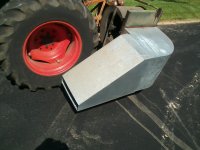
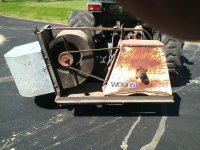
We would like to improve on our driveway blower.
It blows good, but you know, we want to Tim Taylor it.
We have a side discharge as well as a front discharge. Each has it's good points, but takes time to change.
Also when we run full speed, it makes the fins come loose on our blower wheel.
So, I am thinking, we need a heavy duty blower, maybe like sawmill collection blower, then put a hydraulic controlled discharge which we could change direction of discharge on the go. Of course, might go another route & make a vacuum system out of it.
Where might we find a blower that would load up to, maybe 20 HP, and we could run at half throttle, but move Tim Taylor type air.

Any suggestions appreciated.
 

Attachments

  • 0903161051.jpg
    0903161051.jpg
    309.1 KB · Views: 311
  • 0903161050.jpg
    0903161050.jpg
    235.9 KB · Views: 260
  • 4_driveway blower dischargeand2x4.JPG
    4_driveway blower dischargeand2x4.JPG
    71.8 KB · Views: 176
   / Looking for suggestions
  • Thread Starter
#3  
   / Looking for suggestions #4  
I like your setup. The squirrel cage fan you're using usually has some restriction of air flow for the intake in the form of ducts, filters, or what not. Have you tried playing with a piece of sheet metal or plywood and slightly cover the intake. Play with it covering it a little then more and see if it helps with to much pressure on the fins.

The way your chute is now could be built onto with maybe a baffle inside for a diverter. The size blower you have now should be plenty of blowing for cleaning a drive. Like your idea. I think Tim would like it too.
 
   / Looking for suggestions
  • Thread Starter
#5  
I like your setup. The squirrel cage fan you're using usually has some restriction of air flow for the intake in the form of ducts, filters, or what not. Have you tried playing with a piece of sheet metal or plywood and slightly cover the intake. Play with it covering it a little then more and see if it helps with to much pressure on the fins.

The way your chute is now could be built onto with maybe a baffle inside for a diverter. The size blower you have now should be plenty of blowing for cleaning a drive. Like your idea. I think Tim would like it too.

Yes, we are familiar with normal blowers with electric motors having to be partially blocked to keep from overloading the motor. In this case we are just overloading the wheel because we have power to spare. We have tied baling wire around the outside center of the wheel, trying to hold the fins down. All we have to do is slow down the engine rpm to keep this from happening. But you know old TIM, when something sticks & you want it to move, it is hard not to open the throttle a little. We have kept back a spare blower wheel for when this one comes apart completely.
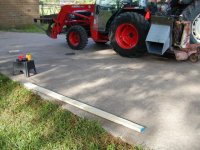
In that last picture with the 2x4x8' shown, it will blow it off the drive, I think, somewhere around 1/2 throttle, at the distance shown in the picture. If you walk in front of it while running, when you pick your foot up, it will not land on the intended spot to put it down.
Just thinking, if we had a paddle wheel blower, maybe it could take all the kubota could dish out.
 
   / Looking for suggestions #6  
Hi,

I have similar setup here in UK with lots of leaves (beech and oak) I made mine in same way with a side discharge. Main difference is that I kept the fan speed at the rate it was designed for by not increasing pto speed to much (about 3:1) so fan runs at approx 1500rpm.
Yours appears to have a greater pulley ratio hence higher speed and thus problems with coming apart etc.
I thought higher speed = more flow but not the case hence back to speed it was originally designed for and it seems to work ok
Used on a 26hp Italian machine

It works well and enables me to blow large area of lawn into ahead for collection.

I made mine about 6yrs ago and has worked well with no problems.

A paddle wheel fan would be more suited to collecting than blowing - more work but all picked up in one go.
 
   / Looking for suggestions #7  
As Densleigh said, the blower is designed to operate at a certain range of RPM's. Overdriving it doesn't increase anything except the probability of failure.

When I built mine, I calculated the pulley size based on matching the RPM's of the electric motor that drove the fan when it lived in the piece of HVAC equipment it was harvested from. I did experiment a bit with the nozzle part of the rig, but since I was trying to work within the confines of certain dimensions there were some limitations that may have prevented it from being better. It does work well and can clear a couple acres of leaves in the Fall lickety-split.

The maximum amount of air is moved when the intake has no restrictions. As you know, blocking the intake decreases the volume of air passing through it.

http://vid1295.photobucket.com/albums/b628/jim_miller7/IMG_0767_zpsrkkzg7vr.mp4
 
   / Looking for suggestions #8  
The "fan law" says ( Fan Affinity Laws ) head increases with square of speed while flow increases linearly. Power required to run the blower=mass flow * head therefore to double the speed of the fan requires 8 times power increase. Since real life blowers deviate from ideal machine the actual number will differ but for simple blower should be pretty close to ideal machine. What you need is axial blower.
 
   / Looking for suggestions
  • Thread Starter
#9  
The "fan law" says ( Fan Affinity Laws ) head increases with square of speed while flow increases linearly. Power required to run the blower=mass flow * head therefore to double the speed of the fan requires 8 times power increase. Since real life blowers deviate from ideal machine the actual number will differ but for simple blower should be pretty close to ideal machine. What you need is axial blower.

Thanks for the info & link. We are not smart enough to make full use of all the formulas, but I believe that comes up pretty close to my estimates. Maybe: 540 pto = 3466 cfm, 311 pto = 2000 cfm.

You see, I am not a "Redneck in training" but a "Redneck with a full degree". This may be the first time we remember hearing the term "axial" blower.
 
   / Looking for suggestions #10  
Thanks for the info & link. We are not smart enough to make full use of all the formulas, but I believe that comes up pretty close to my estimates. Maybe: 540 pto = 3466 cfm, 311 pto = 2000 cfm.

You see, I am not a "Redneck in training" but a "Redneck with a full degree". This may be the first time we remember hearing the term "axial" blower.

My bonfires are spectacular but otherwise I am flanked the redneck course.:laughing: There is chart in the link that shows the relationship between rpm and required power to achieve it. Axial produce low head and large volume.
Example of axial is your ceiling fan on the very simple side and the compressor of jet engine on the complex side.
 
   / Looking for suggestions
  • Thread Starter
#11  
My bonfires are spectacular but otherwise I am flanked the redneck course.:laughing: There is chart in the link that shows the relationship between rpm and required power to achieve it. Axial produce low head and large volume.
Example of axial is your ceiling fan on the very simple side and the compressor of jet engine on the complex side.

If we looked at the right chart, I think it shows, double the rpm = double the cfm, but uses 8 time the power to run it. Power use does not bother me, we have 39 pto at our disposal.
Now for the axial blower, my mind says, ceiling fan not good, but if we could come up with a cheap (out of the junk pile) jet engine blower, then we might show Tim Taylor a thing or two.
 
   / Looking for suggestions #12  
If we looked at the right chart, I think it shows, double the rpm = double the cfm, but uses 8 time the power to run it. Power use does not bother me, we have 39 pto at our disposal.
Now for the axial blower, my mind says, ceiling fan not good, but if we could come up with a cheap (out of the junk pile) jet engine blower, then we might show Tim Taylor a thing or two.

But then it would take all your tractor HP to just keep moving forward. Maybe even 4 wheel drive. Unless of course you had the jet blast going backwards.:laughing:
 
   / Looking for suggestions #13  
If we looked at the right chart, I think it shows, double the rpm = double the cfm, but uses 8 time the power to run it. Power use does not bother me, we have 39 pto at our disposal.
Now for the axial blower, my mind says, ceiling fan not good, but if we could come up with a cheap (out of the junk pile) jet engine blower, then we might show Tim Taylor a thing or two.

You are wanting Tim Taylor power I think you're on the right track with the Jet engine. :)

Those axial fans used in "confined" spaces I remember blows a lot of air for their size and pull as much air as they push. We used to put one in each end of confined spaces when we were working inside. I never paid attention to their design. Might be worth looking at one and get an idea for a large version. Just a thought.
 
   / Looking for suggestions
  • Thread Starter
#14  
But then it would take all your tractor HP to just keep moving forward. Maybe even 4 wheel drive. Unless of course you had the jet blast going backwards.:laughing:

Hadn't thought of that. Now you're showing off my Redneck Degree.
 
   / Looking for suggestions
  • Thread Starter
#15  
You are wanting Tim Taylor power I think you're on the right track with the Jet engine. :)

Those axial fans used in "confined" spaces I remember blows a lot of air for their size and pull as much air as they push. We used to put one in each end of confined spaces when we were working inside. I never paid attention to their design. Might be worth looking at one and get an idea for a large version. Just a thought.

That made me think, we have an old chicken house fan. Probably too big to make work easily, but I remember hooking it up one time, and it was very noisy but I think it was moving a lot of air. I remember wondering why they didn't use a larger, slower fan for less noise. Maybe OSHA doesn't worry about the chickens.
 
   / Looking for suggestions #16  
The "fan law" says ( Fan Affinity Laws ) head increases with square of speed while flow increases linearly. Power required to run the blower=mass flow * head therefore to double the speed of the fan requires 8 times power increase. Since real life blowers deviate from ideal machine the actual number will differ but for simple blower should be pretty close to ideal machine. What you need is axial blower.

This is why I love this kind of thread. Thanks.
Can you explain the use of the term "affinity" here? I'm thinking it has a specific connotation in physics-speak that is over my head.
 

Tractor & Equipment Auctions

Rotadairon RD145 Pull-Behind Rotary Tiller Tractor Attachment (A59228)
Rotadairon RD145...
Toro Sand Pro (A56859)
2021 CATERPILLAR GP30N STRAIGHT MAST FORKLIFT (A60429)
2021 CATERPILLAR...
2016 Chevrolet Tahoe SUV (A59231)
2016 Chevrolet...
2022 Horizon (A55973)
GMC 2500HD 4wd Service Truck (A56438)
GMC 2500HD 4wd...
 
Top