Lucas CAV rotary injection pump math

/ Lucas CAV rotary injection pump math #1  

fitterski

Gold Member
Joined
Oct 20, 2016
Messages
377
Location
Nouvelle, QC
Tractor
1987 Cat-426, 1991 Deutz-Dx-6.05, 2019 Husqvarna 2xHP
On a Cummins 5.9 12-valve currently in the shop I will have to take a close look inside the injectin pump as it is the last one in a long line of suspects for failure to accelarate. There is another engine just like it on youtube where you can see THAT operator also trying to coax the rpm's up with only a litle more success. These engines are usually started automatically and almost immediately drive to full power, I SUSPECT that their timing is OFF the typical automotive application for example. My use for it will be more like automotive or tractor (actually a snow blower, another thread).

Cummins firepump - YouTube

I've redone the injectors, inside everything is like new (supposedly 1300 hours and consistent with that #). The pump is a Lucas CAV
tag-injection-pump-600.jpg

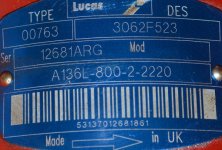
It is turned by a 73 tooth gear @ half crank speed. There are timing LETTERS in the view-window and a ref line. According to the plate the letter B should be at the timing line when the pump is installed with #1 cyl at TDC. The gear is keyed so it can only be installed one way but it may be turned together with the pump innards beforehand to change timing. Normally the inside drum is locked by a screw prior to removal at TDC and unlocked after reinstallation. So far so good.

The thing is that I like to understand things before I touch them. I have no idea what the other timing letters stand for or what the actual timing would be at the prescribed "Letter B". On the automotive 5.9 typical timing is 11 degrees before TDC, which would approximate about 5.5 degrees on the pump gear. If I turn the spool from the letter B to A it eats up 9 teeth, far too many degrees to be an 'an adjustment' thing, and backing just 5.5 degrees to take a wild guess at the actual injection point there is no mark to be found. I hate Cummins for not being much, *MUCH* more explicit in the manual! Maybe the letters are used for different engines with different numbers of cylinders.

At LEAST igf they had placarded timing as "The Letter B = 12 degrees" or something then I would have a point of reference. I want to know what I'm getting into before I open the pump up.

Any pump experts around with a few words of wisdom? TIA

Oh yeah, I can't delete the hi-res image to save on upload overhead, how do you do that? What's the use of a thumbnail as opposed to an inline image?
 

Attachments

  • tag-injection-pump.jpg
    tag-injection-pump.jpg
    3.9 MB · Views: 1,677
/ Lucas CAV rotary injection pump math #2  
The timing is 5* advanced on the pump at letter B.. Hope this helps.. TPG
 
/ Lucas CAV rotary injection pump math
  • Thread Starter
#3  
The timing is 5* advanced on the pump at letter B.. Hope this helps.. TPG

It certainly DOES, thanks! From that I can start bracketing if need be 1/2 degree for every crank degree. I got a lot to learn about injection pumps. I had a similar pump on my Cat-426 go bad because of water in the fuel, my mechanic had it redone cause we had no time for puzzle games. If I remember correctly the flyweights didn't work and a spring was broken (due to rust through).
 
/ Lucas CAV rotary injection pump math
  • Thread Starter
#4  
Is it likely for the flyweight response to be poor on a 1300 hour engine?

Here's what I've done:

Pump timing verified on spec i.e. "On Letter B"

Stripped engine, the only problem found was valve lash being extrememly high (probably a misread of 0.100 instead of 0.010 by the last person doing it). Lash reverted to spec in-010/exh-020.

Smoke is gone, idle is very nice, otherwise little change. Entire pump body slewed to adjustment advance limit (clockwise seen from rear). Accelertation now also improved and I can now work my way up to 2100 but engine still misses if accelerating fast to or above about 1800.

Initially my hunch was that timing to spec "On letter B" must be a mistake but that would really require knowing what the added dynamic advance would be, which I don't. On the other hand if the dynamic timing has gone 'jamming or jammed' then that could be a possible culprit and would show similar symptoms. It 'seems' (maybe just wishful thinking) that exercising the pump is also improving the result. I'll exercise it some more and maybe crank the gear over a tooth for another 5 degrees of static advance, then look at the performance. If I get a good run with high static advance then that would pretty well point the finger at no dynamic advance I think.

http://trixtar.org/3/tinkerings/12valve208hp/barf2.mp4
 
/ Lucas CAV rotary injection pump math #5  
Pump advance it based on rpm & internal pressure.. The faster the pump spins, the more internal pressure it creates, moving the advance piston.
The rate of movement can be changed by adding & removing shims.. located under the spring cap at the advance housing..
The spring cap is the one that has the small screw in the center of it..
Its SOP to replace the "pressure parts" inside the pump on a rebuild.. Liner & blades.. & the pump is checked/set for internal pressure & advance movement on the test stand..
We run the pump at a certain speed & set a pressure according to manuf. specs.. THEN run the pump at another speed & set the amount of advance required according to spec, by adding or removing shims..
The PRESSURE has to be there in order for the advance to move..
 
/ Lucas CAV rotary injection pump math
  • Thread Starter
#6  
Pump advance it based on rpm & internal pressure.....

There's a man who sounds like he's seen a few pumps :)

Some of this is news to me, most of what I THINK I know comes from bits and pieces of CAV manuals found on the net plus this youtube video:

CAV Injection pump full strip down to re seal and stop fuel leaks - YouTube

Thanks for the info, I was under the impression that flyweights alone did the advance work. I'll try to get as prepared for opening the pump as I can over the next days. Could you expand on the location of that 'spring cap'? Also, what's a good source for decent rebuild kits? I don't mind buying chinese but good references are indispensable

In YOUR experience what is the probability of a 1300 hour pump developing a case of whooping-cough like this? It's a rhetorical question in a sense, I wasn't prepared to see valve lash at 1/5 of an inch either yet there it was :)))
 
/ Lucas CAV rotary injection pump math #7  
There are several parts that NEED to be replaced..
Kit> 7135-110
Liner> 7139-540
Blades> 7123-019 comes in a 2 pk..
IF its not leaking from the throttle shaft.. just pull the end plate, 4> 5/16 bolts & replace the liner & blades.. THAT can be done ON the machine.
TORQUE the bolts to 35-40 INLBS..
WATCH the video.. & determine if you want to tackle it..
The parts can be purchased online BUT if you go to a "local" diesel fuel injection shop.. it'll be cheaper.. about 25.00US
 
/ Lucas CAV rotary injection pump math
  • Thread Starter
#8  
There are several parts that NEED to be replaced..
Kit> 7135-110
Liner> 7139-540
Blades> 7123-019 comes in a 2 pk..
IF its not leaking from the throttle shaft.. just pull the end plate, 4> 5/16 bolts & replace the liner & blades.. THAT can be done ON the machine.
TORQUE the bolts to 35-40 INLBS..
WATCH the video.. & determine if you want to tackle it..
The parts can be purchased online BUT if you go to a "local" diesel fuel injection shop.. it'll be cheaper.. about 25.00US

I think I _will_ tackle it, even if it means removal, just did that twice so I now know it by heart :))

I've just checked the check ball and it's not missing. In addition to this the Cummins manual also says that broken springs will cause too much advance and knocking while low pressure will cause retardation. Well, I do not have enough advance by the look of things so it's gotta be #2. I'm still surprised that a 1300 hour pump should be in such a state. We have a general diesel shop and a major auto parts stopre 50 kms away, I'll see tomorrow if I can get the goodies from them, if not I'll try on-line.
 
/ Lucas CAV rotary injection pump math #9  
That check ball will give more trouble than its worth.. if its at all possible, try hooking up a straight pipe off the pump to catch the return, bypassing/removing the checkball return fitting & see if it doesn't cure your problems..
BTW> the springs in the advance DONT break..
Low pressure is caused by worn liner & blades which is a direct result of dirty fuel &/or, poor filter maintenance..
Have you checked the inlet pressure TO the pump.. what kind of condition is the lift pump in?? IF the lift pump is not working properly, that may be your entire problem..??
 
/ Lucas CAV rotary injection pump math
  • Thread Starter
#10  
That check ball will give more trouble than its worth.. if its at all possible, try hooking up a straight pipe off the pump to catch the return, bypassing/removing the checkball return fitting & see if it doesn't cure your problems..
BTW> the springs in the advance DONT break..
Low pressure is caused by worn liner & blades which is a direct result of dirty fuel &/or, poor filter maintenance..
Have you checked the inlet pressure TO the pump.. what kind of condition is the lift pump in?? IF the lift pump is not working properly, that may be your entire problem..??

I should have the liner/blade set tomorrow, the old one doesn't look too bad

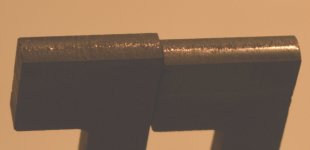
Lucas-CAV-transferpump-blades.jpg

I also opened the Advance fitting and eyeballed the piston, it's free to move with no sticking and has just a touch of staining in two spots.

BTW it's the Cummins manual that says that a missing check-ball will result in NO advance. By a straight pipe you mean to remove that fitting with the check-ball altogether and T a hose into the return-to-tank line? I think I should be able to rig that up too.

The filter is new and the lift pump seems like-new. During runs we did pump it manually in addition and vigoroulsy to see if it would make a difference, it did not. I'm not equipped to gauge output but I could try to rig something up. I do have a mobile electric lift pump that I could piggyback on it. I could also cannibalize the lift pump off my Ram-engine (it's a 175hp version in pieces, similar hours i.e. 130k kms).

I'm 80% convinced it's a dynamic advance problem because cranking in an additional 4-5 degrees of manual static advance seemed to help. If the new liner/blades don't fix it I think I will next crank in a lot more manual advance like maybe a whole tooth on the gear (5 degrees) plus the mounting screw slot good for another 4 to 5. If the result is even better than the last try then I'll be just about certain that it is a lack-of advance issue.
 
/ Lucas CAV rotary injection pump math #11  
Look at the liner for scratches..
Yes, I was talking about by-passing the return connector, just like you described..
BE CAREFUL w/ piggy backing an electric lift pump.. IF the pressure is to great, the check ball seats in the UP position, actually blocking OFF the return fuel.. causing extreme internal pressure & blowing out the front seals.. THEN you have 20 gallons of diesel fuel in the OIL..
Seen it happen MORE THAN once.. THATS WHY I said, the check ball return on a DPA is more trouble than its worth..
I've seen it happen w/ just trash in the pump.. & I've seen it on the test stand after a rebuild..[faulty connector]
 
/ Lucas CAV rotary injection pump math
  • Thread Starter
#12  
Thanks for all your advice. The liner had no scratches, installed new liner and blades but to no avail. Well at least I know that's not where it's at.

Also ended the day with a test with the check ball removed which supposedly causes dynamic advance to FAIL. No difference, ball left removed on subsequent runs to prevent any dynamic resurrection from stepping on the already raised static advance.

Finally, I advanced at the gear level by 2 teeth and this in combination with full housing advance gave about 15 degrees of static advance. This resulted in hesitation begining around 1800rpm, a very far cry from "Letter-B" timing so I'd postulate that dynamic timing just ISN'T taking place. I don't dare to advance any more because I have no clue as to how much total advance there is supposed to be at let's say 2500 rpm (5 static +?).

see the rearranged 6 test run videos @ the bottom of

http://trixtar.org/3/tinkerings/12valve208hp/index.html

By then I got tired and called it quits. For tomorrow I think I'll put the gear back to standard tooth, remove the pump again and maybe look for another suspect.

The Cummins manual says that 2 kinds of lift pumps are used, a diaphragm type good forf 3+ psi and a low-power piston type good for about 15 psi. I presume either is OK for the injection pump. I might yet try to use my electrical one instead of the one on the engine which IS a diaphragm type so it COULD be underperforming.

Your idea of bypassing the check-ball remains on the roster, as a permanent mod to do but I'll have to take another look at that hole on the bench because the fitting is also a hold-down device.

Cheers!
 
/ Lucas CAV rotary injection pump math
  • Thread Starter
#13  
I still don't understand how dynamic injection "timing advance" works, or IF it exists on these pumps.

The metering valve sets the amount of fuel injected, more fuel causes acceleration until stabilized. The governor flyweights apply an additional fuel AMOUNT increase on load to attempt to maintain speed by adding more fuel. None of this does anything to injection timing. If that is set to 5 degrees BTDC then when and exactly what and how increaes the number of degrees advance at a higher speed? Or is the static timing set on a stoped engine THE ONLY injection timing remaining valid thoroughout, an idea I would have a hard time digesting.
 
/ Lucas CAV rotary injection pump math #14  
More speed = more pressure = more pressure being applied to the pressure side of the advance piston.. The spring is holding the piston from moving to full advance at start-up..
When speed is decreased, the pressure is decreased & allows the spring in the advance housing to push the piston back.. inturn, moving the cam ring to adjust the "timing" of injection..
 
/ Lucas CAV rotary injection pump math
  • Thread Starter
#15  
More speed = more pressure = more pressure being applied to the pressure side of the advance piston.. The spring is holding the piston from moving to full advance at start-up..
When speed is decreased, the pressure is decreased & allows the spring in the advance housing to push the piston back.. inturn, moving the cam ring to adjust the "timing" of injection..

And I had worked on the "Advance Piston" fitting, too tired to think:laughing:

made 6 new runs, edited the same page, see bottom table:

http://trixtar.org/3/tinkerings/12valve208hp/index.html

Also tried an electric lift-pump, no change in performance. Rolled the whole circus indoors for 3 days of rain coming, expect to take a deeper look into the pump.

Cummins says the 5.9 engines with the Lucas-CAV use the gear letter D, except these fire pumps which (should) use the letter G which gives 5 degrees (1 tooth) less static advance. It so happens that I got the best result (up to 1900 rpm) using the letter D. I'd have a mind to go for it but for that I'd have to know that the two Lucas-CAV pumps perform an identical dynamic advance profile, which I do not know. Nor do I have any idea WHY these engines use 5 degrees less.

Also replaced the check-ball for the last run using the additional lift-pump. There was no difference at all either on account of the lift pump or the check-ball, still looks like a lack of dynamic advance unless I'm completely missing the diagnosis.
 
/ Lucas CAV rotary injection pump math
  • Thread Starter
#16  
I'm reading this 48page CAV shop manual (CAV and SIMMS Parts and Service LONDON w3 2124) and it 'seems' that what I thought was additional dynamic timing advance is actually a dynamic MODULATION of the static advance set via the gear and mounting provisions. As such, it would either ****** OR advance the static setting. Another untitled 21 page manual shows advance test at 1200 rpm as 1.5-2 degrees, and at 1800 rpm as 3.75-4.25 degrees but it doesn't say if these degrees are absolute, or added, or what. I would assume that not being negative these COULD be ahead or positive or further-advanced modulations. Thus the almost 5 degree figure would be close to the single-tooth or 5 degree increase from letter G to D which is what I got by making that shift on the relevant test run and getting rpm's up to around 1900. If the dynamic were operative maybe I would getthe same withOUT goping to letter D or I would get 5 more on top of letter D's 5 more than letter G's. I hope this isn't too freakin confusing, it is to me!
 
/ Lucas CAV rotary injection pump math #17  
OK.. last post.. When you rotate your engine until the pin falls in.. your at TDC on the engine timing.. When you put your LOCKED pump on, its actually set for 5* RETARDED.. its retarded for ease of starting & smoking.. {EPA}
The total advance movement on the pump is 5.75* to 6.25* @ 500pump & 1000 rpms engine..
So basically your starting at -5* & moving +.75 to 1.25* at "just above" low idle.. & thats all she's got..
It works for the rest of the world.. why not you??? I THINK you might be chasing ghosts.. & blaming the pump for something else..
 
/ Lucas CAV rotary injection pump math
  • Thread Starter
#18  
OK.. last post.. When you rotate your engine until the pin falls in.. your at TDC on the engine timing..

The #1 cylinder is at TDC, no problem with that, just like gas or in fact all piston engines and I have rebuilt a few. It's just that this is my second diesel patient ever.

When you put your LOCKED pump on, its actually set for 5* RETARDED.. its retarded for ease of starting & smoking.. {EPA}

THIS is news to me, I always presumed that it was advanced, just like gas engines, I have seen no mention of retarded in any of the documentation so far, and it certainly is a game changer.

The total advance movement on the pump is 5.75* to 6.25* @ 500pump & 1000 rpms engine..
So basically your starting at -5* & moving +.75 to 1.25* at "just above" low idle.. & thats all she's got..

Where is this and other such data, like the spring attachment 'code' published? I'd also wanna break down the part/model numbers and such.

It works for the rest of the world.. why not you??? I THINK you might be chasing ghosts.. & blaming the pump for something else..

I'm chasing whatever suspects I can think of, I have a 1300 hour engine that is sick. I'd much rather look elsewhere, and I have, but so far I've found nothing really wrong. That BTW is exactly where the previous owner gave up, something I on the other hand am not familiar with :)
 
/ Lucas CAV rotary injection pump math #19  
I MESSED-UP// The pump is locked 5* ADVANCED not retarded.. so in reality its starts at 5* & moves an additional 5*..
Sorry about that..
The code on the last line on the pump name plate is your fuel output @ what speed.. then the governor spring position, then the max rpm..
example> 113-1100-1-2400
spring code positions are a "code".. {1} & can be deciphered w/ a legend found on-line..
 
/ Lucas CAV rotary injection pump math
  • Thread Starter
#20  
I MESSED-UP// The pump is locked 5* ADVANCED not retarded.. so in reality its starts at 5* & moves an additional 5*..
Sorry about that..
The code on the last line on the pump name plate is your fuel output @ what speed.. then the governor spring position, then the max rpm..
example> 113-1100-1-2400
spring code positions are a "code".. {1} & can be deciphered w/ a legend found on-line..

Thanks for the info. I just made another run following rectification of yet another bug. Yesterday while intent on cleaning an otherwise insignificant amount of tiny paint chips from the inlet screen-filter I decided to check out that complete inlet end fitting. The little coil spring in the bottom of the pit was lying on its side (Murphy'd been there) , fixed that. At first I thought I had done it myself during disassembly but the test run video is unequivocally points a finger and shows a lot of improvement. Still not home base though.......... but it looks like a lesson in multiple-causes (like I needed one) :laughing:

Now that the 'fits' the engine rolls into are much less violent I ran it up to 2200 just to show more clearly what it's doing.

http://trixtar.org/3/tinkerings/12valve208hp/run-7-inletspring-1500.mp4

I want to get on top of this and once resolved I'll retime to the letter D on the gear.
 

Marketplace Items

(15) UNUSED 8'X41' PROTECTION MATS (A60432)
(15) UNUSED 8'X41'...
500 Gallon Fuel Tank with Pump (A55853)
500 Gallon Fuel...
2014 Ford Focus Sedan (A59231)
2014 Ford Focus...
2015 DODGE RAM 3500 4X4 CREW CAB PICKUP TRUCK (A59904)
2015 DODGE RAM...
207273 (A52708)
207273 (A52708)
2015 DODGE RAM 1500 CREW CAB TRUCK (A60430)
2015 DODGE RAM...
 
Top