Moving Dirt

/ Moving Dirt #21  
Eddie, I live up north of you... A bit north of I-30 and Mt. Pleasant. We have fine white sand and then clay. The clay is red, grey, yellow all mixed up with iron ore gravel mixed in. I had to dig a hole to bury some stuff since we can't burn and I dug it 4ft deep at 12ft wide plus the ramp to get down since I had was a smooth edged FEL bucket and a 90hp tractor.

It is real dry here, and even down to 4ft the clay was rock hard. You had to go into it with an aggressive tilt to the blade and then once it bit, tilt shallow before you stalled out. I had solid clumps of clay a couple feet wide and 4" thick that stayed togethor and were too heavy to pick up by hand. That gravel is real neat if you have a chance to really look at it. It is all mostly round out there but it you break it open it has a hollow center. What causes that I have no clue.

Thing is, in some places you can dig forever and not hit rocks. I know cause as a kid out here, my idea of fun was a shovel. I would dig a hole till I hit the water table which could be 10ft or deeper. I even had to build ramps into the holes to load my wagon up with dirt to dump at the surface.

Just east of me though, there is a ledge of that iron ore rock that comes to the surface and it isn't very crumbly. Pretty hard stuff. Looks like half melted iron covered in rust. If you had hit that building your lake, I am sure you could have removed it, but it would have made the job a lot harder. Glad to see you didn't have any such difficulties. It is all coming together and looking real good.
 
/ Moving Dirt
  • Thread Starter
#22  
Hey Jay,

My brother is going to move here and we spent quite a few days in your area looking at properties. We both thought you guys get allot more rain than I do down here because of how much thicker and taller the pastures were.

I'm all mudied up here now and ther's allot of places I can't get a tractor or even work. The burn ban was lifted, so now I have a new project to work on.

My main vein of iron ore comes to the surface near my entrance and it's very nice for the road. Then it drops down and heads toward the lake. I did have some fears that it went that far, and what I'd do if I hit it, but luckily that never happened.

I also have a few small pockets of sand. It's just in certain areas and is more like what you find at a golf course. Go along on the green and all of a sudden there's this little area of sand. Same here. Just up the road a few miles and that's all they have. No clay at all, just sand. I hate sand. I've done some jobs in it and don't like it. Growning a pasture in it is the most dificult of all soils.

Thanks,
Eddie
 
/ Moving Dirt #23  
Eddie, did you get any of the rain I keep seeing on the weather chanel? We were wondering if the lake has started filling yet. The low place you are putting the dirt, is that from the end of the open feild down towards the lake, to the left of the start of the big berm that goes down beside the lake where you were talking about putting the gazebo? That is where it looks like from the pics. Kids looked like they were having a ball on the dirt pile, same as you and I, just cheaper toys. Later, Nat
 
/ Moving Dirt #25  
Willl said:
We need a map of Eddie's place, I'm lost !

Maybe Eddie can use google earth and give us a link. I noticed recently it has changed over to color imagery and the pics are from last year I beleive. Our property is in the middle of this link for instance. Everything inside of the block those 4 roads make. About 100 acres. You can see our cow pond todards the southern end.

Google Maps

Sand out here is bad. When it is dry it gets kicked up real easy, and it doesn't hold moisture. It drains out quick. There are areas out here with red clay dirt like Eddie has, but that is south of us. If you go north or west you run into the black land praire.
 
/ Moving Dirt #26  
Just quick story about moving dirt and how to get paid for it. Unlike down in Texas and other places with sand, it's not so plentiful up here in parts of the northwest. The area is growng and concrete companies need sand.

My father in law had 40 acres outside Bellingham, WA that was hilly in some places. One day when he was having someone excavate an area for my bil's manufactured home, the guy running the excavator came over and asked if my fil knew what he had. It turns out that under a lot of the acreage was sand. A concrete company found out about it, built a road to the sandy area and paid my fil for every huge truck of sand that they took out. It turned out to be his retirement fund. The best part is that they flattened out the area so his land was more usable, put back the topsoil and gave him money to boot. Now that's the way to move dirt.

Harris
 
/ Moving Dirt
  • Thread Starter
#27  
Hey Nat,

The dirt pile is off to the left of where the feeder is that we shoot all the wild hogs. It was pretty heavily wooded when you were here, so you might not recognize it. What I'm doing there is extending that pasture further in that direction. I've taken out all the trees in the middle and will grade it out so it will also catch all the rainwater and direct it to the lake.

The fill area is part of my entrance road. The exit road has gravel on it now, but the entrance road is on the other side of the front pasture and pond. If you had kept driving straight on that road, you would have come to this drainage area. It's key to my layout for the long term, monthly sites.

Jay,

Google Earth and Terra Server isn't frequent enough to keep up with my changes. In the last two months, my Dad and I have taken out well over a thousand trees. That might sound like allot to some people, but as you know, we get trees that are inches apart and rarely more than a foot apart from each other. Especially in the younger stands of oak, sweet gum and pines. In ten years time, they will turn a field into an impossible jungle.

To help clarify, the Lake Project is along my Southern boundry. The dirt pile is in the middle of my land, uphill from the lake and the low spot that I'm building up is towards the front of my land, but on the Northern boundry.

The pasture between them actually peaks, and at the low spot, rainwater will run the wrong way. It goes away from my lake!!! I've spent many, many hours changing this as much as possible, but there is a point that some rain water escapes my attempts to get it in the lake. hahahah

Eddie
 
/ Moving Dirt #28  
JayDavis said:
Maybe Eddie can use google earth and give us a link.

Actually, I was thinking something on the back of a napkin with a crayon would suffice.
 
/ Moving Dirt #29  
EddieWalker said:
Hey Curt,

Compaction is always a concern for me when building up an area. Building pads are the most important, but roads need it too. This is a long term project and since I wont be paving over it any time soon, this is my plan.

I'm putting down the dirt over a wide area. Then I'll spread it out with the dozer. It weighs 40,000 pounds, but since it's on tracks, it's not very good at compaction. After I spread out the dirt and make it flat, I'll continue to build it up by driving the dump truck over it with a full load. My guess is that another hundred trips over the first layer with the tires always making new tracks will really help with compaction. But I also realize it wont get it all the way either.

Then I'll spread the next layer out with the dozer, and start building up the third layer. This should be the last layer. The lowest spot will need to come up about ten feet, give or take a foot, so there's a massive amoutn of dirt that I'll need. If it takes a fourth layer, than I'll just keep repeating the process.

This road is the entrance to my long term sites that I'm working on. It will be driven over constantly with all sorts of equipment. By the time I'm ready to pave it, I should be well past any compaction issues.

Eddie

IIRC, you need over 90% compaction under concrete slabs to meet building code. That's one of the reasons you'll see the water spray trucks running around the big jobsites around here. And sheeps foot rollers also.

I've also seen them spread and water in lime on the ground before pouring the concrete pads to increase compaction.
 
/ Moving Dirt
  • Thread Starter
#30  
Flusher,

That was one of the first construction jobs I had after the Marine Corps. Back in 1988, we had to get 98% compaction for anything, roads, parking lots and building pads.

This area I'm working on is a road on my land. It will eventually be paved, but not for awhile and it's in my own best interest to get it compacted to avoid having my roads crack right after I pave them. It's my land, no permits or regulations, so I can do as I please. I'm also stuck with any problems that develop from cutting corners.

Thanks,
Eddie
 
/ Moving Dirt #31  
EddieWalker said:
Flusher,

That was one of the first construction jobs I had after the Marine Corps. Back in 1988, we had to get 98% compaction for anything, roads, parking lots and building pads.

This area I'm working on is a road on my land. It will eventually be paved, but not for awhile and it's in my own best interest to get it compacted to avoid having my roads crack right after I pave them. It's my land, no permits or regulations, so I can do as I please. I'm also stuck with any problems that develop from cutting corners.

Thanks,
Eddie

And so is the guy who buys your place. That's one reason the state of CA and my Tehama Co. building inspectors make life difficult with all their regulations and permitting requirements.
 
/ Moving Dirt #32  
flusher said:
That's one reason the state of CA and my Tehama Co. building inspectors make life difficult with all their regulations and permitting requirements.

ummmm some how i belive its more about generating taxes off the buildings and fees off the permits than it is "public safty".... after all its private land...
 
Last edited:
/ Moving Dirt
  • Thread Starter
#33  
flusher said:
And so is the guy who buys your place. That's one reason the state of CA and my Tehama Co. building inspectors make life difficult with all their regulations and permitting requirements.


Flusher,

I'm not sure I understand your post. Are you being negative for a particular reason, or is this somehow intended to be helpful?

For the life of me I don't get why your view that building inspectors make life dificult in Tehama Co, so that some imaginary person buys my land, will have a certain level of compaction on my roads. If the dirt isn't compacted enough in a year or two when I pave them, then they will crack and I'd have wasted a bunch of money. If I sell the place sometime in the future after that, it's obvious that cracked pavement will affect the sales price of the land just like pavement that is not cracked will improve my sales price.

Do you have any experience with my soils that I should be made aware of, or are you just comparing apples to oranges?

Eddie
 
/ Moving Dirt #34  
Not being negative. Wouldn't think of it. I'm just commenting on how things are here regarding building codes and inspections. And I was thinking more about compaction under slabs than under driveways and roads.

During real estate escrow in CA there are manditory hazard reports that have to be provided by the Seller to the Buyer. And most Buyers in CA have a thorough house inspection during escrow with slab cracks as one of the priority items.

Just reacting to your "no permits or regulations so I can do as I please". I suppose some folks in Texas and in CA have this idea only to get a surprise when getting into escrow and construction defects start to show up.
 
/ Moving Dirt
  • Thread Starter
#35  
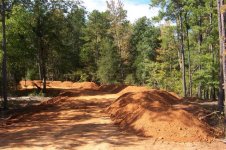
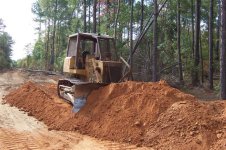
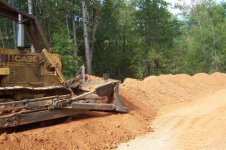
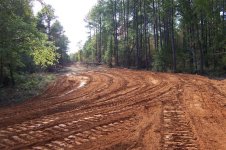
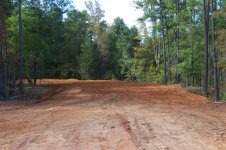
Here's a few more pics on the road project. The rains made it too muddy to move dirt with the dump truck for a few days, than I had a few good days, and now it's raining again. Yesterday the forecast was 100% for rain for last night and today. For once, they got it right!!!

I had about 40 loads all lined up and decided to smooth it out before it rained. Dirt piles are like a sponge when it rains. After a certain point, the dirt just absorbs all the water and it's impossible to work it. The only solution is to spread it out a bit, let it dry, and spread it some more. Not fun, and it takes months to get it dry enough to be usable.

The first pass is just to knock off the tops of the piles and start spreading the dirt a little. It takes allot of passes to get it where I want it. The ground slopes down quite a bit on one side because it was a drainage area, so it's taking twice as much dirt on one side than the other. It's impossible to get the dump truck into that area, so I build up my piles and spread with the dozer.

I'm leveling it by eye for now since I'm only rough grading it. I still have several more feet of fill to build it up, but I'm not wide enough all the way through yet either. The road needs to be 36 feet wide across the top when finished. I need to have two RV's be able to pass in oposite directions and room for people to walk along the side of them.

Eddie
 

Attachments

  • Big Dirt Mountain 028 (Small).jpg
    Big Dirt Mountain 028 (Small).jpg
    86.7 KB · Views: 346
  • Big Dirt Mountain 032 (Small).jpg
    Big Dirt Mountain 032 (Small).jpg
    84.8 KB · Views: 356
  • Big Dirt Mountain 033 (Small).jpg
    Big Dirt Mountain 033 (Small).jpg
    69.4 KB · Views: 336
  • Big Dirt Mountain 035 (Small).jpg
    Big Dirt Mountain 035 (Small).jpg
    81.1 KB · Views: 322
  • Big Dirt Mountain 034 (Small).jpg
    Big Dirt Mountain 034 (Small).jpg
    67.3 KB · Views: 350
/ Moving Dirt #37  
Evening Eddie.
Wish I lived closer to you,for I would like to help out spreading the piles...outside work w/good equipment you can't beat it....nice eye for leveling.
 
/ Moving Dirt #38  
Mornin Eddie,
Looking at all the great pics you posted, I really understand when another poster made mention that you do things in a really big way :)
At least your in the right state for all your projects :)

Im jealous of all the seat time your gettin on the dozer !
 
/ Moving Dirt #39  
flusher said:
Not being negative. Wouldn't think of it. I'm just commenting on how things are here regarding building codes and inspections. And I was thinking more about compaction under slabs than under driveways and roads.

During real estate escrow in CA there are manditory hazard reports that have to be provided by the Seller to the Buyer. And most Buyers in CA have a thorough house inspection during escrow with slab cracks as one of the priority items.

Just reacting to your "no permits or regulations so I can do as I please". I suppose some folks in Texas and in CA have this idea only to get a surprise when getting into escrow and construction defects start to show up.

I didn't see anything negative in your post. If I was buying a piece of property I would expect that it was built to code. I know I can always sue for recourse but nobody wins when that happens. I'm sure some people will disagree with me but I believegood building codes protect the seller as well as the buyer.
 
/ Moving Dirt #40  
turbo36 said:
If I was buying a piece of property I would expect that it was built to code.

you truely must be a person of 21 century.

i have never owned nor lived in a house that wasnt 80 years old or more. in 1920 many of the "building codes" you speak of didnt exisit. The house on my property i just bought dates back to 1900. (gasp yes dam near 110 years old)

you make it sound like with out building codes the world would stop rotateing and everything would fall down and kill us:rolleyes:

My property is sold AS IS. you want to get inspections so be it but im in no way obligated to fix anything! You dont like it.... find you a nice new POS in the middle of suburbia h3ll that was built 2 years ago (or less).
 
Last edited:

Marketplace Items

2021 Ford F350 XL (A57148)
2021 Ford F350 XL...
2012 John Deere 8235R (A60462)
2012 John Deere...
2014 Lamar Trailer (A55973)
2014 Lamar Trailer...
2015 Nissan Quest Van (A61569)
2015 Nissan Quest...
2019 Case CX80C (A60462)
2019 Case CX80C...
(INOP) 1996 FORD F150 SIN CAB TRUCK (A59823)
(INOP) 1996 FORD...
 
Top