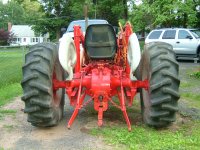
New Guy, First Tractor

/ New Guy, First Tractor #1  

R-G

Bronze Member
Joined
Jun 17, 2007
Messages
50
Location
CT/NY
Hello all, i picked up a "59" ford 801 for the main reason to use a brush hog and do some tilling. I have no experience running a tractor so there might be a few more questions later on.:) The fellow that sold it to me showed me the basic operations to use the pto and 3 point set up. I was looking it over and saw a small lever located just in front of the pto control shaft, looked it up in the manual that he gave me, and its for draft control. Can someone please explain what this is? I tryed doing a search but am not very familiar with this site yet, but i have heard of "draft control" here somewhere (wish i saved it)
This is a great site with lots of info i have already stumbled upon, so please forgive me if my question/s are "silly". :eek:
 
/ New Guy, First Tractor #2  
R-G said:
Hello all, i picked up a "59" ford 801 for the main reason to use a brush hog and do some tilling. I have no experience running a tractor so there might be a few more questions later on.:) The fellow that sold it to me showed me the basic operations to use the pto and 3 point set up. I was looking it over and saw a small lever located just in front of the pto control shaft, looked it up in the manual that he gave me, and its for draft control. Can someone please explain what this is? I tryed doing a search but am not very familiar with this site yet, but i have heard of "draft control" here somewhere (wish i saved it)
This is a great site with lots of info i have already stumbled upon, so please forgive me if my question/s are "silly". :eek:

This was a search for "draft control"

http://www.tractorbynet.com/forums/search.php?searchid=674632
 
/ New Guy, First Tractor #3  
Draft control is used to maintain working depth on ground engaging equipment. ie.. 1 or 2 bottom plows, cultivators, subsoilers.

It works by pulling up on the 3pt when drag increases (caused by soil pulling implement deeper). When drag is reduced (tractor going over small rise), it allows implement to drop some more. You will want it off for bush hoggin' and I think for tilling too.

Good luck, and keep asking questions.
 
Last edited:
/ New Guy, First Tractor #4  
When that lever is up, the tractors hydraulics are in "position" control, which is where they should be for most tasks, especially mowing. The lower link arms are kept in constant position relative to the tractor. Move that lever down and the hydraulics will be in "draft" control. This setting is reserved mainly for a plow and helps achieve constant depth plowing as the tractor moves over uneven terrain. In draft control the lower link arms are moved up or down automatically as the load on the upper link increases or decreases. To remember which position is which, just remember: Draft - D - Down. Until you hook that tractor to a plow, keep the lever up in position control at all times. Certain tractors, like old Fergusons, had only draft control, and when used for mowing, required chaining the lower links up to keep the mower from crashing into the ground whenever the load on the upper link got low. Many newer tractors, including most CUT's, have only position control, and when used on a plow, require frequent manual adjustment to maintain even depth as the tractor crosses uneven terrain. Fords were the first tractors to offer both draft and position control around 60 years ago, and to this day, that system has not been improved significantly.
 
/ New Guy, First Tractor #5  
R-G:

Welcome to TBN :D! There no silly questions. We all have had our own "learning curves" and some of our "curves" have been steeper than others :rolleyes:. I have seen some really stupid answers :( to some honest questions on occassion. Keep the posts coming :). Jay
 
/ New Guy, First Tractor #6  
Biggest thing for a new operator is learning safety.
Tractors can roll fairly easily under the right conditions. You old Ford doesn't have many of the safety additions the newer machines do, such as a ROPS (Roll Over Protective Structure).

Never...repeat, never tow anything rigged to any part of the tractor except the draw bar. Rigging anywhere else is a receipe for a deady accident.
Maintain a distance from you PTO when in operation. I strongly suggest you have your tractor key in your pocket (meaning engine off) when working around or rigging an implement to the PTO. If your Cutter or tractor does not have an over-running clutch, get one (cutters can push the tractor even if the clutch is disengaged).


TBN has a good Safety Forum. You'll learn a lot if you read it.
 
/ New Guy, First Tractor #7  
RG,
Welcome to TBN. You should be able to find pretty much everything you will need on this forum. As far as draft control is concerned I think the above answers your question. I use the draft control on mine when using the box blade and even my landscape rake. It helps keep things on a level plane. I never used a tiller, but I would think draft control would be useful. Try it!!

You should take a few minutes to browse through the saftey section as well as all the rest of the forum as well. You will learn alot by just looking!!! Good Luck. Always wear your seat belt!!
 
/ New Guy, First Tractor #8  
dtd24 said:
RG,
EDITED BY ROY
Always wear your seat belt!!

Not in this case...his 801 is a 1959 or 1960 model (post states 1959). His tractor won't have a ROPS.
No ROPS, no seatbelt...and with no ROPS, you want to get away from the tractor if it goes over...
 
/ New Guy, First Tractor #9  
RoyJackson said:
Biggest thing for a new operator is learning safety.
Tractors can roll fairly easily under the right conditions. You old Ford doesn't have many of the safety additions the newer machines do, such as a ROPS (Roll Over Protective Structure).

Never...repeat, never tow anything rigged to any part of the tractor except the draw bar. Rigging anywhere else is a receipe for a deady accident.
Maintain a distance from you PTO when in operation. I strongly suggest you have your tractor key in your pocket (meaning engine off) when working around or rigging an implement to the PTO. If your Cutter or tractor does not have an over-running clutch, get one (cutters can push the tractor even if the clutch is disengaged).


TBN has a good Safety Forum. You'll learn a lot if you read it.


Mornin' Roy!

You sure must be in a "red" mood today! I got a bit scared just reading your post... Still, the points were valid - if'n a bit too red for my tastes!


One point that was missed so far. Old tractors in general will have a tendancy to rust up the clutch. If you won't be using it for a week or two (always over the winter) dog down the clutch peddle. On my old ford I use a C clamp, but anything that gets it all the way down is good.

The old fords were and still are good basic machines. Change the fluids everywhere. Differential, hydraulic reservour, transmission, engine and radiator. Old fluid is the root of all evil when dealing with old tractors. It can have both water and dirt/grit in it - rusting and grinding away at the rotating parts.

Post back on you model for more detailed input.

jb
 
/ New Guy, First Tractor #10  
john_bud said:
Mornin' Roy!

You sure must be in a "red" mood today! I got a bit scared just reading your post... Still, the points were valid - if'n a bit too red for my tastes!


One point that was missed so far. Old tractors in general will have a tendancy to rust up the clutch. If you won't be using it for a week or two (always over the winter) dog down the clutch peddle. On my old ford I use a C clamp, but anything that gets it all the way down is good.

The old fords were and still are good basic machines. Change the fluids everywhere. Differential, hydraulic reservour, transmission, engine and radiator. Old fluid is the root of all evil when dealing with old tractors. It can have both water and dirt/grit in it - rusting and grinding away at the rotating parts.

Post back on you model for more detailed input.

jb

Yeah, I like to emphasize some things...especially when it comes to safety.

Just be glad I haven't discovered "smiley faces" yet...
 
/ New Guy, First Tractor #11  
I thought draft control was getting the right head on a beer?

mark
 
/ New Guy, First Tractor #12  
mjarrels said:
I thought draft control was getting the right head on a beer?

mark

Afternoon Mark,
Well yep it is ;) the right amount of tilt to the mug while pouring ! :)
 
/ New Guy, First Tractor #13  
scott_vt said:
Afternoon Mark,
Well yep it is ;) the right amount of tilt to the mug while pouring ! :)

SAFETY SAFETY SAFETY------------------no draft beer please.
 
/ New Guy, First Tractor
  • Thread Starter
#14  
Thanks for the info guys, i understand draft control now, sounds simple enough when you know what its for. As for safety ill check out the thread on it. I have 3 young boys so im pretty well geared in a "safety mode" anyways.
Was out tinkering with it last night, engaged pto, hydraulics, getting familiar with it. It has the SOS transmission, (one of the reasons why i bought it) so its easier to operate. One thing i did notice is that the pto spins all the time.
With tractor in gear and clutch in its still spinning, same with clutch out. Is it normal to spin un-engaged, maybe drag on it or? Im not going to grab it and find out lol. It all seems tight, no noises. I was asked can you still run pto when shifted into reverse, or do you have to dis-engage then re-engage when in reverse, would the mowers spin backwards. I told them i have no clue, but i know the right guys to ask lol. Brush hog rough cut is next on the list, not sure what size to go with, maybe a 6' or 7' tractor has 42-46 horse im told, 5' might be to small?
 
/ New Guy, First Tractor #15  
Brush hogs, new tractor owner and trees with low limbs spell an accident or death. I agree with RoyJackson on safety. I grew up on an Iowa farm and bushhogged 30 acre timber area, road ditches ,fence lines etc. That timber area was plenty dangerous going around the trees. One has a tendency to look behind to see how small saplings and high brush is going thru the cutter, and the next instant, you turn around and a low branch is coming up to the front of the tractor air cleaner and muffler. One must really concentrate when close to low branches. My Dad always warned my brother and I that about ever year or two, you will hear about someone getting knocked over backwards by a tree limb while running a bushhog. (funeral notice; closed casket). I don't know if you have any trees to worry about, but this is good to hear stories like this so you can educate yourself. Machines don't care about people.
 
/ New Guy, First Tractor #16  
I was just about to ask you what model of 801 you have.. but sounds like you have the 871 ( probably ) or the 881 ( not as common ). It's a 10speed.. and has good ground speed control. What you are calling the clutch is more correctly an inching pedal.. thoug it 'basically' performs the same task.

As you have been told.. the littl lever ahead if the 3pt control is the draft/position selector. For most non ground engaging jobs you can use position... for tilling.. I'd use position. The *6* models and the *7* and *8* models were the only 4 cyl fords that were any good at roto tilling.. mainly because of ground speed vs pto.. the 6/7/8 all were live pto models.. your /7/8 machine being a live independent machine.

As you have found out, the SOS ( select-o-speed ) tranny setup does not have a pto brake. The pto will freewheel even when not engaged.


The SOS machines are picky about maintenance and oil.. The early SOS models gave ford a black eye as there were many failures. Field service fixes and tranny swapouts mostly corrected the problems.. however ford SOS's still live with the stigma attached to them.. and in many places.. SOS trannied fords command less money than a gear trannied counterpart. The big issue is parts/repair... Few mechanics will work on an SOS.. and if you do find one that will.. a typical rebuild of a major' problem can run up to 2500$.. which is why some SOS tractors that shell out a tranny get a 5 speed or 8 speed dropped in them as the 'repair', depending on the model in question. Still.. that said.. if you have a good working unit that runs in all 10 ranges and 2 reverse speeds.. and you maintain it with clean filters and good clean oil.. it should continue going strong for a long time.

Lets see.. some more info.. Hmm.

Do try to pick up an owners manual for the 801 series.. as well as the SOS addition leaflet.. it's chock full of info you will want to know about the SOS.

Also.. if you ever need to move her, and she won't run.. the rear wheels will be locked. You will need to throw the traction disconnect to disconnect the rear end drive pinion from the tranny output shaft.. your sos manual will tell you exactly where it is on your model.. though ist's generally accessed from the side of the tractor.. rear of the tranny, near the union to the diffy section... not difficult or complicated.. just may not stand out.

If you have the 881.. you will have a 2 speed pto.. the 871 has a single speed pto.

Enjoy that ford and post some pics..

Soundguy

R-G said:
Thanks for the info guys, i understand draft control now, sounds simple enough when you know what its for. As for safety ill check out the thread on it. I have 3 young boys so im pretty well geared in a "safety mode" anyways.
Was out tinkering with it last night, engaged pto, hydraulics, getting familiar with it. It has the SOS transmission, (one of the reasons why i bought it) so its easier to operate. One thing i did notice is that the pto spins all the time.
With tractor in gear and clutch in its still spinning, same with clutch out. Is it normal to spin un-engaged, maybe drag on it or? Im not going to grab it and find out lol. It all seems tight, no noises. I was asked can you still run pto when shifted into reverse, or do you have to dis-engage then re-engage when in reverse, would the mowers spin backwards. I told them i have no clue, but i know the right guys to ask lol. Brush hog rough cut is next on the list, not sure what size to go with, maybe a 6' or 7' tractor has 42-46 horse im told, 5' might be to small?
 
/ New Guy, First Tractor
  • Thread Starter
#17  
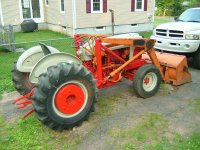
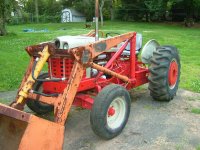
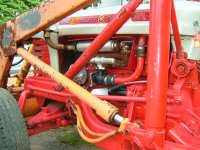
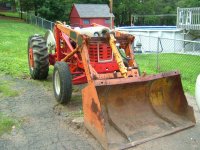
I thought 801 was the model number? Ive looked everwhere for numbers to get a owners manual, but have found nothing. It looks to be a 2 speed pto, after looking at the repair manual i have, there is a threaded hole at the end of the shaft (head of bolt missing, must be threads holding it in place?) looks to be the 540 end, whats the advantage to switching shafts? Traction disconnect figured out. All fluids/filters will be changed before it goes to work, the more i look into it the more complicated it gets. Heres a couple of pics, previous owner added the bucket after it was painted. (bucket came with tractor when he bought it, was not installed because original hyd cylinders for bucket "disapeared")
 

Attachments

  • DSCF0303.JPG
    DSCF0303.JPG
    462.1 KB · Views: 286
  • DSCF0302.JPG
    DSCF0302.JPG
    463 KB · Views: 256
  • DSCF0301.JPG
    DSCF0301.JPG
    461.3 KB · Views: 227
  • DSCF0298.JPG
    DSCF0298.JPG
    468.7 KB · Views: 215
  • DSCF0300.JPG
    DSCF0300.JPG
    463.3 KB · Views: 213
/ New Guy, First Tractor
  • Thread Starter
#18  
My mistake, its not a 2 speed PTO
 
/ New Guy, First Tractor #19  
801 is the series... if your is a single pto speed SOS.. then it's model number is 871

8 means 172ci engine
7 means single speed pto/SOS tranny
1 means it is a 58-62 01 series.. though has to be 59+ for SOS

I believe an FO-20 service manual covers that machine.. but you need an SOS insert manual to further maintain it. To get that SOS manual you need to know if it is the original trans.. or a field swap out. The swapped trans may be repainted..might be blue.. and painted over red.. the original should show same oem red paint / layers as the original unit.. The newer and older trans will have different manual inserts.

Soundguy

R-G said:
I thought 801 was the model number? Ive looked everwhere for numbers to get a owners manual, but have found nothing. It looks to be a 2 speed pto, after looking at the repair manual i have, there is a threaded hole at the end of the shaft (head of bolt missing, must be threads holding it in place?) looks to be the 540 end, whats the advantage to switching shafts? Traction disconnect figured out. All fluids/filters will be changed before it goes to work, the more i look into it the more complicated it gets. Heres a couple of pics, previous owner added the bucket after it was painted. (bucket came with tractor when he bought it, was not installed because original hyd cylinders for bucket "disapeared")
 
/ New Guy, First Tractor
  • Thread Starter
#20  
Soundguy, it looks to be orignal tranny, paint layers match up. Where could i find this "insert"? I have the parts and repair manuals that came with it, found the model #(871) stamping but cannot read the serial # yet. You all have been very helpfull !!
 
 
Top