New Holland SenseTrack and SuperSteer--Can someone explain how it works?

   / New Holland SenseTrack and SuperSteer--Can someone explain how it works? #1  

npalen

Elite Member
Joined
Nov 17, 2009
Messages
3,601
Location
Beloit, KS
Tractor
Kubota B9200 HSTD and Mahindra 3015
I have a NH TC29DA 29 HP FWA and would like to understand exactly how the SenseTrack works. The 4WD (Front wheel assist) lever has two positions: Automatic FWA and full FWA.
I do know, from checking the parts list, that there is a "one way clutch" in the driveline going to the front wheels. My understanding is that, in the automatic mode, the front wheels will always maintain "equal" rotation with the rear wheels. In other words if the rear wheels start spinning the front wheel assist will engage.
Would sure like to know exactly how this all works particularly with respect to sharp turns with the SuperSteer option.

Edit: I checked the speed ratio between the front and rear wheels and found that the fronts are geared to run about 3-4% "faster". I do realize this is fairly typical for front wheel assist tractors but also wondering how this relates to the "automatic mode".
 
Last edited:
   / New Holland SenseTrack and SuperSteer--Can someone explain how it works? #2  
The sense track is designed to be use with the super steer front axle and its purpose is to engage/disengage the FWD while turning. When you have the lever in automatic and start to turn, it senses the resistance and automatically disengages the FWD to improve the turning radius. Once the turn is complete and the resistance is gone, it automatically engages the FWD.

When you have the lever in full, the sense track is locked out and you have full time FWD. It will not disengage when turning.
 
   / New Holland SenseTrack and SuperSteer--Can someone explain how it works?
  • Thread Starter
#3  
I would have thought the opposite on the turning issue because, when turning so short, the inside front wheel is nearly perpendicular to the tractor. I would think the wheel would slide sideways in this situation if it wasn't powered, instead it tracks perfectly even on loose gravel.
Automatic FWA (or FWD) to me would mean that it engages only when needed such as in a tight turn to pull the front end around.
I don't mean to be argumentative and I do appreciate your input. Just wanting to get this 70 year old brain wrapped around what is actually happening. Would like to hear some ideas on how to prove/disprove the theories.

Edit: I did a search on Sense Tract and Super Steer and one of the thread posts I found was this: (When saying "rear wheels travel at a faster speed, I'm assuming the author means faster RPM)

2003-09-17 00:00:00 64165 BountyHunter | 3 Pix
Not to beat a dead horse, but in regards to the sensitrack 4WD, does it hold up as well as conventional 4WD? It looks pretty simple, basically a one way clutch at the front end of the drive shaft. If the rear wheels travel at a faster speed than the front it locks the front axle in until the wheels are at relatively the same speed and then it disengages. I plan on signing the papers in the next day or two and want to be relatively sure that I'm buying something that will last. I've talked to 2 dealers in the area and 1 says that it (supersteer and sensitrack) is just bells and whistles but he hasn't had any problems with them and the other dealer says he wouldn't have a tractor without the sensitrack. I even called New Holland, but they referred me back to the local dealer and said that is where I'd get the best information...GO FIGURE. I enjoy reading the threads on this board and look foreward to any other information or opinions on this subject. --Thanks


When saying "rear wheels travel at a faster speed", I assume the above author means "faster" RPM as they would under draft load in a slippery condition. Can I assume that the front wheels slow down relative to the rear wheels in a turn? If so, that would cause the FWA to engage automatically in a turn situation.
 
Last edited:
   / New Holland SenseTrack and SuperSteer--Can someone explain how it works?
  • Thread Starter
#4  
On the other hand :D, the attached would tend to substantiate what AGRIMAN posted above.
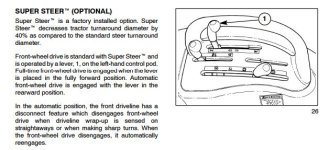
 

Attachments

  • New Holland Super Steer-1.JPG
    New Holland Super Steer-1.JPG
    55.5 KB · Views: 370
   / New Holland SenseTrack and SuperSteer--Can someone explain how it works? #5  
We where on a job building a deck and had to have the home owners shed put back on the new concrete driveway. The manager of the park came over with his NH tractor that had SuperSteer - worked great because of the tight space we had to work in. He was able to push the shed onto the concrete driveway with very little maneuvering of the tractor. Sorry, didn't answer your question, but it seems like a nice option.
 
   / New Holland SenseTrack and SuperSteer--Can someone explain how it works? #6  
On the other hand :D, the attached would tend to substantiate what AGRIMAN posted above.

Does this imply that the front axle is the primary drive axle on this tractor? the only downside I see to that would be front tire tread life, but otherwise it seems like a handy option.
 
   / New Holland SenseTrack and SuperSteer--Can someone explain how it works?
  • Thread Starter
#7  
Welcome to the forum!
That is an interesting concept but, no, I don't think the front is the primary drive.
 
   / New Holland SenseTrack and SuperSteer--Can someone explain how it works?
  • Thread Starter
#8  
The sense track is designed to be use with the super steer front axle and its purpose is to engage/disengage the FWD while turning. When you have the lever in automatic and start to turn, it senses the resistance and automatically disengages the FWD to improve the turning radius. Once the turn is complete and the resistance is gone, it automatically engages the FWD.

When you have the lever in full, the sense track is locked out and you have full time FWD. It will not disengage when turning.

I definitely believe you are correct in your assessment. I had to see it for myself by making a sharp turn in both auto and full FWD. It's quite obvious that the front and rear are fighting each other when in full FWD but very smooth when in auto mode.
It's amazing in that the rear inside tire remains stationary during a slow sharp turn. I realize that any tractor with wheel brakes can do this but not without sliding the front tires "sideways" and doubling the speed of the outside rear tire due to differential action. It's also very hard to do a wheel brake turn with a hydrostat when the wheel brake pedals are on the same side as the HST foot pedal.:confused2:
I'm still wondering, however, how the one way clutch driving the front wheels is able to sense the "driveline wrapup" when driving straight on a paved surface and thereby "declutch" the front drive. This is very useful for guys like myself who might forget to disengage FWD when roading.
Would sure appreciate anyone who can explain this automatic stuff for me.
 
   / New Holland SenseTrack and SuperSteer--Can someone explain how it works? #9  
In automatic, the link is essentially a slip clutch, and only engages if the back wheels move faster than the front. This allows the sharp turning radius speed differential to work out. The negative part of this is that you don't get 4 wheel braking in automatic mode. When off road, I put the 4wd in full time.

Chris
 
   / New Holland SenseTrack and SuperSteer--Can someone explain how it works? #10  
On my TC45d, there isn't a clutch, and the hst and brakes are on opposite sides. It frustrates me that they discontinued that model!

Chris
 
   / New Holland SenseTrack and SuperSteer--Can someone explain how it works? #11  
I'm still wondering, however, how the one way clutch driving the front wheels is able to sense the "driveline wrapup" when driving straight on a paved surface and thereby "declutch" the front drive. This is very useful for guys like myself who might forget to disengage FWD when roading.
Would sure appreciate anyone who can explain this automatic stuff for me.

Sorry npalen, I have been cutting/baling hay for the last two days and nights. I did not take your comments as being argumentative. The sensitrack is basically a clutch, but I think this would be an easier way to explain how it works.

Picture that inside the sensitrack there are two separate shafts. Shaft 1 has a gear that is splined on one end. Shaft 2 also has a splined gear on one end, but it has the ability to slide back and forth on the shaft. There is a large spring behind gear 2 that keeps it forced against gear 1. This is "basically" the setup.

Now let's say that you are driving alone with the lever in automatic and decide to make a turn. When the wrap up or "negative force" generated from the front axle becomes greater than the spring force holding gear 2 against gear 1, the spring pushes back and gear 2 slides back automatically disengaging the FWD. When the turn is complete and the "negative force" drops below the spring force, the spring pushes gear 2 back against gear 1 and automatically reengages the FWD.

So what about the full position. Picture the same setup, but now picture a shifter fork behind the spring on gear 2. When you shift the lever to full, the fork pushes the spring flat against gear 2 which locks it against gear 1. Since gear 2 can't slide, it doesn't matter how much "negative force" is applied by the front axle the FWD stays engaged.
 
Last edited:
   / New Holland SenseTrack and SuperSteer--Can someone explain how it works? #12  
I wonder if it makes a ratcheting noise when slipping. It sounds like it works like a Detroit locker differential from the above description.
 
   / New Holland SenseTrack and SuperSteer--Can someone explain how it works?
  • Thread Starter
#13  
Thanks for the explanation, AGRIMAN. I'm wondering what happens when driving straight on a dry paved surface. Is the FWD engaged at that time and scuffing the front tires?
I was under the impression that the FWD would be disengaged and would only engage on a slick surface that allowed the front wheel rotation to slow down because of rear wheel slip.
What actually happens in a turn situation? Do the front wheels slow down or speed up relative to the rear wheels?

Edit: After thinking more about the turn situation, I realize that it gets a bit complicated in that the "net" rotation speed of the inner and outer wheels is the differential speed.
The sharpness of the turn, of course, enters the picture relative to the front and rear wheels.
 
Last edited:
   / New Holland SenseTrack and SuperSteer--Can someone explain how it works? #14  
During any turn, the 2 front wheels travel a greater combined distance than the 2 rear wheels combined. So in any turn in the auto mode, the clutch allows the 2 front wheels to "freewheel", (travel farther than the rear wheels). In the locked mode the front wheels are forced to only travel as far as the rear wheels, so scuffing occurs from the front wheels traveling slower than they need to. Straight line traveling could become an issue if the front tires are worn a lot more that the rears, causing the clutch to remain locked and pushing the fronts down the road. (ask me how I know). Solution, new fronts. I would describe the clutch as being similar to an overrunning pto clutch, in that it allows the fronts to overrun the rears. The question that I can't answer is whether the clutch works at all in the auto mode, when backing. If it does, then there is a lot more to that clutch than meets the eye.
 
   / New Holland SenseTrack and SuperSteer--Can someone explain how it works? #15  
During any turn, the 2 front wheels travel a greater combined distance than the 2 rear wheels combined. So in any turn in the auto mode, the clutch allows the 2 front wheels to "freewheel", (travel farther than the rear wheels). In the locked mode the front wheels are forced to only travel as far as the rear wheels, so scuffing occurs from the front wheels traveling slower than they need to. Straight line traveling could become an issue if the front tires are worn a lot more that the rears, causing the clutch to remain locked and pushing the fronts down the road. (ask me how I know). Solution, new fronts. I would describe the clutch as being similar to an overrunning pto clutch, in that it allows the fronts to overrun the rears. The question that I can't answer is whether the clutch works at all in the auto mode, when backing. If it does, then there is a lot more to that clutch than meets the eye.
.
On my Boomer 1025 in Auto-Mode in reverse it will spin 1 rear wheel and 1 front wheel as it should. Think of the clutch unit as a limited slip diff unit in a car or truck.
The only time I Lock the front in is on snow, ice or in mud. When I get the front or rear down over a grade and the wheels start to spin I use the diff lock.
There is no need to run with the front locked in 99% of the time.
 
   / New Holland SenseTrack and SuperSteer--Can someone explain how it works? #16  
I'm not sure that the front axle travels faster than the rear axle on the sensitrak installed systems. The front clearly does not bind when roading the tractor. The front axles do not brake in a down hill slide with the rears locked up. I have tested this. :0. They sensitrak clutch does not make any noise, and is oil filled.

Jinman has some drawings about this, I think.

Chris
 
   / New Holland SenseTrack and SuperSteer--Can someone explain how it works? #18  
I definitely believe you are correct in your assessment. I had to see it for myself by making a sharp turn in both auto and full FWD. It's quite obvious that the front and rear are fighting each other when in full FWD but very smooth when in auto mode.
It's amazing in that the rear inside tire remains stationary during a slow sharp turn. I realize that any tractor with wheel brakes can do this but not without sliding the front tires "sideways" and doubling the speed of the outside rear tire due to differential action. It's also very hard to do a wheel brake turn with a hydrostat when the wheel brake pedals are on the same side as the HST foot pedal.:confused2:
I'm still wondering, however, how the one way clutch driving the front wheels is able to sense the "driveline wrapup" when driving straight on a paved surface and thereby "declutch" the front drive. This is very useful for guys like myself who might forget to disengage FWD when roading.
Would sure appreciate anyone who can explain this automatic stuff for me.

I can't really explain how it works, but the few years I had the tractor, I stayed in Auto most of the time and it worked very well. Supersteer took a bit of getting used to when hooking up the FEL as it is not entirely intuitive when getting lined up for the loader, but once learned, it was no big deal. I used the tractor for mainly a mowing tractor, and it was a great one.
 
   / New Holland SenseTrack and SuperSteer--Can someone explain how it works? #19  
Sorry npalen, I have been cutting/baling hay for the last two days and nights. I did not take your comments as being argumentative. The sensitrack is basically a clutch, but I think this would be an easier way to explain how it works.

Picture that inside the sensitrack there are two separate shafts. Shaft 1 has a gear that is splined on one end. Shaft 2 also has a splined gear on one end, but it has the ability to slide back and forth on the shaft. There is a large spring behind gear 2 that keeps it forced against gear 1. This is "basically" the setup.

Now let's say that you are driving alone with the lever in automatic and decide to make a turn. When the wrap up or "negative force" generated from the front axle becomes greater than the spring force holding gear 2 against gear 1, the spring pushes back and gear 2 slides back automatically disengaging the FWD. When the turn is complete and the "negative force" drops below the spring force, the spring pushes gear 2 back against gear 1 and automatically reengages the FWD.

So what about the full position. Picture the same setup, but now picture a shifter fork behind the spring on gear 2. When you shift the lever to full, the fork pushes the spring flat against gear 2 which locks it against gear 1. Since gear 2 can't slide, it doesn't matter how much "negative force" is applied by the front axle the FWD stays engaged.

Thank you for that explanation.. I never understood how it worked. But it worked well for me..
 
   / New Holland SenseTrack and SuperSteer--Can someone explain how it works? #20  
Thanks for the explanation, AGRIMAN. I'm wondering what happens when driving straight on a dry paved surface. Is the FWD engaged at that time and scuffing the front tires?
I was under the impression that the FWD would be disengaged and would only engage on a slick surface that allowed the front wheel rotation to slow down because of rear wheel slip.
What actually happens in a turn situation? Do the front wheels slow down or speed up relative to the rear wheels?

Edit: After thinking more about the turn situation, I realize that it gets a bit complicated in that the "net" rotation speed of the inner and outer wheels is the differential speed.
The sharpness of the turn, of course, enters the picture relative to the front and rear wheels.

Good question. I don't believe that you will generate enough negative force to disengage the FWD by just driving straight on a dry paved surface, so you will remain in FWD. But in theory, if you did reach that point, it would disengage.

Let me do some checking.
 

Tractor & Equipment Auctions

2016 Case Magnum 310 (A60462)
2016 Case Magnum...
UNUSED FUTURE FT36C STAND ON SKID STEER (A52706)
UNUSED FUTURE...
GEARMATIC WINCH CABLE DRUM (A58214)
GEARMATIC WINCH...
FORD 8530 TRACTOR (A58375)
FORD 8530 TRACTOR...
Kubota MX5400 land mgmt package
Kubota MX5400 land...
2008 Ford Escape XLS SUV (A59231)
2008 Ford Escape...
 
Top
