
Kioti Dave
Gold Member
It has been pretty cold here lately in Western Canada. Today, engine blew out crankcase dipstick due to high pressure. I am assuming that a vent hose is frozen. Anyone else see this happen to them?

All of these odd issues with people in the cold North make me glad to live in Texas! It was 72 degrees Fahrenheit here today. Had to turn on the AC because the house was getting warmish and muggy. Can't open the doors due to it being Mountain Cedar season. If you live in South Texas, you know what that means...
But to answer your original question, no, I haven't had that happen. Shouldn't the PCV or other valve take care of excess pressure? Do these things even have one? Hmm...
 it's was minus 42 here the other day. ( same in farenheit or celcius) after I let the tractor sit for a few minutes it was fine. Did it once last winter as well. The hose from valve cover seemed fine. Something is frozen.
Had to rub it in hey! ������ it's was minus 42 here the other day. ( same in farenheit or celcius) after I let the tractor sit for a few minutes it was fine. Did it once last winter as well. The hose from valve cover seemed fine. Something is frozen.
Had to rub it in hey! ������ it's was minus 42 here the other day. ( same in farenheit or celcius) after I let the tractor sit for a few minutes it was fine. Did it once last winter as well. The hose from valve cover seemed fine. Something is frozen.
My older (DK45) has "positive" crankcase venting, but it simply consists of a (very short) hose that runs from the valve cover to the intake manifold. Because there is no throttle (air) valve, there is no need to have a PCV valve to restrict manifold vacuum loss at low power settings.
I cannot visualize how a PCV valve could work in a diesel, or why there would be any need for one. I do agree if you have (any measurable) crankcase pressure, it can be very detrimental to your crankshaft seals. My crankcase vent hose runs from the rear of the valve cover, to the rear of the intake manifold, maybe 1 foot long.
Are you using a block heater?
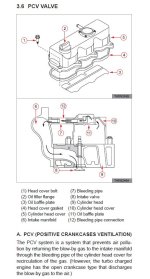
Took a look at the service manual. These tractors do have a PCV valve. Sits on top of the valve cover on the end opposite the fill cap. It has a circular metal cap over it that is attached by what appears to be three screws. The blow-by hose looks like it's 3 or 4 inches in length and is connected to the PCV valve and goes into what appears to be the intake manifold. I'd open that up and see what you can see.
 Thanks for the help.
Yes, it is finally going to 'warm' up to 0 celcius tomorrow, 32 in your world. Will have a good look. I will have to remember to ask about the heat in the summer.
On my 2016 model, there appears to be a 3/4" rubber hose about 10" in length that goes from side of valve cover to intake tube. There is no PCV valve visible. Fired up tractor and no pressure build up. Can't see how the 3/4 " rubber hose could get completely plugged. Will take apart intake to see if there is a valve inside?Took a look at the service manual. These tractors do have a PCV valve. Sits on top of the valve cover on the end opposite the fill cap. It has a circular metal cap over it that is attached by what appears to be three screws. The blow-by hose looks like it's 3 or 4 inches in length and is connected to the PCV valve and goes into what appears to be the intake manifold. I'd open that up and see what you can see.
On my 2016 model, there appears to be a 3/4" rubber hose about 10" in length that goes from side of valve cover to intake tube. There is no PCV valve visible. Fired up tractor and no pressure build up. Can't see how the 3/4 " rubber hose could get completely plugged. Will take apart intake to see if there is a valve inside?
I think you guys are correct. My shop manual from 2016 doesn't have the same photos, so thanks for the diagram. It does take forever for the engine to warm up. Think a block heater and an oil pan heater would help? The engine was at operating temp when this happened though. After I let it sit for 15 minutes it was fine (shut the engine off) Can the PCV get 'stuck'?If you take a look at XCGreen's earlier post with the picture, it shows the valve cover assembly. To the rear of the valve cover assembly is a round cap held on by three or four screws. The picture only shows three, but I suspect there's a fourth screw on the backside. That round cap covers the PCV valve. The tube you found (blow-by tube) comes from the PCV valve and goes to the intake manifold. If you pop that cap off, the PCV valve should be underneath it.
Also, XCGreen is correct in that the DK and NX series share common engine configurations. The graphic he posted is the exact same in the NX workshop manual. The graphic I referred to in order to find the PCV valve is on page 3-80 of the NX workshop manual. The one he posted is found on page 3-41 of the NX workshop manual.
I think you guys are correct. My shop manual from 2016 doesn't have the same photos, so thanks for the diagram. It does take forever for the engine to warm up. Think a block heater and an oil pan heater would help? The engine was at operating temp when this happened though. After I let it sit for 15 minutes it was fine (shut the engine off) Can the PCV get 'stuck'?
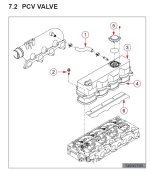
Yes they can. Have a look at this screenshot here, a different view than before. Just take the 4 screws out and have a look at the baffle plate, #5. It could be gummed up stuck against the seal.
A quick thing to rule out while troubleshooting, and with some luck, it could solve your problem.
View attachment 637831

