Off-Grid Solar Setups

/ Off-Grid Solar Setups #41  
Iron Edison makes Ni-Fe batteries that can tolerate 90% discharge. The initial investment is higher than more common batteries but since they last longer they are actually cheaper.
https://ironedison.com/preconfigured-off-grid-systems

I checked out the link and became interested since Itasca-Mantrap charges .129 a KW and a $33.000 monthly fee for the luxury of having power in the boonies. Anyway I then searched about the true maintenance of the Ni-Fe batteries and found this discussion.

nickel-iron batteries - Survivalist Forum
 
/ Off-Grid Solar Setups
  • Thread Starter
#43  
Still waiting to see final specs/pricing in the US for Tesla's PowerWall...next Spring! Which (of course) is when we start building!
 
/ Off-Grid Solar Setups #44  
If I am not mistaken there are two versions of Tesla power wall. One is emergency backup designed to be discharged only seldom. The other is designed to be discharged daily but to lesser degree. There are other entries in the energy storage market now. Iron Edison is one.

If I built my house today I would:
1.) Get the best insulation possible.
2.) Germany made windows.
3.) Shift as much as possible of energy consumption to electricity.
4.) Build thermal energy storage with a heat pump.
5.) Install enough PV to power it all up.

Alternatively I could install split units and used saved money for battery storage.
 
/ Off-Grid Solar Setups
  • Thread Starter
#45  
If I am not mistaken there are two versions of Tesla power wall. One is emergency backup designed to be discharged only seldom. The other is designed to be discharged daily but to lesser degree. There are other entries in the energy storage market now. Iron Edison is one.

If I built my house today I would:
1.) Get the best insulation possible.
2.) Germany made windows.
3.) Shift as much as possible of energy consumption to electricity.
4.) Build thermal energy storage with a heat pump.
5.) Install enough PV to power it all up.

Alternatively I could install split units and used saved money for battery storage.

We're *hopefully* starting in the spring
Looking at doing SIPs or spray foam for insulating
What brand windows are German?
I was thinking Stove and Dryer appliances would be on propane
I'll have to look into the heat pump
As for PV, I'm figuring 1,000 kwh per month (on the high side)
 
/ Off-Grid Solar Setups #47  
My father's cousin has large construction company in Munchen. He told us a story about when new infiltration standard became a law people were dying in their houses. In example they had fire in a fireplace. It used all oxygen and while the fire was dying the CO poisoned the people. Shortly after calibrated infiltration standard was added to the regulations.
There are quite few German manufacturers on US market. My brother has all windows and doors from Germany. The windows can be opened tree ways (tilt and turn), french door as well, all interior doors have invisible hinges etc. Invisible Hinges for Doors and Cabinets | Door Hardware | SOSS Door Hardware
 
/ Off-Grid Solar Setups #48  
We're *hopefully* starting in the spring
Looking at doing SIPs or spray foam for insulating
What brand windows are German?
I was thinking Stove and Dryer appliances would be on propane
I'll have to look into the heat pump
As for PV, I'm figuring 1,000 kwh per month (on the high side)

Use an Electric "Induction" stove, along with convection oven. Heatpump water heater and now dryers are also becoming available. Propane is expensive and likely trending higher. Focus on air sealing the house envelope and use some sort of ventilation system for fresh air (don't need much). In your area Net-zero is easily attainable. www.greenbuidingadvisor.com is a great resource for energy efficient new home construction. In the house I built 2 years ago I used a combination of SIPs and spray foam - worked well but probably will not do it on next house (mainly a cost consideration)
 
/ Off-Grid Solar Setups #49  
I've never met anybody who went with solar for their main power supply who was happy with it and would do it again if they could get power to their place. For $25,000 it's a no brainer having the power company supply it over solar. When you hit the $100,000 mark, that's when you might consider solar, and even then, I know two people who went with solar instead of paying for the power lines to be run and they both regretted it.

SIPS are very expensive and highly rated, but the only real advantage you get is in saving a little time in building. Heat goes up and down, so the main place that affects heating and cooling is the ceiling. You can go with SIPS on your roof, but it's a lot cheaper to get the same results just blowing in two feet or insulation to get an R60 rating then paying for foam. If you want big vaulted ceilings, then foam becomes relevant.

For walls, you have to remember that wind is where you lose most of your energy. It is much more important to have a solid barrier to keep out the wind then going crazy maximizing your R value on your walls. With 2x6 walls, you get R19 with fiberglass at a quarter the cost of SIPS. While the SIPS will have a much higher R value, it's overkill because you lose so much with your windows. Most double pane windows are only R2 to R4. Tripple pain will raise this a fair amount and I even know of one guy who bought four pane windows for a extreme amount of money. But back to reality, the windows and doors limit what you can get out of a wall more then anything else. The only thing worse then a window in a room is a skylight. Those are total energy wasters and probably the dumbest thing you can do for energy savings in a house. But back to the walls, sealing them up is what really matters. Taping the windows, using a high quality house wrap with good tape is where you get your money's worth. Be sure to tape the top and the bottom. I personally like to fold my house wrap over the tops of my walls and then have my rafters or trusses go over the top of the wrap to make the seal 100 percent tight.

Something of interest that I recently discovered is that when I added a huge doggy door, I have not noticed any change in my electric bill. I figured it would cost me more because of how poor the seal is, but we where losing just as much energy opening and closing the door for them all day long, so it's proven to be the same either way.

Another thing to avoid is french doors. Massive waste of energy since it is impossible to get them to seal. I've installed and replaced dozens of them. While brand new, you can barely get them to close, after a few years, leaves are blowing into the house through the gaps in them. When I add on to my house and built my great room, I am going to built my own 4 ft wide door so I can get everything in and out of the room that wouldn't fit through a standard 3 ft door because there is no way I would ever install french doors in my house.

Porches are a huge energy saver. Keeping the sun off the windows will save you money, and also extend the life of the seals around them. Most people just assume that the doors are what needs protecting from the elements, but covering the windows also has a huge benefit.

Be very careful of the latest craze green house energy building techniques. Most are very expensive building techniques or materials that will not show any return compared to proven methods. I never want to be the guinea pig when I build something to last.
 
/ Off-Grid Solar Setups #50  
Use an Electric "Induction" stove, along with convection oven. Heatpump water heater and now dryers are also becoming available. Propane is expensive and likely trending higher. Focus on air sealing the house envelope and use some sort of ventilation system for fresh air (don't need much). In your area Net-zero is easily attainable. www.greenbuidingadvisor.com is a great resource for energy efficient new home construction. In the house I built 2 years ago I used a combination of SIPs and spray foam - worked well but probably will not do it on next house (mainly a cost consideration)

Heat pump water heaters work well in warm climate or when there are at least more AC days than heating days. The WH uses the heat you supplied with your heating. If the heater is inside the house while you have gas/oil heating you will see lower electric bill but you will use more gas. IMO they are not worth the investment when you have heat your house more than cool.
 
Last edited:
/ Off-Grid Solar Setups #51  
Porches are a huge energy saver. Keeping the sun off the windows will save you money, and also extend the life of the seals around them. Most people just assume that the doors are what needs protecting from the elements, but covering the windows also has a huge benefit.
.

As is a good old shade tree. They take a while to grow big and If I were planning to build a new house I would plant the shade tree(s) as far in advance as I could.

I start getting shade at about 2 PM mid summer which is the way I like it.
 
/ Off-Grid Solar Setups #52  
As is a good old shade tree. They take a while to grow big and If I were planning to build a new house I would plant the shade tree(s) as far in advance as I could.

I start getting shade at about 2 PM mid summer which is the way I like it.

But remember to avoid casting shade over the solar panels as this kills their efficiency
:)
 
/ Off-Grid Solar Setups
  • Thread Starter
#53  
Our thought/plan was to use pole mounted Solar Panels. And I agree about the tree shading. Our plan is when we start building next year, we'll "invest" in a MUCH more mature tree (or a couple of them) for around the house. Budget is $750-$1,000 each
 
/ Off-Grid Solar Setups #54  
I've never met anybody who went with solar for their main power supply who was happy with it and would do it again if they could get power to their place. For $25,000 it's a no brainer having the power company supply it over solar. When you hit the $100,000 mark, that's when you might consider solar, and even then, I know two people who went with solar instead of paying for the power lines to be run and they both regretted it.

FWIW, we finished our retirement home early this year and have been living in it full time since April. Only solar for electric as the nearest power lines are many miles away.

We have 27 255W panels on three poles connected to dual Midnite Solar Magnum inverters and Classic charge controllers. 16 Surrette AGM 830 aH batteries wired as two 48V banks in parallel for 39.8 KWh of storage.

The panels are nearly 100' from the house so we put a small TuffShed building right next to the panels to hold the batteries and inverters. That way we could run straight AC to the main house panel in a trench.
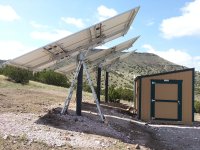
Solar Panels and Shed.jpg

The house is stick-built on a pier and beam foundation. The walls and floor have R23 denim insulation. The roof has R30 blown in fiberglass. For heat we have a normal gas furnace running off propane and also a Harmon P68 pellet stove fairly central in the main living space (kitchen, dining area, living room and sitting room) which is an open plan. Other than testing the furnace so far we have only used the pellet stove. Stove and dryer are propane Kenmore units. Water heater is a Rheem on-demand also on propane. Dishwasher, microwave and fridge are also Kenmore units. Generally speaking we went with efficient appliances but didn't go overboard on it. We added a small Whirlpool 14 cu ft chest freezer in the garage this summer. Cooling is with a MasterCool ASA7112 evaporative cooler (1hp). The house is 2300 sq ft.
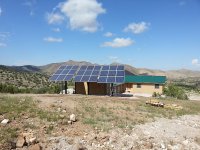
Solar Panels Up.jpg

So far we've been using between 300 and 450 kwh a month with plenty of available power. This winter will be the next big stress test on it with the colder temps and shorter days but not foreseeing any issues as the solar system was actually up and running before last winter.

After federal rebates the complete system including the shed and having the big poles put into the solid rock of the hillside was about $28k. A power line to here would have been many millions of dollars.

Note this is in central New Mexico at an elevation of 5600 feet. We get more than 300 days of sun a year. YMMV.
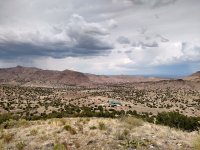
House from halfway.jpg

So, Eddie, now you kind of know 1 person that put in solar and doesn't regret it. :) If you make it over to the Socorro, NM area some time let me know and we'll show you the system.
 
/ Off-Grid Solar Setups #55  
Thank you, I would love to see it. Nice to hear you are happy with it so far. I've been to the home of several people on here and seen their systems, plus I've been overseas and seen them there too. I love the idea of it, but in every case, talking to those who have had solar for several years, they all have said they wish they had city power. I think it's very similar to well water compared to city water. No maintenance, no upkeep or upgrades required. You just pay for what you use and if you live under the same self levels of power usage, you will find the cost of city power to be very small. Of the people I've met, two are in the process of selling their places and looking for something that is on the grid.

Since it sounds like it is impossible for you to do it any other way, I compliment you on what you have accomplished!!!!
 
/ Off-Grid Solar Setups #56  
If we could have gone with grid power for something less than we paid for the solar system we definitely would have done so. No utilities of any kind out here. Fifteen miles by unimproved dirt road to the nearest paved road which is I-25. Obviously there will be expenses in the years to come with replacing the batteries and, much further down the road, the panels themselves. But who knows what other options may be available for us in 10 or 20 years.
 
/ Off-Grid Solar Setups #57  
I tend to equate off-grid with DIY type of folks.

It's not so much that a properly designed/installed modern system requires much in the way of maintenance.... it's more that many consumers today expect to do zero-maintenance, on everything.

Before going off-grid, I'd recommend that everyone take the time to talk to somebody that's owned a system at least 5 years. If what they have been doing for maintenance sounds like way too much work, then off-grid is not a fit.

A leading indicator can be to what extent someone does their own car maintenance. Anyone capable of doing first level basic maintenance on a car should be able to maintain a well designed/installed off-grid system, IMO.

Rgds, D.
 
/ Off-Grid Solar Setups #58  
As is a good old shade tree. They take a while to grow big and If I were planning to build a new house I would plant the shade tree(s) as far in advance as I could.

I start getting shade at about 2 PM mid summer which is the way I like it.

I do like the look and function of porches.

That said, the advantage of a deciduous shade tree up north is you want to get the solar gain during the Winter..... not easy to accomplish with a conventional porch.

Rgds, D.
 
/ Off-Grid Solar Setups #59  
If we could have gone with grid power for something less than we paid for the solar system we definitely would have done so. No utilities of any kind out here. Fifteen miles by unimproved dirt road to the nearest paved road which is I-25. Obviously there will be expenses in the years to come with replacing the batteries and, much further down the road, the panels themselves. But who knows what other options may be available for us in 10 or 20 years.

Small price to pay for having such "good neighbors" :D

Must be peaceful.
 

Marketplace Items

72" ROCK BUCKET (A52706)
72" ROCK BUCKET...
2012 DOOSAN G25 GENERATOR (A58214)
2012 DOOSAN G25...
2013 Nissan Rouge SUV (A59231)
2013 Nissan Rouge...
2014 Chrysler 200 Sedan (A59231)
2014 Chrysler 200...
Husqvarna Riding Mower (A56857)
Husqvarna Riding...
2008 BMW 535xi AWD Sedan (A59231)
2008 BMW 535xi AWD...
 
Top