Ballast On the subject of ballast

/ On the subject of ballast #21  
My wife has told me I'm not a great listener, what if I don't hear the tractor until she screams? :laughing:

You proved her right in post #13. :D
 
/ On the subject of ballast #22  
My SCUT only had to tell me once....


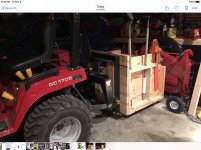
20190513_134020.jpg

20190513_134501.jpg

20190513_134544.jpg

Ballast is 2' x 2' x 1' (4cu ft) and weighs in between 500-600 pounds

Dale
 
/ On the subject of ballast #23  
I have a JD 2025r and my opinion is JD is on the heavy side for ballast needed. I don’t remember the exact numbers but something like filled tires with 700 lbs of rear ballast. I have about 400 lbs in my ballast box and it seems fine to me. They do make ballast box extenders for some boxes that adds several inches around the top. I’ll join the club and say try what you have to start.
 
/ On the subject of ballast #24  
This is a very cool idea. I had been thinking down the path of just buying one or two more ballast boxes, to load at different weights, but that creates a little storage headache. Your solution solves that, but is harder on the back than just backing up to a different box with a quick hitch. Both options to consider...

It's only hard on the back if you lift them manually ;) .....and what size weights/objects are being used. A core 700lb ballast box + ten 40-50lb weights/bags/etc would put you at (or above) 1100lbs.

Alternatively if you wanted to get fancy; additional weight boxes (potentially even just filled with concrete) on casters (or dollies) could be rolled up next to the core ballast box & attached (by whatever means) with no/minimal lifting needed as the 3pt.

....and there's also the route of a carry-all like was mentioned in post #20 by Imold.

Just me, but personally I prefer not to have a whole lot of weight (beyond what is needed) because it's all additional weight that the brakes/engine has to stop ..... which on my flat terrain means there's times I'll move light materials (e.g. mulch, aged manure/compost) without having anything on the back other that the wheel weights. ...again just me, as I tend to keep my hand by/on the loader controls to drop the whole load if/when needed.
 
/ On the subject of ballast
  • Thread Starter
#25  
All good suggestions, just double or triple the sub-compact size numbers of the last few posts. Remember loader has a lift capacity of 2125 lb with a reach of 59 inches, easily double or triple some of the machines used as examples in the last several posts. But it’s mounted on a machine with a base weight of only 2900 lb. and wheelbase of only 68 inches, making it darn near a seesaw... a 6000 lb. seesaw with a full load, before adding ballast. This is my third Deere loader tractor (previously 750 and 855), and it is by far the most tippy of the three, more than 230% that of the 855, when looking at lift x reach vs. weight x wheelbase.

The total ballast Deere spec’s for this loader on this machine is right around 2000 lb. If taking the proposed 700 lb. box and adding 40 lb. suitcase weights, I’d be looking to add 32 of them for the heaviest jobs. Superbly flexible, but that’s an awful lot of weights to purchase, move, and store. I think I’d be better off just having two or even three different ballast boxes of different weights, definitely more convenient and easier to change weight, when considering the number of weights I’d really need on this machine.

At this point, I’m down to two options, both of which would have me keep my 700 lb. ballast box for a lot of the lighter work, and buying bigger boxes for heavy work:

1. Put 400 - 500 lb. on the rear wheels, either liquid or iron but not both, and buy a second ballast box to load around 1500 lb. This won’t be a Deere ballast box, they don’t make one that big in cat.1, but I believe some others do.

2. Skip the wheel weight, buy that same 1500 lb. ballast box, plus 15 x 40 lb. suitcase weights. This would allow me to drop all weight for lawn jobs (I do a lot of yard work with loader removed), and load up with 700, 1500, or 2000 lb. on the 3-point as needed. Unfortunately, it does very little for my side-hill stability when loaded. It also means I’ll have to continue removing the loader to pull small trailers in 2wd, I presently can’t even get up the hill that is my back yard without either going into 4wd or removing the loader, my rear is just that light.

My gut is telling me to go with option 1, but I’m receiving advice from other channels to go option 2, from some who know my usage patterns, and have substantial experience (Deere dealer, Deere mechanic, and golf course equipment manager). I do have a lot of hilly terrain right around the house (we’re up on a small bluff), which means a lot of side-hill work when mulching gardens and moving my wood trailer around from the wood lot to the house.
 
Last edited:
/ On the subject of ballast #26  
This is my third Deere loader tractor (previously 750 and 855), and it is by far the most tippy of the three, more than 230% that of the 855, when looking at lift x reach vs. weight x wheelbase.
It seems tractor's wheelbases are getting shorter and their loaders are sticking out front farther. I can understand they want better numbers like turning radius and FEL lift height but they are designing a cheap tractor that is unstable without a ton of weight on the rear. Why? My TC33D had the Supersteer option that pushed the front axle further to the front but still had a better turning radius and the loader was shorter to the front of the tractor. It was a much better balanced machine without ballast. Skid steers and my Toolcat have the bucket tight to the front wheels for a reason. These tractors are getting the FEL further and further out the front. Why?
 
/ On the subject of ballast
  • Thread Starter
#27  
It seems tractor's wheelbases are getting shorter and their loaders are sticking out front farther. I can understand they want better numbers like turning radius and FEL lift height but they are designing a cheap tractor that is unstable without a ton of weight on the rear. Why? My TC33D had the Supersteer option that pushed the front axle further to the front but still had a better turning radius and the loader was shorter to the front of the tractor. Skid steers and my Toolcat have the bucket tight to the front wheels for a reason. These tractors are getting the FEL further and further out the front. Why?

Yeah, I was thinking exactly the same thing, when I was shopping this machine and others. But they’re all doing it, I assume for the reasons you mentioned, better marketing numbers. I don’t think it’s bad, though, you can still make them stable with the appropriate ballast, it just increased the importance and amount of ballast required to use the loader at full capacity.

It appears the big bump in loader capacity was back when Deere introduced the “X” loaders in the early 2000’s. From a friend who used to be a Deere mechanic: “The capacity bump for the loaders was back when the 300, 300X, and the 300CX loaders were introduced, on the twilight of the 4x10 series tractors and the onset of their 3x20 replacements. Your 320R is very similar to the 300CX loaders we were putting on 43/4410's and 3x20 series machines back in 2005. And they were an incremental improvement over the 410/420/430 loaders they replaced. Of course, all of these models have significantly more capacity than what was available when your 855 was new.”

What has changed is the tractors have gotten larger and heavier for each model series. People think the modern 4-series is a replacement for a 4410, but actually my 3033R is exactly the same weight and wheelbase as an old 4410.

Any opinion on option 1 vs. option 2?
 
/ On the subject of ballast #28  
These tractors are getting the FEL further and further out the front. Why?

Because power densities are permitting it, and consumers are buying them would be the obvious answer. ;)

After all, are there many (or any) who would turn down a more capable machine in a smaller package? (even if that smaller machine needs a whole lot of add-ons to use the full potential of the machine).

To be honest, between the continuing development of engine technology, the increasing pressures used in hydraulic systems and even advancing material technologies it's probably not long before some of these machines start straying into being legitimately unsafe for use without configuring it for the various specific uses.
 
/ On the subject of ballast #29  
On my 4310 I set the front wheels in the wide position. I haven't found where Deere says not to for loader work on my model but I think they say not to on yours. If I tear up the front axle then I guess I will have to fix it.

On the rear I bought a set of mounted turfs that came on wheels with a greater offset by almost 2 inches each. Set in the wide position my tractor is right at 6 ft wide in the rear.

None of this offsets the front to rear balance but it feels infinitely more stable.

I upsized the cylinders on my loader and I think it would be equivalent to the 430 loader capacity.

The 1200 lbs I put on the 3pt keeps it planted for loader and grapple work. May be harder on the 3pt but still well under the rated capacity.

Ballast on the 3pt is exaggerated by hanging past the axle just like having weight further forward on the loader decreases it's capacity.

My feeling is adding different ballast to the 3pt for different needs makes the most sense to me.
 
/ On the subject of ballast #30  
The total ballast Deere spec’s for this loader on this machine is right around 2000 lb. If taking the proposed 700 lb. box and adding 40 lb. suitcase weights, I’d be looking to add 32 of them for the heaviest jobs.

At this point, I’m down to two options, both of which would have me keep my 700 lb. ballast box for a lot of the lighter work, and buying bigger boxes for heavy work:

1. Put 400 - 500 lb. on the rear wheels, either liquid or iron but not both, and buy a second ballast box to load around 1500 lb. This won’t be a Deere ballast box, they don’t make one that big in cat.1, but I believe some others do.

2. Skip the wheel weight, buy that same 1500 lb. ballast box, plus 15 x 40 lb. suitcase weights. This would allow me to drop all weight for lawn jobs (I do a lot of yard work with loader removed), and load up with 700, 1500, or 2000 lb. on the 3-point as needed. Unfortunately, it does very little for my side-hill stability when loaded. It also means I’ll have to continue removing the loader to pull small trailers in 2wd, I presently can’t even get up the hill that is my back yard without either going into 4wd or removing the loader, my rear is just that light.

Think we may have had a miscommunication as I wasn't intending to suggest taking the ballast box to 2000lbs - just to the manufacturer's recommended 1100lbs (or slightly beyond).

I'd always recommend adding at least some weight to the wheels (either liquid, iron, or both) in order to keep the unladen tractor (with loader attached) safely balanced without the use of a rear implement. This also keeps some of the ballast weight off the rear axle as weight on the wheels is usually carried on the wheel itself.

So the recommendation of making the current ballast box selectively heavier was intended primarily to avoid having multiple ballast boxes (and having to shuffle tools between them). In other words, basically option #1 but using add-on weights to take the current ballast box to 1100lbs -- or up to 1500lbs (if possible/wanted/etc).

Personally I would avoid the option of not having any weight on/in the tires. Experience has taught me the rear end can get light when the tractor isn't actively carrying the attached 3pt implement (i.e. the 3pt implement is down and being used rather than carried). Wheel weights can be removed if the loader is removed, liquid can't (or not as easily). However, both iron and liquid are good options.

However, ultimately it's your money, time and choice to make and all the rest of can do is offer options/suggestions.
 
/ On the subject of ballast #31  
You already have a 700 pound box, just make second box, maybe 2 x 2 x 2 (anything 8 cubic feet capacity if not a true "box") and fill with concrete, maybe 1200 pounds... IF 700 lb box is to light change it to heavy box... Personally at age 75 I m not going to fuss with adding or subtraction (suitcase weights and such) to get good balance....

Dale
 
/ On the subject of ballast #32  
.I upsized the cylinders on my loader and I think it would be equivalent to the 430 loader capacity.

I found on my current tractor the lift capacity is limited by the pumps ability.
by adding larger cylinders does that give your pump the ability to lift more?
does it slow down loader control speed?
What is the load capacity of your front end?

After breaking a tractor frontend twice because the loader was stronger than the tractor I have upgraded to a tractor with greater lifting ability. If the bigger tractor cant lift what I am doing on a regular basis I will get a bigger tractor again. Experience and a lot of age has made me watch what I am doing more closely :)

OP...If I found myself in a situation where I keep feeling the tractor is going to tip over I would have to rethink why and correct my positioning of the tractor and correct it... not add more counterbalance. or widen the stance more than the tractor was built for.
The good news it because of the compact tractor craze there are a buttload of larger tractors availabe at a great price.


Its really hard to tip a piece of equipment over if its carried low to the ground
 
/ On the subject of ballast #33  
Thank you for the idea on the hitch! I like that. A little extra weight at the aft end of that ballast box can help, too. If I end up keeping this box, I知 definitely going to follow this advice.

But your idea on front tire ballast is incorrect, I think. The front axle is on a free pivot, at least on all of my tractors, so theyæ±*e essentially a tricycle. That weight in the front tires does absolutely zero for side-hill stability until the tractor has tipped to a point where the uphill front wheel lifts off the ground. Given the amount of travel in the front axle pivot, that will not happen until the tractor is already well past the point of no return.

If your tractor has some sort of suspension or shock absorber to limit the force or rate of front axle pivot, then the physics are different, but mine do not. They pivot completely freely, until they hit a stop, but that stop is likely too far past the tipping point to save me on a side-hill scenario.

Glad to offer ideas, consider all of it free, ha.

I believe you are correct about my front loaded tires, but it was only $100 for all 4 tires (as SCUT's have small tires) and I knew it wasn't going to make much of a difference and now I know it will make less of a difference...

I know those suitcase weights are pricey, so as a option you could get a number of 1/2" plates (lighter and easier to handle then 3/4" plates) and add them on the back with a "U" shape/or square cutout on the bottom of the plates (that would be able to rest on top of the hitch) and add them to the ballast box as needed (should require some type of mechanical fastener to secure), just another thought.

again, good luck with your choice of ballast, KC

Also, we do not have to always fill/use the front bucket to the max.
 
/ On the subject of ballast
  • Thread Starter
#35  
by adding larger cylinders does that give your pump the ability to lift more?
Yes. Your tractor has a fixed pressure limit, likely close to 2500 PSI. On a 2" cylinder, that pressure would develop 7850 lb. force. Increase to a 3" cylinder and it generate 17,663 lb. at the same pressure. However, your other loader components were only designed to handle the force created by the OEM cylinders, at rated pressure.
does it slow down loader control speed?
Yes, by the same R^2 ratio, as the tractor is limited to a fixed flow rate, likely somewhere in the range of 5 - 10 GPM for a typical modern hydro CUT. The 3" cylinder will take 2.25x longer to travel the same distance as a 2" cylinder, at a given flow rate.
OP...If I found myself in a situation where I keep feeling the tractor is going to tip over I would have to rethink why and correct my positioning of the tractor and correct it... not add more counterbalance. or widen the stance more than the tractor was built for.
This tractor is made to carry substantially more weight than I am discussing, here. In fact, the question is about ballasting with less than the weight recommended by the manufacturer, or more specifically, making the majority of that ballast removable.
Also, we do not have to always fill/use the front bucket to the max.
Definitely, but the primary justification for stepping up to this machine (versus just another new 2-series or equivalent predecessor) is that extra capacity. I don't need that extra capacity every day, but there are definitely times when I do. This is why I like so many of the ideas, including yours, for making the ballast solution flexible and tunable.

What about 3 pt forks for the heavy logs?
Yep, I had to settle for doing that a lot on my JD 855. One of the primary reasons for going with the 320R loader over the 300R loader on the 3033R is so that I should not have to resort to that nearly as often!
 
/ On the subject of ballast
  • Thread Starter
#36  
I致e seen at least two mentions of corrosion issues with RimGuard, despite their marketing that it痴 not corrosive, at least by comparison to CaCl2. Can someone who痴 been reading this forum more regularly than me give me the straight dope on RimGuard? Has it been living up to or falling short of the claimed performance?
 
/ On the subject of ballast #37  
Rimguard advantage - weight
Rimguard disadvantage - cost
 
/ On the subject of ballast #39  
/ On the subject of ballast #40  
One alternative is a weight rack for your 3 point;
Category 1 Hitch

My preference is for bolt on weight for the wheels,
I just do not care for the long term aggravation of liquid filled tires (flats).
As far as corrosion, rim guard is pretty much non corrosive you can get minor rusting of the wheels,
in 40-50 years it might be an issue.

Bolt on weights for the wheels can be removed if needed to, not real easy but doable.
A rear ballast box or weight rack can weigh what ever you wish it to, or can be adjustable.
 
 
Top