You are using an out of date browser. It may not display this or other websites correctly.
You should upgrade or use an alternative browser.
You should upgrade or use an alternative browser.
plows
- Thread starter harley152
- Start date
- Views: 5301
More options
Who Replied?
/ plows
#1

JerryG
Super Member
What is the tractor model? It's not in your Bio.

Oleozz
Veteran Member
- Joined
- Jan 14, 2006
- Messages
- 1,656
- Location
- Pa.
- Tractor
- International 1066 with Year Round Cab, Kioti DK 45S with Cab, 451 Loader
I am pulling a 2 bt 12 inch plow with a 45 hp tractor. I am plowing in heavy sod that hasn't been turned over in 25 yrs and it makes the tractor work. In the right conditions you probably could pull a 3bt 12in. plow or a 3-14 inch.

Farmwithjunk
Super Member
harley152 said:Just wondering how much plow I can pull---have a massey 45 hp. 4X4 diesel tractor and want a plow---I have pasture that has been sub-soiled and needs to be plowed before tilling or disking---what can I pull???
tia
Jerry
sandy/loamy type soil.
Engine hp or pto hp? In "the good ol' days" horsepower of a farm tractor was generally spoken in terms of pto hp (or belt hp before that) Those were the days when plows were common also.
45 ENGINE hp will play out as 38 to 42 pto hp most cases. That said, 45 engine hp will EASILY pull a 2-bottom plow in just about every concievable condition. If propely ballasted, and mfwd traction is included in the mix, 45 hp MIGHT pull a 3-bottom plow in sandy/loamy soils. Some consideration must be given to WHICH plow (brand)
12", 14" or 16" plows are each different animals too. Plows work best at a depth of 1/2 their bottom width. (i.e. 12" @ 6" deep, 14" @ 7" deep, 16" @ 8" deep) A 3-bottom X 12" plow moves less dirt per pass than a 2 X 16" plow IF operated at the intended depth. We need to keep in mind that most soil conditions ARE NOT consistant at varying depths. The dirt at 8" down might be harder than the same ground at 6" deep. We aren't plowing a "text book". Conditions of soil structure and type must be considered.
Different brands pull harder or easier than others. The new HOWSE plows (available at TSC) pull like an anchor compared to a Ford 101, even though they share replacement wear parts. John Deere plows pull harder than any brand due to angle of the share and contour of the moldboard. (They also tend to perform less favorably compared to other brands in some conditions like plowing sod.)
The "better" 3-point mounted plows IMHO? Ford 101's, Massey FErguson #43, #66, (#74's in CAT II version) Any Oliver/White plows are good but parts are getting scarce.
I'd opt for a 2-bottom plow in your case, increasing plowing speed if you find adaquate hp and traction. Test's by several manufacturers in the 1960's made it evident that using smaller implements at higher ground speeds would (a) accomplish same (or greater) results and (b) prove to be more fuel efficient. And as an added benefit, smaller than maximum "load" is easier on the tractor in the long term.
Last edited:

redlevel
Gold Member
As usual, the junkster is right on the money with his advice.
Not only are the Ford 101 and MF 43 two of the best, they are usually the most numerous. There must be 100 of them in the weeds within a two mile radius of where I'm sitting right now. I have three of the Fords and one MF myself. The only problem is that it has gotten right expensive to keep them up if you are doing more than plowing a few acres for a garden or food plots. It is also a little harder to find the points, shins, and other wear components, and I would hate to see what a new moldboard would cost. Most NH dealers can get the parts for the Ford plows if they don't have them in stock.
Not only are the Ford 101 and MF 43 two of the best, they are usually the most numerous. There must be 100 of them in the weeds within a two mile radius of where I'm sitting right now. I have three of the Fords and one MF myself. The only problem is that it has gotten right expensive to keep them up if you are doing more than plowing a few acres for a garden or food plots. It is also a little harder to find the points, shins, and other wear components, and I would hate to see what a new moldboard would cost. Most NH dealers can get the parts for the Ford plows if they don't have them in stock.
Farmwithjunk
Super Member
redlevel said:As usual, the junkster is right on the money with his advice.
Not only are the Ford 101 and MF 43 two of the best, they are usually the most numerous. There must be 100 of them in the weeds within a two mile radius of where I'm sitting right now. I have three of the Fords and one MF myself. The only problem is that it has gotten right expensive to keep them up if you are doing more than plowing a few acres for a garden or food plots. It is also a little harder to find the points, shins, and other wear components, and I would hate to see what a new moldboard would cost. Most NH dealers can get the parts for the Ford plows if they don't have them in stock.
Thank ya kindly sir!
Parts for the Massey plows are still available at AGCO/Massey Ferguson dealers, as well as a few aftermarket sources. Share for 12" and 14" are getting scarce, but 16" are easy to get and share the same bolt pattern. They can be cut down to work just as well as the shorter ones. In spite of having different part #'s, all the rest of the parts are the same on 12", 14" and 16". (Frog is the same on all sizes)
OEM parts are roughly the same price as aftermarket and they fit MUCH better.
Shares sell around $15 ea.
Shins about $12
Landslides are available only in the longer rear version. Cut them off to fit front bottoms. About $45 ea.
Cover boards (trash boards) are $50 ea.
Moldboards break the piggy bank into shreds. Nearly $100 ea.
By the time you buy new plow bolts, figure $250 per bottom to replace all wear parts except coulters.
Coulters are a tough item to find. "assembly" (hub and disc) sell new for over $125
And don't forget the UPS man. HE gets a few pesos for packing all that iron to your door.
Ford 101 parts mirror cost on MF plows for the most part. 12" bottom parts are darn near impossible to find.
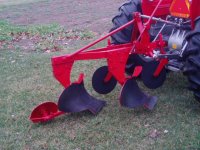
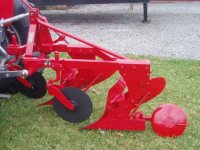
Here's the #66 Massey plow I re-did last winter. Parts, freight, paint, and decals set me back over $650.
Attachments

Dascro
Silver Member
Farmwithjunk,
That is one nice looking 2 bottom plow you have there!! The tractor, what I can see of it looks pretty good too. What model MF is the tractor?
I grew up on a farm and one of the tractors I learned to plow on was a Ford 860 pulling a Ford 2 botton plow (I believe they were 14" bottoms). After mastering plowing with the Ford, I was "allowed" to move up to some big (at the time) IH tractors pulling some big 4 bottom plows (all quick hitch).
I have tried and tried to find a set of "workable" Ford, Massey or Fergusen plows (1 or 2 bottoms), but I can't find anything but junk around here. Those plows that TSC sell just make me smile.
I agree completely (for what its worth) with your advice on selecting a plow. Getting a good plow is a big part of doing a good plow job. Setting it up is the other half. Growing up, the quality of the plow job was a measure of the farmer (within the farming circles).
Dave
That is one nice looking 2 bottom plow you have there!! The tractor, what I can see of it looks pretty good too. What model MF is the tractor?
I grew up on a farm and one of the tractors I learned to plow on was a Ford 860 pulling a Ford 2 botton plow (I believe they were 14" bottoms). After mastering plowing with the Ford, I was "allowed" to move up to some big (at the time) IH tractors pulling some big 4 bottom plows (all quick hitch).
I have tried and tried to find a set of "workable" Ford, Massey or Fergusen plows (1 or 2 bottoms), but I can't find anything but junk around here. Those plows that TSC sell just make me smile.
I agree completely (for what its worth) with your advice on selecting a plow. Getting a good plow is a big part of doing a good plow job. Setting it up is the other half. Growing up, the quality of the plow job was a measure of the farmer (within the farming circles).
Dave
Farmwithjunk
Super Member
Dascro said:Farmwithjunk,
What model MF is the tractor?
Dave
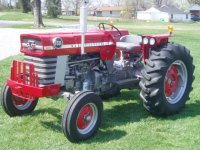
1971 MF 150, 8-speed diesel.
Attachments
JerryG
Super Member
Dave,
You will have to hit farm auctions until you find a good plow. I bought a MF model 66, 3-14" at a farm auction for $135. It was like new. Didn't look like it had been in the ground. I couldn't believe that I got that good of a plow for that price.
You will have to hit farm auctions until you find a good plow. I bought a MF model 66, 3-14" at a farm auction for $135. It was like new. Didn't look like it had been in the ground. I couldn't believe that I got that good of a plow for that price.
Farmwithjunk
Super Member
JerryG said:Dave,
You will have to hit farm auctions until you find a good plow. I bought a MF model 66, 3-14" at a farm auction for $135. It was like new. Didn't look like it had been in the ground. I couldn't believe that I got that good of a plow for that price.
You just HAVE to keep bringing that up, don't you!

Bill, who paid MUCH MUCH more for his plow.
Dascro
Silver Member
Bill, that is a beautifully done 150. A neighbor farm (when I was growing up) had an MF 180. And I loved that tractor. Those Perkins always sounded so smooth to me. We were always more IH at the time, but we did have that Ford 860 too.
Jerry, you sure got a deal on that plow!
I'll keep looking around (including auctions) and hopefully sooner or later I'll find something that is worthwhile. But I doubt I'll find anything real nice for $135 though.
Dave
Jerry, you sure got a deal on that plow!
I'll keep looking around (including auctions) and hopefully sooner or later I'll find something that is worthwhile. But I doubt I'll find anything real nice for $135 though.
Dave
Dk45_Jeff
Silver Member
Farmwithjunk said:If propely ballasted, and mfwd traction is included in the mix, 45 hp MIGHT pull a 3-bottom plow in sandy/loamy soils. Some consideration must be given to WHICH plow (brand)
I don't have wide experience with tractors, plows or soils but this is what I've actually experienced. Tractor Kioti DK45, has draft control 45 hp engine , AG tread, 4wd engaged, filled rears, FEL mounted, approximate field weight 3 tons. Plows ford 3x14 with shear bolts and a Ferguson 2x16 solid beam both plows have full sets of coulters. Plows set to cut level at half bottom width with tire in furrow. Soils Virginia: heavy rock free red clay, red-yellow clay mixture with many small flinty stones (marble to bread loaf size), New York: sandy loam with moderate concentration of glacier deposited stones (softball to bathtub sized).
Tractor has no problem pulling either plow in mid range through Virginia clay. I've only used the shear bolt protected 3x14 in New York and the tractor can pull the plow in high first gear up there. In all three soil types I've worked areas reclaimed from scrub growth that could not have been farmed for at least 50 years if it had ever been. I believe the machine will handle a 3x16 and I'm keeping my eyes open for one to find out.
JerryG
Super Member
Ha, I'm one of those people that go and go to auctions and never buy anything because of the prices that things get run up to. When I do get a deal, it is usually a good deal.Farmwithjunk said:You just HAVE to keep bringing that up, don't you!
Bill, who paid MUCH MUCH more for his plow.

Glowplug
Veteran Member
JerryG said:Dave,
You will have to hit farm auctions until you find a good plow. I bought a MF model 66, 3-14" at a farm auction for $135. It was like new. Didn't look like it had been in the ground. I couldn't believe that I got that good of a plow for that price.
I'll take it off your hands for twice that. No questions asked, won't even need to see it!
You can't beat a 100% profit can you?Eric_Phillips
Platinum Member
I came into a 3x14 ford 101 with worn out shins. My soil ranged from clay to loam with some sand. The field had been farmed three years prior in corn. I hooked up that plow rust and all squirted grease in the coulters and went to town. I tried the best I could to set up the plow with right hand wheels up on blocks. I am not sure it was perfect setup but away I went. I had to be carefull when I got to the loamy stuff because it would try to dig to China. I think I pulled it in 2H out of 4 gears. I had brush hogged the field first then went at it with the plow. I am sure it was not as good as some of the "professionals" here could have done but not bad for my first time. Now what did I do that with, a 27hp FarmTrac with loaded bar tires. I get the feeling from everything I have read on here that I am the exception, being able to pull that much plow with so few horses. But I thought you said the field was already ripped up you just want to turn it over. From my extremely limited experience I would have thought you could pull at least a three bottom.
Here are some similar links:


- Replies
- 35
- Views
- 8K