Note-------- what I know about welding is......... deeper the better.........so, with that in mind:
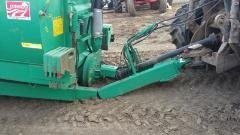
We just had a situation where the main two "beams" under a tandem-axle slurry tanker broke, just in front of the tank (where the greatest flex would occur). Have not figured why yet....applicator/tanker is not that old, is only 6000 gal, and is not "banged" over corn rows.....loaded or empty..........maybe just crap happens sometimes.
Anyway......... the fix is going to be ........ an upright plate, about 8ft long, 8inchs wide, and 3/8inches thick.........welded onto the vertical sides of the 7.5inch box metal that composes the two main beams under the applicator........both of which meet in front of the tanker, and V into the drawbar.
The plate will be slightly "taller" than the box metal.......and will be able to be welded on the shoulders of the box metal, so that a greater depth/amount of weld will be allowed.
My question.......... in that application------ plate onto the sides of box metal-------- is drilling holes in the plate and plug welding to the box metal needed?
Seems to me logical that it would provide much more support, but is that additional support necessary when the plate is going to be fastened pretty much all along the edges of the box metal? (I assume it will not be continuous weld, but rather skip-welded...every few inches)
I would assume that the flex is going to be pretty much taken out of the box metal, after two plates 3/8 inches thick are welded to the vertical sides of each of the box metal "beams".
Your comments will be appreciated------ thanks.
We just had a situation where the main two "beams" under a tandem-axle slurry tanker broke, just in front of the tank (where the greatest flex would occur). Have not figured why yet....applicator/tanker is not that old, is only 6000 gal, and is not "banged" over corn rows.....loaded or empty..........maybe just crap happens sometimes.
Anyway......... the fix is going to be ........ an upright plate, about 8ft long, 8inchs wide, and 3/8inches thick.........welded onto the vertical sides of the 7.5inch box metal that composes the two main beams under the applicator........both of which meet in front of the tanker, and V into the drawbar.
The plate will be slightly "taller" than the box metal.......and will be able to be welded on the shoulders of the box metal, so that a greater depth/amount of weld will be allowed.
My question.......... in that application------ plate onto the sides of box metal-------- is drilling holes in the plate and plug welding to the box metal needed?
Seems to me logical that it would provide much more support, but is that additional support necessary when the plate is going to be fastened pretty much all along the edges of the box metal? (I assume it will not be continuous weld, but rather skip-welded...every few inches)
I would assume that the flex is going to be pretty much taken out of the box metal, after two plates 3/8 inches thick are welded to the vertical sides of each of the box metal "beams".
Your comments will be appreciated------ thanks.