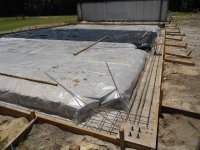
Pour foundation without forms

/ Pour foundation without forms #1  

quarencia

Silver Member
Joined
Apr 2, 2007
Messages
108
Location
NW Connecticut
Tractor
Kubota BX2230 & B3200
Accidentally posted this in regional forum, but meant to post here, so I reposted. Anybody ever poured a foundation without forms? Not just the footing. The entire footing and wall without forms. Free pour directly in the trench. Getting ready to build small barn (20x24) for equipment storage and was thinking would be faster and cheaper to skip the forms. Have access to excavator with 12" bucket and can trench it myself. I remember a post years ago where tbn'r did this for a garage. Oh yeah, I'm in Connecticut, so I have to go 48" down. And I want to put slab inside after foundation poured. Anybody ever done this?
 
/ Pour foundation without forms #2  
I wouldn't try it if you have any frost in the ground; it will grab hold of any rough edges and move it around.
 
/ Pour foundation without forms #4  
Doesn't sound like a good idea. The top of the slab should be 4 to 6 inches above grade. If you formed it with soil you would have to remove it.
 
/ Pour foundation without forms #5  
Accidentally posted this in regional forum, but meant to post here, so I reposted. Anybody ever poured a foundation without forms? Not just the footing. The entire footing and wall without forms. Free pour directly in the trench. Getting ready to build small barn (20x24) for equipment storage and was thinking would be faster and cheaper to skip the forms. Have access to excavator with 12" bucket and can trench it myself. I remember a post years ago where tbn'r did this for a garage. Oh yeah, I'm in Connecticut, so I have to go 48" down. And I want to put slab inside after foundation poured. Anybody ever done this?

The cost of the excess concrete you will need will exceed the cost of the forming by a factor of about 5.
Harry K
 
/ Pour foundation without forms #7  
I am thinking of a small retaining wall and will just dry lay the block and pour full of crete. Ed
 
/ Pour foundation without forms #8  
Actually the only reason for concrete forms is to hold/keep the concrete where you want it until it sets...and sometimes for suspending reinforcing bars etc...
If your excavation fills the bill...go for it...being less uniform it might require more material (as mentioned)...As long as you can address working and exposed surfaces it's a no brainer IMO...
 
/ Pour foundation without forms #9  
I just had slab put in for a 40' X 60' building and they only formed the top area.
They compacted the ground very well then dug it out per the drawing.
 

Attachments

  • DSCN0712.JPG
    DSCN0712.JPG
    725.8 KB · Views: 322
/ Pour foundation without forms #10  
Are you talking about cider blocks or.icf blocks?

10" wide x 8"tall x 16"long blocks using mortar in between. I guess I never called them cinder blocks, just cement blocks... You would need footings the right depth for the frost problem and would need to fill holes in the blocks with concrete every 4 foot or so.

Funny story; I put footings in for a 1900 sg ft house with full basement and part of it was for a frost wall that was 4' deep. I was 27 years old and never really built anything major before. I got plywood for some 4' frost walls but didn't know how to hold them together so I formed it using 2x4s against the dirt walls and started pouring cement in. My wife did the mixing with a cement mixer using sand, gravel and portland cement. I would throw rocks in for filler. What started out as roughly a 10" wide wall 4' tall by 30' long ended up being 30' long, 4' high by 24 to 30" wide at the top. It started bulging out so I braced more and kept throwing concrete in with rocks maybe a foot in diameter as a filler. The upside was when I put cement blocks of and fascia stone on, I had a really nice base. That footing ain't goin' anywhere. That was 40 years ago.

In hindsight I should have used wall ties to hold them together or used cement blocks if I wanted to do it myself, or jusy used cement blocks from the frost footings all the way up.
 
/ Pour foundation without forms #11  
Accidentally posted this in regional forum, but meant to post here, so I reposted. Anybody ever poured a foundation without forms? Not just the footing. The entire footing and wall without forms. Free pour directly in the trench. Getting ready to build small barn (20x24) for equipment storage and was thinking would be faster and cheaper to skip the forms. Have access to excavator with 12" bucket and can trench it myself. I remember a post years ago where tbn'r did this for a garage. Oh yeah, I'm in Connecticut, so I have to go 48" down. And I want to put slab inside after foundation poured. Anybody ever done this?

sounds like overkill.

there are many "slabs poured on grade" basically concrete poured on top of the ground. no walls / supports down into the ground. most likely top soil removed, and back filled with drainage rock" and then concrete poured. at most... what is called a footer is done around the outside perimeter of the concrete. to help the edges stay together. and keep from cracking.

i have 3 large pours like above... 1 large pour outside (used to be feed lot for cattle.), and then i want to say 40x60 shed 2/3rds of it is concrete just poured on the ground. and then the other shed 30x60 i want to say there is 30 by 15 foot slab poured inside of it.

contact your local concrete pourers / finishers / crews. they will know your local codes / weather conditions and suggest something.

pay for a "good finisher" a bad finisher can make or break a concrete floor pour. as being to rough to lines in it, to little waves in it, to high / low spots in the floor. a good finisher has the tools and more so ability to control things to get correct wanted outcome.
 
/ Pour foundation without forms #12  
I did it in '79 but with a worn out 8" trencher, not a 12" backhoe. It was also on well draining deep loam clarion soil. It was attached to the house with a breezeway. I lived there for another 10 years and didn't see any movement to worry about. It was 24' long by 32' wide with a 4/12 pitch roof. I had one spot where the wall kept caving in. We found an old cistern there so we filled it partially in, added a lot of steel for reinforcement and filled the trench with concrete before the trench caved in again.

Cafe-ins are the biggest problem, I don't think i would do it again.
 
/ Pour foundation without forms #13  
Actually the only reason for concrete forms is to hold/keep the concrete where you want it until it sets...and sometimes for suspending reinforcing bars etc...
If your excavation fills the bill...go for it...being less uniform it might require more material (as mentioned)...As long as you can address working and exposed surfaces it's a no brainer IMO...

Gonna be very difficult to wind up with a level smooth surface to set the floor/walls on. I guess one could use lumber to form the top of it wth all below being rough dug.

Harry K
 
/ Pour foundation without forms #14  
I agree with others that block is going to be easier.

IF not block, and you want a "Poured" wall, for starters you need plenty of rebar. And IMO, you are going to need to form it, but not that it has anything to do with the dirt or trench. You need the concrete ABOVE the ground to build your wall on, and not just flush with the ground. If you are just level with the ground, and start stick building a structure on top of that, you are not going to have much luck sealing a concrete-wood transition that is right at ground level.

When I did my 40x72, we used the trench to form just as you describe, but we were only pouring a footer. 6-rows of block on top of that then started building. Gives me ~2-block above grade so no wood or metal is touching dirt anywhere.

I would also check on the 12" width. I know its a smaller building but 12" still seems pretty narrow. Its all based on your area, soil conditions, and size of building/anticipated snow loading.
 
/ Pour foundation without forms #15  
I agree with others that block is going to be easier.

IF not block, and you want a "Poured" wall, for starters you need plenty of rebar. And IMO, you are going to need to form it, but not that it has anything to do with the dirt or trench. You need the concrete ABOVE the ground to build your wall on, and not just flush with the ground. If you are just level with the ground, and start stick building a structure on top of that, you are not going to have much luck sealing a concrete-wood transition that is right at ground level.

When I did my 40x72, we used the trench to form just as you describe, but we were only pouring a footer. 6-rows of block on top of that then started building. Gives me ~2-block above grade so no wood or metal is touching dirt anywhere.

I would also check on the 12" width. I know its a smaller building but 12" still seems pretty narrow. Its all based on your area, soil conditions, and size of building/anticipated snow loading.

12" width poured kneewall is already wider than most residential codes callfor. Even block walls can be made only 6" wide although standard is 8"

Harry K
 
/ Pour foundation without forms #16  
12" width poured kneewall is already wider than most residential codes callfor. Even block walls can be made only 6" wide although standard is 8"

Harry K

Thats surprising, but I guess it isnt a very wide building. And 6" block cost more than 8", so 8" is the way to go.

IIRC mine called for 16 or 18". I just dug it with a 2' bucket and called it good.

Another consideration is how accurate can you dig the footer. 12" width laying 8" block dont leave much room for error. Dont have to be as precise and picky if digging larger.
 
/ Pour foundation without forms #18  
Regardless of the foundation wall thickness, you probably require a footing width of 24", so your excavation will need to be at least 24" wide and 48" deep.
You may be able to pour the footings without forming them up but the walls need forms or be built up beyond grade with block.
 
/ Pour foundation without forms #19  
Thats surprising, but I guess it isnt a very wide building. And 6" block cost more than 8", so 8" is the way to go.

IIRC mine called for 16 or 18". I just dug it with a 2' bucket and called it good.

Another consideration is how accurate can you dig the footer. 12" width laying 8" block dont leave much room for error. Dont have to be as precise and picky if digging larger.

Okay, you seem to talking about the footer, not the wall. I misread it. Yes, a standar footer would be at least 16".

Harry K
 
 
Top