Proportional Electrohydraulic Systems??

   / Proportional Electrohydraulic Systems?? #1  

jgrreed

Platinum Member
Joined
Jun 3, 2008
Messages
786
Location
Regina, Saskatchewan
Tractor
JD 4720
Hi Everyone,

Has anyone on here either worked on, or installed, electrohydraulic systems that are proportionally/coil controlled - ie. are 'featherable' (is that a word??).

I've seen a few posts on TBN of electrohydraulic systems that are non-proportional (ie solenoid controlled, 'all or nothing flow'), but not any that are proportional (ie coil controlled, 'sometimes a little flow, sometimes a lot') valves. I see a proportional system as a potential method for adding additional hydraulic controls in a very clean and customizable way.

I've thrown out a few queries on here regarding this, so I hope no one gets upset for asking in too many places......

I really appreciate any help anyone may have to offer.

-Jer.
 
   / Proportional Electrohydraulic Systems?? #2  
Hi Everyone,

Has anyone on here either worked on, or installed, electrohydraulic systems that are proportionally/coil controlled - ie. are 'featherable' (is that a word??).

I've seen a few posts on TBN of electrohydraulic systems that are non-proportional (ie solenoid controlled, 'all or nothing flow'), but not any that are proportional (ie coil controlled, 'sometimes a little flow, sometimes a lot') valves. I see a proportional system as a potential method for adding additional hydraulic controls in a very clean and customizable way.

I've thrown out a few queries on here regarding this, so I hope no one gets upset for asking in too many places......

I really appreciate any help anyone may have to offer.

-Jer.

Okay, what do you want to know. I can tell you that the parts are expensive and sensitive. I worked on forklifts with this system. They used an electric motor to spool the valve. You really need a computer to control the motor. There is either a potentiometer or an encoder on the control handle which sends a signal to the computer. How far you stroke the handle tells the computer how much to move the valve spool. Then, on the other side of the valve spool is another sensor, an LVDT or linear variable differential transformer, to verify the amount of spool movement to the computer. Granted, all systems aren't this complex. In my experience, this is a great system, when it worked. Don't get me wrong, it is a reliable system and I have seen them go over 10,000 hours without a problem, but when they do go bad, you aren't going to Surplus Center for $200.

These are already in use for about 20 years on high end forklifts and have found their way onto more common ones and I think it's a matter of time before you see them on tractors.

Here is where I am used to working on them. http://www.crown.com/usa/products/usa_electric_forklift/turret_trucks/TSP_6000_Series/index.html

You ever seen a forklift like that? Try repairing them.
 
Last edited:
   / Proportional Electrohydraulic Systems?? #3  
WCH:

Are you sure it was a Crown you worked on? It says right on the web site that "service is simplified".
 
   / Proportional Electrohydraulic Systems?? #4  
WCH:

Are you sure it was a Crown you worked on? It says right on the web site that "service is simplified".

That's what they tell the customer. Wait until you get the bill for service.:eek: When I left, they were charging over $80 an hour for labor.
 
   / Proportional Electrohydraulic Systems?? #5  
Jer,
I know you have asked about this several times now, And I have been thinking of a good response-but I really don't have one, Definitely above my pay grade!

BUT:
I think you will go to the poorhouse and the madhouse trying to design a system like this to "adapt" to your machine. Plus finding the real estate to mount it all will be a problem. Skid steers and Mini excavators use Pilot operated control to keep the light feel on the controls, and those systems a real pricey also-plus the machines are engineered with them in mind so it all works nicely together. I just do not think it's feasible to adapt these sophisticated control systems to a CUT.


There are plenty of great cost-effective and proven solutions to add front and rear remotes to yours or any tractor-with or without dealer/OEM support.
 
Last edited:
   / Proportional Electrohydraulic Systems?? #6  
Jer,

What are you trying to accomplish?

Kenny,
I forgot about that system. I worked on a Takeuchi mini excavator a couple months ago that had a pilot operated valve system, I thought that was real slick. But they did that because of the layout that those minis need to have.

Andy
 
   / Proportional Electrohydraulic Systems?? #7  
A hydraulic servo valve will work that way. The more current you put into it the more flow. You can get them bi-directional too, they will work in both directions that way with a plus or minus current.
 
   / Proportional Electrohydraulic Systems??
  • Thread Starter
#8  
Jer,

What are you trying to accomplish?

Andy

My end goals are:

1. Featherable SCV to the front for a grapple that is on a thumb switch on the joystick
2. 2 Featherable SCV's to the rear to control top n' tilt, preferably on a hat switch on the joystick.
3. 1 solenoid on/off valve controlled by a pushbutton (or the trigger) on the joystick that would open the yet to be created PTO driven high flow circuit to drive a FEL mounted snowblower.
4. A simple pushbutton for a horn on the joystick.

I'd like them to be 'slick' - easy to use, and a clean install. I was thinking that the real estate issue might actually be made easier by using an electro system because the valve bank can be anywhere, not limited by plumbing limitations or cable lengths.

I read a bit about the systems that have feedback from the valve/LVDT as a way of error corrrection, but also read about some that don't use that method. What I don't know is whether or not you MUST have a computer of some kind between the control and the valves.

Otto has a TON of options in terms of switches, buttons, hat switches, etc.

I'll look into it more in the new year and let you all know what I find out. I'm gonna try Otto engineering and Scorpion controls. My little bro is an ag engineer, and his girlfriend is an ag engineer who's MSc is in hydraulic stuff. A friend of mine is also an electrician who used to install electro over pneumo and electro over hydraulic systems in a sawmill, so he may be able to help.

Appreciate all your responses, hope we can keep some discussion going on this one.

Happy New Year!!

-Jer.
 
   / Proportional Electrohydraulic Systems?? #9  
Jer,

I think you can do it. It's not going to be easy, but it sounds like you have available to you what it would take to do it. Personally, the more I think about it, I would try to find an old, or wrecked, or burned up mini-excavator and rape all the parts from it. You could do it with a joystick, but now you're talking getting electronics involved. They do use the system I first talked about in freezers down to -20 Fahrenheit and lower so that's not an issue, but I don't know how they would take getting caught in the rain.

Hmmm. You could use a joystick and pilot hydraulics and switch the pilot circuits with solenoid valves. :)

Andy
 
   / Proportional Electrohydraulic Systems?? #10  
A hydraulic servo valve will work that way. The more current you put into it the more flow. You can get them bi-directional too, they will work in both directions that way with a plus or minus current.


This is probably the simplest way, A potentiometer can increase power to the valve. Your eyes would be the feed back But it does not take much to jam them. With remotes coming on and off the foreign material presence goes up. Anybody here ever see a hydraulic servo get stuck at full open. Even if you had time to turn the pot down , the servo spool is stuck . I saw one once, very scary if it was on a mobile piece of equipment. The one I saw was on a stationary industrial machine ,hydraulic motor running a line shaft with cam actuated motions.
When it ran away it sounded like a machine gun as all the keys sheared off.
I suspect the commercial mobile systems have a lot of fancy protection i.e. $$$$$.
 
   / Proportional Electrohydraulic Systems??
  • Thread Starter
#11  
Jer,

I think you can do it. It's not going to be easy, but it sounds like you have available to you what it would take to do it. Personally, the more I think about it, I would try to find an old, or wrecked, or burned up mini-excavator and rape all the parts from it. You could do it with a joystick, but now you're talking getting electronics involved. They do use the system I first talked about in freezers down to -20 Fahrenheit and lower so that's not an issue, but I don't know how they would take getting caught in the rain.

Hmmm. You could use a joystick and pilot hydraulics and switch the pilot circuits with solenoid valves. :)

Andy

Sorry for my ignorance..... but what is/how does a 'pilot' system work?? Is that the one that is sort of the hydraulic equivalent of a electrical relay??

I'm gonna push for it, and follow some of the awesome guides that I've found on here, like Kenny's and Jimgerken, and look for guidance from all the experience here.... We'll see what Otto has to say in early Jan.

-Jer.
 
   / Proportional Electrohydraulic Systems?? #12  
Sorry for my ignorance..... but what is/how does a 'pilot' system work?? Is that the one that is sort of the hydraulic equivalent of a electrical relay??
yes, it is. essentially, you move the stick, that opens a small (1/4"?) valve which sends fluid to open/close a much larger valve. This causes less strain on the operator then directly opening the larger valve (which used to be done with cables that came off the controls, however they often got jammed when working in harsh environments), it also allows the cab to remain cooler as the large (HOT) valvebodies can be farther away from the operator and yes a pilot system is normally proportional

Aaron Z
 
Last edited:
   / Proportional Electrohydraulic Systems?? #13  
Think of a pilot operated valve as a hydraulic amplifier. The input, be it mechanical or electrical, controls a port that uses the hydraulic pressure to control a larger port. This allows a large spool that can handle large flows to be controlled with very little energy input.

My company has designed control systems for snow plow equipment. We use a microprocessor to read the low voltage from the joy stick and convert it to a PWM (pulse width modulation) signal that controls up to about 1 amp of current into a 12 volt servo valve.

You could also do this with no electronics I suppose if you had a hydraulic joy stick of some sort. I don't know much about it doing that way though.
 
   / Proportional Electrohydraulic Systems??
  • Thread Starter
#14  
My company has designed control systems for snow plow equipment. We use a microprocessor to read the low voltage from the joy stick and convert it to a PWM (pulse width modulation) signal that controls up to about 1 amp of current into a 12 volt servo valve.

It's the microprocessor part that scares me the most. I've gotta find out first off if I even need one, second how much it'll cost, and third if I do need one, will a company like Otto or Scorpion pre-make it for me so I could just add it to the system.

I'm hoping that I can safely create and use a system where I am the feedback system. Based on what I see, and the sound I here from the pump and engine I should be able to judge what's going on, no??

Good point on the safety issue, that's something I likely wouldn't be able to incorporate with my limited skillset. Are the servo valves that I'd use for this system prone to these 'stuck-open' failures??

-Jer.
 
   / Proportional Electrohydraulic Systems?? #15  
If you want to do it electronically you'll want a servo valve. The valves I've seen in 12V flavors usually require 1/2 to 1 amp for full flow.

The trick is getting the pot on the joy stick to control the current. The pots are far too small to handle that current directly. The low level of energy in the joystick must be converted to a high level for the valve.

PWM is the most common method because it is very efficient and does not generate much heat like a linear amplifier would.

Most designs today use a processor to accomplish this. The processor output drives an FET (field effect transistor) that switches the 12 volts on/off to the valve. This happens at some higher frequency. The longer the on time the more current flows in the valve. The inductance of the valve filters the frequency to a DC level.

This can be done without a processor. It still requires circuit design. A ramp generator and comparator can convert the joystick to a PWM also.

I have not seen (does not mean there isn't one) a card that takes an analog voltage from a joystick and will drive a solenoid proportionally. There is probably not much call for that since most applications require other features so the designer accomplishes the PWM in the uP. Our system also controls a salt spreader and heads up display as well as 4 PWM outputs and a float solenoid. It has to read vehicle speed as well.

If you want a bi-directional control, I assume you do, you would need to provide a plus and minus power supply to the joystick. Then you could get, say +10 to -10 with 0 at center. A linear amplifier that could accept a +/- 10 volt input and drive the high current +/- 12 volts to the valve would work. There should be some amps like that around.

Our system requires the operator to press a "shoot" button on the stick when moving the stick. That enables the blocking solenoid valve to feed the servo valve. Without that the servo valve will tend to creep when at zero due to small offsets in the circuit and valve. This could be adjusted to zero but it will change with temperature. A blocking valve is safest. Also, if the servo valve spool sticks, as mentioned above, releasing the button on the stick drops the blocking valve and stops motion.

The best approach may be to try to scavange something from an existing machine. That probably isn't so easy either.

I hope this helps a bit.
 
   / Proportional Electrohydraulic Systems??
  • Thread Starter
#17  

Attachments

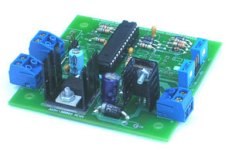
  • solenoid_driver.jpg
    solenoid_driver.jpg
    16.2 KB · Views: 179
   / Proportional Electrohydraulic Systems??
  • Thread Starter
#18  
The trick is getting the pot on the joy stick to control the current. The pots are far too small to handle that current directly. The low level of energy in the joystick must be converted to a high level for the valve.

You're right. The Otto switches run at 32mA, with a 40mA max. I'm actually going to stick with the mechanical joystick I have now, I'm just going to have a custom grip made with the Hall Effect proportional switches to control the featherable circuits I'd like to add, and the one reversible on/off circuit for the blower/broom/auger.

I have not seen (does not mean there isn't one) a card that takes an analog voltage from a joystick and will drive a solenoid proportionally. There is probably not much call for that since most applications require other features so the designer accomplishes the PWM in the uP. Our system also controls a salt spreader and heads up display as well as 4 PWM outputs and a float solenoid. It has to read vehicle speed as well.

Maybe it could control the missile lock I've been wanting too...???!! Do you know of a source for these?? Actually, I think I just found one........

Scorpion Technologies LTD. - Driver Cards

Would that work??

If you want a bi-directional control, I assume you do, you would need to provide a plus and minus power supply to the joystick. Then you could get, say +10 to -10 with 0 at center. A linear amplifier that could accept a +/- 10 volt input and drive the high current +/- 12 volts to the valve would work. There should be some amps like that around.

I do, for sure. The Otto switches look to run from +0.5V to +4.5V.

Scorpion is actually quite close to wear I live, so I think they'll be a good resource.

Really appreciate all the help here.

-Jer.
 
   / Proportional Electrohydraulic Systems?? #19  
Jer
.,

I think one problem you may run into that will be a showstopper is that most of these advanced systems are designed for closed-center hydraulic systems with variable displacement pumps. Your tractor has a open-center system with a fixed displacement pump.
 
   / Proportional Electrohydraulic Systems?? #20  
If you want to do it electronically you'll want a servo valve. The valves I've seen in 12V flavors usually require 1/2 to 1 amp for full flow.

The trick is getting the pot on the joy stick to control the current. The pots are far too small to handle that current directly. The low level of energy in the joystick must be converted to a high level for the valve.

PWM is the most common method because it is very efficient and does not generate much heat like a linear amplifier would.

Most designs today use a processor to accomplish this. The processor output drives an FET (field effect transistor) that switches the 12 volts on/off to the valve. This happens at some higher frequency. The longer the on time the more current flows in the valve. The inductance of the valve filters the frequency to a DC level.

This can be done without a processor. It still requires circuit design. A ramp generator and comparator can convert the joystick to a PWM also.

I have not seen (does not mean there isn't one) a card that takes an analog voltage from a joystick and will drive a solenoid proportionally. There is probably not much call for that since most applications require other features so the designer accomplishes the PWM in the uP. Our system also controls a salt spreader and heads up display as well as 4 PWM outputs and a float solenoid. It has to read vehicle speed as well.

If you want a bi-directional control, I assume you do, you would need to provide a plus and minus power supply to the joystick. Then you could get, say +10 to -10 with 0 at center. A linear amplifier that could accept a +/- 10 volt input and drive the high current +/- 12 volts to the valve would work. There should be some amps like that around.

Our system requires the operator to press a "shoot" button on the stick when moving the stick. That enables the blocking solenoid valve to feed the servo valve. Without that the servo valve will tend to creep when at zero due to small offsets in the circuit and valve. This could be adjusted to zero but it will change with temperature. A blocking valve is safest. Also, if the servo valve spool sticks, as mentioned above, releasing the button on the stick drops the blocking valve and stops motion.

The best approach may be to try to scavange something from an existing machine. That probably isn't so easy either.

I hope this helps a bit.

What is the price and models of the valves you are using? I just did some searching on servo valves. and I was constantly seeing them priced at over $1000 each.
 

Marketplace Items

2025 GPS Equipment Trailer (A56859)
2025 GPS Equipment...
2021 Club Car Carryall 500 Electric Utility Cart (A59228)
2021 Club Car...
UNUSED FUTURE 32" HYD TILTING BUCKET (A52706)
UNUSED FUTURE 32"...
2007 FELLA SM350 3 PT DISC MOWER (A55315)
2007 FELLA SM350 3...
CATERPILLAR 306 CR EXCAVATOR (A60429)
CATERPILLAR 306 CR...
2020 DRAGON ESP 150BBL ALUMINUM (A58214)
2020 DRAGON ESP...
 
Top