Question about disassembling the accumulator

   / Question about disassembling the accumulator #1  

MikeOConnor

Silver Member
Joined
Dec 16, 2002
Messages
173
Location
Western Wisconsin
Tractor
Two Power-Trac 1850s (preferred for mowing and grapple-bucket clearing type work on really steep hills). Kubota M680 for snowblowing, grading, bucket.
Hi gang,

I'm fixing blown seals in my accumulator today and would normally call Terry about this one -- but it's Saturday and they're not around.

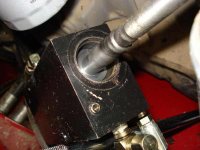
I've attached a photo of where I'm at -- I've removed the big spring and the seal fitting. What you're looking at is the piston. Which doesn't budge when I pull on it.

Hence my question for somebody who's pulled this unit apart. Should I just pull harder, or should I be relieving hydraulic pressure, or is there a retaining nut I should be removing, or... what?

No biggie -- I can ask Terry on Monday, just thought I'd see if anybody's got the word to the wise today.
 

Attachments

  • AccumulatorPiston.jpg
    AccumulatorPiston.jpg
    23.8 KB · Views: 222
   / Question about disassembling the accumulator #2  
I did not know that PT's had accumulators. It looks different than most accumulators that I have seen. What part of the circuit is it used? Accumulators store the hydraulis oil under pressure until it is needed. In some accumulators, there is a large spring, some have a diaphragm and in others, there is a nitrogen filled bladder. I would be very careful about taking that unit apart. It may have to be put in a jig, so when you release the bolts, the jig will allow the unit to seperate slowly. Let us know how this works out , and take pictures of the parts.
 
Last edited:
   / Question about disassembling the accumulator #3  
I forgot to add that the fluid usually goes in one fitting, and comes out the same fitting. If that is just a plunger, I would think that you have to open the source of the fluid to relieve suction. If this is true, you will not be able to pull the plunger out, unless something is defective. About the only thing other than leaking that could go wrong on an accumulator is the nitrogen bladder burst, or the spring collapses .
 
   / Question about disassembling the accumulator
  • Thread Starter
#4  
The rain's moved in, so I'm off the Other Tractor (Kubota) for a while.

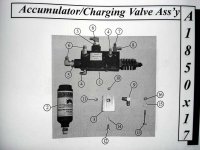
Yep, it's really an accumulator. Here's the next picture -- I shot a photo of a page out of the manual.
 

Attachments

  • AccumulatorManual.jpg
    AccumulatorManual.jpg
    57.1 KB · Views: 198
   / Question about disassembling the accumulator
  • Thread Starter
#5  
You're right, it's got a huge spring. Here's a picture of it before I've done anything (except unbolt it from the side of the PT).
 

Attachments

  • Accumulator-GettingStarted.jpg
    Accumulator-GettingStarted.jpg
    46.4 KB · Views: 198
   / Question about disassembling the accumulator
  • Thread Starter
#6  
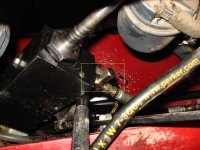
And here's the next picture. I've highlighted a little nipple fitting. It's a lot like the one that we use to bleed the air out of the hydraulic system after we've replaced the filter, but this one is on the bottom of the accumulator.

I'm starting to think that opening this up would release the suction in the accumulator and I could pull that piston out. Whatcha think?
 

Attachments

  • Accumulator-Nipple.jpg
    Accumulator-Nipple.jpg
    46.5 KB · Views: 254
   / Question about disassembling the accumulator #7  
What does your manual call item # 2 in the picture? Do you know what your accumulator is used for. Is it used to charge the tram pump, or to activate the hyd brakes?

That fitting that you discribe, sounds like the fitting used to test the pressure on the charge circuit.
 
   / Question about disassembling the accumulator
  • Thread Starter
#8  
They call #2 "Accumulator"... I'm not messing with that, I'm fooling around with the gizmo up at the top of the page, they call that the "Charging Valve".

Beats the heck out of me where this thing is in the circuit. The !@#$%^!!! manual is completely unhelpful -- just page after page like this one with terrible photos of components, with parts lists underneath. Don't get me started...

Does anybody have a hydraulic diagram of an 1850? I'd love to see one of those.
 
   / Question about disassembling the accumulator #9  
MikeOConnor said:
I'm starting to think that opening this up would release the suction in the accumulator and I could pull that piston out. Whatcha think?

I'll defer to the hydraulic gurus on the Forum as to the functions and repair procedures on the accumulator. If it is a nitrogen charged unit, just please be careful :eek: The accumulator may be totally different, but this kinda' brings back memories of near disaster when someone at the track tried to mess with a nitrogen-charged mono-shock. It blew parts under considerable force around the race pits. His sheepish reply was that the unit had no warnings on it :confused:
 
   / Question about disassembling the accumulator #10  
tracdoc said:
I'll defer to the hydraulic gurus on the Forum as to the functions and repair procedures on the accumulator. If it is a nitrogen charged unit, just please be careful :eek: The accumulator may be totally different, but this kinda' brings back memories of near disaster when someone at the track tried to mess with a nitrogen-charged mono-shock. It blew parts under considerable force around the race pits. His sheepish reply was that the unit had no warnings on it :confused:

Item #2 That unit is the accumulator all by itself. The rest of the stuff in the picture is the apparatus that utilizes the stored energy to activate a cylinder, a valve of some kind, or a control rod. You said somethng was leaking. A little or a lot?
 
   / Question about disassembling the accumulator
  • Thread Starter
#11  
J_J said:
Item #2 That unit is the accumulator all by itself. The rest of the stuff in the picture is the apparatus that utilizes the stored energy to activate a cylinder, a valve of some kind, or a control rod. You said somethng was leaking. A little or a lot?

I'd put it in the middle of that "a little" to "a lot" spectrum. Introducing a new term, I'd call it "mop-able". I isolated the leak to the charging pump, talked to Terry about it, further isolated it to the pump itself rather than the little nipple fitting, and he sent me a rebuild kit for the valve assembly. The conversation went like this;

Terry; "the oil appears on the nipple?"

Mikey; "nope, it's showing up on the spring on the valve."

Terry; "Ah, you've blown the seals in valve, I'll get a rebuild kit to you on UPS."

So I think this happens with some regularity.

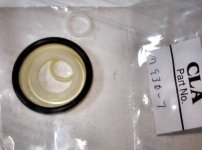
I've put a picture of the kit on this post as an attachment -- the two biggest circles (black, and white) are O-rings, the next biggest is a seal, and the little ones are all O-rings.

Terry described what to do. He cautioned me to measure where the spring-retention nuts were BEFORE I took them off, so I could get them back in the right place -- they control the pressure. I imagine the "right" way to do this is put some kinda pressure meter on that nipple fitting, but he said "just put the nuts back where they were, you'll get within 100 pounds." <grin> A guy after my own heart.
 

Attachments

  • AccumulatorRebuildKit.jpg
    AccumulatorRebuildKit.jpg
    27.3 KB · Views: 161
   / Question about disassembling the accumulator #12  
Mike, There is a correct pressuue for the charge pump, and he should have told you, but yes the number of threads showing on the stud after you have tighten them is a good start. Your book should say or maybe not what the correct pressure is. I believe this unit is the unit that charges the variable speed transmission pump. I believe it is in the 200 to 300 psi range.
 
   / Question about disassembling the accumulator #13  
I note you have an 1850. The 1850 (and the 1845) use an accumulator in the emergency brake system.
 
   / Question about disassembling the accumulator #14  
J_J said:
Mike, There is a correct pressuue for the charge pump, and he should have told you, but yes the number of threads showing on the stud after you have tighten them is a good start. Your book should say or maybe not what the correct pressure is. I believe this unit is the unit that charges the variable speed transmission pump. I believe it is in the 200 to 300 psi range.
This link may give you information on the correct charge pressure.
http://www.braketender.com/accumulators.htm
 
   / Question about disassembling the accumulator #15  
Bob, You are right on. You are the only that have said this is the brake tender unit. Now, I see the purpose of the large spring. The charging pump I had mention in an earlier post has nothing to do with this circuit. I don't think the accumulator in this circuit is the problem either, but you should bleed off the pressure before working on the unit. The tender unit apparently is leaking. When and if you get it broken down, please post a picture of the tender unit
 
   / Question about disassembling the accumulator
  • Thread Starter
#16  
Yikes. 'Fella gets a project done, gets distracted with other stuff and never finishes off the thread. Sorry about that.

Here's how things wound up...

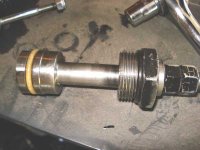
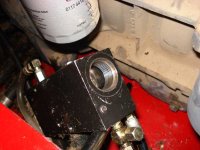
I talked to Terry on Monday -- "pulling harder" was indeed the answer. I wound up having to apply a fair amount of leverage, but evenutally it came out. The pictures of the valve and the piston show the two halves. I kinda reassembled the piston so's to get something (that big fitting on the right) to apply leverage to. See that white O-ring on the left side of the piston? That was a complete pain to replace -- getting the old one off wasn't bad, but putting the new one on was beyond me. I finally had to take the thing into Big Bruce the Mechanic at the implement store and have him pop it on with his Crusher Hands.

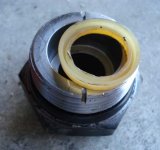
Third picture shows the seal that was probably the one that was actually leaking. Pretty amazing that it would fail, given that I've only got a couple hundred hours on the machine. But hey...

Put everything back together, fired it up, all good. Thanks for the suggestions gang -- sorry about the long delay in this followup post.
 

Attachments

  • Valve - piston removed.jpg
    Valve - piston removed.jpg
    25.6 KB · Views: 187
  • Piston.jpg
    Piston.jpg
    24.3 KB · Views: 165
  • Seal.jpg
    Seal.jpg
    21.7 KB · Views: 170
   / Question about disassembling the accumulator #17  
Mike , An old trick of mine is to put the o-ring in some warm hydraulic fluid for about 15 min, then you should be able to just roll the o-ring right on. A sandwich bag works good for this, as you don't get hydraulic fluid all over you hands.
 
   / Question about disassembling the accumulator
  • Thread Starter
#18  
I've never had trouble with an O-ring before -- but that white one isn't stretchy rubber, it's more like plastic. Very little "give" at all. Does the warm hydraulic fluid soften it up?
 

Tractor & Equipment Auctions

INTERNATIONAL FLAT BED TRUCK (A52707)
INTERNATIONAL FLAT...
2021 Chevrolet Silverado 1500 4x4 Crew Cab Pickup Truck (A59230)
2021 Chevrolet...
Pace American MW8516TA2 T/A Enclosed Concession Trailer (A56857)
Pace American...
Morgan 26ft Box Truck Body (A59228)
Morgan 26ft Box...
2021 Ford F350 XL (A57148)
2021 Ford F350 XL...
PNEUMATIC GREASE UNIT (A58214)
PNEUMATIC GREASE...
 
Top