Question for haymakers

   / Question for haymakers #21  
Can someone exlpain the benefit of large squares? The only time I see them around here is the occasional truckload on the interstate, so I'm not familiar. One of the benefits of big rounds is being able to store them outside. Other than stackability for people with the barn space, I can't think of any benefit of the large squares. They sure look nice, but that only goes so far. :)

Easier to handle and transport, isn't a "wide load".

Better stacking in a shed or barn.

Can be fed in slices like a small square, doesn't require special equipment to break the bale down or unroll it for TMR mixers.

Less waste at the feeder since the whole bales doesn't have to be fed.

Better leaf retention.

Higher capacity baling.

I am sure there are more.

I don't buy into the thought of storing round hay outside, any hay worth baling is worth storing under cover.
 
   / Question for haymakers #22  
Better recalculate your math. :laughing:

After making and using big squares I hate to even think about using rounds. To me round bales are almost as primitive as small squares.

Yah, you're probably right.. I should have considered $100,000+ for a new, big Square baler and $140,000+ for a new, 150hp 4x4 tractor with loader!

Likely comes out at 6X...

And if you get really serious about big squares - then you need a telehandler and a self-propelled bale wagon.

Hate to guess what those might run...

But -- if you're cutting 1,500 acres of irrigated alfalfa for export to Japan -- well, it's just "economy of scale"!! :D

AKfish
 
   / Question for haymakers
  • Thread Starter
#23  
I am a small operation.

I buy the large bales and handle them with a L5030HSTC. Hay spike on the front to move them, then bucket with grapple jaw to "bite" a chunk off and then feed. Much easier to feed from the AC cab when its 100+ in the summer, and hip deep snow in the winter.
 
   / Question for haymakers #24  
I don't buy into the thought of storing round hay outside, any hay worth baling is worth storing under cover.

Maybe it's a regional thing. It's very rare for folks around here to have storage space to store hundreds of round bales. That's the whole point of round bales.
 
   / Question for haymakers #25  
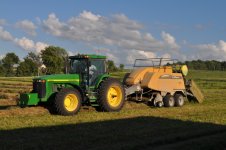
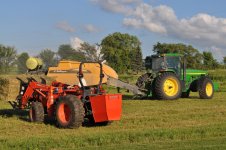
Here is what the guy uses to bale my hay. Tractor is 180hp JD8200. Glad this crop turned out OK. I lost the entire first crop because we only had 7 dry days in the month of June :mad:.
 

Attachments

  • DSC_0522 baler.jpg
    DSC_0522 baler.jpg
    252.4 KB · Views: 150
  • DSC_0534 haying.jpg
    DSC_0534 haying.jpg
    230 KB · Views: 152
   / Question for haymakers #26  
Sorry about your hay crop.

What is the tank on the back of the baler for? I've seen them going down the road, but never in operation.

Thanks.
 
   / Question for haymakers #27  
Maybe it's a regional thing. It's very rare for folks around here to have storage space to store hundreds of round bales. That's the whole point of round bales.

The whole point?

Sorry, I just can't get past wasting that much valuable feed.
 
   / Question for haymakers #28  
The whole point?

Sorry, I just can't get past wasting that much valuable feed.

Yes, the whole point that I'm aware of?
Maybe you don't feed or store all that much hay. Or, maybe you have more storage space than most people. I stole this pic from another website. How would you store this much hay?
 
   / Question for haymakers #29  
Sorry, forgot picture.
 

Attachments

  • 071.jpg
    071.jpg
    91.3 KB · Views: 183
   / Question for haymakers #31  
I wanna see that shed. :D No doubt the big squares stack much better, though big rounds stack pretty well if stacked properly. I just don't know of anyone with enough room to store that much hay. The economics have to play a part as well. The difference in equipment to make large rounds is enormously different than that needed for large squares. Maybe they're more geared towards horse people, who aren't feeding nearly the hay that cattle farmers are.
 
   / Question for haymakers #32  
Can someone exlpain the benefit of large squares? The only time I see them around here is the occasional truckload on the interstate, so I'm not familiar. One of the benefits of big rounds is being able to store them outside. Other than stackability for people with the barn space, I can't think of any benefit of the large squares. They sure look nice, but that only goes so far. :)

The benefit for us is that they are much easier to sell as the majority of our hay goes to the states and trucking is a major issue . Last winter is was getting more for 800lb squares to the states than for 1200lb rounds locally . A lot of the dealers we trade with won't even buy a round bale at any price .
If i was feeding my own stock then i would use round as the inputs are far less and as said they don't need to be under cover . Last 3 years have had 5-600 rounds in single lines and found very little waste , Winter is'nt a problem as it's froze but wet springs are when the damage starts but i have 100 left now and theres maybe 6 inches of spoil around the outside after a year but nobody's complaining as it was very nice stuff so horse guys are buying them steadily !
 
   / Question for haymakers #33  
Sorry about your hay crop.

What is the tank on the back of the baler for? I've seen them going down the road, but never in operation.

Thanks.

The tank holds an acid solution that can be applied when hay has to much moisture. The solution is supposed to stop mold and decomposition.
 
   / Question for haymakers #36  
Some people do indeed store and feed that much hay. You don't feed thousands of cattle all winter with 50 round bales.

Most cow-calf operators and large acreage range feeders (yearling steers) feed big round bales. They're easier and cheaper to utilize beginning from baling in the field to feeding the front end of the cow compared to big squares.

Large dairy cattle operators and international hay exporters predominately utilize big square bales. Larger horse stables also use big squares.

That said, it takes a specialized niche to make big squares profitable. Most small scale guys can't make it "pencil out"... - IMO.

AKfish
 
   / Question for haymakers
  • Thread Starter
#37  
MMagis,

Guy down the road apiece has quite few hay sheds. The hay in that pic would not fill one of them.

Everyone around here stores their hay under cover, round or square. My "next door" neighbor (about a mile away) runs a small operation. He puts up about 200 acres of round bales and stores them 4 high.

We live in one of the smaller counties, about 1500 square miles, 3600 people, and not one traffic light.
 
   / Question for haymakers #38  
MMagis,

Guy down the road apiece has quite few hay sheds. The hay in that pic would not fill one of them.

Everyone around here stores their hay under cover, round or square. My "next door" neighbor (about a mile away) runs a small operation. He puts up about 200 acres of round bales and stores them 4 high.

We live in one of the smaller counties, about 1500 square miles, 3600 people, and not one traffic light.

If you ever have a camera handy, I'd love to see a pic of that, just because it interests me. That's something we don't see around here. We have a lot of row crops around, and small (30-100 head) cow/calf operations. Nothing real big.
 
   / Question for haymakers #39  
Most cow-calf operators and large acreage range feeders (yearling steers) feed big round bales. They're easier and cheaper to utilize beginning from baling in the field to feeding the front end of the cow compared to big squares.

Large dairy cattle operators and international hay exporters predominately utilize big square bales. Larger horse stables also use big squares.

That said, it takes a specialized niche to make big squares profitable. Most small scale guys can't make it "pencil out"... - IMO.

AKfish

Around here cattle operations don't use much hay, Silage (grass, corn, or baleage) is where its at. Don't need a shed for that. Small squares are the most valuable for the horse market but lots of people have gone to the large rounds, don't see many large squares, but we are a little behind.
 

Tractor & Equipment Auctions

2013 Ford F-450 Dump Truck (A59230)
2013 Ford F-450...
7021 (A55851)
7021 (A55851)
2025 GPS Trailers (A56859)
2025 GPS Trailers...
DEUTZ MARATHON 60KW GENERATOR (A58214)
DEUTZ MARATHON...
9ft. Flatbed Truck Body with Gooseneck Connection (A59230)
9ft. Flatbed Truck...
2021 CATERPILLAR 313GC EXCAVATOR (A60429)
2021 CATERPILLAR...
 
Top