Question on ballest for new tractor

   / Question on ballest for new tractor #1  

kcook

Platinum Member
Joined
Apr 30, 2001
Messages
778
Location
MI
Tractor
Cub Lawn Tractor
Looking for any input on getting tires filled or ballest box for a new cut tractor 20 to 26 hp for landscapings, mowing, driveway maintenance and a few other things. Ground is very sandy. Location is Mid lower MI.

KC
 
   / Question on ballest for new tractor #2  
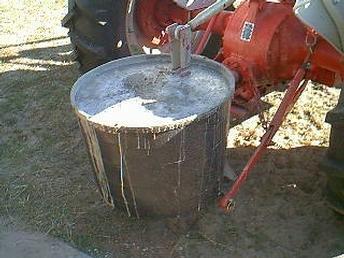
There is a 'Favorite Ballast' thread recently in which SoundGuy showed pictures of an incredibly simple, inexpensive, compact and efficient 3pth ballast. I made one in around 45min and spent 12$ or so.

Unless you need the extra weight all the time, I would lean toward using removable ballast.


Shawn
 
   / Question on ballest for new tractor #3  
I just bought my first tractor and debated the same issue. My backyard, yet to have grass just weeds, is like sandbox sand. I have loaded R4 tires.Driving around in the backyard does leave significant tracks. Once the lawn is in I will be avoiding driving the tractor over that area. The fact that I had decided not to use the tractor for finish mowing around the house helped make my decision. If I was going to use the tractor for finish mowing in the sand I would probably have gone with removable weight. Now out front where the soil is much harder I would not have an issue with the extra weight. I am very much a novice at this tractor think but this is what has been my experience over the past several months.

Eric
 
   / Question on ballest for new tractor #4  
Heck it sounds like you could use a box blade. Buy one and use it for ballast, I did!
 
   / Question on ballest for new tractor #5  
Thanks for the plug! Yep... I can't remember the cost for mine.. but it was 15$ or something like that.. just a surplus cow feed tub, and old drawbar.. some carriage bolts and scrap iron.. and bags of sackcrete.

works great as a counterballance for my FEL on my 1955 Ford 660.
i2442.jpg


Soundguy
 
   / Question on ballest for new tractor #6  
I have a removable box filled with concrete. In the sandy soil, you will leave marks in the ground if you fill the tires. However, the filled tires make a big difference in stability when using the FEL. I did not fill my tires because I use my tractor for finish mowing ( I also remove the FEL). Both are easy to put on and take off and I can still finish mow.
 
   / Question on ballest for new tractor #7  
A box blade is a nice choice if you are not working in tight spaces AND if the box blade you own is a HEAVY blade. 2 problems I see with box blades is that they are typically as wide as your tractor and they stick out about 3' or 4' behind your tractor. . . IF you work in open areas, this presents NO problem. But if you work in tight areas, then a ballast box is much smaller and offers an advantage.

The other issue with weight boxes is they are really heavy if you load them up, that is also true IF you have a quality built heavy box blade, but often a box blade, particularly smaller ones are lightly built to make them less expensive. For ballast when using the FEL, you want as much weight as possible on the back end, given the choice of a 350# box blade or a 400# ballast box, I'd take the ballast box every day. Given the choice between a 500# box blade and a 400# ballast box, I'd take the box blade MOST of the time but not always.

Another option is fluid fill in the tires. Fluid fill in a typical small frame 21hp to 24hp tractor is going to put approximately 175# in each rear tire assuming R4 industrial tires. Turfs will hold more, Ags will hold less. Fluid weight can vary so this is an approximate. I have never seen a CUT where fluid fill ONLY was enough ballast effectively counter balance the FEL capacity. Understand that ballast farther back (on the 3pt hitch) is more effective than ballast in the tires.
 
   / Question on ballest for new tractor #8  
</font><font color="blue" class="small">( I have never seen a CUT where fluid fill ONLY was enough ballast effectively counter balance the FEL capacity )</font>

I agree.. On my ford 660 w/ 1 arm front end loader.. I have fairly large r-1 tires.. 12.4-28's they are filled with cacl, and it was not enough weight to even drive around with the laoder empty /forums/images/graemlins/shocked.gif

The 600?# eweight box on the back made the tractor 'useable'.

Soundguy
 
   / Question on ballest for new tractor #9  
Interesting side note on filled tires:

We HALF filled the tires on my Dad's 48hp Case on our own in the early 90's. Worked great on the huge agi tires, BUT every time you back up to an implement the tractor gently rocks back and forth as the fluid washes back and forth in the tires for a few seconds....guess we should have put more fluid in, eh?

Sure added stability with the weight sitting so low to the ground.


Shawn
 
   / Question on ballest for new tractor #10  
On my 2210 loaded rear tires is enough for light loader work -- anything more than that, I get out the ballast box which I've filled with concrete. I almost joined the upsidedown club and am doing everything now to avoid membership! /forums/images/graemlins/tongue.gif
 
   / Question on ballest for new tractor #11  
Good points Bob! One of the reasons I chose the 72" heavy BB was the 74" total rear tire width and 610#!
 
   / Question on ballest for new tractor #12  
I need both on my DX33. With only filled tires, the rear end will instantly lift off the ground when digging into a pile of dirt. With filled tires and a 400+ lb BB I still have to be cautious not to stop quick with a loaded bucket or lower the bucket to fast. Also remember when using an implement for ballast, it adds 1.5 times the weight of the implement to the rear axle because of the leverage of the lift arms and length of the implement.
 
   / Question on ballest for new tractor #13  
<font color="red"> I need both on my DX33. With only filled tires, the rear end will instantly lift off the ground when digging into a pile of dirt. With filled tires and a 400+ lb BB I still have to be cautious not to stop quick with a loaded bucket or lower the bucket to fast. </font>

Boomerang1, the 14LX loader you have is an exceptional loader for a mid-frame CUT. I find the same thing applies to my 12LA on my small frame CUT. Both are CNH products and really are beasts for their size class. My manual states I need wheel weights + ballast box -or- fluid fill + ballast box. When the loader is well matched to the tractor, there is no question you need both. CNH tractors are fairly heavy, not as heavy as some, but heavier than most, and still they need a lot of ballast to balance the FEL power.

While I am not sure about CUT weight distribution, I recently dug up information that for AG tractors that are 4wd, the ideal weight distribution is 60% on the FRONT axle, and 40% on the rear. For FEL work, that is far from ideal. But as I look at most CUTS, I wonder if that is pretty close to normal. Compare a modern CUT to a Ford 8N or similar older AG tractor and it becomes obvious that the weight distribution cannot be the same. The old iron had huge rear wheels compared to similar HP modern CUTs for traction, our new machines have 4wd for traction and the % difference between the front and rear tire sizes is much smaller on a modern CUT than on an older tractor. I think what it boils down to is that I belive small tractors are inherantly front heavy due to their 4wd design, and regardless of if you have a lightweight B Kubota or a heavy Mahindra, you need proper ballast to balance your load.
 
   / Question on ballest for new tractor #14  
Been reading this thread with great interest.

I have a new B7510HST with LA302 FEL.

Been using the Bota lately to move sand around my place to fill in electrical trenches (about 1100 ft of trench total).

I had about 10 CY of sand dumped along side the driveway.

No rear ballast, no filled tires. Just my 200 lbs in the seat.

Not knowing any better, I just scoop up a heaping bucket of sand and trundle away in low gear with the bucket raised about 3 feet. My place is pretty level. But it was once an almond orchard (only 28 trees left now) and the ground is pretty rough, especially where trees once stood.

So far I've had no problem keeping the rear wheels on the ground, even when going up and down small slopes where the main tractor road cuts across the orchard. Looks to me like the tractor and FEL are very well matched and balanced, at least for the type of service I'm subjecting it to.

Seems to me that what I'm doing with the sand is similar to what landscape guys do with their favorite pulverized materials.
 

Marketplace Items

2017 Chevrolet Tahoe SUV (A55853)
2017 Chevrolet...
2401 (A60432)
2401 (A60432)
2015 DODGE RAM 3500 4X4 CREW CAB PICKUP TRUCK (A59904)
2015 DODGE RAM...
GRID SHAPED BUCKET FOR MINI EXCAVATOR (A58214)
GRID SHAPED BUCKET...
Rainbow Self-Propelled Volume Gun (A53317)
Rainbow...
UNUSED RAYTREE RMA42 HYD AUGER (A60432)
UNUSED RAYTREE...
 
Top