question on going from conventional oil to synthetic on smaller engines

   / question on going from conventional oil to synthetic on smaller engines #41  
I run it in my compressor pump also.
I didn't even know this was a thing, my compressor used supertech for 20 years....
 
   / question on going from conventional oil to synthetic on smaller engines #42  
5W30 means it's the same as 5 viscosity when it's cold and the 30 means it's the same viscosity (thickness) as 30 when it gets hot.
Jet engines can ONLY run synthetic as the normal oil operating temp is around 500 F.
I know that.
That's why I posted it.
 
   / question on going from conventional oil to synthetic on smaller engines #43  
Actually the opposite.

At the rating temperatures the "5" is molasses while the "40" is pretty darn thin.

The 5 is assigned based on the lowest temperature they think a reasonably designed engine could pump oil to bearings. 5W is -30°C.
No way.
Then 120 weight gear oil would be thinner than water.
 
   / question on going from conventional oil to synthetic on smaller engines #44  
Grumpycat has it right. ALL oil gets thicker as temperatures decrease. A 5 (W)inter oil just thickens less than a 10 (W)inter oil at the rated temperature.
 
   / question on going from conventional oil to synthetic on smaller engines #45  
very helpful discussion
something we all share, changing oil

when I had my farm in NC, I had 22 engines to maintain.
Quite a shelf of odd ball oil, some old 40 weight from a marine diesel.
Used that in oil squirt can. And then about six other oil weights.
I always keep a spare can, so those spares mount up over the years.

then over the years ratings have sure changed.
The V10 in my motorhome started out with one recommendation, then about ten years later they
changed the oil spec, a little.
Too bad the spec is the Motorcraft blend that is all the way at the bottom of that chart. :rolleyes:

I started using Mobil 1 when it came out, then when synthetic oils got so good that even Walmart's stuff is good,
why spend more? Unless you need the very highest performance, why buy it?
it's like putting premium in an engine designed to run on 87 octane. If same additive pack, just wasting money.

I sent this to my friend who just bought a used Ecoboost to pull an rv trailer. Sounds like shorter oil intervals would make sense
on such a pumped up engine.

not all of us need the best. We aren't towing, we aren't racing, we aren't starting in -30F.
Most of us need "very good" at a good price. today's very good oil is yesterday's racing oil, the bar has been raised.
But it's up to us to change the oil.
I think for most folks, once a year makes a lot of sense, right before winter in the North.

biggest problem with oil is you never knew what was in it. Not like ingredients on a cake mix.
without industry standard performance specs, gets back to flashy marketing labels and promises.
 
   / question on going from conventional oil to synthetic on smaller engines
  • Thread Starter
#46  
Thanks for everyone's feedback and info. I have 2 Pennzoil 30W 5 qt containers; one still not opened and the other one 5/8 full...I guess I will stick with conventional until I consume these
Wow so many answers. Let me give you the bad news, your oil sucks. Now the good news, you switch from conventional to synthetic and back and forth and mix them it won’t hurt anything. Now for the sales pitch. Save your money changing oil so often and get the best oil you can buy, amsoil. Use it once a year or every 25k in your truck and once a season for off road equipment. Oh and use their two stroke in all your smokers at 100:1 and make all your stuff last longer.
why does it suck ?
 
   / question on going from conventional oil to synthetic on smaller engines #47  
Thanks for everyone's feedback and info. I have 2 Pennzoil 30W 5 qt containers; one still not opened and the other one 5/8 full...I guess I will stick with conventional until I consume these

why does it suck ?
because when he signed up to be a oil reseller for amsoil, he got a brochure that taught him how to sell oil. its almost word for word, what I heard from every amsoil dealer on the planet.

ignore him and move on
 
   / question on going from conventional oil to synthetic on smaller engines #48  
I have been using Mobil one in all my small engines since it first came out. Cost really isn’t a factor since they hold such a small amount. Since those engines are mostly splash lubricated it makes sense. Synthetic will move around in a cold engine easily when first started and warming up. This is when the most wear takes place. I could tell the difference in power and found they idled faster with the same settings. Cylinder walls are always the driest part and the highest friction area, the sooner oil is splashed on them the better.
 
   / question on going from conventional oil to synthetic on smaller engines #49  
Grumpycat has it right. ALL oil gets thicker as temperatures decrease. A 5 (W)inter oil just thickens less than a 10 (W)inter oil at the rated temperature.
When you compare that way, maybe.

Take 5W oil and pour it in a container when it is 0deg out.
Now, take 50W oil and pour it in a container when it is 0deg out. The 50W won't even flow probably, while the 5W will.
When it is 0deg out you don't want 50W in your crankcase because it won't flow through the engine to lubricate.
 
   / question on going from conventional oil to synthetic on smaller engines #50  
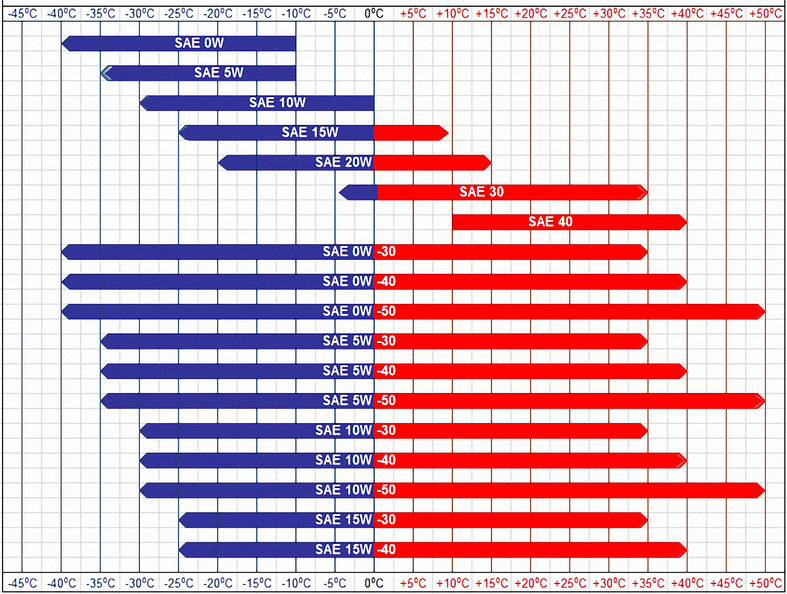
I think it is interesting that the recommended oil for my rv gen, a 4kw air cooled Onan, is a synthetic blend, not full synthetic.
17 dollars a quart for oem Onamax oil. Whooeeeee.
note the 15/40 spec.
recommended oil for my gas motorhome, synthetic blend.
recommended oil for my Volvo, pure synthetic, whatever dealer is using. $125 oil change

It took years and years for Kubota to even think about putting synthetic oil in their engines.
Conventional oil clearly has some advantages.

oil has simply gotten so good, it's like stereo amplifiers. They are better than our ears. You want better sound? Get better
speakers. You want to baby your engine? Change the oil more often.
too bad they don't have a biodegradable oil, even edible.
soybean oil
somehow I don't think the turbo bearings in your Ecoboost truck will like soybean oil unless they make it synthetic...

if you go from conventional to synthetic on older engine, I'd check for drips after a few hours. Pretty sure you will be fine.
I had a 1956 Farmall Super A. It dripped like an English motorcycle normally. Straight 30W or 40W based on temp.
I can't imagine what putting modern synthetic in that
crankcase would do. If you have just rebuilt the engine, maybe.
otherwise some chance of loosening up 50 years of gunk in engine.

when I repowered my Gravely 8199 with a Vanguard 23hp, full syn has been in since beginning.
Uses zero oil. Original Kohler KT19 had worn rings and points to file. It smoked and smelled and
was well past its prime. Plus...4 more hp. 4 more hp transformed the little tractor.
Plus of course the chrome exhaust tip is worth at least one more hp.........
I wanted a modern engine on my older baby tractor.
modern engines usually are engineered for synthetic oil.

it would seem in more and more general applications now, when in doubt,
go with synthetic blend. That's what I would put in an older air cooled vs full synthetic in
modern liquid cooled engine. After break in with conventional oil.
 
   / question on going from conventional oil to synthetic on smaller engines #51  
Lol I have an old JD 212 up north that burns more oil than gas every time I get motivated to crack it open and maybe rebuild it I lose all motivation cause I find other projects. So had some non synthetic 20w-50 lying around from hydrostatic transaxle fluid replacement and I use that instead of 30w its cut the oil consumption by about 1/3rd and still runs good enough for occasional seasonal use.
 
   / question on going from conventional oil to synthetic on smaller engines #52  
When you compare that way, maybe.

Take 5W oil and pour it in a container when it is 0deg out.
Now, take 50W oil and pour it in a container when it is 0deg out. The 50W won't even flow probably, while the 5W will.
When it is 0deg out you don't want 50W in your crankcase because it won't flow through the engine to lubricate.
That's how temperature and viscosity work in oils all right, and it used to be a lot bigger problem before multi-weight oils came on the market. It is exactly why multi-weight oils like 5w-50 were developed.
 
   / question on going from conventional oil to synthetic on smaller engines #53  
When you compare that way, maybe.

Take 5W oil and pour it in a container when it is 0deg out.
Now, take 50W oil and pour it in a container when it is 0deg out. The 50W won't even flow probably, while the 5W will.
When it is 0deg out you don't want 50W in your crankcase because it won't flow through the engine to lubricate.
I didn't compare 5W to 50W. I compared 5W at its rating temperature to 40 not-W at its rating temperature. The 5W is molasses at that temperature.

50W is not 50-weight but an oil which pours down to the same temperature as a 50-weight oil would flow.

50W and 50-weight are totally different measurements. It might be the same oil, it might not.
 
   / question on going from conventional oil to synthetic on smaller engines #54  
I didn't compare 5W to 50W. I compared 5W at its rating temperature to 40 not-W at its rating temperature. The 5W is molasses at that temperature.

50W is not 50-weight but an oil which pours down to the same temperature as a 50-weight oil would flow.

50W and 50-weight are totally different measurements. It might be the same oil, it might not.

Semantics.
Go to the auto parts store ask for a case of 50weight oil...guess what they will give you. It's in the lexicon now.
 
   / question on going from conventional oil to synthetic on smaller engines #55  
Semantics.
Go to the auto parts store ask for a case of 50weight oil...guess what they will give you. It's in the lexicon now.
Language is a mathematical equation. If you use the wrong variable names you get the wrong answer.

If you ask for 50 weight and get 50W then the monkey behind the counter lacks the intellect or understanding of his job.
 
   / question on going from conventional oil to synthetic on smaller engines #56  
Language is a mathematical equation. If you use the wrong variable names you get the wrong answer.

If you ask for 50 weight and get 50W then the monkey behind the counter lacks the intellect or understanding of his job.
What does the W stand for in 50W?
 
   / question on going from conventional oil to synthetic on smaller engines #57  
What does the W stand for in 50W?
“Winter” “W” in SAE/API viscosity means the viscosity grade represents the cold temperature the oil flow. As I said earlier 5W is -30°C. Pretty darn cold.

”weight” or “wt” represents operating temperature viscosity.

I posted a link to the reference earlier but here it is again:
 
   / question on going from conventional oil to synthetic on smaller engines #58  
My B&S mower is 31 years old and beside changing the carb film twice and push primer bulb once, has always started on first pull. I put 30 grade conventional oil from whatever I can get my hands on in the spring.

In my 27 years old Tecumseh snow blower, same but 5W30 conventional oil. It starts right away too.
 
   / question on going from conventional oil to synthetic on smaller engines #59  
Synthetic is the way to go. I run Rotella T6 in my F250 and the tractor. In all my small engines I run straight 40W. Of course this is Texas and it gets hot in the summer, and not much use in the winter.
 
   / question on going from conventional oil to synthetic on smaller engines #60  
Synthetic is the way to go. I run Rotella T6 in my F250 and the tractor. In all my small engines I run straight 40W. Of course this is Texas and it gets hot in the summer, and not much use in the winter.
Where do you get "40W"? I've never seen it. Why do you use a winter rated oil in hot Texas?

I have seen "40 weight". That is not the same as 40W.
 

Marketplace Items

GENIE S-60 MANLIFT (A58214)
GENIE S-60 MANLIFT...
2025 Swict 66in Bucket Skid Steer Attachment (A59228)
2025 Swict 66in...
2015 UTILITY VS2RA 53FT REEFER TRAILER (A59905)
2015 UTILITY VS2RA...
2015 Toro Z Master 6000 Series 60in Zero Turn Commercial Mower (A59228)
2015 Toro Z Master...
Kubota M108S (A53317)
2020 PETERBILT 567 (A58214)
2020 PETERBILT 567...
 
Top