Rigid metal frame 50x100 building considerations

   / Rigid metal frame 50x100 building considerations #1  

5030tinkerer

Gold Member
Joined
Dec 27, 2005
Messages
457
Location
Iowa
Tractor
Kubota GL3830/GL5030
I just picked up a de-constructed 50x100 rigid metal frame building. The plans call for a continuous footing. In my area, that means the bottom of the footing 42" deep.

Any ideas on what sort of footing and frost wall I will need? Would the wall tie into my (hopefully) future concrete slab or would the slab just float inside the building?

I was thinking about having the frost wall extend 15" above grade so that the planned 5" slab with 2" of rigid foam underneath would leave me with 8" concrete curbs.

Any and all thoughts are most appreciated. I am also considering stacked concrete block filled with concrete and reinforced with rebar since I don't own any concrete forms. Crazy?
 
   / Rigid metal frame 50x100 building considerations #2  
i'd pay an engineer to design a proper foundation for you. metal building foundation sizes are usually driven by wind uplift forces. you need to make sure you have enough concrete to provide ballast with an appropriate safety factor to resist the uplift that is going to be developed.

also, if footings have to bear at -42" to avoid frost heave in your area, you're going to need a pretty substantial amount of rebar, just to meet the minimal code required cross sectional areas.

-matt
 
   / Rigid metal frame 50x100 building considerations #3  
I really can't help much, but I did want to mention, that when my Dad built a 60x75 Bulter Farmstead metal building, years ago, they actually dug a trench between the major support columns and tied them together between the 60 foot width(underground) with cables. This may be a common practice, but I thought I would mention it.
 
   / Rigid metal frame 50x100 building considerations
  • Thread Starter
#4  
I appreciate the mention on upforce requirements - I hadn't thought of that and will heed the advice. Still, if anyone has already been down this road, I'd love to hear what you were told.

The locals tend to use rebar tied together in trench and then set in concrete between the major support posts, set about 12" below grade. I'm not sure why that is magically not subject to frost heave, though. I really like the idea of cables taking care of this.

I may dig a trench at footing level and just connect things up both at the top and the bottom. Thoughts?
 
   / Rigid metal frame 50x100 building considerations #5  
Put up a 100'x125' but I went with a 100% cement slab. The beams are held in place with bolts set in the concrete. All the walls are further strengthened / squared up with cables and turn buckles.

If my memory serves me right the contractor set all the footings holes first and then did a one pour for the slab and footings all at once. 30' x 100" of the building was set for future so I have no building on that part of the slab, just the bolts still popping up from the slab.

No matter what, I think you will need to have an engineer involved with proper stamps per your local codes.
 
   / Rigid metal frame 50x100 building considerations
  • Thread Starter
#6  
Interesting that your building was able to simply have posts. At its last building site, there was a perimeter frost wall around the entire perimeter. If I could get away without that, using 2' or whatever diameter holes 48" down instead, the money saved in trenching and frost walls could easily go against a slab. I would love to have the whole interior benefit from a slab, but had been concerned about the ability to financially swing it.

The monolithic pour of a 5" 4000psi slab (especially if I opted for a thickened edge) and piers would hold the posts nicely, I would think.
 
   / Rigid metal frame 50x100 building considerations #7  
I put up a rigid frame building in southestern, MN. Its foundation was called a "grade beam" with footers. It was 60X50 deep (i.e., each section was 25 deep and there were 6 footers plus footers (2) for the door. Between the footers was a grade beam only about 1 foot deep. The slab was poured with the footers and grade beam. There were no real problems with it (I kept it heated), but a large indoor tennis club in the area was done similarly, except the main slab had an expansion jount all around and between it and the grade beam. It was truly floating and would be something to consider. After almost 30 years, the floor in my building has no new cracks (one appeared in the first year near the door opening). A floating slab may have avoided that crack.

John
 
   / Rigid metal frame 50x100 building considerations
  • Thread Starter
#8  
I don't plan to keep this building heated except when in use. I like the idea of a floating slab, but am concerned that I need to tie the posts to each other. One way to do this would be to go ahead with the aforementioned cables and then let the slab float just anyway, but am curious if there are better methods.
 
   / Rigid metal frame 50x100 building considerations #9  
Of course the posts are tied together. There is rebar in the grade beam, and above ground, you have the metal siding and "wind" bracing (i.e., crossing bracing). In my building with only 2 sections, only one section needs to be cross braced.

John
 
   / Rigid metal frame 50x100 building considerations #10  
Is this a clear span?

I think floating slab is good idea, economically, just realize that it is not perfect and expect to have a wild crack or door that doesn't work perfect in the winter.
 
   / Rigid metal frame 50x100 building considerations #11  
I've built several steel buildings of similar size. The cost to have an engineer design footings is well worth it. S/he will consider uplift, wind loads, local soil bearing, etc.
That being said, a trench footing 42 " deep with standard piers (the bldg manufacturer might have 'stock' pier details) can be dug. No forms needed if your soils are sufficiently stiff. Just dig with appropriate size bucket.
Rebar cages at piers and in foundation walls should be engineered for your site.
Perimeter foundation insulation is adequate for the floor. Just be sure to use isolation joints at columns. The floor can then float.

Good luck. Share photos when you build.
 
   / Rigid metal frame 50x100 building considerations
  • Thread Starter
#12  
The building is a clear span, yes. I recognize that the posts will be tied to each other on the common walls if I used a conventional footing or near grade beam system. The question is how to best tie the posts across the span from each other to each other when using a floating slab. The present thought is that cables are the best way to do this, but you guys have convinced me that I need to engage an engineer. Of course, the other option would be to tie the slab to the footings, thus tying the posts to each other across the span and really everywhere, but then the issue becomes what prevents the slab from heaving if the building isn't heated 24/7.

Merely digging a trench of the appropriate width using the proper width bucket seems fine, but a possible waste of concrete. I had envisioned having, say, a 24" wide by 8" tall footing at 42" deep and then maybe a 6" wide frost wall going up from there to just above grade for the posts to rest on.

If I take, say, a 24" wide bucket and dig a trench 42" down and don't use forms, I am stuck with a 24" wide frost wall footing - likely excessive in my application. Of course, I could use a 12" wide bucket, but that still results in the same issue (albeit to a less extent) and, at that point, I begin to be concerned that the footing wouldn't be wide enough to bear the weight of the structure without sinking.
 
   / Rigid metal frame 50x100 building considerations #13  
The building is a clear span, yes. I recognize that the posts will be tied to each other on the common walls if I used a conventional footing or near grade beam system. The question is how to best tie the posts across the span from each other to each other when using a floating slab. The present thought is that cables are the best way to do this, but you guys have convinced me that I need to engage an engineer. Of course, the other option would be to tie the slab to the footings, thus tying the posts to each other across the span and really everywhere, but then the issue becomes what prevents the slab from heaving if the building isn't heated 24/7.

Why would they need to be tied together?


Merely digging a trench of the appropriate width using the proper width bucket seems fine, but a possible waste of concrete. I had envisioned having, say, a 24" wide by 8" tall footing at 42" deep and then maybe a 6" wide frost wall going up from there to just above grade for the posts to rest on.

If I take, say, a 24" wide bucket and dig a trench 42" down and don't use forms, I am stuck with a 24" wide frost wall footing - likely excessive in my application. Of course, I could use a 12" wide bucket, but that still results in the same issue (albeit to a less extent) and, at that point, I begin to be concerned that the footing wouldn't be wide enough to bear the weight of the structure without sinking.

You have to balance the waste of concrete vs the waste of backhoe time and form rent .
 
   / Rigid metal frame 50x100 building considerations #14  
5030,

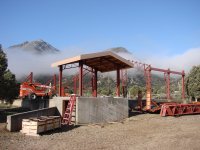
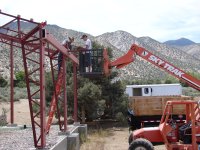
I'm building a 48X60 clear span steel frame house with a 12X60 foot expander. It will have a 700 sq ft porch, a 36 x 28 shop/garage and a two bedroom 2 bath home.

We poured square footings that went about 2 feet below the frost line of 18". Each post has one of these footings and the land is sloped, so, in the front, the footings are abut 5 feet high and in the back, right at ground level.

Then a stem wall section was poured between each footing. The forms for the footings had steel sticking out to tie into the stem walls.

Finally, the slab will be poured with radiant heating throughout that is tied to a grid of bar on about 9" centers.

Here are a couple of pix.

These pix are a bit old now. We have the roof on but no walls yet.
 

Attachments

  • DSC09531.JPG
    DSC09531.JPG
    899.5 KB · Views: 424
  • DSC00485.JPG
    DSC00485.JPG
    881.8 KB · Views: 321
   / Rigid metal frame 50x100 building considerations #15  
5030,

I'm not a casual as some about just digging a trench for the footing pour. We excavated the area to the level of the bottom of the footings. Then we compacted and watered till we could not get further compaction with a vibrator and a jumping jack. Next the form boxes were set and the rebar installed. After these were poured and stripped we formed the stem walls and poured them. Then we backfilled and compacted around the outside and filled the inside with 1 1/2 inch rock and compacted as we went.

Our elevation is 4900 feet and we are on decomposing granite.

The slab will not be floating but will be tied directly to the footings.

If you are worried about heaving in your slab, you might consider void forming it. This leaves suporting stem walls under the slab with compressable temporary cardboard or insulation to pour on top of between the underneath supporting walls. It's an excellent method for expansive soils.
 
   / Rigid metal frame 50x100 building considerations
  • Thread Starter
#16  
5030,
If you are worried about heaving in your slab, you might consider void forming it. This leaves suporting stem walls under the slab with compressable temporary cardboard or insulation to pour on top of between the underneath supporting walls. It's an excellent method for expansive soils.

I am not following what you are describing. Could you elaborate? Amazingly cool images, btw. Thanks for sharing.
 
   / Rigid metal frame 50x100 building considerations #17  
5030,

I'll try to describe it better.

In void forming there is a perimeter footing and a grid of footings under the slab area. The slab is supported by the grid of footings or stem walls under the slab. These might be set up at about 4' on center, for instance, and are deep enough to prevent them from heaving. Between the stem walls under the lab, where the slab would normally sit on the ground, thick cardboard is laid down first, about 2" thick. Then the slab is poured and rests on the cardboard between the stem walls and on the stem walls directly. No cardboard is placed on top of the stem walls.

Over time the cardboard deteriorates and leaves voids. Then when the ground swells there is a place for it to move into instead of lifting the slab.

This design could also be used with underslab insulation that would eliminate the need for the insulation to support the slab as it would do if there was no other means of support inside of the perimeter.

I deal with insulated slabs all the time and I'm concerned about supporting a slab with insulation. I won't do it on my house with a concrete slab and radiant heating. Even though many say that underslab insulation brings a benefit.


John
 

Marketplace Items

32in. Tilt Grading Bucket Mini Excavator Attachment (A59228)
32in. Tilt Grading...
500 BBL FRAC TANK (A58214)
500 BBL FRAC TANK...
Freighliner Tender Truck (A61306)
Freighliner Tender...
Volvo EC220EL (A60462)
SWICT 66" SKID STEER BUCKET (A60430)
SWICT 66" SKID...
PALLET OF 15 4X8 GROUND PROTECTION MATS (A58214)
PALLET OF 15 4X8...
 
Top