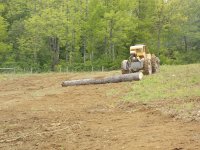
I hate to be a naysayer, but to me, that was way over aggressive, for what needed to be done. That appears to be a pasture, and if it is the only pasture she has, it will probably be June, before she can turn those horses out on it. If she has another pasture so she can turn them out, until this one heals, you'll be OK. Other wise, hope she has plenty of hay.
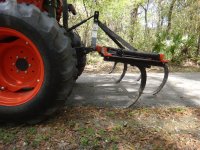
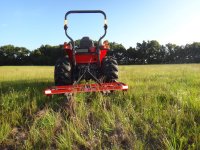
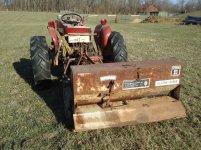
Without the option to rotate pasture here, I inter-seed using 3 methods. One is a slit seeder, which in the picture, you can see it disturbs very little of the existing grass. A no-till drill will pretty well do the same. No need to buy either, as they can be rented by the hour, or acre. Around here, a new slit seeder like pictured is $175 a day rental. No-Till drills can be rented from the local Soil Conservation Office. A buddy of mine rented one last Fall to plant a cover crop on some vegetable crop land, and I'm thinking it was $15 or less per acre. But, those require a 50 hp. tractor. And, you're done in one pass.
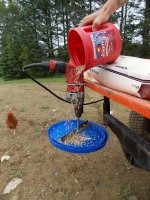
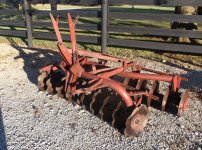
The other option, is scuffing the surface with a disk like below. I used this to re-seed my hayfield last Fall with Timothy. The soil needs to be just damp enough to cut the surface, down through the existing growth. I ran long ways with the field, then crossways. And, used my broadcast seeder, to seed it. I then took my 6' pull type disk, set nearly straight, with cultipacker, to set the seed. And done just before a nice 1/2" to 3/4" rain, to really set it in. We actually had 3 rains amounting to at least 1/2" after that within 5 days. After 10 days, I had a chance to have a look. I was pretty happy to see a very thick cover of 1" sprouts popping up all over, and pretty even.
Most grass seed only needs to be planted a 1/4" or so deep. So where it's likely you'll get some washing, inter-seeding is a great way to go. Usually with pasture, or hayseed, unless it's a straight crop, there is a grass in the mix with deep roots, that will grow, even with the compaction you'll be getting with either animals, or, multiple passes when making hay. Even at that, I have a 3 pt. 6' core/plug aerator I run over both, towards the end of April, when the soil is damp, but not wet. With the added weight, it will take out plugs 3" deep, down in the root zone. This is a big help getting the Spring fertilizer application down to where it's needed. After a couple rains, you'll never know you ran the aerator over it. On the pasture, none is needed, as the horses provide that. You've really got to be careful if you have a lush pasture in the Spring, if you're turning horses out on it. Lush Spring grass, will have a protein content of 21%, and can cause laminitis/founder, if you just turn them out on it, and let them graze. If they don't get the exercise, as like a race horse, or work horse, you'll get founder. Don't ask me how I know.
There is one other option, but, being in California, doubt it's possible. It's called Frost Seeding. Here, it's done the last 2 weeks of Feb, or first 2 weeks of Mar. when the soil is at the freeze/thaw stage. Frozen enough to run a tractor with broadcast seeder over it, and soil looks honeycombed on the surface. Basically, you're mimicking Mother Nature, spreading seed on the honeycombed ground when it's frozen. When it thaws, the honeycomb will close, pulling in, and covering the seed. I've had very good results with that too. Problem here, is getting a March day, without 15-20 mph. winds, and blowing the seed all one direction. That's the reason I bought the slit seeder, if I decide to do a Spring touch-up.
What you did, does look good for the tooling you have, and the soil looks great. I really hope it works out well.