ROPS LOOSE ?

/ ROPS LOOSE ? #1  

LOOPHOLE

Silver Member
Joined
May 24, 2007
Messages
116
Location
Horry County,SC
Tractor
140 Farmall w/belly mower NH 1925 FEL/BH
I have noticed on my ROPS that it bolts together about 1FT above fender and it is loose. In other words the top U of the ROPS will rock back and forth. Does that indicate that there was previously a fold down joint in place and has been removed ? The bolt that runs thru is tight but top half of ROPS is still loose. ??????
 
/ ROPS LOOSE ? #2  
I don't know. I thought most non-folding ROPS were single piece construction. Have you asked the dealer?

jb
 
/ ROPS LOOSE ?
  • Thread Starter
#3  
Bought used, 1925 NH / Have not spoken to any dealer yet. Guess I could drill holes out where it would be tighter ? U part of ROPS that fits down into main brace must have a larger hole for bolt.
 
/ ROPS LOOSE ? #4  
I added a ROPS to a B7100 Kubota. It came in several parts. Where two parts fit together, there was a sleeve that fit inside both that had a through bolt to each part. Prior to putting it on the tractor the joint was loose, but the overall fit was such that I had to put some stress on the thing to get it in place and that took of the loose fitting parts.

If the thing telescopes together, the fit is probably the way it should be. If it's a butt joint, there should be a small section of smaller tubing inside both parts. A ROPS doesn't need to be very precise to do it's job, which in my case seems to be putting dents in the garage door trim.
 
/ ROPS LOOSE ? #5  
Post pics of that setup... Is it possible it was prev-owner modified?
In any case.. if it has play it is of no use as a protective structure!!!


soundguy

LOOPHOLE said:
I have noticed on my ROPS that it bolts together about 1FT above fender and it is loose. In other words the top U of the ROPS will rock back and forth. Does that indicate that there was previously a fold down joint in place and has been removed ? The bolt that runs thru is tight but top half of ROPS is still loose. ??????
 
/ ROPS LOOSE ? #6  
Soundguy said:
In any case.. if it has play it is of no use as a protective structure!!!
soundguy

I respectfully disagree with that idea. The upper bow could fit loosely over about a foot of the lower one, be through bolted in place, rattle like a loose fender, and still provide plenty of rollover protection. Just being a loose fit doesn't make it weak. You would still need to bend the bow in a lateral rollover for the unit to fail.

The folding unit on my DX29 moves some at the hinge and makes the pins rattle from time to time. I'm not too concerned that it won't do it's job if it needs to.
 
/ ROPS LOOSE ? #7  
daTeacha said:
I respectfully disagree with that idea. The upper bow could fit loosely over about a foot of the lower one, be through bolted in place, rattle like a loose fender, and still provide plenty of rollover protection. Just being a loose fit doesn't make it weak. You would still need to bend the bow in a lateral rollover for the unit to fail.

The folding unit on my DX29 moves some at the hinge and makes the pins rattle from time to time. I'm not too concerned that it won't do it's job if it needs to.

That was an apples to watermellon comparison. Your example assumes a 1' overlap with the top piece loosly coupled yet backed up.

I'm talking about a flipover unit that has 2 mating flanges like we commonly see on fold down rops. If his rops are REAL loose, more than just some pin slop.. then when he rolls, it's likely that pins and bolts will be called upon to take side loading and shear forces, and not the rops itself... that's not an ideal situation . Rops are emergency last ditch safety devices anyway... start adding in ineficiencies and you start getting into trouble..

Soundguy
 
/ ROPS LOOSE ? #8  
Hey guys...lets wait until LOOPHOLE posts the pictures and then we'll know for sure...:D ...unless the pictures are BAD...:rolleyes:
 
/ ROPS LOOSE ? #9  
No argument there...Pictures are worth 1000 words.. as they say.. etc.

soundguy
 
/ ROPS LOOSE ?
  • Thread Starter
#11  
Thanks for the interest- and picture is on the way soon. {Translation: As soon as my son takes picture and shows me how to transfer to TBN.} Should happen later today.
 
/ ROPS LOOSE ?
  • Thread Starter
#12  
Speaking of ROPS-JOHN FORCE must build pretty good ones.
 
/ ROPS LOOSE ? #13  
Just from an academic standpoint, is a Roll-Over Protective Structure designed to deal with the forces resulting from an end over flip? I know it should help some if you should happen to flip the tractor over it's tail or nose, but isn't the primary function to protect during a roll along the longitudinal axis? From what I remember of the JD literature, they make a point of the fact that their ROPS is tall enough to protect your head when the tractor is totally upside down with the ROPS and hood being the ground contact points, implying that not all brands do that.

I don't know what the OSHA standard or whatever regulation resulted in the things being required calls for, but based on the above, I suspect it only involves rolls along the longitudinal axis. Does anyone have access to the "rules" manufacturers have to follow when designing a ROPS? Are they something like the passenger protection standards we have for cars in that they specify how much protection should be afforded in specific defined situations in the hopes that there will be enough carryover to save your noggin if you do something else, too?

Soundguy -- I think any foldable unit will see a lot of the forces in a roll taken up by the hinge pin and through pin. They're what keeps the flange pieces in the loose contact they have. If firm contact along the flange mating surface was important, there would probably be some kind of camming arrangement like on a chain binder to close the things tightly. On mine, the small flange seems more intended to help line up the holes for the pin when the ROPS is upright rather than being a load bearing component. The pin itself appears to be something better than grade 2 steel, and I can move the top section back and forth along the hinge when it's up. The closure is by no means tight, and the angle of the thing causes the top to lean back on the pins hard enough to keep it from rattling -- unless I'm going down one of my steeper hill sections. :)
 
/ ROPS LOOSE ? #14  
Just about every rops structure I've ever seen is taller than your head.. otherwise I don't see how it would keep the op out of the crush zone.

I do also believe a rops should help stall or prevent, or survive a backflip, if that is what you are asking.

My concern in any flip is speed /energy and shock load. While a rops and the underlying casting is obviously designed to take the static weight, and is also certified for some sort of shock load as seen in a roll over.. I'd be inclined to think that if something catastrophic happend like the tractor ran off a shallow cliff.. say.. 20'-30' and then landed on the rops.. I'd think that the shock load may damagee the casting or the rops to an extent that it may not protect in that situation... ( if it was a tumble down.. then.. that's different than a dead drop/stop.. etc.. ) i have no evidence to back that up.. just conjecture.

As far as foldable rops go.. again.. the more slop in it.. the less efficiency i see. Take a 4' section of 2x4, and then then 2 2.5' sections of 2x4 and overlap and nail the shorter sections together to make a 4' section.

Put both pieces in a jig and start checking compresional and tortional, side
loads on them. i suspect the uniform 1 piece section of material to perform better than the 2 joined pieces... Ie.. the mechanical joint seems inherently less efficient than the homogenous piece of material.

All that said... I'm not saying a 2 part rops is not strong enough for the applcation it's designed for... just that I'd prefer a 1-piece unit.. etc..

Soundguy
 
/ ROPS LOOSE ? #15  
Agreed -- the one piece seems inherently stronger to me, too. I was just wondering about exactly what the things are required to do in the event they're needed.

Re the height thing with JD: All the ROPS are taller than the operator's head when seen with the tractor sitting on its tires. JD draws a line from the top of the ROPS to the top of the radiator shell and says the operator's head is below that line. Other brands are not as tall and do not show this. In fact, one reason I didn't get a JD was that tractors of the size I wanted wouldn't fit through the door I'm always going in and out of. I have enough trouble remembering to lower mine once in a while to go into the garage. If I had to do it every time I went into the barn, I would probably get lazy and just leave it down.

Personally, I don't think any ROPS structure would survive a vertical fall over a 30 foot drop. A tractor falling that falling that far would be moving close to 35mph at impact and the things are pretty heavy. Mine, with the counterweight and loader, is close to 4400 lb. There is no way I would want that weight falling at that speed landing on my ROPS with my life on the line.
 
/ ROPS LOOSE ? #16  
daTeacha said:
Just from an academic standpoint, is a Roll-Over Protective Structure designed to deal with the forces resulting from an end over flip? I know it should help some if you should happen to flip the tractor over it's tail or nose, but isn't the primary function to protect during a roll along the longitudinal axis? From what I remember of the JD literature, they make a point of the fact that their ROPS is tall enough to protect your head when the tractor is totally upside down with the ROPS and hood being the ground contact points, implying that not all brands do that.

I don't know what the OSHA standard or whatever regulation resulted in the things being required calls for, but based on the above, I suspect it only involves rolls along the longitudinal axis. Does anyone have access to the "rules" manufacturers have to follow when designing a ROPS? Are they something like the passenger protection standards we have for cars in that they specify how much protection should be afforded in specific defined situations in the hopes that there will be enough carryover to save your noggin if you do something else, too?

Soundguy -- I think any foldable unit will see a lot of the forces in a roll taken up by the hinge pin and through pin. They're what keeps the flange pieces in the loose contact they have. If firm contact along the flange mating surface was important, there would probably be some kind of camming arrangement like on a chain binder to close the things tightly. On mine, the small flange seems more intended to help line up the holes for the pin when the ROPS is upright rather than being a load bearing component. The pin itself appears to be something better than grade 2 steel, and I can move the top section back and forth along the hinge when it's up. The closure is by no means tight, and the angle of the thing causes the top to lean back on the pins hard enough to keep it from rattling -- unless I'm going down one of my steeper hill sections. :)

You ask...and it is delivered...:D

Protective frames for wheel-type agricultural tractors -- test procedures and performance requirements. - 1928.52
 
/ ROPS LOOSE ? #17  
I've got no preoblem with height.. however I doo seem to run my 10' mower into the canopy I park under more often than I'd like :D

Ditto on the large fall. I meant that conjecture to cover the 1 piece rops as well.. not the 2 piece only... sorry for any confusion and lack of clarity on my part.

Soundguy

daTeacha said:
Agreed -- the one piece seems inherently stronger to me, too. I was just wondering about exactly what the things are required to do in the event they're needed.

Re the height thing with JD: All the ROPS are taller than the operator's head when seen with the tractor sitting on its tires. JD draws a line from the top of the ROPS to the top of the radiator shell and says the operator's head is below that line. Other brands are not as tall and do not show this. In fact, one reason I didn't get a JD was that tractors of the size I wanted wouldn't fit through the door I'm always going in and out of. I have enough trouble remembering to lower mine once in a while to go into the garage. If I had to do it every time I went into the barn, I would probably get lazy and just leave it down.

Personally, I don't think any ROPS structure would survive a vertical fall over a 30 foot drop. A tractor falling that falling that far would be moving close to 35mph at impact and the things are pretty heavy. Mine, with the counterweight and loader, is close to 4400 lb. There is no way I would want that weight falling at that speed landing on my ROPS with my life on the line.
 
/ ROPS LOOSE ?
  • Thread Starter
#18  
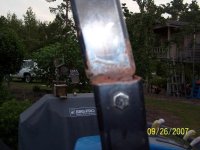
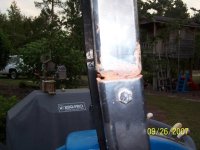
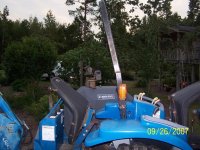
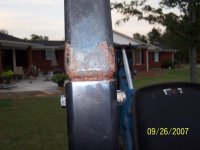
Finally some pics. 1.jpg2.jpg3.jpg4.jpg
 
/ ROPS LOOSE ?
  • Thread Starter
#19  
Finally got 4 pictures on site/what do you think? Maybe modified from earlier owner? Top section slides into bottom mounts w/bolt run thru.Top section pivots back & forth.
 
/ ROPS LOOSE ? #20  
I ain't no 'rops engineer'.. but something strikes me as that not looking factory... For 1, the joint is excessively sloppy.. the ID/OD fit could have been much closer... If i had to guess.. I'd say the prev owner cut the rops, and then welde din a stub that was used to couple the pieces together. The weldment at the top tube to the smaller OD piece looks.. uh.. nonfactory.

Also... there appears to be 'spray paint added to cover the lower portion of the joint.. not to metion the paint is coming off the top part of the joint.. as if it had been excessively heated after painting.. like when the stub was welded on. Whereas the oem rops would have been welded.. then painted afterwards..

Again.. I'm not specifically a mechanical engineer.. those are just my observations.. I'd like to hear others observations.

Soundguy
 
 
Top