You are using an out of date browser. It may not display this or other websites correctly.
You should upgrade or use an alternative browser.
You should upgrade or use an alternative browser.
smaller backhoe bucket
- Thread starter charlz
- Start date
- Views: 42946
More options
Who Replied?
/ smaller backhoe bucket
#21
Seon
Silver Member
Admirable that you made the bucket. Being retired, I had high hopes to do the same thing and with most the honeydo's done, last spring, I went out and bought a 5th wheel travel trailer for the wife and I to do some camping. Then while out camping, I decided to do some fishing which led to buying a boat. So it left little time to build a smaller bucket. I searched the net, and found an outfit that built one from my drawings. They fabricated, welded and shipped the 12" bucket for $465. I haven't had a chance to try it out as yet...been fishing but hopefully soon, I'll get back to the tractor to play  .
.
.patrick_g
Elite Member
John, That bucket design is of course superior to my idea and requires no extra hydraulics. I guess I had the right idea but not a well thought through solution. The relationship to the position of the bucket emptier vs curl angle could be made to be quite non-linear so the flap didn't move much till curled nearly to the limit and then pop out.
I like it!
Thanks John.
Pat
I like it!
Thanks John.
Pat

SkunkWerX
Platinum Member
Nice JOB!! Beautiful.
You should notice a measureable difference when digging, using the narrower set-up, perfect for trenching.
Action pics??
You should notice a measureable difference when digging, using the narrower set-up, perfect for trenching.
Action pics??
SkunkWerX said:Nice JOB!! Beautiful.
You should notice a measureable difference when digging, using the narrower set-up, perfect for trenching.
Action pics??
Thanks! The cutting edge material won't be here till about this time next week so action pics will have to wait
Our weather is supposed to be more like winter starting tomorrow so may have to wait quite a while As others have suggested I am going to try it without any teeth and go from there.
Charles

RedDirt
Gold Member
- Joined
- Dec 4, 2007
- Messages
- 469
- Location
- Northern Idaho
- Tractor
- Kubota BX23, Wards 16HP HST Garden Tractor, (previous) D2 Logging Cat
patrick_g said:John, That bucket design is of course superior to my idea and requires no extra hydraulics. I guess I had the right idea but not a well thought through solution. The relationship to the position of the bucket emptier vs curl angle could be made to be quite non-linear so the flap didn't move much till curled nearly to the limit and then pop out.
I like it!
Thanks John.
Pat
patrick g,
I am also building (going to this winter) a narrow bucket. Looked at the extractor flap at Harford Mfg link from pycoed's post. From the Harford photo I can't quite make out the geometry of the flapper "actuator" lever, pin locations, etc. I like your idea of a not-quite-linear setup. Any way you could post a rough sketch of the mechanics?
patrick_g
Elite Member
Red Dirt, I'm sorry if I led you astray. I have no drawing or completed design but while reading the post to which I replied a couple methods came to mind.
One was a cam and the other was a bellcrank and control horn with pushrods.
First the cam: if you cut out a steel cam to be attached to the bucket and have the cam follower actuate the flapper then the cam can be flat until slightly before the end of travel of the curl. Then as you begin to reach the end of travel the follower will ride up on the slope of the cam and activate the flapper. This would probably need a spring to keep follower in direct contact with the cam and to keep the attached flapper out of the way till the curl action energized it.
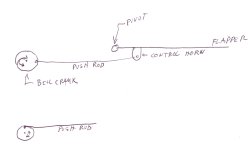
Bellcrank and control horn approach:
If the curl action moved a pushrod connected to a bell crank and a second pushrod connected to the bellcrank activated the flapper with a control horn then adjusting the radii of the connections of the pushrods and the location of the bellcrank and length of the control horn would allow you to essentially get only a little motion from the output pushrod until the bellcrank rotated quite a ways through its travel and then when the proper geometry was achieved the output pushrod would rapidly start to actuate the flapper connected control horn.
Since my bellcrank description may be less than complete, concise, and communicative I have included a sketch to completely eliminate any ability to understand my meaning.
In the sketch you can see that rotary motion (bucket curling motion) when moving the attachment point of the push rod in the upper portion of the sketch will not move the pushrod very much from about 2-4 O'clock position. Note in the lower partial sketch just showing bellcrank and pushrod with the attachment point of the pushrod at or near the 12:00 position that the pushrod will be moved the most.
By adjusting the radius at which the pushrods (both at the bellcrank and the control horn) are attached you regulate the angular to linear motion ratios which as seen in the drawing are non linear. Of course you would want the least range of motion of the bellcrank on the flapper to be in the range of rotary motion when the curl was not to near the limit (when you want the flapper to expel dirt)
I have built mechanical systems just like this for non-linear rotary to linear to rotary motion conversion but NOT A BACKHOE BUCKET. It was to apply elevator control for an airplane.
I suspect the equipment already doing this sort of thing has worked out all the design issues and would be a far better starting place than my brute force and awkwardness.
Pat
One was a cam and the other was a bellcrank and control horn with pushrods.
First the cam: if you cut out a steel cam to be attached to the bucket and have the cam follower actuate the flapper then the cam can be flat until slightly before the end of travel of the curl. Then as you begin to reach the end of travel the follower will ride up on the slope of the cam and activate the flapper. This would probably need a spring to keep follower in direct contact with the cam and to keep the attached flapper out of the way till the curl action energized it.
Bellcrank and control horn approach:
If the curl action moved a pushrod connected to a bell crank and a second pushrod connected to the bellcrank activated the flapper with a control horn then adjusting the radii of the connections of the pushrods and the location of the bellcrank and length of the control horn would allow you to essentially get only a little motion from the output pushrod until the bellcrank rotated quite a ways through its travel and then when the proper geometry was achieved the output pushrod would rapidly start to actuate the flapper connected control horn.
Since my bellcrank description may be less than complete, concise, and communicative I have included a sketch to completely eliminate any ability to understand my meaning.
In the sketch you can see that rotary motion (bucket curling motion) when moving the attachment point of the push rod in the upper portion of the sketch will not move the pushrod very much from about 2-4 O'clock position. Note in the lower partial sketch just showing bellcrank and pushrod with the attachment point of the pushrod at or near the 12:00 position that the pushrod will be moved the most.
By adjusting the radius at which the pushrods (both at the bellcrank and the control horn) are attached you regulate the angular to linear motion ratios which as seen in the drawing are non linear. Of course you would want the least range of motion of the bellcrank on the flapper to be in the range of rotary motion when the curl was not to near the limit (when you want the flapper to expel dirt)
I have built mechanical systems just like this for non-linear rotary to linear to rotary motion conversion but NOT A BACKHOE BUCKET. It was to apply elevator control for an airplane.
I suspect the equipment already doing this sort of thing has worked out all the design issues and would be a far better starting place than my brute force and awkwardness.
Pat
Attachments
RedDirt
Gold Member
- Joined
- Dec 4, 2007
- Messages
- 469
- Location
- Northern Idaho
- Tractor
- Kubota BX23, Wards 16HP HST Garden Tractor, (previous) D2 Logging Cat
Pat, thanks for the sketch. You've given me some ideas I'll need to chew on when I have more time. I kinda like the cam concept; less moving parts in a confined space. Maybe I'll start a design/build thread later on an "ejector bucket" as charles' fine work is beyond this point and this ejector stuff is getting off his topic.
2manyrocks
Super Member
- Joined
- Jul 28, 2007
- Messages
- 9,516
Charlz, did you cut out the sides and the parts that attach the bucket to the backhoe with just an angle grinder?
2manyrocks
Super Member
- Joined
- Jul 28, 2007
- Messages
- 9,516
Thanks for all the details about what you're doing. Might just have to copy your work.
Wonder if there's some miracle nonstick coating that would help? What makes clay stick so well in a bucket?
Wonder if there's some miracle nonstick coating that would help? What makes clay stick so well in a bucket?
2manyrocks said:Wonder if there's some miracle nonstick coating that would help?
What makes clay stick so well in a bucket?
Question 1, Spray on Pam. Seriously, it helps. But you need to be on and off spraying often. You know it's not often enough when you are getting the shovel.....
Question 2, Suction and compaction. The dirt if moist will form a vacuum tight seal and won't come out. If it gets compacted, it is too strong materially to crumble and fall out. A larger bucket gives enough unsupported span that the soil breaks and falls out. There is also a relationship of adhesion to surface area with the volume of the stuff in the bucket. Small buckets have lots more surface area per unit volume than large buckets do. And adhesion is a surface property.
RedDirt
Gold Member
- Joined
- Dec 4, 2007
- Messages
- 469
- Location
- Northern Idaho
- Tractor
- Kubota BX23, Wards 16HP HST Garden Tractor, (previous) D2 Logging Cat
john_bud said:Question 2, Suction and compaction. The dirt if moist will form a vacuum tight seal and won't come out. If it gets compacted, it is too strong materially to crumble and fall out. A larger bucket gives enough unsupported span that the soil breaks and falls out.
For the suction aspect would drilling several holes in the back of the bucket help relieve the suction? I'm thinking 4 or 6, maybe 3/8" dia holes.
Would increasing the "draft" (taper front-to-back of the bucket sides) also help release clay?
My bx 12" bucket is about 1 3/8" wider at the front than the back. I did not realize it was that much until I measured it just now. From earlier posts I had thought I'd increase the draft but if I'm starting with 8" in the front anything less than 6 1/2" wide in the back seems pretty small. I may mock-up with a 6 1/4" back an see what it looks like.
BTW - when I made my template for the back plate I just bent a piece of cardboard around the radius of my bucket and scribed flush with the side plates. When the template is laid flat the shape is a shallow hourglass. If I connect a chord line between the ends of one of the arcs I can find the area of maximum draft. Then I'll use a "bendy-stick" to eyeball more (or less) draft.
Another thing I'm gleaning from this discussion is to make the insides of the bucket smooth. The bx bucket skin is only 1/8" but has 2"x1/4" plates at the front edge sides and a 4"x1/2" cutting edge. All these plates are added to the 1/8" skin, butt welded flush (inside faces align) and fillet welded on the outside. The butt welds on the inside have unfinished weld crowns. Seems these crowns could inhibit dirt evacuation especially if the clay was moist and compressed. On narrow buckets it may prove valuable to finish grind these inside welds flat.

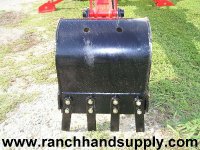
My hoe has these holes drilled in the bottom of the standard bucket (pic attached).RedDirt said:For the suction aspect would drilling several holes in the back of the bucket help relieve the suction? I'm thinking 4 or 6, maybe 3/8" dia holes.
I'm still considering buying the 8" trenching bucket.
Attachments
Team_Green
Member
- Joined
- Nov 7, 2007
- Messages
- 30
Very nice work. I think i can build the unit i was going to buy after reading and looking at your pics. I have a 9 inch bucket for ripping and trenching i would love a 12 or 16 inch for cleaning out holes i have ripped up with the 9 inch bucket.
2manyrocks
Super Member
- Joined
- Jul 28, 2007
- Messages
- 9,516
Didn't have any Pam in the kitchen, but the ingredients on our other nonstick sprays list canola oil as the primary ingredient. I guess I could buy a quart or two and spray it on with the garden sprayer.
I remember reading once to spray plows with vegetable oil after use to keep them shiny and from rusting.
I remember reading once to spray plows with vegetable oil after use to keep them shiny and from rusting.

sandman2234
Super Member
- Joined
- Dec 4, 2005
- Messages
- 6,677
- Location
- Jacksonville, Florida
- Tractor
- JD2555 and a few Allis Chalmers and now one Kubota
Around here, those holes in the bucket would let sand out faster than you could dig it! Guess you better make sure of what your digging before drilling.
David from jax
David from jax
Good point.sandman2234 said:Around here, those holes in the bucket would let sand out faster than you could dig it! Guess you better make sure of what your digging before drilling.
David from jax

wedge40
Veteran Member
- Joined
- Oct 8, 2007
- Messages
- 2,197
I would drill the holes and then have a plug made that I could bolt on. Basically something like and very big carriage bolt, with the head inside the bucket.shvl73 said:Good point.
Wedge

You could use a chain that is attached to the bucket and to the dipper. As the bucket (curled) is filled it will push the chain to the bottom of bucket. When you dump the bucket (uncurl) it will drag the chain through the dirt in the middle of bucket and will help with dumping. This might work and is a pretty simple and cheap way if this works for you. big dan



